Bay Leaves for Skin: Can This Simple Herbal Ingredient Really Reduce Wrinkles?
Introduction
Bay leaves have been used for centuries in cooking, traditional preparations, and herbal practices. Their distinctive aroma makes them a familiar ingredient in kitchens around the world. More recently, bay leaves have also appeared in online beauty remedies, where they are sometimes promoted as a natural solution for wrinkles, fine lines, sagging skin, and signs of aging.
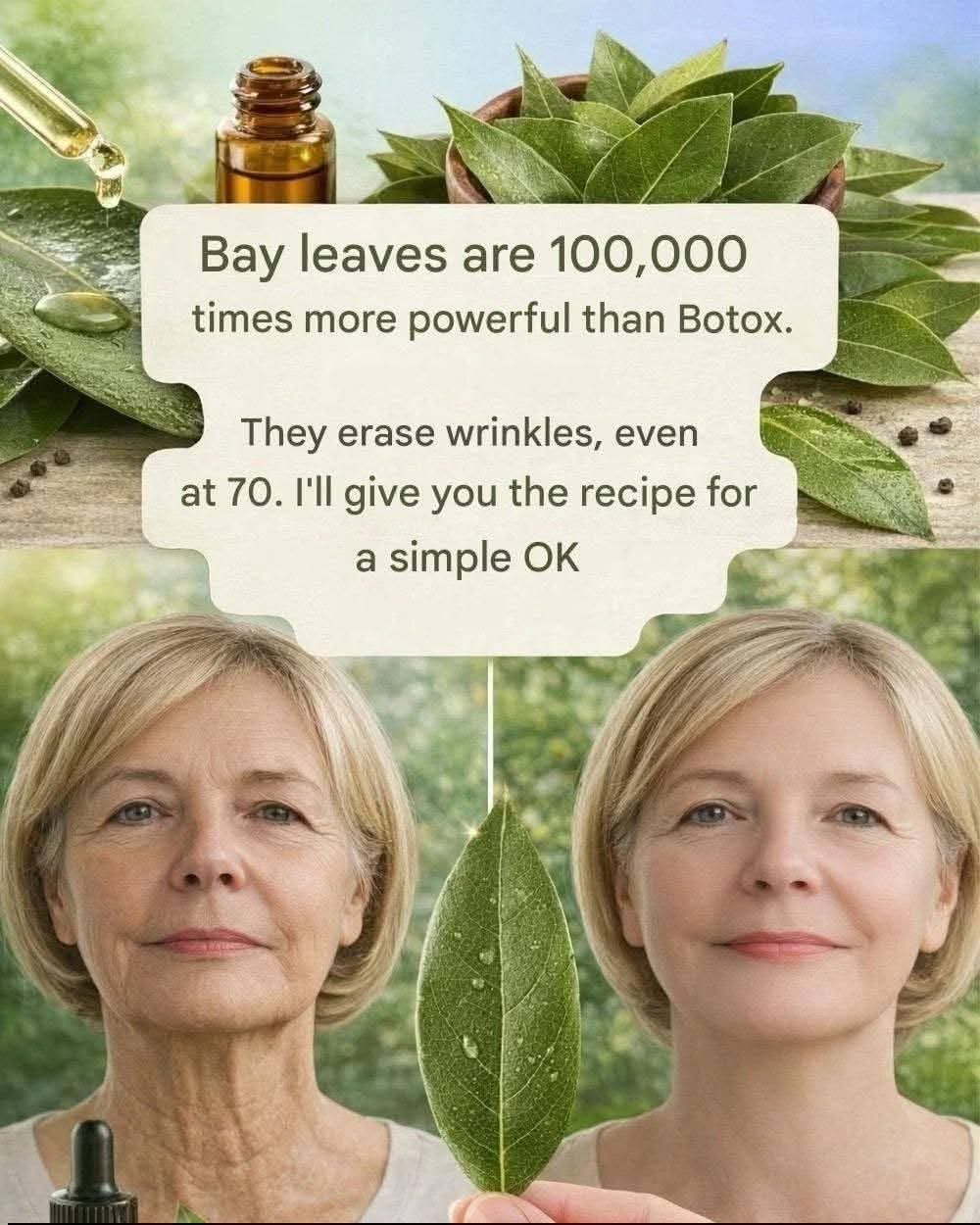
One viral claim goes much further, suggesting that bay leaves are “100,000 times more powerful than Botox” and can erase wrinkles—even at age 70. This sounds exciting, especially for people looking for inexpensive and natural alternatives to cosmetic procedures. But it is important to separate traditional beauty practices from claims that have not been scientifically demonstrated.
Bay leaves do contain naturally occurring plant compounds with antioxidant and antimicrobial properties, and they can be part of a gentle homemade skin-care routine when used appropriately. However, there is no credible scientific evidence that bay leaves are remotely comparable to Botox, that they are 100,000 times more powerful than Botox, or that a bay-leaf preparation can erase wrinkles permanently.
That does not mean bay leaves have no place in personal care. A carefully prepared bay-leaf infusion may provide a refreshing skin-care experience, while a simple facial routine built around sun protection, moisturization, and proven ingredients can do considerably more for the visible signs of aging.
This article explains what bay leaves can realistically do for your skin, how people traditionally prepare them, what the research does—and does not—show, and how to use a homemade bay-leaf preparation safely.
What Are Bay Leaves?
Bay leaves are the aromatic leaves of plants in the Laurus genus, particularly Laurus nobilis, commonly known as Mediterranean or Turkish bay laurel.
They contain a variety of naturally occurring compounds, including aromatic oils and polyphenolic substances. The precise chemical composition varies according to the plant, growing conditions, harvesting, drying, and preparation method.
In cooking, whole bay leaves are generally removed before serving because their texture is tough and their edges can be sharp. They are used to flavor soups, stews, sauces, rice dishes, beans, meats, and many other foods.
Traditional herbal practices have also used bay leaves in different preparations. Today, their antioxidant and aromatic properties have attracted attention from people interested in natural skin care.
However, “natural” does not automatically mean “more effective.” The concentration and biological activity of compounds in a homemade preparation can be very different from those in a laboratory-tested cosmetic product.
The Viral “100,000 Times More Powerful Than Botox” Claim
The claim that bay leaves are 100,000 times more powerful than Botox is not supported by reliable clinical evidence.
Botox is a purified pharmaceutical preparation of botulinum toxin. When appropriately administered by qualified medical professionals, it temporarily reduces the appearance of certain wrinkles by affecting nerve signaling to targeted muscles.
Bay leaves work in a completely different way.
There is no established scientific mechanism showing that applying bay leaves to the skin produces the same muscle-relaxing effect as botulinum toxin. There are also no high-quality clinical trials demonstrating that bay leaves can outperform Botox.
This distinction is important because sensational claims can encourage people to replace effective treatments with unproven remedies.
A better way to describe bay leaves is this:
Bay leaves may contain compounds that can support a general skin-care routine, but they are not a natural form of Botox.
That statement is both more realistic and more useful.
Can Bay Leaves Remove Wrinkles?
Wrinkles develop through multiple processes.
As we age, the skin gradually loses collagen, elastin, and other structural components. Repeated facial movement contributes to expression lines. Sun exposure can accelerate collagen breakdown and cause changes in skin texture and pigmentation. Dehydration, smoking, pollution, genetics, and hormonal changes can also influence the appearance of aging skin.
A homemade bay-leaf preparation cannot reverse all of these processes.
At most, a hydrating or soothing preparation may temporarily make the skin appear fresher or smoother. Hydration can reduce the visibility of some very fine lines because well-moisturized skin reflects light differently and appears more supple.
But temporary smoothing is not the same as removing wrinkles.
If a bay-leaf infusion makes your skin feel softer or refreshed, that can be a pleasant benefit. It should not be interpreted as evidence that the preparation has rebuilt collagen or permanently erased wrinkles.
Why Antioxidants Matter for Skin
One reason plant-based ingredients receive attention in skin care is their antioxidant content.
The skin is constantly exposed to environmental stressors. Ultraviolet radiation, pollution, and other factors can contribute to oxidative stress. Antioxidants can help neutralize certain reactive molecules in laboratory and biological systems.
Bay leaves contain several plant compounds that have demonstrated antioxidant activity in laboratory research.
This is interesting, but there is an important difference between:
- demonstrating antioxidant activity in a laboratory, and
- proving that applying a homemade bay-leaf preparation to human skin prevents or reverses wrinkles.
The second requires controlled human research.
Therefore, it is reasonable to say that bay leaves contain antioxidant compounds. It is not reasonable to promise that rubbing bay leaves on your face will eliminate wrinkles.
A Simple Bay-Leaf Facial Infusion
If you want to experiment with bay leaves as part of a gentle skin-care routine, a diluted infusion is a more sensible approach than applying concentrated essential oil directly to the face.
Ingredients
- 3–4 dried bay leaves
- 2 cups of clean water
- A clean glass container with a lid
- Cotton pads or a clean, soft cloth
Instructions
- Place the bay leaves in a small saucepan.
- Add the water.
- Bring the water to a gentle boil.
- Reduce the heat and simmer for approximately 5–10 minutes.
- Turn off the heat and allow the liquid to cool completely.
- Strain out the leaves.
- Transfer the cooled liquid to a clean container.
- Store it in the refrigerator and use it promptly rather than keeping it for a long period.
How to Use It
Clean your face with a gentle cleanser and pat the skin dry.
Apply a small amount of the cooled infusion to a small area of skin using clean fingers or a cotton pad.
Do not scrub aggressively.
Allow the skin to dry naturally, then follow with a fragrance-free moisturizer.
If you use this type of preparation during the daytime, finish with a broad-spectrum sunscreen.
Always Perform a Patch Test
Homemade skin-care preparations can cause irritation, even when they contain familiar culinary ingredients.
Before applying a bay-leaf preparation to your entire face, test a small amount on an inconspicuous area of skin.
Wait and observe for irritation.
Stop using the preparation if you develop:
- Burning
- Persistent redness
- Itching
- Swelling
- Rash
- Blistering
- Significant dryness
People with sensitive skin should be especially cautious.
The skin around the eyes is also particularly delicate. Avoid applying homemade bay-leaf preparations directly to the eyelids or close to the eyes.
What About Bay-Leaf Essential Oil?
Bay-leaf essential oil is much more concentrated than a water infusion.
This distinction matters.
Essential oils contain concentrated aromatic compounds and may irritate the skin when applied undiluted. Some essential oils can also cause allergic reactions or photosensitivity depending on their composition.
For this reason, do not put undiluted bay-leaf essential oil directly on your face.
If an essential oil is used in cosmetic products, it should be properly formulated and diluted according to appropriate safety guidance. For people with sensitive skin, allergies, eczema, or other skin concerns, professional advice is preferable before experimenting with concentrated botanical oils.
More concentrated does not automatically mean more effective.
Can Bay Leaves Tighten Sagging Skin?
Another popular claim is that bay leaves can tighten loose or sagging skin.
A cool liquid applied to the skin may create a temporary refreshing or tightening sensation. However, a sensation of tightness does not necessarily mean that the underlying skin has become structurally tighter.
True skin laxity is associated with changes in collagen, elastin, fat distribution, connective tissue, and other structures beneath the surface.
A homemade bay-leaf infusion cannot be expected to physically lift sagging skin in the way that medical or surgical procedures can.
That does not make the infusion useless. It simply means we should have realistic expectations.
The Importance of Moisturizing
If your goal is to make mature skin look smoother, moisturizer is one of the simplest steps to prioritize.
As skin ages, it may become drier and less efficient at retaining moisture. Dryness can emphasize fine lines.
A good moisturizer helps support the skin barrier and reduce water loss from the outer layers of skin.
Look for products containing ingredients such as:
- Glycerin
- Ceramides
- Hyaluronic acid
- Squalane
- Petrolatum
- Fatty acids
You do not need an expensive product. Consistent use of a suitable moisturizer can be more valuable than constantly changing homemade remedies.
Sunscreen Is More Important Than Any Viral DIY Remedy
If your goal is to protect your skin from premature aging, daily sun protection deserves much more attention than claims about miracle ingredients.
Ultraviolet radiation contributes significantly to premature skin aging. Repeated exposure can damage collagen and elastin and contribute to wrinkles, uneven pigmentation, and changes in skin texture.
A broad-spectrum sunscreen with an appropriate SPF can help reduce ongoing UV damage.
Other helpful habits include:
- Seeking shade during strong sunlight
- Wearing protective clothing
- Wearing a wide-brimmed hat
- Using sunglasses
- Avoiding intentional tanning
- Reapplying sunscreen as recommended
A homemade bay-leaf remedy cannot compensate for repeated unprotected sun exposure.
What Ingredients Have Better Evidence for Aging Skin?
If you want to address wrinkles, there are cosmetic and dermatological ingredients with substantially more evidence than bay leaves.
Retinoids
Retinoids are among the best-known topical ingredients for photoaging. They can influence skin-cell turnover and support collagen-related changes over time.
Because retinoids can cause irritation and are not appropriate for everyone, it is sensible to discuss them with a dermatologist or qualified healthcare professional, particularly if you have sensitive skin or take medications that affect your skin.
Vitamin C
Topical vitamin C is widely used in skin care because of its antioxidant properties and its role in collagen synthesis.
Product formulation matters considerably, because vitamin C can be unstable under certain conditions.
Niacinamide
Niacinamide, a form of vitamin B3, is another widely used cosmetic ingredient. It can support the skin barrier and may help improve the appearance of uneven tone and texture.
Moisturizers
Never underestimate basic moisturization. A well-functioning skin barrier can make skin look smoother and more comfortable.
Sunscreen
For preventing additional photoaging, sunscreen remains one of the most important daily skin-care steps.
A Better Natural Anti-Aging Routine
You do not need a complicated routine to care for mature skin.
Morning
Step 1: Gentle cleansing
Use a mild cleanser if cleansing is needed.
Step 2: Antioxidant product
A properly formulated antioxidant serum may be used if your skin tolerates it.
Step 3: Moisturizer
Choose a moisturizer suitable for your skin type.
Step 4: Sunscreen
Apply broad-spectrum sunscreen.
Evening
Step 1: Cleanse
Remove sunscreen, makeup, sweat, and environmental residue.
Step 2: Treatment
If appropriate, use a proven anti-aging ingredient such as a retinoid.
Step 3: Moisturize
Apply a nourishing moisturizer to support the skin barrier.
This simple routine is much more realistic than expecting one herb to reverse decades of skin aging.
Why Homemade Remedies Can Be Appealing
There are good reasons people are attracted to natural beauty remedies.
They can be inexpensive.
They often require ingredients already found at home.
They can connect us with traditional practices.
And making something yourself can feel satisfying.
There is nothing inherently wrong with enjoying a traditional bay-leaf facial infusion if your skin tolerates it.
The problem occurs when a traditional preparation is promoted as a scientifically proven medical treatment.
There is a major difference between:
“This feels refreshing and may contain useful plant compounds.”
and:
“This is 100,000 times stronger than Botox and erases wrinkles.”
The first is a reasonable possibility. The second is an unsupported claim.
Bay Leaves and Skin Hygiene
Plant preparations can also introduce another concern: contamination.
A homemade infusion contains water and plant material. Unless handled carefully, microorganisms can grow in it.
For this reason:
- Use clean utensils.
- Use clean containers.
- Wash your hands before preparation.
- Keep the preparation refrigerated.
- Do not use it if it develops an unusual smell, appearance, or texture.
- Avoid storing homemade preparations for long periods.
- Do not share your preparation with other people.
Freshly prepared does not automatically mean sterile.
This is particularly important for people with compromised skin barriers.
Can You Leave Bay-Leaf Water on Overnight?
There is no strong evidence that leaving bay-leaf water on the face overnight produces superior anti-aging benefits.
In fact, prolonged contact with a botanical preparation could increase the chance of irritation for some people.
If you choose to try it, a conservative approach is preferable: use a small amount, monitor your skin, and discontinue it if irritation develops.
Your skin does not need to feel burning, tingling, or extreme tightness for a product to “work.”
Those sensations can be signs of irritation rather than effectiveness.
Common Mistakes to Avoid
Mistake 1: Using concentrated essential oil directly
This can cause irritation or allergic reactions.
Mistake 2: Scrubbing the face with bay leaves
Physical scrubbing can damage the skin barrier, especially if performed aggressively.
Mistake 3: Applying the remedy around the eyes
The eye area is delicate and should be protected from homemade preparations.
Mistake 4: Expecting overnight results
Skin aging develops over years. Meaningful changes in skin appearance generally require consistent care.
Mistake 5: Replacing sunscreen with herbal remedies
A botanical ingredient cannot substitute for effective UV protection.
Mistake 6: Believing dramatic social-media claims
Before-and-after photographs can be misleading. Lighting, makeup, facial expression, camera angle, filters, hydration, and image editing can all alter the appearance of wrinkles.
What About People Over 70?
Healthy skin care is valuable at every age.
Someone in their 70s can absolutely improve skin comfort, hydration, and appearance through consistent habits.
But the idea that a bay-leaf mixture can “erase wrinkles at 70” is unrealistic.
Mature skin may benefit from:
- Gentle cleansing
- Regular moisturization
- Daily sun protection
- Avoiding smoking
- Adequate nutrition
- Sufficient sleep
- Appropriate physical activity
- Evidence-based dermatological treatments when desired
The goal does not have to be looking decades younger.
Healthy, comfortable, well-cared-for skin is a worthwhile goal at any age.
A Realistic Way to Think About Bay Leaves
Instead of thinking about bay leaves as a miracle wrinkle treatment, think of them as an optional traditional botanical ingredient.
They may provide:
- A pleasant aromatic experience
- Antioxidant plant compounds
- A refreshing sensation
- An inexpensive addition to a personal-care ritual
But they should not be promoted as:
- A replacement for Botox
- A permanent wrinkle remover
- A guaranteed collagen booster
- A cure for sagging skin
- A treatment for serious dermatological conditions
Keeping expectations realistic allows you to enjoy traditional ingredients without being misled by exaggerated promises.
Frequently Asked Questions
Are bay leaves really stronger than Botox?
No. There is no reliable scientific evidence supporting the claim that bay leaves are 100,000 times more powerful than Botox.
Can bay-leaf water remove wrinkles?
There is no strong clinical evidence showing that bay-leaf water can remove wrinkles. It may feel refreshing and can be part of a simple skin-care ritual, but permanent wrinkle removal should not be expected.
Can I use bay leaves every day?
If you tolerate a properly prepared, diluted infusion, some people may choose to use it occasionally. However, daily use is not proven to provide anti-aging benefits, and irritation is possible.
Can I use fresh bay leaves?
Fresh bay leaves can be used in traditional preparations, but identification is important. Not every plant commonly called “bay” is the same species, and some plants may be unsafe.
Can I use bay-leaf essential oil on my face?
Avoid applying undiluted essential oil directly to facial skin. Concentrated essential oils can irritate the skin and may cause allergic reactions.
Is bay-leaf water better than moisturizer?
No evidence shows that it is. A properly formulated moisturizer has a much clearer role in supporting the skin barrier and reducing dryness.
What is the best way to prevent wrinkles?
Daily sun protection, not smoking, adequate moisturization, a balanced lifestyle, and evidence-based skin-care products are much more reliable strategies than miracle remedies.
Can natural ingredients really help skin?
Yes. Many plant-derived compounds are used in cosmetic products, and some have promising research behind them. However, effectiveness depends on the specific ingredient, concentration, formulation, stability, and quality of evidence.
Final Thoughts
Bay leaves are fascinating plants with a long history in cooking and traditional herbal practices. Their naturally occurring compounds make them an interesting subject for research, including research into antioxidant and antimicrobial activity.
But viral beauty claims need to be approached carefully.
Bay leaves are not 100,000 times more powerful than Botox, and there is no good evidence that they can erase wrinkles.
A homemade bay-leaf infusion can be viewed as an optional, gentle beauty ritual—not a miracle treatment.
If you enjoy natural skin care, you can experiment cautiously with a diluted preparation while paying close attention to how your skin responds. Always patch-test first, avoid the eyes, avoid concentrated essential oils, and maintain good hygiene when preparing homemade products.
Most importantly, build your anti-aging routine around strategies with stronger evidence: protect your skin from the sun, moisturize regularly, avoid smoking, maintain healthy habits, and consider proven topical ingredients or professional dermatological treatments when appropriate.
Aging is a natural process, and there is no need to chase impossible promises. The most effective skin-care routine is usually not the one with the most dramatic headline—it is the one you can use safely and consistently over time.
Important note: This article is for general educational purposes and does not replace professional medical or dermatological advice. If you have persistent redness, a rash, unusual pigmentation, painful lesions, or another concerning skin change, consult a qualified healthcare professional.