You Cut Open a Watermelon and Saw Cracks? Stop Eating It Immediately! Here’s What It Really Means!
Introduction
Watermelon is one of the most refreshing fruits of summer. Its bright red flesh, crisp texture, naturally sweet flavor, and high water content make it a favorite for picnics, family meals, barbecues, and hot days. But sometimes you cut open a watermelon expecting a beautiful, juicy interior and instead discover something unusual: cracks, splits, hollow spaces, or areas where the flesh appears separated.
That can be alarming.
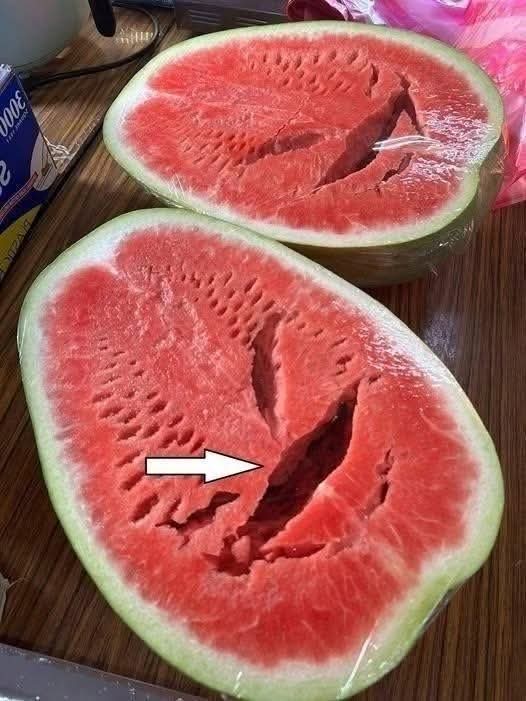
A photograph like the one accompanying this article can easily lead to the conclusion that the watermelon is dangerous or poisonous. Headlines such as “You cut open a watermelon and saw cracks? Stop eating it immediately!” are attention-grabbing, but the reality is more complicated.
Cracks inside watermelon flesh do not automatically mean that the fruit is unsafe to eat.
Internal cracks can happen for several reasons, including rapid growth, irregular water availability while the fruit was developing, temperature changes, certain growing conditions, or a condition sometimes described as hollow heart. In some cases, the fruit can have an unusual internal appearance while still being perfectly safe and edible.
However, unusual cracks can also occur alongside deterioration. If the watermelon has a fermented or rotten smell, slimy flesh, mold, excessive leaking, unusual discoloration, or an unpleasant taste, it should not be eaten.
The important lesson is simple: do not judge watermelon safety from cracks alone. Examine the entire fruit.
This article explains what those cracks may mean, why they happen, how to distinguish harmless internal defects from genuine spoilage, how to store watermelon safely, and when it is better to throw it away.
What Are the Cracks Inside a Watermelon?
The cracks visible in the photograph appear to be separations or cavities within the red flesh. They may look dramatic because the watermelon flesh has pulled apart along internal structures.
These cracks are different from ordinary seed spaces or small natural gaps. Depending on how the watermelon developed, the interior can sometimes contain:
- Large internal splits
- Hollow cavities
- Gaps between sections of flesh
- Areas of uneven texture
- Dry or fibrous sections
- Soft or collapsing flesh
- Cracks radiating from the center
Although these abnormalities can look unpleasant, appearance alone does not tell you whether the fruit is contaminated.
Watermelon is a living plant structure that continues developing after flowering and fruit set. Environmental conditions during that development can influence the final texture and appearance.
Just as an apple can develop internal browning or a potato can have internal discoloration, watermelon can develop structural abnormalities without necessarily becoming dangerous.
Does a Cracked Watermelon Mean You Must Throw It Away?
Not necessarily.
This is one of the most important points to understand.
An internal crack is not, by itself, proof of bacterial contamination, poisoning, or chemical treatment. If the watermelon smells fresh, the flesh is firm and juicy, there is no mold, and there are no obvious signs of spoilage, an internal structural defect may simply be a quality issue.
However, a watermelon with extensive cracking deserves closer inspection.
Cracks can create spaces where moisture collects. If the fruit has already been cut, damaged, stored improperly, or kept for too long, microorganisms can grow more easily.
Therefore, the correct approach is not:
“Cracks always mean danger.”
It is:
“Cracks mean the watermelon should be inspected carefully before eating.”
What Causes Internal Cracks in Watermelon?
There are several possible explanations for an unusual watermelon interior.
- Rapid Growth
Watermelon can grow rapidly under favorable conditions. If the fruit expands quickly, the internal tissues may not always develop uniformly.
This can contribute to cracks, cavities, or separations in the flesh.
The external rind may look normal while the interior has developed differently.
Rapid growth is one reason growers pay close attention to irrigation, temperature, soil conditions, and fruit development.
- Irregular Water Availability
Watermelon requires consistent access to water during development.
If the plant experiences periods of limited water followed by abundant water, the fruit can respond to the sudden change in moisture availability.
The plant may absorb water quickly, causing the fruit to expand. Internal tissues can become stressed, and structural defects may appear.
This is one reason consistent irrigation is important for producing high-quality watermelon.
- Hollow Heart
One possible explanation for cavities or unusual spaces inside watermelon is a condition commonly called hollow heart.
Hollow heart describes internal gaps or cavities that can develop within the flesh.
Importantly, hollow heart does not automatically mean that the watermelon is rotten or poisonous.
The watermelon may still have good flavor and may be edible if there are no signs of spoilage.
The quality can be disappointing, however, because the texture may not be as uniform as expected.
- Temperature Stress
Temperature can influence watermelon development.
Large changes in temperature during the growing season can affect the way fruit tissues develop. Extremely hot conditions, particularly when combined with irregular moisture, can contribute to abnormal fruit development.
This can sometimes produce internal differences that are not obvious from the outside.
- Natural Differences Between Watermelons
Not every watermelon develops identically.
Even fruit grown in the same field can have differences in:
- Texture
- Sweetness
- Color
- Seed distribution
- Flesh firmness
- Internal structure
- Cavity formation
Agricultural products are biological organisms, not manufactured objects. Some variation is completely natural.
That is why an unusual-looking watermelon should be evaluated based on multiple signs rather than a single visual feature.
- Overripe Fruit
Another possibility is that the watermelon has passed its ideal eating stage.
As fruit becomes overripe, the texture can change. Flesh may become softer, less crisp, watery, or slightly fermented.
An overripe watermelon may also develop an unpleasant smell or taste.
If cracking is accompanied by these changes, the watermelon should be treated more cautiously.
The Most Important Question: Does It Smell Fresh?
Your nose can provide an important warning sign.
A fresh watermelon should have a clean, mild, fruity smell. When you cut it open, you should not normally detect a strong alcoholic, sour, fermented, or rotten odor.
If you notice a powerful unpleasant smell, do not try to convince yourself that the watermelon is safe simply because the outside looked normal.
A strange smell is a reason to discard the fruit.
Signs That a Watermelon Should Be Thrown Away
Instead of focusing exclusively on cracks, look for several warning signs.
- Strong Fermented Smell
A watermelon that smells like alcohol, fermentation, vinegar, or decay should not be eaten.
- Slimy Flesh
Fresh watermelon should be juicy and crisp.
If the flesh has become slimy, sticky, or unusually slippery, discard it.
- Visible Mold
Any visible mold is a clear reason to discard the affected fruit rather than simply cutting around the moldy area.
- Rotten or Collapsing Flesh
If sections have turned mushy, brown, gray, or otherwise severely degraded, the fruit should be discarded.
- Unusual Leakage
A watermelon that is leaking liquid together with a bad odor or deteriorated flesh may be spoiled.
- Strongly Sour or Alcoholic Taste
Do not continue eating a watermelon simply to determine whether it is spoiled.
If the first bite tastes distinctly fermented, sour, or rotten, stop eating it and discard it.
What If the Watermelon Has Cracks but Looks and Smells Normal?
This is where the viral warning becomes misleading.
If you cut open a watermelon and find an internal crack but the flesh is:
- Bright and normal in color
- Firm and juicy
- Fresh-smelling
- Free of mold
- Free of sliminess
- Free of obvious decay
then the crack itself does not establish that the fruit is unsafe.
It may simply be an internal quality defect.
You can remove the affected section if you prefer, especially if the texture is unpleasant, and evaluate the remaining flesh.
Nevertheless, when you are uncertain about the fruit’s condition, the safest choice is always to discard it.
Why Do Viral Watermelon Warnings Spread So Quickly?
Food-safety headlines often use dramatic language because fear attracts attention.
A statement such as:
“Cracked watermelon? Stop eating immediately!”
creates a strong emotional response.
People naturally want to protect themselves and their families, especially when food is involved.
The problem is that a dramatic headline can transform a real observation into an inaccurate universal rule.
There is a major difference between:
“Some unusual watermelon conditions can indicate quality problems or spoilage.”
and:
“Every watermelon with internal cracks is dangerous.”
The first statement is reasonable.
The second is an overgeneralization.
Good food-safety information should explain what to look for rather than relying on fear.
What About Bacteria?
Watermelon, like other fresh produce, can potentially become contaminated with microorganisms.
Contamination can occur on the outside of the fruit through soil, water, handling, transportation, cutting surfaces, or other sources.
When a whole watermelon is cut, microorganisms present on the surface can potentially be transferred into the edible flesh by the knife.
That is why washing the outside of the watermelon before cutting is a sensible food-handling practice.
Once cut, watermelon should be refrigerated promptly rather than left at room temperature for extended periods.
The important point is that internal cracks are not a reliable way to identify bacterial contamination.
Dangerous microorganisms do not necessarily produce obvious visual changes, smells, or flavors.
Therefore, proper food handling is important even when the watermelon looks perfect.
How to Prepare a Watermelon Safely
Before cutting a watermelon, start with clean hands and a clean cutting surface.
Wash the outside of the watermelon under running water and gently scrub the rind if necessary.
You do not need to use soap or household cleaning chemicals on the fruit.
Dry the outside with a clean towel before cutting.
Use a clean knife and cutting board.
After cutting, place the pieces in a clean container and refrigerate them.
Avoid allowing cut watermelon to sit out for long periods, particularly in hot weather.
These simple practices are more meaningful for food safety than judging the fruit solely by whether it contains internal cracks.
How Long Does Cut Watermelon Last?
Cut watermelon is much more perishable than a whole watermelon.
Once the rind is removed or the fruit is cut into pieces, the edible surface is exposed to the environment.
Store cut watermelon in a clean, covered container in the refrigerator.
Do not rely only on the calendar. Examine the fruit before eating it.
If it develops:
- A sour smell
- Fermented odor
- Slimy texture
- Mold
- Significant discoloration
- Unusual bubbling or deterioration
discard it.
When in doubt, throwing away questionable food is safer than taking a risk.
Why the Watermelon in the Photograph Looks So Unusual
The photograph shows two watermelon halves with pronounced internal separations.
The red flesh appears divided by large irregular spaces, particularly toward the center.
This type of appearance can be associated with internal structural problems such as hollow heart or other developmental defects.
However, a photograph alone cannot establish whether the watermelon is safe or spoiled.
There is no reliable way to diagnose food safety simply from one photograph.
The image can tell us that the fruit has an unusual internal structure. It cannot tell us whether microorganisms are present.
That distinction is extremely important.
Is This a Sign of Chemicals or Poison?
Another common rumor surrounding unusual watermelon interiors is that cracks or hollow spaces prove the fruit contains harmful chemicals.
There is no basis for automatically making that conclusion from appearance alone.
A strange internal structure is not evidence that pesticides, growth chemicals, or poison have been injected into the watermelon.
Agricultural practices vary, and pesticide residues are addressed through regulatory systems and proper agricultural use. But an internal cavity does not provide a reliable chemical test.
If you are concerned about agricultural chemicals, visual inspection is not an appropriate method for determining exposure.
Does a Cracked Watermelon Mean It Was Injected With Water?
Another popular claim is that unusual watermelon interiors indicate that someone injected water into the fruit.
Again, internal cracking by itself does not prove this.
Watermelons naturally contain a very high proportion of water. Their tissues also respond to irrigation and environmental conditions while growing.
Changes in water availability can influence fruit development.
Therefore, an unusual cavity or separation should not automatically be interpreted as evidence of tampering.
What Does a Healthy Watermelon Usually Look Like?
A good watermelon generally has flesh that is:
- Bright red, pink, or appropriate to its variety
- Firm
- Juicy
- Crisp
- Evenly developed
- Pleasant-smelling
The exact color depends on the variety.
Some watermelons naturally have differences in flesh color, seed development, or texture.
The rind should also be evaluated when selecting a watermelon.
A whole watermelon should generally feel heavy for its size because watermelon contains a great deal of water.
A creamy or yellow field spot can also be associated with normal ripening and contact with the ground.
What Does Spoiled Watermelon Look Like?
Spoilage can produce several noticeable changes.
The flesh may become:
- Mushy
- Slimy
- Watery in an unusual way
- Darkened
- Discolored
- Fuzzy from mold
- Strongly fermented-smelling
The surface may also become sticky.
If multiple warning signs appear together, do not eat the fruit.
A watermelon that simply has an internal cavity but remains fresh and firm is very different from a watermelon that has cavities plus a sour smell and slimy flesh.
Context matters.
Should You Taste It to Check?
No.
You should not deliberately taste questionable food to determine whether it is spoiled.
If the watermelon has obvious signs of deterioration, there is no benefit in taking a bite just to test it.
Instead, examine its appearance and smell, consider how it was stored, and discard it when there is reasonable doubt.
Can Children Eat Watermelon With Internal Cracks?
Children can enjoy watermelon as part of a balanced diet, but the same food-safety principles apply.
Parents should inspect cut watermelon carefully.
If the fruit looks fresh and has only a harmless structural defect, the crack itself does not automatically make it dangerous.
But if the fruit is spoiled, fermented, slimy, or moldy, it should not be served to children.
Young children can be more vulnerable to some foodborne illnesses, so careful storage and hygiene are especially important.
The Nutritional Benefits of Watermelon
When fresh and properly handled, watermelon can be a nutritious addition to the diet.
It is particularly well known for its high water content.
Watermelon also provides:
- Vitamin C
- Vitamin A in the form of carotenoids
- Potassium
- Naturally occurring sugars
- Carotenoid antioxidants
- Lycopene, especially in red-fleshed varieties
Because it contains substantial water, watermelon can contribute to overall fluid intake.
It is also relatively light and refreshing, making it a popular choice during warm weather.
Watermelon and Lycopene
One of the most interesting compounds found in red watermelon is lycopene.
Lycopene is a naturally occurring carotenoid responsible for much of the red color of watermelon.
It is also found in foods such as tomatoes and pink grapefruit.
Lycopene has antioxidant properties and has been extensively studied as part of a healthy diet.
However, watermelon should not be viewed as a cure for disease.
The best approach is to include a variety of fruits and vegetables rather than relying on one food for a particular health outcome.
Watermelon and Hydration
Watermelon contains a large amount of water, which contributes to its refreshing character.
Eating water-rich fruits can complement drinking water throughout the day.
However, watermelon should not replace adequate fluid intake, especially during intense physical activity or very hot conditions.
Its natural water content is one of the reasons it remains such a popular summer fruit.
Common Myths About Cracked Watermelon
Myth 1: Every crack means poison.
False.
Internal cracks can occur because of natural developmental conditions.
Myth 2: Cracks prove the watermelon was injected.
False.
A cavity or internal separation is not evidence of injection.
Myth 3: Cracked watermelon always contains dangerous bacteria.
False.
A visual crack cannot establish bacterial contamination.
Myth 4: You can always smell dangerous bacteria.
False.
Some harmful microorganisms may not produce obvious odors.
That is why proper handling and refrigeration remain important.
Myth 5: If one section looks bad, the whole watermelon is always safe after cutting that part away.
Not necessarily.
If the watermelon shows significant spoilage, especially mold or extensive deterioration, it is safer to discard it rather than attempting to rescue it.
A Simple Watermelon Safety Checklist
Before eating a watermelon with unusual internal cracks, ask yourself:
Does it smell fresh?
If yes, continue inspecting it.
If it smells strongly fermented, sour, or rotten, discard it.
Is the flesh firm?
Firm and juicy is generally reassuring.
Slimy or collapsing flesh is a warning sign.
Is there mold?
If you see mold, do not eat the fruit.
Is the color appropriate for the variety?
Minor variations are normal, but severe discoloration combined with other spoilage signs is concerning.
Was it stored properly?
Cut watermelon should be refrigerated.
Does it taste normal?
Do not deliberately taste food that already appears spoiled.
This checklist provides a much more useful assessment than simply asking whether cracks are present.
What Should You Do If You Already Ate Some?
If you ate watermelon containing internal cracks and it tasted and smelled normal, there is no reason to panic simply because you later noticed the unusual structure.
An internal crack does not automatically mean you consumed something toxic.
If the watermelon was clearly spoiled, however, monitor yourself for symptoms of foodborne illness and seek appropriate medical advice if you become significantly unwell, especially if symptoms are severe or persistent.
Do not assume that every stomach problem after eating watermelon was caused by the fruit. Many different conditions can produce gastrointestinal symptoms.
How to Choose a Better Watermelon
When buying a whole watermelon, look for one that feels heavy for its size.
The rind should generally be intact without major cuts, punctures, or extensive soft areas.
Avoid fruit that has obvious leaking or severe damage.
A healthy-looking watermelon should feel reasonably firm.
Do not be discouraged by every natural mark on the rind. Surface markings are not necessarily signs of spoilage.
Once you take the watermelon home, store it appropriately and refrigerate it after cutting.
Why Proper Storage Matters More Than a Perfect Appearance
Food safety is not simply about appearance.
A watermelon can look beautiful and still have been handled improperly.
Conversely, a watermelon can have an unattractive internal defect while remaining edible.
That is why safe food practices involve several factors:
- Clean handling
- Proper cutting
- Appropriate refrigeration
- Avoiding cross-contamination
- Checking for spoilage
- Discarding questionable food
These habits are useful for watermelon and many other fresh foods.
The Truth Behind the Viral Warning
The statement “You cut open a watermelon and saw cracks? Stop eating it immediately!” is too absolute.
The photograph shows an unusual watermelon interior, but the cracks alone do not prove that the fruit is poisonous, contaminated, or dangerous.
The more accurate message is:
If your watermelon has internal cracks, inspect it carefully. Cracks may be a harmless developmental defect, but if they are accompanied by mold, slime, foul odor, fermentation, severe discoloration, or other signs of spoilage, discard the fruit.
That is a much more useful food-safety rule.
When Should You Definitely Throw the Watermelon Away?
There are situations where the decision should be easy.
Discard the watermelon if:
- It has visible mold.
- It smells rotten or strongly fermented.
- The flesh is slimy.
- The flesh is significantly decomposed.
- It has extensive unexplained discoloration accompanied by spoilage.
- It has been stored improperly for an extended period.
- You cannot determine whether it has been kept safely.
- You simply do not feel confident about its condition.
Food is replaceable.
Your health is more important than saving a questionable piece of fruit.
Final Conclusion
Seeing cracks inside a watermelon can certainly be surprising. The watermelon in the photograph has an unusual internal appearance, and it is understandable that someone might immediately wonder whether something is wrong.
But the most important fact is this:
Internal cracks do not automatically mean that a watermelon is dangerous.
They can result from natural developmental problems, rapid growth, irregular water availability, environmental stress, or conditions such as hollow heart.
At the same time, unusual cracks should not be ignored if they occur alongside clear signs of spoilage.
Always examine the watermelon as a whole.
Fresh smell, firm flesh, normal appearance, proper storage, and clean handling are important clues. Mold, slime, foul odors, fermentation, and severe deterioration are reasons to discard it.
The viral warning may make people afraid of every cracked watermelon, but food safety is more nuanced than a single visual sign.
So, the next time you cut open a watermelon and discover a strange cavity or crack, don’t panic—but don’t ignore the evidence either.
Look closely.
Smell it.
Consider how it was stored.
Check the texture.
And when genuine signs of spoilage are present, throw it away.
The goal isn’t to fear unusual-looking food.
The goal is to recognize the difference between a natural quality defect and actual spoilage.
A cracked watermelon may simply be an imperfect watermelon.
A rotten watermelon, however, is one you should leave behind.
A Final Reminder for Readers
If you have ever cut open a watermelon and found strange cracks, hollow spaces, or unusual flesh, you are not alone. These internal defects can occur naturally and do not automatically mean the fruit contains poison or harmful chemicals.
However, no photograph can guarantee that a particular watermelon is safe to eat.
When in doubt, choose caution.
Cracks alone are not the verdict. The overall condition of the watermelon is what matters.
And that is the real food-safety lesson behind the viral watermelon warning.