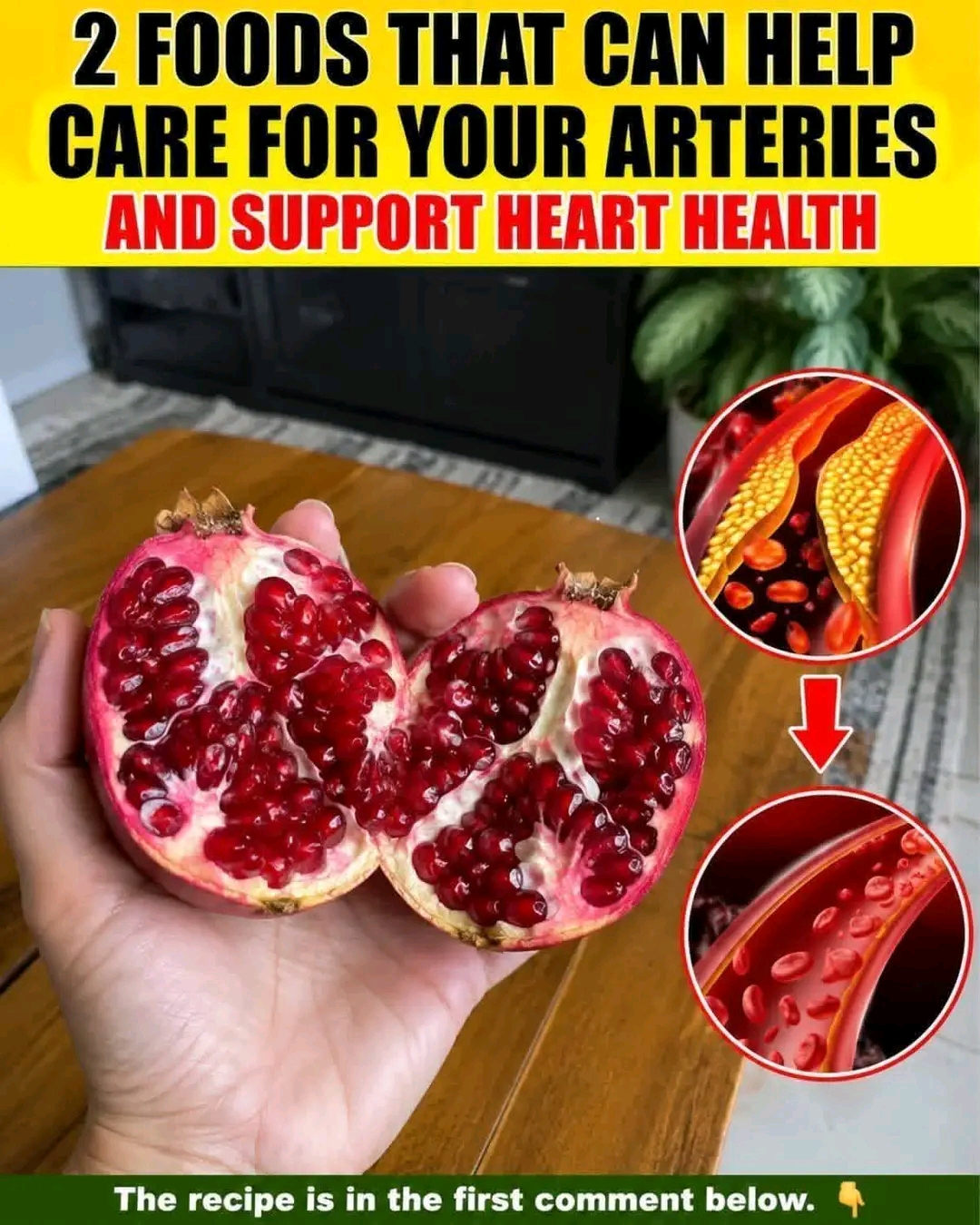
Pomegranate & Oat Heart-Support Smoothie: A Delicious Recipe for a Heart-Friendly Diet
This colorful recipe is inspired by the image’s message about caring for your arteries and supporting heart health. However, it is important to clarify one point: no single food or drink can “clean,” unclog, or repair blocked arteries. Heart and artery health depends on an overall pattern of eating, physical activity, blood pressure and cholesterol management, not on one miracle ingredient.
That said, pomegranate and oats are two nutritious foods that can fit beautifully into a heart-conscious eating pattern. Pomegranate provides polyphenol antioxidants, while oats are rich in soluble fiber, particularly beta-glucan. Together, they make a creamy, naturally sweet breakfast or snack.
❤️ Pomegranate & Oat Heart-Friendly Smoothie
Introduction
A healthy recipe does not have to be complicated. Sometimes the best meals are built around a few simple ingredients that provide fiber, vitamins, minerals and plant compounds.
This pomegranate and oat smoothie combines the bright, slightly tart flavor of pomegranate with the gentle creaminess of oats. A small amount of yogurt or milk gives the drink a smooth consistency, while cinnamon and a touch of fruit provide additional flavor without requiring large amounts of added sugar.
The recipe is particularly suitable for breakfast because oats provide carbohydrates and fiber while yogurt or milk can contribute protein. Pomegranate adds vibrant color and a refreshing fruit flavor.
Rather than thinking of this recipe as an “artery cleanser,” think of it as one delicious component of a balanced heart-friendly lifestyle.
Ingredients
Main ingredients
- 1 cup fresh pomegranate arils
- ½ cup old-fashioned rolled oats
- 1 cup plain unsweetened yogurt
- ½ cup unsweetened milk of your choice
- ½ small banana
- 1 tablespoon ground walnuts or chopped walnuts
- ½ teaspoon cinnamon
- 1 teaspoon chia seeds, optional
- ½ teaspoon honey, optional
- 4–5 ice cubes
- ¼ cup water, if needed for blending
Optional toppings
- A few fresh pomegranate arils
- 1 teaspoon chopped walnuts
- A light sprinkle of cinnamon
- 1 tablespoon rolled oats
- A few pumpkin seeds
- Fresh mint
Why These Two Main Foods?
1. Pomegranate
Pomegranate is famous for its ruby-red seeds and tart-sweet flavor. The fruit contains polyphenolic compounds, including anthocyanins and other antioxidant compounds.
Pomegranate can be enjoyed as part of a diet rich in fruits and vegetables. Some research has investigated pomegranate products in relation to cardiovascular markers, but this should not be interpreted as proof that pomegranate removes plaque from arteries or treats cardiovascular disease.
The best way to enjoy it is simply as a nutritious fruit.
2. Oats
Oats are particularly interesting from a heart-health perspective because they contain soluble fiber called beta-glucan.
When regularly included in a balanced diet, adequate soluble fiber can help support healthy cholesterol levels. This is one reason oats have become a popular breakfast food for people trying to improve their overall diet.
Oats are also inexpensive, versatile and filling.
Instructions
Step 1: Prepare the pomegranate
If using a whole pomegranate, cut it carefully and remove the arils from the white membrane.
Rinse the arils gently and allow excess water to drain.
You can also use unsweetened pomegranate arils that have already been removed from the fruit.
Step 2: Prepare the oats
Place the rolled oats into the blender first.
If you prefer a completely smooth drink, blend the oats by themselves for approximately 15–20 seconds before adding the other ingredients.
This turns the oats into a finer powder and produces a smoother smoothie.
Step 3: Add the ingredients
Add:
- Pomegranate arils
- Oats
- Yogurt
- Milk
- Banana
- Walnuts
- Cinnamon
- Chia seeds, if using
- Ice
Add a small amount of water if the mixture seems too thick.
Step 4: Blend
Blend on high for approximately 45–60 seconds.
Stop and check the consistency.
If it is too thick, add another splash of milk.
If you prefer a thicker smoothie, add a few more ice cubes.
Step 5: Taste
Taste before adding any sweetener.
The banana and pomegranate may provide enough sweetness naturally.
If you want it sweeter, add approximately ½–1 teaspoon of honey.
Step 6: Serve
Pour into a large glass.
Top with a few pomegranate arils, chopped walnuts and a light sprinkle of cinnamon.
Serve immediately.
The Best Method for a Creamy Smoothie
For the smoothest texture, follow this order:
- Add oats.
- Add milk.
- Add yogurt.
- Add banana.
- Add pomegranate.
- Add walnuts and chia seeds.
- Add ice last.
- Blend until creamy.
The liquid helps the blender move the ingredients around, while adding ice last keeps the smoothie cold.
Alternative Method: Pomegranate-Oat Breakfast Bowl
If you do not want a smoothie, the same ingredients can become a breakfast bowl.
Ingredients
- ½ cup rolled oats
- 1 cup milk
- ½ cup pomegranate arils
- ½ banana
- 2 tablespoons plain yogurt
- 1 tablespoon walnuts
- Cinnamon
- 1 teaspoon chia seeds
Method
Cook the oats with milk until creamy.
Transfer them to a bowl and allow them to cool slightly.
Top with yogurt, pomegranate arils, banana slices, walnuts, chia seeds and cinnamon.
This version provides more texture and can be eaten slowly with a spoon.
Another Method: Overnight Pomegranate Oats
Overnight oats are another convenient way to combine these foods.
Ingredients
- ½ cup rolled oats
- ½ cup plain yogurt
- ½ cup unsweetened milk
- ½ cup pomegranate arils
- 1 teaspoon chia seeds
- ½ banana
- Cinnamon
- 1 tablespoon walnuts
Instructions
Combine the oats, yogurt, milk, chia seeds and cinnamon in a jar.
Stir thoroughly.
Cover and refrigerate overnight.
The next morning, add banana, pomegranate and walnuts.
Stir gently and serve cold.
A Brief History of Pomegranate
Pomegranate has a remarkably long history.
The fruit has been cultivated for thousands of years in regions stretching across the Middle East, Mediterranean and parts of Asia.
Its round shape and crown-like calyx have contributed to its symbolic importance in different cultures.
Pomegranate appears in ancient art, literature and traditional cuisines.
It has historically been valued not only for its flavor but also for its striking appearance and versatility.
The seeds can be eaten fresh, pressed into juice, sprinkled over salads or incorporated into sauces and desserts.
A Brief History of Oats
Oats have also been consumed for centuries.
Although oats were initially considered more suitable for animal feed in some regions, they eventually became an important human food, particularly in northern European countries.
Over time, oatmeal and porridge became popular breakfast foods.
Today, oats appear in countless recipes, including:
- Porridge
- Overnight oats
- Granola
- Smoothies
- Muffins
- Bread
- Cookies
- Energy bars
Their popularity is partly due to their affordability, nutritional value and versatility.
Potential Benefits of This Recipe
1. Provides dietary fiber
Both pomegranate and oats contribute dietary fiber.
Fiber is important for digestive health and can help make meals more satisfying.
Oats are especially notable for beta-glucan, a soluble fiber.
2. Contains plant polyphenols
Pomegranate contains numerous plant compounds, including polyphenols.
These compounds are one reason colorful fruits are commonly encouraged as part of a varied diet.
3. Supports a balanced breakfast
Adding yogurt, oats, fruit and nuts creates a more balanced meal than drinking fruit juice alone.
You get carbohydrates, fiber, protein and fats in one serving.
4. Naturally colorful
The deep red color comes from pigments naturally present in pomegranate.
A colorful plate or glass often reflects a variety of plant foods.
5. Can be low in added sugar
Using unsweetened yogurt and milk allows you to control how much added sugar goes into the recipe.
The banana provides natural sweetness.
6. Convenient
The smoothie takes only a few minutes to prepare.
It can be useful for busy mornings when you want something quick.
How This Recipe Fits Into Heart Health
Heart health is influenced by many factors.
A healthy eating pattern generally emphasizes:
- Fruits
- Vegetables
- Whole grains
- Beans and lentils
- Nuts and seeds
- Fish and other nutritious protein sources
- Healthy unsaturated fats
At the same time, it is generally helpful to limit excessive amounts of:
- Added sugars
- Highly processed foods
- Excess sodium
- Trans fats
- Large amounts of saturated fat
One smoothie cannot replace these habits.
The real benefit comes from what you eat consistently over weeks, months and years.
Does Pomegranate Really Clean Arteries?
This is an important question because the image suggests that certain foods can clean arteries.
The answer is no food has been proven to physically scrub plaque from arteries like a cleaning product.
Atherosclerosis involves complex biological processes and the buildup of plaque within artery walls.
Dietary choices can contribute to healthier cholesterol levels, blood pressure, body weight and metabolic health, which are important parts of cardiovascular risk management.
But established cardiovascular disease requires proper medical evaluation.
If someone has chest pressure, shortness of breath, sudden weakness, fainting or other concerning symptoms, food should never be used as a substitute for urgent medical care.
Nutrition
The exact nutritional values depend on the ingredients and serving size.
For a smoothie made with approximately:
- 1 cup pomegranate
- ½ cup oats
- 1 cup plain yogurt
- ½ cup unsweetened milk
- ½ banana
- 1 tablespoon walnuts
you can expect a combination of:
- Carbohydrates from fruit and oats
- Dietary fiber from oats, fruit and seeds
- Protein from yogurt and milk
- Unsaturated fats from walnuts
- Calcium if dairy milk or calcium-fortified milk is used
- Various vitamins and minerals
- Naturally occurring plant compounds from pomegranate
For precise calorie, carbohydrate, protein and fat values, the specific brands and quantities should be entered into a nutrition calculator.
Ways to Make the Recipe Healthier
Choose plain yogurt
Plain yogurt usually allows you to control added sugar more easily than flavored varieties.
Use unsweetened milk
Unsweetened dairy or plant milk can help prevent unnecessary added sugar.
Keep honey optional
You may discover that the banana and pomegranate are already sweet enough.
Use whole oats
Old-fashioned rolled oats provide a simple whole-grain ingredient.
Add nuts carefully
Walnuts provide nutritious unsaturated fats, but they are energy-dense, so a small portion is sufficient.
Who Will Love This Recipe?
This recipe is perfect for people who enjoy:
❤️ Fruit-based breakfasts
❤️ Creamy smoothies
❤️ Quick morning meals
❤️ Oat-based recipes
❤️ Naturally colorful foods
❤️ Tart and sweet flavors
❤️ Simple whole-food ingredients
Children may also enjoy it, although whole pomegranate arils can be messy and the recipe should be adapted to age-appropriate textures.
Recipe Variations
Pomegranate Berry Smoothie
Replace the banana with ½ cup blueberries or strawberries.
This produces a more intensely fruity smoothie.
Pomegranate Apple Oat Smoothie
Add ½ small apple.
For the best texture, remove the core and cut the apple into small pieces before blending.
Pomegranate Ginger Smoothie
Add a very small piece of fresh ginger.
Ginger provides a spicy flavor that pairs beautifully with pomegranate.
Pomegranate Green Smoothie
Add a handful of baby spinach.
The spinach will change the color but provides another serving of vegetables.
Pomegranate Yogurt Bowl
Skip the blender entirely.
Simply combine thick yogurt with pomegranate arils, oats, walnuts, banana and cinnamon.
How to Store It
A freshly prepared smoothie is best consumed soon after blending.
If you need to prepare it ahead of time, keep it refrigerated in a tightly sealed container and consume it promptly.
The texture may change as the oats absorb liquid.
Give it a good shake or stir before drinking.
For meal preparation, overnight oats are generally more convenient than preparing smoothies several days in advance.
Common Mistakes to Avoid
Mistake 1: Adding too much sugar
Pomegranate juice, flavored yogurt, honey and sweetened milk can turn a nutritious recipe into a very sugary drink.
Use unsweetened ingredients whenever possible.
Mistake 2: Treating the smoothie as medicine
This is food, not a treatment for blocked arteries or cardiovascular disease.
Mistake 3: Making portions enormous
Healthy foods still contain calories.
A reasonable serving can be enough for breakfast or a snack depending on your individual needs.
Mistake 4: Using only fruit
A fruit-only smoothie may be less satisfying.
Adding oats, yogurt and nuts creates a more balanced combination.
Meal Ideas to Pair With It
If the smoothie is being used as breakfast, you can pair it with a boiled egg, whole-grain toast or another protein-rich food depending on your dietary needs.
For lunch, consider a meal built around:
- Lentils
- Chickpeas
- Vegetables
- Whole grains
- Fish
- Olive oil
- Fresh fruit
The goal is not perfection.
The goal is a consistent pattern of nutritious foods.
The Bigger Picture: Caring for Your Arteries
Healthy arteries are not maintained by one special recipe.
Daily habits matter much more.
Regular physical activity, not smoking, maintaining a healthy weight when appropriate, managing blood pressure, keeping cholesterol under control, getting adequate sleep and eating a balanced diet all contribute to cardiovascular health.
If a doctor has told you that you have high cholesterol, hypertension, diabetes or cardiovascular disease, follow your medical treatment plan.
Foods such as oats and pomegranate can be part of that plan, but they should not replace prescribed medication.
Frequently Asked Questions
Can I drink this every day?
For most people, this can fit into a varied diet, but dietary needs differ. It is generally better to vary your fruits, whole grains, nuts and protein sources rather than relying on one recipe every day.
Can I use pomegranate juice instead of arils?
Yes, but whole pomegranate arils provide more fiber. If using juice, choose an unsweetened product and remember that juice is easier to consume quickly in large quantities.
Can I make it without dairy?
Absolutely.
Use unsweetened soy, almond, oat or another suitable plant-based milk. For additional protein, choose a suitable unsweetened plant-based yogurt.
Can I leave out the banana?
Yes.
You can replace it with berries, apple or another fruit. The banana mainly contributes sweetness and creaminess.
Can I use instant oats?
Yes, although rolled oats are an easy whole-grain choice and work well in smoothies.
Is this a treatment for clogged arteries?
No.
It is a nutritious recipe that can fit into a heart-conscious diet. It cannot remove arterial plaque or replace medical treatment.
Final Conclusion
Pomegranate and oats make a delicious combination for a nutritious breakfast. The pomegranate contributes vibrant color, refreshing flavor and plant compounds, while oats provide fiber and beta-glucan.
Adding yogurt, walnuts, banana, cinnamon and optional chia seeds turns these ingredients into a satisfying smoothie that can easily become part of a balanced eating pattern.
The most important lesson is to avoid the idea of a single “miracle food.” Healthy arteries are supported by healthy habits practiced consistently.
Enjoy this recipe as one small, delicious step toward a diet rich in fruits, vegetables, whole grains, legumes, nuts and other minimally processed foods.
And most importantly, enjoy it because it tastes good—not because you expect one drink to magically clean your arteries.
Pomegranate + oats + a balanced diet = a delicious way to make nutritious eating part of your everyday routine. ❤️