This Black Natural Fertilizer Can Transform Your Garden: How to Make a Powerful Soil Booster for Healthier Plants
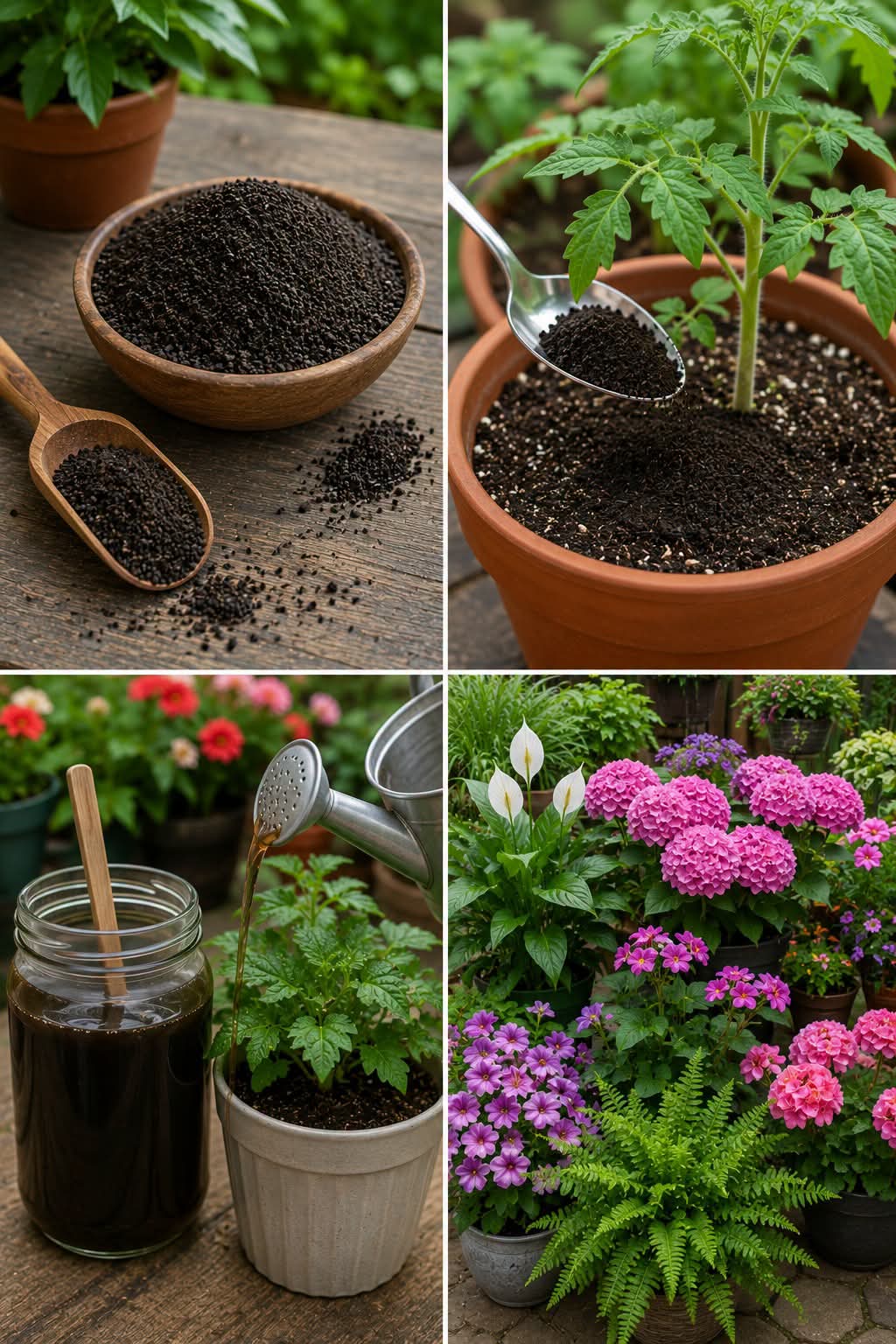
If you love gardening, you have probably searched for a simple, inexpensive way to help plants grow stronger, greener, and more productive without depending entirely on expensive commercial fertilizers. The image above shows a dark, soil-like amendment being added around a tomato plant, along with a dark liquid mixture that can be diluted and used to water plants.
Online gardening communities sometimes describe preparations like this as being “up to 100 times more effective than ordinary fertilizer.” However, that dramatic number should not be treated as a scientifically established fact. No single homemade fertilizer is universally 100 times more effective than every commercial fertilizer. What is interesting is that certain organic soil amendments can improve the growing environment by supplying nutrients, adding organic matter, supporting soil microorganisms, and improving moisture and nutrient retention.
This makes black organic amendments, compost-based feeds, and biochar-containing soil mixes particularly interesting for gardeners who want to build healthier soil over time.
In this complete guide, we will explore what the dark material in the image may represent, how organic soil amendments work, how to prepare a simple homemade plant feed, how to apply it safely, which plants may benefit, common mistakes to avoid, and how to create a long-term soil-building routine.
Why Healthy Soil Matters More Than Strong Fertilizer
When people see a plant growing slowly, their first thought is often:
“It needs more fertilizer.”
Sometimes that is correct. But poor plant growth can have many causes.
A plant may struggle because:
- The soil is compacted.
- Roots cannot access enough oxygen.
- The soil drains poorly.
- The plant is receiving too much water.
- The plant is receiving too little water.
- The soil lacks organic matter.
- The pH is unsuitable.
- Important nutrients are unavailable.
- The roots are damaged.
- The plant does not receive enough sunlight.
- Temperatures are unsuitable.
- Pests or diseases are interfering with growth.
Adding more fertilizer does not automatically solve these problems.
In fact, applying excessive fertilizer can damage roots, increase salt concentrations around the roots, and create additional problems.
That is why a good gardening strategy focuses on soil health first and nutrients second.
A healthy soil system contains minerals, organic matter, water, air, microorganisms, fungi, and countless microscopic processes that influence how plants obtain nutrients.
What Is the Black Material Shown in the Image?
The image shows a very dark granular material that resembles several products commonly used in gardening, including:
- Biochar
- Finely processed compost
- Charcoal-based soil amendments
- Organic soil conditioners
- Composted plant material
- Certain mineral amendments
The exact identity cannot be confirmed from the photograph alone.
One particularly interesting possibility is biochar.
Biochar is a carbon-rich material produced by heating plant material under limited oxygen. Unlike ordinary charcoal intended for cooking, properly produced horticultural biochar is prepared and processed for use as a soil amendment.
Biochar has a porous structure that can interact with water, nutrients, and microorganisms.
However, biochar should not automatically be considered a complete fertilizer.
It generally works better as a soil amendment than as a direct replacement for balanced plant nutrition.
Biochar and Fertilizer Are Not the Same Thing
This distinction is extremely important.
A fertilizer is primarily intended to supply nutrients.
For example, plants require nutrients such as:
- Nitrogen
- Phosphorus
- Potassium
- Calcium
- Magnesium
- Sulfur
- Iron
- Manganese
- Zinc
- Copper
- Boron
- Molybdenum
Biochar, on the other hand, is primarily a carbon-rich soil amendment.
Its value comes from its physical and ecological properties rather than simply providing large amounts of nitrogen or phosphorus.
Depending on how it was produced and prepared, biochar can contribute to soil structure and provide a porous environment that may interact with nutrients and microorganisms.
This is why gardeners sometimes combine carbon-rich amendments with compost or nutrient-containing organic materials.
Why Organic Soil Amendments Can Be So Powerful
The real secret isn’t necessarily one magical ingredient.
It is the combination of soil structure, organic matter, microorganisms, moisture management, and balanced nutrition.
Imagine two gardens.
Garden A receives a strong fertilizer every week, but the soil is compacted, dry, biologically poor, and drains badly.
Garden B receives moderate nutrition, compost, appropriate watering, good drainage, and regular organic matter.
The second garden may produce healthier plants even though it receives less fertilizer.
This demonstrates an important gardening principle:
Healthy roots are the foundation of healthy plants.
When roots function properly, plants can absorb water and nutrients more efficiently.
A Simple Homemade Organic Plant Feed
If you want to make a dark organic liquid plant feed similar in concept to the mixture shown in the image, you can prepare a mild compost-based extract.
Ingredients
You will need:
- 1–2 cups of mature, finished compost
- 4–5 liters of water
- A clean bucket
- A wooden spoon or stick
- A fine mesh strainer or cloth
- A watering can
Optional:
- A small amount of well-aged worm castings
- A small amount of mature leaf compost
Avoid using fresh manure directly in a homemade liquid feed.
How to Prepare It
Step 1: Choose Good Compost
The quality of your compost matters.
Use compost that is:
- Fully decomposed
- Dark brown or nearly black
- Earthy-smelling
- Free from obvious food scraps
- Free from moldy or diseased plant material
Good mature compost should smell pleasant and earthy rather than sour, rotten, or strongly ammonia-like.
Step 2: Add Water
Place approximately one or two cups of mature compost into a bucket.
Add about 4–5 liters of clean water.
Stir thoroughly.
The water will become darker as soluble materials and fine particles disperse.
Step 3: Let the Mixture Rest
Allow the mixture to sit for several hours.
Stir occasionally.
For a simple compost extract, there is no need to leave it sitting for many days.
The goal is to extract soluble material without creating an uncontrolled anaerobic mixture.
Step 4: Strain the Liquid
Pour the mixture through a fine strainer or cloth.
This removes large particles that could block watering cans or irrigation systems.
The remaining liquid can be used as a diluted soil drench.
How to Apply the Homemade Feed
For young or delicate plants, dilute the liquid further.
A conservative approach is:
1 part compost extract + 1 part water
For established plants, the mixture can be used around the soil surface rather than poured heavily onto the leaves.
Always water the soil rather than flooding the plant.
The objective is to provide a gentle supplement, not to saturate the root zone.
The Role of Biochar
If the black material in your garden is actually horticultural biochar, it can be used differently.
Biochar is usually incorporated into soil or mixed with compost rather than simply being sprinkled heavily around plants.
A common gardening approach is to combine biochar with nutrient-rich organic material first.
This process is sometimes called charging the biochar.
The reason is simple.
Fresh biochar contains many pores. Those pores can interact with nutrients and water.
Mixing it with compost before adding it to the garden gives the biochar an opportunity to become associated with nutrient-rich material and biological activity.
How to Charge Biochar
You can make a simple biochar-compost mixture.
Ingredients
- 1 part horticultural biochar
- 2–4 parts mature compost
- Enough water to make the mixture evenly moist
Mix the ingredients thoroughly.
Allow the mixture to sit for several days to a few weeks before incorporating it into the soil.
There is no magic requirement for an exact time. The important point is that biochar should not be treated as though it were a complete fertilizer.
Why Adding Raw Biochar Can Sometimes Be Disappointing
One common gardening mistake is assuming:
“More black material means more growth.”
Not necessarily.
Some biochars can temporarily interact with nutrients, particularly depending on their properties and the soil conditions.
A gardener who adds large quantities of poorly prepared biochar to nutrient-poor soil may not see immediate improvements.
This is one reason combining biochar with compost and other nutrient sources can be more sensible than using large amounts of raw material.
Benefits of Organic Soil Amendments
A good organic soil-building program can offer several potential advantages.
1. Better Soil Structure
Organic matter can help improve the physical condition of soil.
Healthy soil should not behave like solid concrete.
Roots need spaces containing both water and air.
Organic matter can help create a more favorable structure.
2. Improved Moisture Management
Organic materials can help soil retain moisture while still allowing excess water to drain.
This is especially useful in containers, raised beds, and sandy soils.
However, amendments should not be used as a substitute for proper drainage.
3. Support for Soil Microorganisms
Compost contains a diverse community of microorganisms.
These organisms participate in decomposition and nutrient cycling.
A living soil is not simply dirt.
It is an ecosystem.
4. Gradual Nutrient Release
Organic materials generally release nutrients more gradually than highly soluble synthetic fertilizers.
This can be beneficial for long-term soil management.
However, organic does not automatically mean nutritionally complete.
5. Improved Root Environment
When soil structure, moisture, aeration, and nutrient availability improve, roots may have a better environment for development.
Healthy roots support healthy stems, leaves, flowers, and fruit.
Using the Method on Tomato Plants
The photograph prominently shows a tomato plant.
Tomatoes are heavy feeders, particularly during periods of vigorous growth and fruit production.
But tomatoes also dislike several common problems:
- Waterlogged soil
- Extremely dry soil
- Excessive fertilizer
- Poor drainage
- Root disturbance
- Nutrient imbalance
Instead of constantly pouring fertilizer onto tomato plants, create a balanced growing environment.
Start with quality soil.
Add mature compost.
Maintain consistent watering.
Provide adequate sunlight.
Then supplement nutrition according to the plant’s needs.
How Often Should You Feed Tomatoes?
There is no universal schedule that works for every garden.
Factors include:
- Soil fertility
- Container size
- Plant variety
- Temperature
- Rainfall
- Growth stage
- Existing fertilizer
- Potting mix composition
A tomato grown in a large garden bed containing rich compost may need less supplemental feeding than a tomato growing in a small container.
Observe the plant.
Do not automatically fertilize every time the leaves look slightly pale.
What About Flowers?
The image also shows beautiful flowering plants, including hydrangea-like blooms, smaller flowering plants, and ferns.
Organic soil amendments can be useful for ornamental gardens, but flowering plants have different nutritional requirements.
Too much nitrogen can sometimes encourage leafy growth at the expense of flowering in some plants.
Therefore, gardeners should avoid assuming that more nitrogen equals more flowers.
Flowering depends on:
- Genetics
- Light
- Temperature
- Water
- Nutrient availability
- Pruning
- Plant maturity
Container Plants Need Special Attention
Potted plants have a much smaller root environment than plants growing directly in the ground.
This means problems can develop quickly.
A container can become:
- Too dry
- Too wet
- Too salty
- Nutrient-poor
- Root-bound
When using organic amendments in containers, moderation is essential.
Do not fill a small pot with a thick layer of dense compost or unknown black material.
Instead, use a high-quality potting mix designed for container plants.
Can This Replace Commercial Fertilizer?
Not necessarily.
This is one of the most important points to understand.
A homemade compost extract or biochar-based amendment should not automatically be described as a complete replacement for fertilizer.
If your soil is deficient in a particular nutrient, the correct fertilizer or soil amendment may be necessary.
For example, a plant suffering from confirmed nitrogen deficiency requires an available nitrogen source.
Biochar alone will not necessarily correct that deficiency.
The best strategy is often integrated nutrition:
- Compost
- Organic matter
- Appropriate fertilizer
- Correct watering
- Good sunlight
- Proper soil pH
- Healthy roots
The Truth About the “100 Times More Effective” Claim
The headline claim that this method is “100 times more effective and efficient than any other fertilizer” is appealing, but it should be treated as a gardening marketing claim rather than a universal scientific fact.
There is no single fertilizer that is objectively 100 times better than every other fertilizer for every plant, soil type, and growing condition.
Effectiveness depends on what you are measuring.
Are you measuring:
- Leaf growth?
- Root development?
- Flower production?
- Fruit yield?
- Nutrient uptake?
- Water efficiency?
- Soil carbon?
- Long-term soil quality?
Different products can perform differently under different conditions.
A responsible gardening article should therefore focus on what the amendment can realistically contribute rather than promising miraculous results.
How to Get the Best Results
If you want to maximize the benefits of an organic soil-building approach, follow these principles.
Start With the Soil
Before adding anything, examine your soil.
Is it compacted?
Does water drain?
Does it dry out immediately?
Does it smell healthy?
Is there organic matter?
A soil test can provide useful information about pH and nutrient levels.
Use Mature Compost
Finished compost is one of the most useful materials available to home gardeners.
It can improve soil structure and contribute organic matter and nutrients.
Avoid adding large quantities of unfinished compost directly around sensitive roots.
Use Appropriate Biochar
If you choose biochar, select a product intended for horticultural use.
Do not assume that ordinary barbecue charcoal is equivalent to garden biochar.
Avoid charcoal containing lighter fluid, additives, binders, artificial flavors, or other chemicals.
What You Should Never Add to the Garden
Some viral homemade fertilizer recipes recommend unusual household materials.
Be cautious.
Do not add:
- Bleach
- Detergent
- Salt
- Large amounts of baking soda
- Cooking oil
- Chemical cleaners
- Undiluted vinegar
- Unknown charcoal products
- Fresh animal manure directly onto edible crops
Natural does not automatically mean safe.
Avoid Overfertilizing
More fertilizer does not mean faster growth forever.
Plants have limits.
Excess nutrients can lead to:
- Root damage
- Leaf burn
- Excessive leafy growth
- Reduced flowering
- Nutrient imbalances
- Salt accumulation
- Environmental runoff
A mild feeding program is generally safer than repeatedly applying concentrated mixtures.
Signs Your Plant May Need Attention
Instead of immediately adding fertilizer, look for clues.
Yellow Leaves
Yellowing may be caused by:
- Nutrient deficiency
- Overwatering
- Poor drainage
- Root problems
- Natural aging
- Disease
Brown Leaf Edges
Possible causes include:
- Dry soil
- Salt buildup
- Heat stress
- Excess fertilizer
- Low humidity for certain plants
Slow Growth
Possible causes include:
- Insufficient light
- Poor soil
- Low temperatures
- Root restriction
- Nutrient deficiency
- Pest damage
The solution depends on the cause.
A Better Garden Fertilizer Routine
Instead of searching for one miracle fertilizer, consider a simple yearly strategy.
Spring
Prepare beds with mature compost.
Check soil condition.
Apply nutrients according to the needs of your plants.
Early Summer
Monitor growth.
Mulch around plants.
Maintain consistent watering.
Feed heavy-feeding vegetables when appropriate.
Mid-Summer
Watch for heat stress.
Check containers more frequently.
Avoid excessive fertilizer during periods of severe plant stress.
Autumn
Add compost to garden beds.
Leave healthy plant residues where appropriate.
Use fallen leaves to create future leaf mold or compost.
Winter
Allow soil-building materials to decompose.
Plan next season’s crop rotation.
Prepare compost.
Why Mulch Works So Well With Organic Amendments
One of the easiest ways to improve your garden is to combine soil amendments with mulch.
Suitable mulch can include:
- Shredded leaves
- Straw
- Wood chips
- Grass clippings used appropriately
- Compost
Mulch helps reduce evaporation and protects the soil surface.
It can also contribute organic material as it decomposes.
Do not pile mulch directly against plant stems.
Leave a small gap around stems to reduce moisture-related problems.
The Importance of Water
Even the best fertilizer cannot compensate for incorrect watering.
Plants need water to transport nutrients.
But roots also need oxygen.
Waterlogged soil can fill air spaces and create conditions that damage roots.
A simple rule is:
Water according to the plant, soil, container, weather, and season—not according to a rigid calendar.
Check the soil before watering.
A Simple Recipe for a Garden Soil Booster
Here is a practical version you can save for future use.
Ingredients
- 2 cups mature compost
- 4 liters clean water
- Optional: ½ cup mature worm castings
- Optional: a small amount of horticultural biochar that has already been conditioned with compost
Method
- Place compost into a clean bucket.
- Add the water.
- Stir thoroughly.
- Allow it to sit for several hours.
- Stir again.
- Strain the liquid.
- Dilute with additional water if using it on young or sensitive plants.
- Apply directly to moist soil around the plant.
- Repeat only as needed rather than using it excessively.
The remaining solid compost can be returned to the garden or compost pile.
How to Use the Solid Material
Do not throw away the strained compost.
Spread it around plants as a thin top dressing.
Gently work it into the upper layer of soil where appropriate.
For container plants, use small amounts because excessive organic material can alter drainage and moisture retention.
Plants That May Benefit From Good Organic Soil Management
A healthy soil-building program can be useful for many plants, including:
Vegetables
- Tomatoes
- Peppers
- Cucumbers
- Squash
- Beans
- Lettuce
- Kale
- Carrots
Herbs
- Basil
- Parsley
- Mint
- Rosemary
- Thyme
Flowers
- Roses
- Marigolds
- Petunias
- Geraniums
- Hydrangeas
- Zinnias
Ornamentals
- Ferns
- Hostas
- Many foliage plants
However, individual plants have different requirements, especially regarding pH, drainage, and nutrient levels.
Why Gardeners Love Homemade Soil Amendments
There is something satisfying about turning simple organic materials into something useful for the garden.
Homemade soil amendments can be:
- Affordable
- Simple
- Low-waste
- Easy to prepare
- Useful for soil improvement
- Compatible with many gardening styles
They also encourage gardeners to think beyond instant growth.
The goal is not simply to make a plant grow quickly.
The goal is to create a garden ecosystem that can support plants season after season.
Common Mistakes to Avoid
Mistake 1: Using Too Much
More is not always better.
Start with a modest amount.
Mistake 2: Using Fresh Manure
Fresh manure can be too strong and may create sanitation concerns, particularly around edible crops.
Use properly composted manure instead.
Mistake 3: Using Unknown Black Powder
Never assume that every black powder is suitable for plants.
Identify the material before applying it.
Mistake 4: Ignoring Soil pH
Some nutrients become less available when soil pH is unsuitable.
Mistake 5: Fertilizing a Severely Stressed Plant
If a plant is severely wilted, waterlogged, diseased, or suffering from heat stress, adding fertilizer may make the situation worse.
First identify and address the stress.
Frequently Asked Questions
Is black soil amendment better than normal fertilizer?
Not necessarily. A black soil amendment may improve soil conditions, while fertilizer supplies nutrients. They perform different functions.
Can I use this on tomatoes?
A properly prepared compost-based amendment can be incorporated into a tomato-growing program. Tomatoes also need balanced nutrition, adequate sunlight, and consistent watering.
Is biochar a fertilizer?
Biochar is primarily a soil amendment rather than a complete fertilizer.
Can I use barbecue charcoal?
Do not assume barbecue charcoal is appropriate. Many charcoal products contain additives or are manufactured for cooking rather than horticultural use.
Can homemade fertilizer burn plants?
Yes. Concentrated or inappropriate homemade fertilizers can damage roots and leaves. Dilution and moderation are important.
How often should I use compost extract?
There is no universal schedule. Occasional applications are generally more sensible than frequent heavy applications.
Does organic fertilizer work instantly?
Most organic amendments work gradually. They are better viewed as part of a long-term soil-management strategy.
Final Thoughts
The dark material shown in the image is a great reminder that successful gardening is about much more than buying the strongest fertilizer.
Whether the material is biochar, compost, or another horticultural amendment, its value depends on what it actually contains and how it is used.
The most effective garden strategy is not necessarily the one that produces the most dramatic claim.
It is the one that consistently provides plants with:
healthy soil + appropriate nutrition + water + oxygen + sunlight + good drainage + proper care.
Organic matter can play an important role in this system. Compost can help build soil. Properly prepared biochar can be useful as a soil amendment. Compost extracts can provide a gentle supplemental treatment. Mulch can protect the soil. And careful observation can help you determine what your plants actually need.
So, rather than promising that one homemade mixture is literally “100 times better than every fertilizer,” think of this approach as a long-term soil-building method.
That is where the real power lies.
A healthy garden is not created by one miracle ingredient.
It is created by healthy soil, healthy roots, balanced nutrition, and consistent care.
And when those pieces work together, even a simple home garden can produce remarkably vigorous plants, abundant foliage, beautiful flowers, and productive vegetables—without relying on excessive amounts of fertilizer.