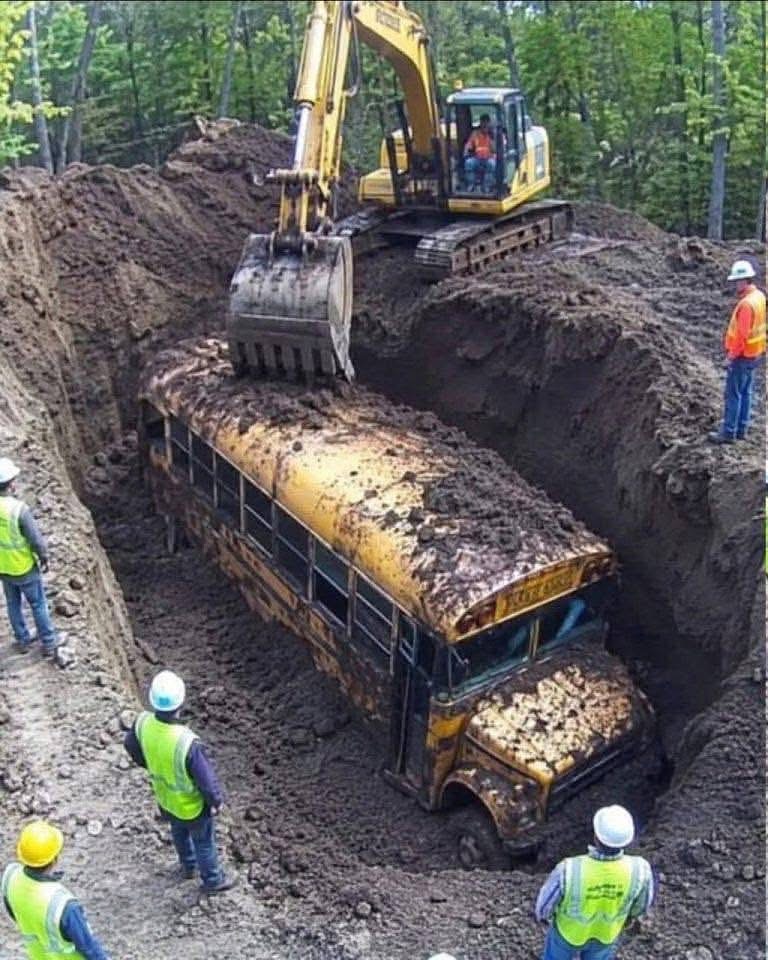
For decades, the residents of Hallstead County lived with a haunting and unanswered question. On a spring morning in 1986, fifteen children boarded a yellow school bus for a field trip and never returned home. The fog that blanketed the county that morning seemed almost symbolic of the mystery that followed. Countless theories emerged over the years. Some believed the bus had plunged into a nearby lake, others suspected an accident concealed by nature, and a few whispered of something far more sinister. Despite exhaustive investigations, searches, and profound heartbreak, no answers ever materialized.
That changed during an ordinary construction project. Shortly after seven in the morning, Deputy Sheriff Lana Whitaker received a call that would alter everything. A crew working near Morning Lake Pines had struck metal while digging for a septic system. Initially assuming it was abandoned farm equipment, the workers soon noticed yellow paint beneath the dirt. Moments later, the unmistakable shape of a school bus was revealed.
Even before the license plate could be confirmed, Deputy Whitaker knew exactly which case this belonged to. She had carried the weight of this mystery for almost forty years. As a child, she had been scheduled to join that very same field trip, but a bout of chickenpox kept her home. She had watched her classmates leave from her bedroom window, never to see them again.
By the time investigators arrived, the workers had stopped digging,…
By the time investigators arrived, the workers had stopped digging, leaving half of the vehicle buried beneath layers of earth. The emergency exit was already open, and inside, everything appeared frozen in time. Dust covered every surface, seat belts still hung from their mounts, a faded pink lunchbox rested beneath one seat, and a single child’s shoe lay near the rear exit. Nature had slowly reclaimed the vehicle, but one crucial element was missing. There were no children, no driver, no teacher, and no remains. The bus was completely empty.While documenting the vehicle, Deputy Whitaker noticed an old class roster attached to the dashboard. Every child’s name remained listed, but across the bottom, written in faded red marker, was a chilling sentence: We never made it to Morning Lake. Investigators immediately realized this was no ordinary accident scene. Someone had been inside the bus long after it originally disappeared, and the mystery had only deepened.Back at the county archives, Deputy Whitaker reviewed decades of old investigation files. Boxes filled with photographs, interviews, maps, and newspaper clippings painted the same heartbreaking picture of a massive, fruitless search effort involving helicopters, volunteer rescue teams, divers, and tracking dogs. Nothing had ever produced evidence explaining where the children went, leading to the case’s final classification of Missing and Presumed Lost. For almost forty years, that was the official ending. Now, the case is officially reopened.
Navigating the Modern Information Landscape
As stories like this resurface and capture public attention, they enter a complex modern information landscape. Readers and citizens play a vital role in shaping how these narratives are discussed. Every time we pause to verify a claim before sharing it, seek out trustworthy sources, or question sensational headlines, we contribute to a healthier public conversation. In an era where attention often arrives before evidence, patience remains one of the most powerful forms of critical thinking. This principle applies not only to historical mysteries but to all viral content circulating online.
Frequently Asked Questions
Has the object in Donald Trump’s hand been officially identified?
At the time of public discussion surrounding the footage in question, no widely confirmed official explanation had resolved all of the online speculation. Much of the conversation remained based on interpretation rather than verified facts, highlighting the need for caution when consuming viral media.
Why do viral political videos spread so quickly?
Content involving prominent political figures often generates strong public interest and emotional reactions. Furthermore, social media algorithms prioritize highly engaging content, allowing speculation to spread rapidly before additional context or factual verification becomes available.
How can readers avoid misinformation online?
The most effective strategies include checking multiple reputable news sources, looking for official statements when available, avoiding reliance solely on viral posts or screenshots, and remembering that early reports may change as new, verified information emerges.
Conclusion
What are your thoughts on stories like this? Do viral moments reveal more about the event itself, or do they reveal how quickly people form opinions online? Share your perspective in the comments below, and please remember to keep the conversation respectful and focused on verified information.