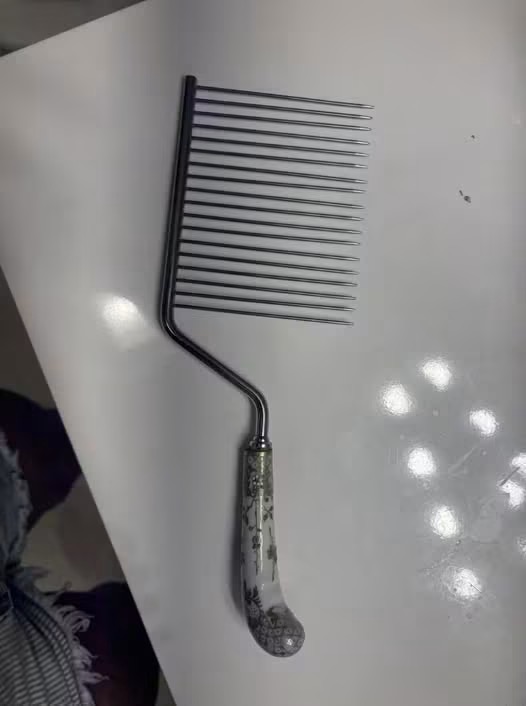
Some kitchen utensils transcend their basic function to become storytellers. The angel food cake cutter is one of the most unique and memorable tools to ever grace a countertop. Resembling a delicate cross between a rake and a comb, this specialized implement evokes fond memories for anyone lucky enough to have watched it in action.
While it may look peculiar to modern eyes, this tool was born out of absolute culinary necessity, designed to solve a very specific baking challenge.
Why This Tool Works: The Mechanics of the Perfect Slice
To understand the genius of the angel food cake cutter, you first have to understand the cake itself. Angel food cake is crafted from whipped egg whites, sugar, and flour, and contains absolutely no butter or oil. This unique formulation results in a wonderful, spongy, cloud-like texture.
However, this delicate structure is inevitably ruined when sliced with a regular, solid-bladed knife. The weight and flat surface of a standard knife compress the air pockets, crushing the cake into a dense, unappetizing mess.
The angel food cake cutter removes the guesswork through brilliant, simple engineering. It relies on thin, widely spaced tines that penetrate the delicate crumb without crushing or flattening it. To achieve a perfect slice, the user inserts the tines straight down into the cake and then slides the cutter alongside the tines, allowing the cake to separate cleanly along the lines of the comb.
A Mid-Century Kitchen Staple
From the 1940s through the 1970s, angel food cake was a beloved staple dessert in thousands of American homes and backyard picnics. Its airy lightness made it the perfect concluding course after an ample family dinner, a heavy holiday feast, or a casual potluck.
Because the cake was so ubiquitous, the cutter became a mandatory tool in the mid-century kitchen. It was a symbol of a time when home baking was a cherished ritual, and presenting a flawless, towering cake was a point of pride.
The Artistry and Sentiment of the Design
These cutters were not just purely utilitarian; they were often beautiful objects in their own right. Many featured handles crafted from ceramic or porcelain, frequently adorned with delicate floral patterns or elegant gold accents. Others were plain, practical, and made of turned wood. Regardless of the style, each cutter represented a conscientious display of care in the kitchen.
Beyond their physical beauty, these tools hold immense sentimental value. For many families, the cake cutter was not an everyday item. It might have sat quietly on a high shelf, brought down only two or three times a year for special occasions. Over the decades, regular use wore the wooden handles down until they felt completely smooth and polished to the touch. Holding one today reminds us of an era when people baked with intention, served others with love, and savored shared meals slowly.
Modern Utility and Vintage Charm
While the angel food cake may not be baked as frequently today as it was in the mid-century, the cutter itself is far from obsolete.
For the modern baker, these tools still serve a highly practical purpose. They are incredibly effective for slicing other delicate baked goods, such as:
Chiffon cakes
Soft, artisan breads
Crumbly desserts and tarts
Even if you never use the cutter in the kitchen again, it makes a stunning vintage culinary display item. Hanging one on a kitchen wall or placing it in a glass cabinet adds a touch of historical charm to your home. Furthermore, a wealth of videos and tutorials are now available online demonstrating how these cutters operate. Watching them in action not only preserves the knowledge of their function but also creates a newfound respect for the clever design of a tool that time has largely left behind.
A Lasting Slice of Nostalgia
The angel food cake cutter represents a small but deeply meaningful chapter in kitchen history. It was designed with a specific, intentional purpose, and its impact continues to resonate with those who remember the joy of a perfectly sliced, towering cake.
Whether it is handed down through generations as a family heirloom or rediscovered at a flea market, this humble tool remains a beautiful reminder of “the good old days.” It stands as a testament to a time when every utensil had a purpose, and every meal was an occasion to be celebrated.