Can Eating Pears Really Shrink an Enlarged Prostate? The Truth Behind the Viral “2,000 Times More Powerful” Claim
Introduction
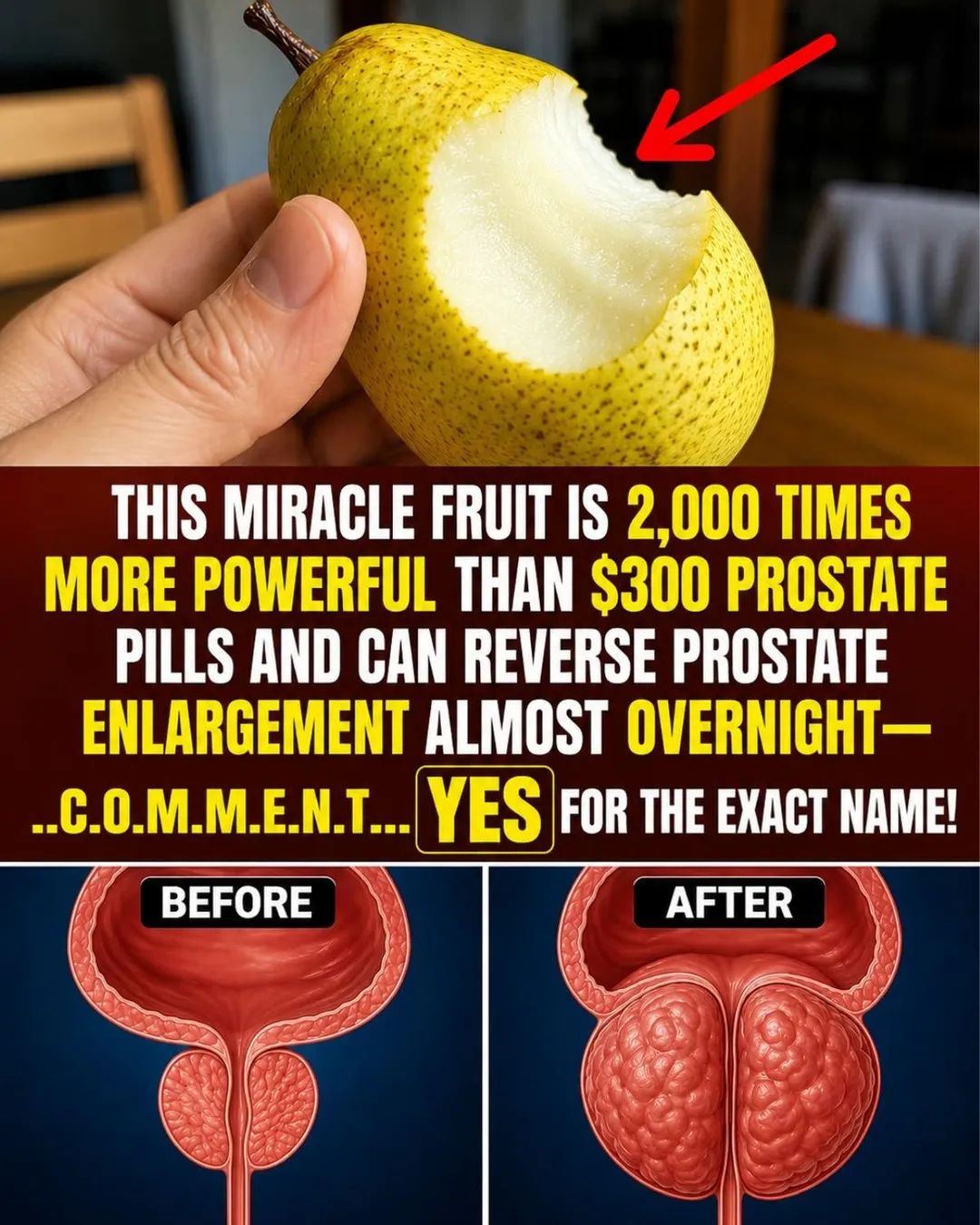
A photograph of a juicy yellow pear has recently been circulating online with a dramatic claim: this “miracle fruit” is supposedly 2,000 times more powerful than expensive prostate pills and can reverse prostate enlargement almost overnight.
The image is attention-grabbing, especially for men who experience frequent urination, a weak urine stream, nighttime bathroom trips, or difficulty emptying the bladder. But there is an important difference between a food being nutritious and a food being a proven treatment for an enlarged prostate.
The fruit shown in the image appears to be a pear. Pears are genuinely nutritious fruits and can be an excellent part of a balanced diet. They provide dietary fiber, water, vitamins, minerals, and plant compounds. However, there is no good clinical evidence that eating pears can shrink an enlarged prostate overnight—or that pears are 2,000 times more powerful than prescription medicines.
Benign prostatic hyperplasia, commonly called BPH, is a common condition in which the prostate becomes enlarged as men age. It can cause urinary symptoms ranging from mild inconvenience to serious problems with bladder emptying. The National Institute of Diabetes and Digestive and Kidney Diseases explains that BPH is common in older men and can produce symptoms such as a weak or interrupted urine stream, difficulty starting urination, urgency, frequency, dribbling, and nighttime urination.
So, should pears be included in a prostate-friendly diet? Absolutely, if you enjoy them and they fit your nutritional needs.
Should a pear replace prescribed prostate treatment? No.
Let’s examine the claim, the real benefits of pears, what BPH actually is, and what men can realistically do to support urinary and prostate health.
What Is an Enlarged Prostate?
The prostate is a small gland located below the bladder. It surrounds part of the urethra, the tube through which urine leaves the body.
As men age, the prostate can gradually become larger. When this enlargement begins to interfere with urine flow, it may lead to symptoms associated with BPH.
BPH is not prostate cancer, although the two conditions can occur in the same person. NIDDK describes BPH as prostate enlargement that is not caused by cancer.
The prostate has growth phases throughout life, and its second major growth phase begins around age 25 and continues with aging. BPH commonly develops during this later period. NIDDK estimates that BPH affects approximately 5% to 6% of men ages 40 to 64 and about 29% to 33% of men ages 65 and older.
This explains why prostate-related urinary complaints become increasingly common with age.
Common Symptoms of BPH
An enlarged prostate doesn’t affect every man in exactly the same way.
Some men can have a relatively large prostate with only minor symptoms, while others can have significant urinary problems despite a less dramatically enlarged prostate.
Common symptoms include:
- Difficulty starting urination
- A weak urine stream
- A urine stream that stops and starts
- Dribbling after urination
- Feeling that the bladder has not completely emptied
- A frequent need to urinate
- Sudden urinary urgency
- Getting up several times during the night to urinate
- Discomfort or pain during urination in some cases
These symptoms can interfere with sleep, work, travel, social activities, and overall quality of life.
Importantly, urinary symptoms shouldn’t automatically be blamed on BPH. Similar symptoms can occur with urinary tract infections, bladder disorders, prostatitis, and other conditions, including prostate cancer.
That is why persistent urinary changes deserve medical evaluation.
The Viral “2,000 Times More Powerful” Claim
The biggest problem with the image is not the pear itself.
The problem is the medical claim attached to it.
There is no established scientific evidence showing that pears are 2,000 times more powerful than prostate medications. There is also no reliable evidence that eating a pear can reverse prostate enlargement overnight.
In fact, proven BPH treatments work through specific biological mechanisms.
For example, certain medications called 5-alpha-reductase inhibitors can help stop prostate growth or shrink the prostate in some men. Other medications, including alpha blockers, work by relaxing muscles around the bladder neck and prostate to improve urine flow. NIDDK lists medications, lifestyle measures, minimally invasive procedures, and surgery among the established approaches to managing BPH.
A fruit does not work in the same way as a prescription medication.
That doesn’t make fruit unimportant. It simply means we should not confuse healthy nutrition with medical treatment.
So, Is the Pear Still Good for You?
Yes.
Pears can be an excellent everyday fruit.
They are naturally sweet, contain substantial water, and provide dietary fiber. Eating whole fruit rather than relying heavily on highly processed desserts can make it easier to build an overall healthy eating pattern.
The fiber in pears is particularly useful because dietary fiber supports normal digestive health and can contribute to a more satisfying diet.
A healthy digestive system, healthy body weight, adequate physical activity, and good cardiovascular health all form part of a broader approach to healthy aging.
But these benefits should not be exaggerated into a claim that pears can directly dissolve prostate tissue.
Think of pears as one useful piece of a healthy lifestyle, not a miracle cure.
How Pears May Fit Into a Prostate-Friendly Diet
Although research has not established pears as a treatment for BPH, they can easily fit into a generally nutritious eating pattern.
A prostate-friendly diet doesn’t need to be complicated.
Instead of searching for one “magic” food, focus on the overall pattern.
A balanced diet can include:
- Pears and other whole fruits
- Vegetables
- Beans and lentils
- Whole grains
- Nuts and seeds
- Fish and other protein sources
- Adequate water
- Healthy unsaturated fats
- Moderate portions of minimally processed foods
At the same time, many people benefit from reducing excessive intake of highly processed foods, added sugars, and large amounts of alcohol.
NIDDK notes that researchers have not established diet or nutrition as a cause or prevention strategy for BPH, although dietary and fluid changes may help manage some urinary symptoms.
That distinction is important.
Diet may support overall health and symptom management, but that is different from curing prostate enlargement.
Pears and Dietary Fiber
One of the most practical reasons to eat pears is their fiber content.
Fiber is important for digestive health and can help contribute to regular bowel movements.
Why does this matter when we’re talking about the prostate?
The prostate and lower bowel occupy neighboring areas of the pelvis, and constipation can be uncomfortable for people who already have pelvic or urinary problems. Maintaining regular bowel habits is therefore a sensible component of general pelvic health.
However, it would be inaccurate to say that pear fiber directly shrinks the prostate.
Instead, think of fiber as supporting the digestive side of a healthy lifestyle.
Whole pears are generally more useful in this respect than pear-flavored drinks or highly sweetened pear products.
Whole Pear vs. Pear Juice
If you’re eating pears for general nutrition, whole fruit is usually the better choice.
A whole pear contains the fruit’s natural fiber and requires chewing, which can make it more satisfying.
Juice, on the other hand, is easier to consume quickly and can contain much less fiber than the original whole fruit.
For someone trying to improve their overall eating pattern, replacing sugary drinks with whole fruit can be a simple step.
You don’t need a special pear recipe.
You can simply:
- Eat a ripe pear as a snack
- Slice pear over oatmeal
- Add pear to plain yogurt
- Combine pear with nuts
- Add sliced pear to a salad
- Eat pear alongside a balanced breakfast
- Use diced pear in a fruit-and-vegetable bowl
The goal is consistency, not a miracle effect.
What About Pear Skin?
The skin of many pears is edible and contributes additional fiber and plant compounds.
If you enjoy eating the skin, simply wash the pear thoroughly first.
There is no scientific reason to believe that the skin contains a secret prostate-shrinking substance.
Social-media posts sometimes take a normal nutritional feature and transform it into a dramatic medical claim. That’s why it’s useful to separate what a food contains from what it has actually been shown to treat.
What Actually Helps With BPH?
For men experiencing mild symptoms, lifestyle adjustments may sometimes help.
NIDDK recommends several practical strategies for men managing BPH symptoms, including reducing fluids before bedtime or before situations where bathroom access is difficult, limiting alcohol and caffeine, staying physically active, emptying the bladder completely, and avoiding unnecessarily holding urine.
These steps aren’t equivalent to shrinking the prostate, but they can make urinary symptoms easier to manage.
For example, someone who drinks several large caffeinated beverages late in the evening may naturally wake more often during the night.
Changing the timing and quantity of those drinks could help reduce nighttime bathroom trips.
Similarly, staying physically active supports general health and may be particularly valuable as men age.
Prescription Treatments Are Different From Foods
It is important to understand why the “2,000 times more powerful” comparison is misleading.
Prescription medications are developed, tested, standardized, dosed, and monitored for specific medical purposes.
For BPH, doctors may use several types of medications depending on the patient’s symptoms and prostate characteristics.
Alpha blockers
These medications can relax muscles around the prostate and bladder neck, helping urine pass more easily.
5-alpha-reductase inhibitors
These medications can reduce the hormonal stimulation involved in prostate growth and may help stop growth or shrink the prostate in some men.
Other medications
Certain phosphodiesterase-5 inhibitors can also relieve some BPH symptoms in appropriate patients.
The correct treatment depends on the individual.
That is why replacing prescribed medication with a fruit based on a viral image is not a safe approach.
What About “Natural Prostate Pills”?
The word natural does not automatically mean effective.
Many supplements are marketed for prostate health, particularly products containing herbs such as saw palmetto.
However, evidence for these products is mixed.
The National Center for Complementary and Integrative Health reports that a 2023 review of 27 studies found that saw palmetto used alone provides little or no benefit for BPH symptoms.
Other complementary approaches have also been studied, but the evidence varies considerably.
This is another reason to be cautious with advertisements that promise dramatic prostate improvements.
If a product claims to shrink the prostate “overnight,” “instantly,” or thousands of times better than established treatments, that should be treated as a major warning sign.
Can a Food Shrink an Enlarged Prostate Overnight?
There is no credible basis for believing that eating one pear—or any ordinary fruit—can physically reverse BPH almost overnight.
BPH is a biological condition associated with prostate growth and aging. When medication is used to reduce prostate size, the effect is not generally an instant process.
Medical treatment takes time, and doctors evaluate whether the chosen therapy is working.
Therefore, an image showing a dramatic “before and after” prostate diagram should not be interpreted as proof that a particular fruit can reproduce that result.
The graphic itself is not a clinical trial.
Why Viral Health Posts Are So Convincing
Health misinformation often works because it combines several powerful elements:
A familiar food + an expensive medicine + a dramatic number + a frightening condition + an instant solution.
The result is highly shareable.
The pear image uses exactly this structure.
It suggests that people have been spending hundreds of dollars on medications when a cheap fruit could supposedly do something much more powerful.
That is emotionally compelling.
But medicine doesn’t work by popularity.
A treatment needs evidence from appropriate scientific studies.
Before accepting an extraordinary health claim, ask:
- Who conducted the study?
- Was it performed in humans?
- How many people participated?
- Was there a control group?
- Was the study published in a reputable medical journal?
- Was the result independently reproduced?
- Does a major medical organization recommend the treatment?
- Are the claimed benefits biologically plausible?
- Could the claim cause someone to stop necessary treatment?
These questions can protect you from many misleading health posts.
When Urinary Symptoms Need Medical Attention
Men should not ignore significant changes in urination.
NIDDK recommends speaking with a health professional about urinary symptoms because similar symptoms can have different causes.
Seek prompt medical attention if you experience:
- Inability to urinate
- Blood in the urine
- Significant urinary pain
- Fever and chills with urinary symptoms
- Severe lower abdominal or urinary tract discomfort
Acute inability to urinate can be a medical emergency and should not be treated with fruit, tea, supplements, or home remedies.
Does Having BPH Mean You Have Prostate Cancer?
No.
BPH is a noncancerous enlargement of the prostate.
However, BPH and prostate cancer can occur in the same person, and urinary symptoms alone cannot reliably distinguish between different prostate conditions.
That is why persistent or concerning symptoms deserve proper assessment.
Depending on the situation, a healthcare professional may review medical history, perform an examination, conduct urine testing, and consider other tests such as PSA testing or additional prostate evaluations. NIDDK lists several diagnostic approaches that may be used depending on the individual.
The important lesson is simple:
Don’t diagnose yourself from a social-media graphic.
A Practical Daily Approach to Prostate and Urinary Health
Instead of searching for one miracle fruit, consider building a collection of healthy habits.
- Eat more whole foods
Include fruits such as pears, apples, berries, oranges, and other seasonal options.
- Eat plenty of vegetables
Vegetables provide fiber and a broad range of nutrients and plant compounds.
- Stay physically active
Regular physical activity supports cardiovascular and metabolic health and is associated with many benefits during aging.
- Watch caffeine and alcohol
Both can worsen urinary frequency for some people. NIDDK specifically recommends limiting alcohol and caffeine when managing BPH symptoms.
- Adjust evening fluids
If nighttime urination is a problem, reducing the amount you drink immediately before bed may help.
- Don’t routinely hold urine
Using the bathroom when necessary can be more comfortable than repeatedly delaying urination.
- Maintain a healthy weight
Excess body weight is associated with several health conditions that can coexist with urinary problems.
- Discuss persistent symptoms
If symptoms continue, interfere with sleep, or affect daily life, speak with a healthcare professional.
- Take medications as prescribed
Never stop a prescribed prostate medication because a viral post claims that a food or supplement is more powerful.
- Treat supplements cautiously
Tell your healthcare professional about supplements you take, especially if you use prescription medications.
A Simple Pear-Based Snack for a Healthy Diet
If you enjoy pears, here’s an easy way to include them in your routine.
Pear and Yogurt Bowl
Ingredients
- 1 ripe pear
- 1 cup plain yogurt
- 1 tablespoon chopped walnuts
- 1 tablespoon oats
- A small sprinkle of cinnamon
- Optional: a few berries
Method
Wash the pear thoroughly and slice it into bite-sized pieces.
Place the yogurt in a bowl and add the pear slices.
Sprinkle over the oats and chopped walnuts.
Add cinnamon and a few berries if desired.
This makes a simple breakfast or snack containing fruit, protein from yogurt, healthy fats from walnuts, and fiber from the fruit and oats.
It is nutritious—but it should still be viewed as food, not medicine.
What the Viral Image Gets Right
Despite the exaggerated headline, there is a small grain of truth behind the idea that diet matters.
Food matters to overall health.
A diet rich in minimally processed foods can support cardiovascular health, metabolic health, digestive health, and healthy aging.
Fruits such as pears can be part of that pattern.
The mistake is turning a nutritious food into a supposed pharmaceutical replacement.
It is perfectly reasonable to say:
“Pears are a healthy fruit that can be part of a balanced diet.”
It is not reasonable to say:
“Pears are 2,000 times more powerful than prostate medication and can reverse BPH overnight.”
Those are completely different statements.
The Bigger Picture: Prostate Health Is About More Than One Food
The prostate does not exist in isolation from the rest of the body.
A man’s overall health, activity level, weight, cardiovascular health, medications, age, and other medical conditions can all be relevant when evaluating urinary symptoms.
That is why the most useful prostate-health strategy is usually not a single food.
It is a long-term lifestyle and medical plan.
Eat nutritious foods.
Stay active.
Sleep well.
Avoid excessive alcohol.
Don’t smoke.
Pay attention to urinary symptoms.
Have appropriate medical checkups.
And use evidence-based treatment when treatment is needed.
This approach is much less exciting than a headline promising overnight transformation—but it is far more realistic.
Frequently Asked Questions
Can pears cure an enlarged prostate?
No. Pears are nutritious, but there is no established clinical evidence that they cure BPH or reverse prostate enlargement.
Is the pear in the viral image really 2,000 times stronger than prostate pills?
There is no credible evidence supporting that numerical claim.
Can eating pears support general health?
Yes. Pears can contribute fiber, fluid, and other nutrients to a balanced diet.
Should I stop taking my prostate medication and eat pears instead?
No. Do not stop prescribed medication based on a social-media claim. Discuss medication changes with your healthcare professional.
Can BPH go away overnight?
BPH is generally related to prostate growth associated with aging. Symptoms can fluctuate, but claims that a food can reverse prostate enlargement almost overnight are not supported by established evidence.
Is BPH the same as prostate cancer?
No. BPH is noncancerous prostate enlargement. However, urinary symptoms can have several causes, so appropriate medical evaluation is important.
Can lifestyle changes help BPH symptoms?
Yes. Depending on the individual, measures such as reducing evening fluids, limiting caffeine and alcohol, staying active, and properly emptying the bladder may help manage symptoms.
What if I cannot urinate?
Inability to urinate requires prompt medical attention. It should not be managed with fruit or home remedies.
Final Thoughts
The yellow pear shown in the viral image is not a miracle prostate medicine.
It is simply a nutritious fruit.
And that is actually enough.
There is no need to exaggerate the health benefits of natural foods to appreciate them. Pears can be delicious, hydrating, fiber-rich additions to a balanced diet. They can replace less nutritious snacks and contribute to an overall healthy eating pattern.
But the claim that a pear is “2,000 times more powerful” than $300 prostate pills and can “reverse prostate enlargement almost overnight” should not be treated as established medical fact.
BPH is a genuine medical condition, and effective treatments exist. Depending on the severity of symptoms and the individual’s prostate characteristics, treatment can involve lifestyle changes, watchful waiting, medications, minimally invasive procedures, or surgery.
The safest approach is therefore to enjoy pears as part of a healthy diet while taking prostate symptoms seriously.
If you have a weak urine stream, increasing urinary frequency, difficulty starting urination, repeated nighttime urination, or a feeling that your bladder isn’t emptying properly, don’t wait for a viral “miracle food” to solve the problem.
Get the symptoms evaluated.
Eat the pear if you enjoy it. Keep the healthy habits. But don’t confuse a nutritious fruit with a proven treatment for an enlarged prostate.
Medical Disclaimer
This article is for educational purposes only and does not diagnose, treat, cure, or prevent any medical condition. The information should not be used as a substitute for professional medical advice. If you have urinary or prostate symptoms, speak with a qualified healthcare professional. If you are unable to urinate, have blood in your urine, or develop severe urinary symptoms with fever, chills, or significant pain, seek medical care promptly.