The Tiny Hole in a Nail Clipper: What Is It Really For?
Introduction
Have you ever looked closely at a nail clipper and noticed the tiny round hole near the end of the handle? It is one of those small details that many people see but rarely think about. Most of us use nail clippers for years without ever asking why that little hole is there.
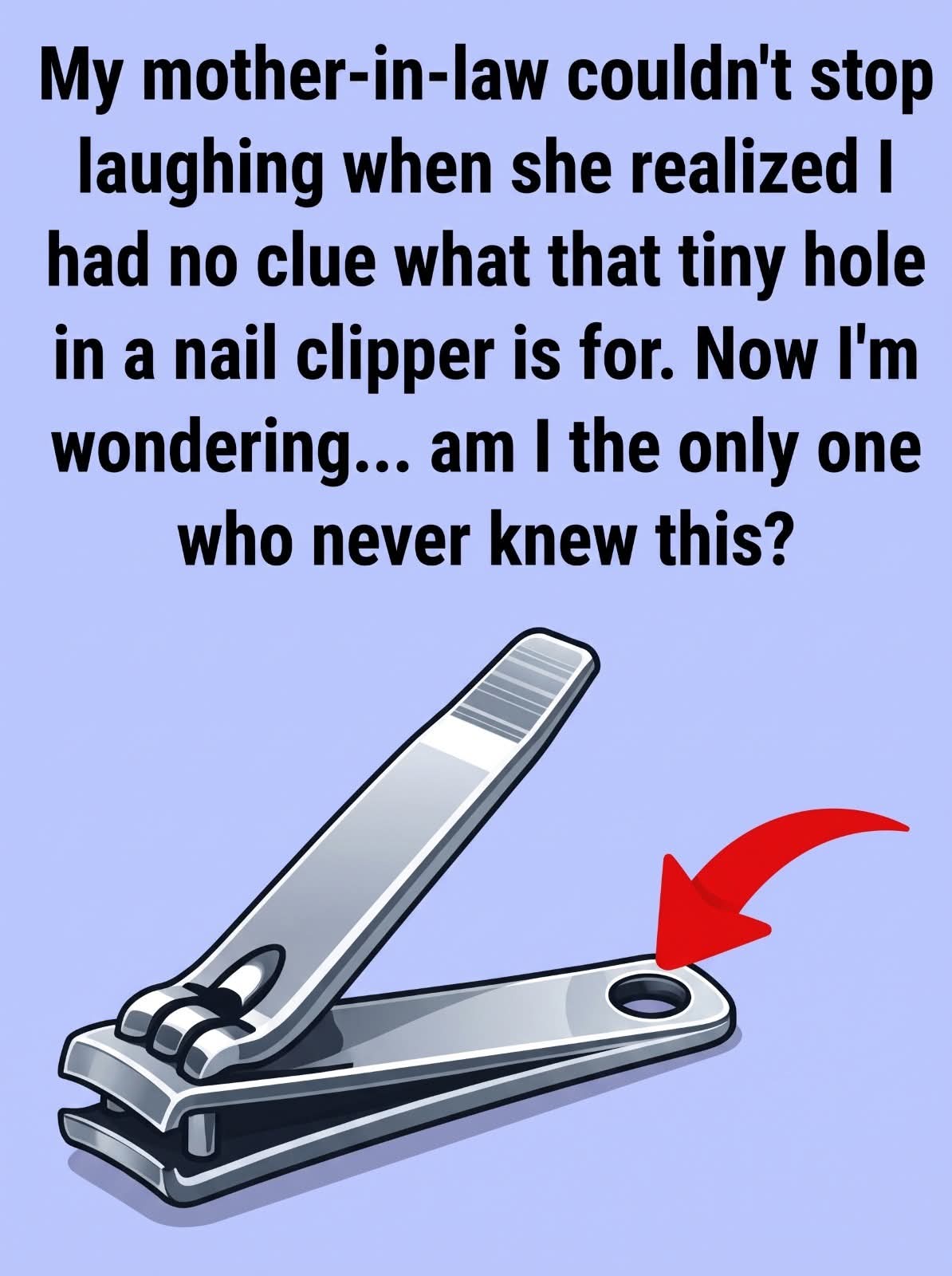
A viral-style image recently brought attention to this overlooked feature, with the message: “My mother-in-law couldn’t stop laughing when she realized I had no clue what that tiny hole in a nail clipper is for.” The image points directly to the small opening at the end of a standard nail clipper and asks whether everyone else knew its purpose.
The answer is surprisingly simple, although there can be some variation between nail-clipper designs.
In many traditional nail clippers, the hole is primarily a hanging or attachment hole. It can be used to attach the clipper to a small ring, chain, lanyard, or other holder. It can also make the tool easier to store by allowing it to hang from a hook or organizer.
Because the hole is so small and sits in an otherwise ordinary-looking piece of metal, it is easy to assume that it must have some special nail-care function. That is what makes the design so interesting. A tiny opening that appears almost decorative can actually have a practical purpose.
This article explores the little hole in a nail clipper, why manufacturers include it, how nail clippers are designed, other useful features you may have overlooked, and how to use and maintain your nail clipper safely.
What Is the Tiny Hole in a Nail Clipper For?
The small hole shown in the image is generally designed as an attachment or hanging point.
The hole allows the nail clipper to be connected to something such as:
- A small key ring
- A metal chain
- A lanyard
- A grooming-kit holder
- A storage hook
- A travel organizer
- A clip or attachment system
This makes the nail clipper easier to carry or store.
For example, some people keep a nail clipper in a travel toiletry bag. Others may attach small grooming tools together so they are less likely to get lost. A hole through the metal body provides a simple way to do this without adding a separate loop or bulky attachment.
The exact purpose can depend on the manufacturer and model. Not every hole on every nail clipper has been designed for exactly the same reason. Some modern clippers may include openings as part of the manufacturing or design structure.
However, for the traditional hole found near the back of many standard nail clippers, attachment and hanging are the most common practical explanations.
Why Does a Nail Clipper Need a Hole?
At first glance, it may seem unnecessary. A nail clipper already works perfectly well without being attached to anything.
But small tools benefit from being easy to store.
Nail clippers are usually quite small. That makes them convenient, but it also makes them easy to misplace. A tiny grooming tool can disappear inside a bathroom drawer, travel bag, handbag, cabinet, or suitcase.
Adding a small hole provides an easy solution.
Instead of designing a separate handle or storage mechanism, manufacturers can simply create a small opening in the metal. The user can then attach the clipper to a ring or hang it in a convenient location.
This is a good example of simple product design: a very small feature can make an everyday object more convenient without making it significantly larger, heavier, or more expensive.
The Hole Can Be Used for Storage
One of the simplest uses for the hole is hanging the nail clipper.
If your bathroom has a grooming organizer with hooks, the clipper can potentially be hung there. This keeps it visible and prevents it from getting buried underneath other objects.
A nail clipper can also be stored together with other grooming tools.
For example, you might attach:
- Nail clippers
- A small nail file
- Tweezers
- Cuticle tools
to a grooming organizer or travel kit.
Keeping these tools together makes them easier to find when needed.
The hole therefore provides a small storage advantage that most people never think about.
It Can Also Make the Clipper Easier to Carry
Small grooming tools are particularly useful when traveling.
People often carry nail clippers in luggage, backpacks, purses, toiletry bags, or emergency kits. Because nail clippers are so small, it is easy for them to become separated from other grooming items.
An attachment hole can help keep the clipper connected to a larger item.
For example, a manufacturer may provide a small ring through the hole, allowing the clipper to be attached to a grooming kit or another suitable holder.
This is especially useful for people who frequently travel and want to keep their small personal-care tools organized.
Is the Hole for Cleaning Under Your Nails?
This is one of the questions that often comes up when people see the viral image.
The answer is generally no.
The hole shown in the image is not normally designed as a specialized nail-cleaning tool.
Some nail clippers do have additional features intended for grooming or cleaning. These may include small pointed tools, files, or specially shaped attachments. But the simple circular opening at the end of the clipper should not automatically be interpreted as a nail-cleaning device.
Trying to use a small metal hole to clean underneath your nails can also be uncomfortable or potentially cause injury if you press too hard.
If you need to clean underneath your nails, a dedicated nail-cleaning tool or the appropriate part of a grooming tool is usually more practical.
Is It a Bottle Opener?
Another common internet question is whether unusual features on everyday objects are secretly designed for completely different purposes.
Some multi-purpose nail clippers do include extra tools. Depending on the model, a nail clipper may come with:
- A nail file
- A nail-cleaning tip
- Tweezers
- Scissors
- A small knife
- A key-ring attachment
But the simple circular hole shown in the image is not generally a bottle opener.
It is important to distinguish between a hole used for attachment and a functional opening tool.
A bottle opener needs a particular shape and leverage point. A plain circular hole does not normally provide that functionality.
Why Do Manufacturers Make the Hole So Small?
The hole does not need to be large.
Its purpose is usually to accommodate a thin ring, cord, chain, or similar attachment. Making it larger would provide little additional benefit while potentially removing useful material from the clipper.
A small hole also keeps the tool compact.
Nail clippers are designed to be portable. Every part has to fit into a small space while still providing enough strength to cut nails effectively.
The tiny opening is therefore consistent with the overall philosophy of nail-clipper design: small, practical, durable, and easy to carry.
A Nail Clipper Is More Carefully Designed Than It Looks
The average nail clipper may look like nothing more than two pieces of metal pressed together.
In reality, several components work together.
A typical lever-style nail clipper includes:
- Cutting jaws
- Metal body
- Lever
- Pivot or attachment point
- Grip surface
- Sometimes a nail file
- Sometimes a cleaning tool
- Sometimes an attachment hole
When you press the lever, force is transferred to the cutting jaws. The jaws come together and cut the nail.
The design is based on leverage. A relatively small movement of your finger can create enough force at the cutting edges to cut through a fingernail or toenail.
That is why something as small as a nail clipper can perform a task that would otherwise require considerably more force.
The History of Nail Clippers
People have been cutting and maintaining their nails for thousands of years.
Before modern nail clippers existed, people used a variety of tools to trim nails. These included knives, scissors, small blades, files, and other handmade implements.
As metalworking improved, specialized nail-care tools became more practical.
The modern lever-style nail clipper eventually became popular because it was compact, inexpensive, and easy to operate.
Instead of using separate scissors, a person could carry one small tool capable of trimming nails quickly.
The basic design has remained remarkably recognizable.
Even modern nail clippers still commonly use the same general principle: opposing cutting edges operated by a lever.
Why Nail Clippers Became So Popular
There are several reasons nail clippers became a standard household grooming tool.
They are small
A nail clipper can fit inside a pocket, purse, toiletry bag, or drawer.
They are inexpensive
Basic nail clippers can be manufactured relatively simply.
They are easy to use
Most people can learn to use one within seconds.
They require no electricity
Unlike electric nail trimmers, ordinary nail clippers work anywhere.
They are reusable
With proper cleaning and maintenance, a quality nail clipper can last for many years.
These advantages helped make nail clippers a common personal-care item around the world.
The Other Features You May Have Overlooked
The tiny hole is not the only part of a nail clipper that people sometimes misunderstand.
Many traditional nail clippers have a small textured surface on the top lever. This texture provides additional grip and helps prevent your finger from slipping while applying pressure.
Some models also include a built-in nail file.
A nail file may have a rough surface for shaping the nail after trimming. Some versions include a pointed end that can be used for limited cleaning or grooming purposes.
However, not every nail clipper contains the same features.
That is why it is useful to look at the design of your particular model instead of assuming that every part serves the same function.
How to Use a Nail Clipper Correctly
Using a nail clipper is simple, but good technique can make nail trimming safer and more comfortable.
Step 1: Clean the clipper
Before using the tool, make sure it is clean. If multiple people share the same clipper, cleaning becomes especially important.
Step 2: Position the clipper
Place the cutting edges around the portion of nail you want to remove.
Do not position the clipper too deeply into the corners of the nail.
Step 3: Cut gradually
Rather than attempting to remove a large section of nail in one powerful cut, use controlled movements.
For fingernails, small cuts can make it easier to maintain the desired shape.
Step 4: Avoid cutting too short
Cutting nails extremely close to the skin can cause discomfort and may increase the chance of irritation.
Step 5: Smooth rough edges
If the nail feels sharp after clipping, use a nail file to gently smooth the edge.
Fingernails and Toenails Are Different
Although the same nail clipper can sometimes be used for both, fingernails and toenails require slightly different care.
Fingernails are generally thinner and more flexible.
Toenails tend to be thicker and may require a stronger clipper.
When trimming toenails, many people prefer a straight or gently shaped edge rather than cutting deeply into the corners. This can help reduce unnecessary irritation around the edges of the nail.
If a nail is unusually thick, painful, discolored, or difficult to trim, it may be better to seek advice from an appropriate healthcare professional rather than repeatedly forcing a standard clipper through it.
Why You Should Keep Your Nail Clippers Clean
A nail clipper comes into contact with nails and surrounding skin, so cleaning is an important part of good grooming hygiene.
After using the clipper, remove visible nail fragments.
The tool can then be cleaned according to the manufacturer’s instructions. A suitable disinfecting method may be appropriate, particularly when the tool is shared.
Keeping the clipper clean also helps prevent buildup of dirt and debris.
Do not assume that because a clipper is made of metal it can never become contaminated. Metal tools still need proper cleaning and storage.
Should You Share Nail Clippers?
It is generally better for each person to have their own personal grooming tools.
Nail clippers come into contact with nails and sometimes the surrounding skin. Sharing personal grooming equipment can transfer microorganisms between people, particularly if the tool is not cleaned properly.
For households, keeping separate nail clippers for each person is a simple habit.
If a clipper must be shared, it should be cleaned and appropriately disinfected between users.
Why Does the Internet Find Tiny Details So Fascinating?
The nail-clipper-hole story is a perfect example of why ordinary objects can become fascinating online.
People use familiar objects every day without examining their construction.
A nail clipper is something most people probably pick up without thinking. We know what it does, so there seems to be no reason to inspect every little detail.
Then someone points at an overlooked feature and asks:
“Do you know what this is for?”
Suddenly, an ordinary object becomes a mystery.
This happens with many everyday products. People discover hidden compartments, unusual buttons, markings, grooves, holes, and secondary functions that were always there.
The surprise comes from realizing that something we have seen hundreds of times may contain a feature we never understood.
The Lesson Behind the Tiny Hole
The real lesson isn’t necessarily that everyone should have known what the hole was for.
Instead, it demonstrates how much we take everyday design for granted.
Manufacturers often include small features for practical reasons. Some are obvious, while others only become useful in certain situations.
The hole in a nail clipper is a good example.
Most people don’t need to attach their nail clipper to anything. As a result, they may never discover why the hole exists.
Someone who uses a grooming kit, carries a clipper while traveling, or stores tools on hooks may find the feature much more useful.
Can You Put a Key Ring Through It?
If the hole is appropriately sized and designed for attachment, a small key ring can often be placed through it.
However, you should not force a ring through the opening.
The metal around the hole is part of the tool’s structure. Excessive force could bend or damage the clipper.
If the manufacturer specifically provides a ring or attachment mechanism, use that rather than improvising with something too large.
Can the Hole Help You Find Your Nail Clipper?
Indirectly, yes.
One practical advantage of an attachment hole is organization.
If you keep several small grooming tools in the same drawer, it can be difficult to locate the one you need.
A ring or holder can keep the clipper attached to the rest of your grooming equipment.
This turns a tiny hole into a surprisingly useful organizational feature.
Why Some Nail Clippers Don’t Have a Hole
Not every nail clipper looks exactly like the one in the image.
Some models have a hole.
Others may have a solid end.
Some are designed as part of manicure sets and may include additional storage systems.
Others are larger toenail clippers with different shapes.
Manufacturers can change the design depending on the intended use, materials, manufacturing process, and target market.
Therefore, the absence of a hole does not mean that a clipper is defective.
It simply means that the manufacturer chose a different design.
Common Myths About the Nail Clipper Hole
Myth 1: It is designed to clean your ears
No. A nail clipper should not be used as an ear-cleaning tool.
Myth 2: It is for cleaning underneath nails
The opening itself is generally not intended to function as a nail-cleaning tool.
Myth 3: It is a bottle opener
A plain circular attachment hole is not normally designed to open bottles.
Myth 4: Every nail clipper hole has exactly the same purpose
Not necessarily. Designs vary between manufacturers.
Myth 5: The hole is completely useless
For someone who never hangs or attaches their clipper, it may seem useless. But it can provide a convenient attachment or storage point.
How to Store Nail Clippers Properly
Proper storage can extend the useful life of your grooming tools.
After cleaning the clipper, allow it to dry completely before putting it away.
Keep it somewhere clean and dry.
Avoid leaving it permanently in a wet shower area, where moisture can encourage corrosion on certain metal components.
A bathroom drawer, grooming case, or dedicated organizer can be a better storage location.
If your clipper has an attachment hole, you can use it as part of your storage system.
What Makes a Good Nail Clipper?
A good nail clipper should feel comfortable and stable in your hand.
The cutting edges should meet properly.
The lever should operate smoothly.
The metal should feel reasonably strong.
The clipper should cut rather than crush or excessively bend the nail.
A nail clipper does not need to be complicated to be useful. In fact, one of the strengths of the traditional design is its simplicity.
When Should You Replace a Nail Clipper?
Nail clippers can last for years, but eventually they may become worn.
Consider replacing one if:
- The cutting edges become badly damaged.
- The lever becomes loose.
- The tool develops significant rust.
- The clipper no longer cuts cleanly.
- The metal becomes bent.
- The tool is difficult to clean.
- It causes nails to split or crush rather than cut.
A sharp, properly functioning clipper is generally easier to control than a damaged one.
The Surprising Beauty of Simple Design
The little hole in the nail clipper is a reminder that good design does not always look impressive.
There is no complicated technology involved.
There is no electronic component.
There is no sophisticated mechanism hidden inside.
It is simply a small opening made in a small piece of metal.
Yet that opening can make the tool easier to attach, organize, carry, or store.
This is often what makes everyday industrial design so interesting. The most useful ideas can be incredibly simple.
Why This Small Discovery Feels So Funny
The humor behind the viral image comes from the fact that many people have probably owned nail clippers for years without knowing about the hole’s practical purpose.
The joke becomes even more amusing when someone imagines a family member confidently discovering the feature and explaining it.
It creates a classic “I can’t believe I never noticed that” moment.
These discoveries are relatable because everyone has experienced something similar.
You might learn that a clothing feature has a specific purpose, discover a hidden setting on an appliance, or finally understand why an everyday object has an unusual shape.
The nail clipper is simply another example.
Nail Clipper Care Tips
Here are some simple habits that can help keep your nail clipper in good condition:
1. Clean it regularly
Remove nail debris after use.
2. Keep it dry
Moisture can damage some metal tools over time.
3. Don’t force it
If a nail is too thick for the clipper, forcing the tool may damage it.
4. Don’t use it for unrelated tasks
Avoid using nail clippers to cut wire, plastic, packaging, or other hard materials.
5. Store it safely
Keep the tool in a clean location where it will not be damaged.
6. Avoid unnecessary sharing
Personal grooming tools are best kept personal.
What We Can Learn From Everyday Objects
The nail clipper story is more than a fun internet discovery.
It teaches us to pay attention to the objects we use every day.
A product that appears simple may contain dozens of small design decisions.
The shape of the handle, the angle of the cutting edges, the position of the lever, the texture of the grip, and even a tiny hole can all have practical reasons behind them.
When we understand those details, we often appreciate everyday products differently.
Frequently Asked Questions
What is the small hole in a nail clipper for?
On many traditional nail clippers, the small hole near the end is intended as an attachment or hanging point. It can accommodate a small ring, chain, lanyard, or similar holder.
Can I use the hole to clean under my nails?
It is generally not intended for that purpose. Use an appropriate nail-cleaning tool instead.
Can I attach a key ring to the hole?
If the hole is designed for attachment and the ring fits easily, it can be used as an attachment point. Avoid forcing anything into it.
Does every nail clipper have this hole?
No. Nail-clipper designs vary.
Is the hole decorative?
Usually, it has a practical design purpose rather than being purely decorative, although the exact function depends on the particular model.
Why is it so small?
A small opening is enough for a ring or thin attachment while keeping the nail clipper compact and strong.
Can I hang my nail clipper from a hook?
If the hole is suitable for the hook or attachment system, yes. This can be a convenient way to organize it.
Conclusion
That tiny hole in the nail clipper may have gone unnoticed for years, but it is a great example of how everyday objects can contain small practical details that we rarely think about.
For many traditional nail clippers, the hole serves as an attachment or hanging point, making it possible to connect the tool to a ring, chain, lanyard, organizer, or storage system.
It isn’t generally a secret nail-cleaning device, bottle opener, or mysterious hidden feature. Instead, its purpose is much simpler: keeping a small tool easier to carry and organize.
The interesting part is not just the hole itself. The real fun comes from realizing how easily we overlook the design details of objects we use every day.
So the next time you pick up a nail clipper, take a second look. You may notice the little hole that has been sitting there the whole time.
And if you already knew what it was for, congratulations—you are officially ahead of everyone who has spent years staring at their nail clippers without asking the question.
A Final Word for Nail Clipper Lovers
There is something satisfying about discovering the purpose behind a tiny feature on an ordinary object.
A nail clipper is a simple tool, but its design is practical, compact, and efficient. The small hole is one more example of how manufacturers can add functionality without making an object complicated.
Whether you use it to attach your clipper to a grooming kit, hang it in an organizer, or simply leave it unused, the feature has a reasonable explanation.
And perhaps the best part of the whole discovery is the conversation it creates.
“Wait… you knew what that hole was for?”
That may be exactly why this little nail-clipper detail has become such an entertaining subject online.
Sometimes the most surprising discoveries aren’t hidden in complicated machines or expensive gadgets. Sometimes they’re sitting quietly in the palm of your hand—on an object you’ve been using for years.