Can a Simple Gelatin Recipe Cure Joint Pain? What the Viral Claim Really Means
Introduction
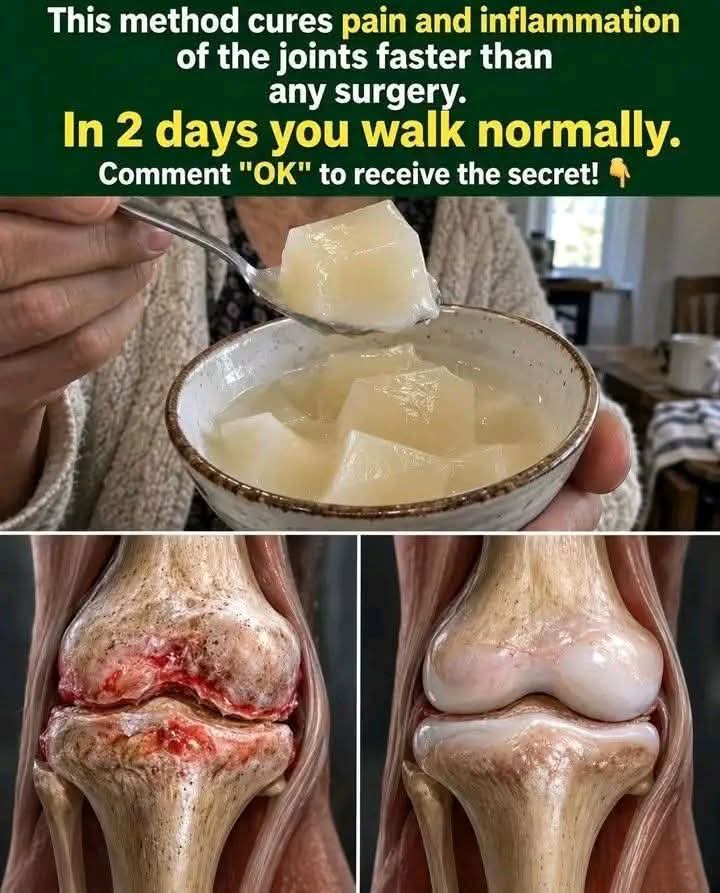
A viral image circulating online claims that a simple food shown in the photograph can “cure pain and inflammation of the joints faster than any surgery” and that people will “walk normally” within two days. The picture shows translucent gelatin-like cubes in a bowl alongside illustrations of a damaged and apparently healthy knee joint.
The message is attractive because joint pain is extremely common, especially in the knees, hips, hands, and other weight-bearing joints. Many people naturally look for foods, drinks, supplements, and home remedies that might make movement easier. Gelatin and collagen are also interesting because collagen is an important structural protein found in connective tissues.
However, an important distinction needs to be made between a food that may be part of a healthy diet, a supplement that might modestly affect symptoms, and a treatment that can cure a joint disease.
Current evidence does not support the claim that eating gelatin can cure arthritis in two days, restore damaged cartilage, or work faster than joint-replacement surgery. Osteoarthritis is a chronic condition, and established medical guidance focuses on exercise, weight management when appropriate, physical therapy, pain-management strategies, medications when needed, and—in severe cases—surgery.
That does not mean collagen or gelatin is useless. Research into collagen-derived products has produced some encouraging findings, particularly regarding pain and function in osteoarthritis. A 2024 meta-analysis of 35 randomized controlled trials involving more than 3,000 participants found small-to-moderate improvements in pain and function with collagen derivatives compared with controls. But these findings should not be confused with a rapid cure.
This article explains what the viral image is showing, what gelatin actually contains, what research says about collagen and joint health, how osteoarthritis develops, and which approaches have stronger evidence for managing joint pain.
Understanding the Viral Joint-Pain Claim
The image makes several dramatic claims:
- A particular method supposedly cures joint pain.
- It supposedly eliminates inflammation.
- It is allegedly faster than surgery.
- It promises normal walking in only two days.
- It implies that a simple food can reverse visible joint damage.
These statements go far beyond what clinical research demonstrates.
A person can sometimes experience noticeable improvement in joint pain over a short period, particularly when inflammation or overuse is reduced. But improvement in symptoms is not the same thing as repairing damaged cartilage or curing arthritis.
Osteoarthritis involves changes to cartilage, bone, the joint lining, muscles, and other tissues. It develops over time and can cause pain, stiffness, swelling, reduced movement, and difficulty performing everyday activities.
The CDC notes that osteoarthritis has no cure, although there are proven ways to manage symptoms and improve function. These include physical activity, maintaining a healthy weight, protecting joints, self-management, physical therapy, medications, supportive devices, and, in some cases, joint replacement.
Therefore, readers should be particularly cautious whenever an online post promises that arthritis will disappear within 24 or 48 hours.
What Is Gelatin?
Gelatin is a protein-rich substance produced by processing collagen, which is naturally present in animal connective tissues.
It is commonly used in:
- desserts
- jellies
- marshmallows
- gummy foods
- certain capsules
- cooking
- food manufacturing
When mixed with water, gelatin can form a soft or firm gel.
Because collagen is an important structural protein in the body, researchers have investigated whether consuming collagen-derived products could influence joint symptoms.
This is where some of the confusion surrounding viral health posts begins.
Gelatin contains collagen-derived proteins, but eating gelatin does not mean that the gelatin travels directly to a damaged knee and rebuilds cartilage.
During digestion, proteins are broken down into smaller components, including amino acids and peptides. The body then uses these building blocks according to its physiological needs.
So the simplistic idea that “eat gelatin → gelatin goes to the knee → damaged cartilage becomes normal” is not an accurate description of human biology.
Gelatin and Collagen Are Related but Not Identical
The words “gelatin” and “collagen” are sometimes used interchangeably online, but they are not exactly the same.
Collagen is a structural protein naturally found throughout the body.
Gelatin is produced from collagen through processing.
Collagen supplements can also contain hydrolyzed collagen, sometimes called collagen peptides. These products are processed so that the collagen is broken into smaller peptide fragments.
Research has examined several different collagen-related products, including:
- gelatin
- hydrolyzed collagen
- collagen peptides
- undenatured collagen
Because these substances are different, research involving one type cannot automatically be applied to every gelatin recipe or food.
This is an important point when interpreting social-media claims.
What Does the Research Say About Collagen and Osteoarthritis?
There is legitimate scientific research investigating collagen supplementation and osteoarthritis.
A 2019 meta-analysis examined randomized placebo-controlled trials involving collagen supplementation. The researchers reported improvements in some overall osteoarthritis symptom measures, although the results for individual pain and functional outcomes were not consistently significant.
More recent research has been encouraging.
A 2024 trial-sequential meta-analysis included 35 randomized controlled trials involving 3,165 participants. The researchers found that collagen derivatives were associated with small-to-moderate improvements in pain and function compared with control treatments. They also reported that collagen derivatives did not increase adverse events compared with controls.
Another systematic review and meta-analysis published in 2025 examined 11 randomized controlled trials involving 870 participants with knee osteoarthritis. It reported improvements in pain and function among participants receiving oral collagen-based supplementation.
These findings are worth knowing—but they need to be interpreted carefully.
The research suggests that certain collagen products may help some people manage osteoarthritis symptoms.
It does not establish that:
- ordinary gelatin cures arthritis
- gelatin repairs severely destroyed cartilage
- gelatin eliminates inflammation in two days
- gelatin replaces surgery
- everyone with arthritis will respond
- people can stop prescribed treatment and use gelatin instead
The difference between “may provide symptom relief” and “cures the disease” is enormous.
Can Gelatin Repair Damaged Cartilage?
This is one of the most important questions raised by the picture.
Cartilage is a specialized tissue that helps bones move smoothly against each other. In osteoarthritis, cartilage can become damaged and the joint can undergo additional structural changes.
Eating a protein does not mean that the protein becomes the same tissue in the exact location where it was consumed.
Your digestive system breaks dietary proteins down before the resulting amino acids and peptides are absorbed and used.
Some collagen research suggests that collagen-derived supplements could influence joint symptoms, but that is very different from proving that a bowl of gelatin rebuilds a severely damaged knee.
There is currently no good evidence that the particular gelatin food shown in the viral image can transform an arthritic knee from the “damaged” illustration into the “normal” illustration within two days.
Why Joint Pain Can Improve Without the Joint Being “Cured”
Pain and structural damage are not always perfectly correlated.
A person can have significant joint changes on imaging but experience relatively little pain at a particular moment. Another person may experience considerable pain despite less obvious structural damage.
Pain can also change because of:
- activity levels
- inflammation
- muscle tension
- sleep
- stress
- body weight
- previous injuries
- physical conditioning
- other medical conditions
This explains why someone might eat a particular food and later feel better without that food having repaired the joint.
Improvement is real, but the explanation may be more complicated than the viral post suggests.
What Is Osteoarthritis?
Osteoarthritis is one of the most common forms of arthritis.
It commonly affects:
- knees
- hips
- hands
- spine
- other joints
Symptoms can include:
- joint pain
- stiffness
- reduced range of motion
- swelling
- tenderness
- difficulty walking
- difficulty climbing stairs
- discomfort after prolonged activity
The condition develops through interactions between several structures in and around a joint rather than simply being a problem of “worn-out cartilage.”
Risk factors can include age, previous joint injury, repeated joint stress, genetics, and excess body weight.
A proper diagnosis is important because not every painful joint has osteoarthritis.
Other conditions can cause joint pain, including inflammatory arthritis, gout, bursitis, tendon problems, infections, and injuries.
Why Weight Matters for Knee Health
The knees carry substantial loads during daily activities.
When someone has overweight or obesity, reducing body weight can decrease mechanical stress on weight-bearing joints.
The American College of Rheumatology and Arthritis Foundation strongly recommend weight loss for people with knee or hip osteoarthritis who are overweight or obese. Their guideline notes that benefits can increase with greater amounts of weight loss and that combining weight loss with exercise can enhance symptom improvement.
This does not mean someone should pursue rapid or extreme dieting.
A sustainable approach is generally more appropriate, particularly when weight loss is being used to support joint health.
Exercise Is One of the Most Important Treatments
People with painful knees sometimes become afraid of movement.
It is understandable to think:
“My knee hurts, so I should stop using it.”
But prolonged inactivity can weaken the muscles supporting the joint.
Evidence-based osteoarthritis care places substantial emphasis on physical activity and exercise.
The National Institute of Arthritis and Musculoskeletal and Skin Diseases explains that exercise can reduce pain and stiffness while improving flexibility, muscle strength, and endurance. Suggested activities can include walking, cycling, swimming, water exercise, stretching, strengthening, and other low-impact activities.
The American College of Rheumatology/Arthritis Foundation guideline also strongly recommends exercise for osteoarthritis of the knee, hip, and hand.
The ideal exercise program depends on the person’s condition.
Someone with severe pain, major instability, recent injury, or another medical problem may need guidance from a physician or physical therapist.
Gentle Movement for Stiff Joints
For many people with osteoarthritis, gentle movement can be more comfortable than high-impact exercise.
Examples can include:
Walking
Walking can help maintain mobility and general fitness.
Swimming
Water supports some of the body’s weight and can make movement easier.
Water aerobics
Warm-water exercise can combine movement and strengthening while reducing joint loading.
Cycling
Stationary cycling can provide lower-impact movement for some people with knee problems.
Range-of-motion exercises
Gentle movements can help maintain joint mobility.
Strength training
Strengthening muscles around a painful joint can improve support and function.
Exercise should be increased gradually rather than suddenly.
The Importance of Physical Therapy
Physical therapists can help people choose exercises appropriate for their condition.
A personalized program may include:
- strengthening
- stretching
- balance work
- walking technique
- mobility exercises
- functional movements
- advice about activity levels
This can be especially useful when pain makes it difficult to know how much activity is appropriate.
The goal is not simply to “exercise harder.”
The goal is to improve strength, movement, confidence, and daily function safely.
Can Food Support Healthy Joints?
Food cannot be expected to cure advanced arthritis, but nutrition can contribute to overall health.
A balanced eating pattern can provide:
- protein
- vitamins
- minerals
- fiber
- healthy fats
- antioxidants
- adequate energy
Protein is particularly important because muscles support joints.
Foods commonly included in a balanced diet include:
- fish
- eggs
- beans
- lentils
- vegetables
- fruits
- whole grains
- nuts
- seeds
- yogurt and other nutrient-rich foods
Gelatin can also be eaten as part of a normal diet.
However, a gelatin dessert containing large amounts of added sugar should not automatically be considered a therapeutic joint treatment.
A Simple Gelatin Recipe
If you enjoy gelatin, you can prepare it as a normal food rather than treating it as a cure.
Ingredients
- 1 tablespoon unflavored gelatin
- ½ cup cool water
- 1½ cups warm water
- Optional: a small amount of fruit
- Optional: a modest amount of honey or another sweetener
Instructions
- Place the gelatin in the cool water.
- Allow it to sit for several minutes so it can hydrate.
- Add the warm water.
- Stir until the gelatin dissolves.
- Add fruit if desired.
- Pour the mixture into a container.
- Refrigerate until firm.
- Serve chilled.
This can be a convenient protein-containing food, but it should not be presented as a medical treatment for arthritis.
What About Bone Broth?
Bone broth is another food frequently promoted online for joint health.
Bone broth can contain collagen-derived proteins and other nutrients, depending on how it is prepared.
However, the nutritional composition can vary significantly between recipes and commercial products.
Bone broth should be considered a food rather than a proven treatment for osteoarthritis.
If someone enjoys it, it can fit into a balanced diet, but it should not replace appropriate medical care.
When Pain Requires Medical Attention
Not every painful joint should be treated at home.
Medical evaluation is especially important when joint pain is:
- severe
- persistent
- rapidly worsening
- associated with significant swelling
- associated with redness or warmth
- accompanied by fever
- caused by an injury
- associated with inability to bear weight
- associated with major loss of movement
Sudden severe joint pain with redness, swelling, or fever can have causes that require prompt medical attention.
A healthcare professional can determine whether the problem is osteoarthritis or something else.
What Treatments Are Available for Osteoarthritis?
Treatment depends on the individual.
Medical management can include several approaches.
Exercise
Exercise is one of the central components of osteoarthritis management.
Weight management
For people with overweight or obesity and knee or hip osteoarthritis, weight loss can reduce symptoms and improve function.
Physical therapy
Physical therapists can create individualized exercise and movement programs.
Pain-relieving medicines
Depending on the person and their medical history, healthcare professionals may recommend topical or oral medications.
The American College of Rheumatology/Arthritis Foundation guideline includes topical and oral nonsteroidal anti-inflammatory drugs among recommended options for certain forms of osteoarthritis.
However, medications are not appropriate for everyone, and some can have important side effects or interactions.
Injections
Some patients may receive injections into a joint as part of symptom management.
Assistive devices
Canes, braces, orthotics, and other supportive devices may sometimes improve mobility or reduce stress on a joint.
Surgery
For advanced disease that causes substantial pain and disability despite appropriate nonsurgical treatment, joint replacement may be considered.
The CDC lists joint replacement as one of the medical options that may be used when other treatments have not worked.
Why the “Faster Than Surgery” Claim Is Misleading
Surgery and dietary approaches are not equivalent treatments.
Joint replacement involves physically removing damaged joint surfaces and replacing them with artificial components. It is a major medical procedure performed for appropriately selected patients.
A food cannot reasonably be compared with joint replacement as though both perform the same biological function.
If a joint is severely damaged, eating gelatin does not mechanically replace the damaged surfaces.
This is why dramatic statements such as “faster than any surgery” should be viewed critically.
They may attract attention online, but they do not provide a reliable basis for medical decision-making.
Can Collagen Supplements Be Considered?
The research on collagen is more nuanced than the viral claim.
Recent evidence suggests collagen derivatives may provide modest improvements in pain and function for some people with osteoarthritis.
That means collagen supplementation is an area of legitimate scientific interest.
However, several questions remain important:
- What type of collagen was used?
- What dose was studied?
- How long was it taken?
- Were participants diagnosed with a particular type of osteoarthritis?
- Was the product tested against placebo?
- How large was the improvement?
- Was the study independently funded?
- Did participants have side effects?
These questions matter because a supplement used in a clinical trial is not necessarily equivalent to an ordinary homemade gelatin recipe.
Possible Limitations of Collagen Products
Although the 2024 meta-analysis found collagen derivatives generally safe compared with controls, individual products can vary.
People should consider:
- allergies
- dietary restrictions
- source of collagen
- added ingredients
- sugar content
- interactions with individual medical conditions
- product quality
Anyone taking medication or managing a chronic disease should discuss supplements with a healthcare professional before making significant changes.
Why Two Days Is an Unrealistic Promise
One of the strongest warning signs in the image is the promise of normal walking in two days.
Some types of pain can improve quickly.
For example, reducing an irritating activity or treating an acute minor problem may produce rapid symptom relief.
But chronic osteoarthritis is different.
Joint degeneration develops over time, and treatment generally focuses on managing symptoms, maintaining mobility, improving strength, and preserving quality of life.
A two-day deadline is therefore not a realistic general expectation for someone with established osteoarthritis.
If someone experiences dramatic improvement after trying a food for two days, that improvement should not automatically be interpreted as proof that cartilage has been repaired.
The Difference Between Symptom Relief and Disease Modification
This distinction is extremely important.
Symptom relief
Means a person experiences:
- less pain
- less stiffness
- easier movement
- improved daily function
Disease modification
Would mean changing the underlying progression or structure of the disease.
A treatment can potentially improve symptoms without reversing the underlying structural changes.
This is why scientific studies measure multiple outcomes.
A supplement that produces a modest improvement in pain should not automatically be advertised as a cure.
How to Evaluate Viral Health Claims
Before trying a remedy promoted on social media, ask several questions.
What exactly is being claimed?
Is it saying:
- “may help”?
- “reduces symptoms”?
- “cures”?
- “rebuilds cartilage”?
- “works in two days”?
The stronger the claim, the stronger the evidence should be.
Is there a clinical study?
Look for randomized controlled trials rather than testimonials.
Is the study actually about the same product?
A study on collagen peptides does not automatically prove that a homemade gelatin dessert has the same effects.
How many people were studied?
A small study can produce interesting findings but may not provide definitive evidence.
Was there a placebo group?
Controlled studies are particularly important when the outcome is subjective, such as pain.
Can the claim be independently verified?
Reliable medical organizations and peer-reviewed research are more useful than anonymous social-media posts.
A Practical Joint-Health Routine
A sensible approach to long-term joint health can include several components.
Morning
Begin with gentle movement rather than suddenly demanding intense activity from stiff joints.
A short walk or mobility routine may help.
During the Day
Avoid sitting completely still for very long periods.
Regular movement can help maintain mobility.
Exercise
Include appropriate strengthening and low-impact aerobic activity.
If pain or mobility problems are significant, consider professional guidance.
Nutrition
Eat a balanced diet containing sufficient protein, vegetables, fruit, whole grains, and other nutrient-rich foods.
Gelatin can be included if you enjoy it.
Weight Management
If excess weight contributes to knee or hip symptoms, gradual weight management can be an important part of treatment.
Sleep
Adequate sleep is important for general health and may influence how people experience pain.
Medical Follow-Up
Persistent or worsening joint pain deserves proper evaluation rather than relying exclusively on internet remedies.
Benefits of Including Gelatin in the Diet
Gelatin can still have legitimate nutritional uses.
It can:
- provide protein
- add texture to foods
- be used in desserts
- help create convenient snacks
- contribute collagen-derived amino acids and peptides
However, the amount and nutritional quality depend on the recipe.
A gelatin dessert containing large amounts of sugar should not be considered equivalent to a clinical collagen supplement.
What Gelatin Cannot Reliably Do
Based on the evidence available, gelatin should not be promoted as something that can:
- cure osteoarthritis
- rebuild severely damaged cartilage in two days
- guarantee normal walking
- replace joint replacement surgery
- eliminate all joint inflammation
- work for every person with joint pain
- allow people to discontinue prescribed treatment
These claims go beyond the available evidence.
Conclusion
The gelatin shown in the viral image is a real food containing collagen-derived protein, and research into collagen supplementation and osteoarthritis is legitimate. Recent systematic reviews and meta-analyses have reported that some collagen derivatives may produce modest improvements in pain and physical function.
But the viral claim that a simple gelatin preparation can cure joint pain and inflammation faster than surgery, with normal walking in only two days, is not supported by established medical evidence.
Osteoarthritis is a complex chronic condition. Effective management commonly involves exercise, physical activity, weight management when appropriate, education, physical therapy, pain-management strategies, and sometimes medications, injections, supportive devices, or surgery.
Gelatin can certainly be enjoyed as part of a balanced diet. Collagen supplementation may also be worth discussing with a healthcare professional for someone interested in the available evidence. But it should be viewed as a possible nutritional or supplemental approach—not as a miracle cure.
The most useful lesson from the viral picture is therefore not to ignore gelatin, but to understand the difference between promising research, symptom management, and a proven cure.
Final Takeaway for Readers
If you have joint pain, you do not necessarily need to avoid gelatin. You can include it in a balanced diet if you enjoy it.
But don’t stop prescribed treatment because an online post promises that gelatin will repair your joints in 48 hours.
For persistent knee, hip, hand, or other joint pain, getting the correct diagnosis is the first step. Once the cause is known, an appropriate combination of movement, strengthening, weight management when relevant, pain control, physical therapy, and medical treatment can be considered.
Gelatin may be food. Collagen may have potential benefits. Neither should be presented as a guaranteed two-day cure for arthritis.