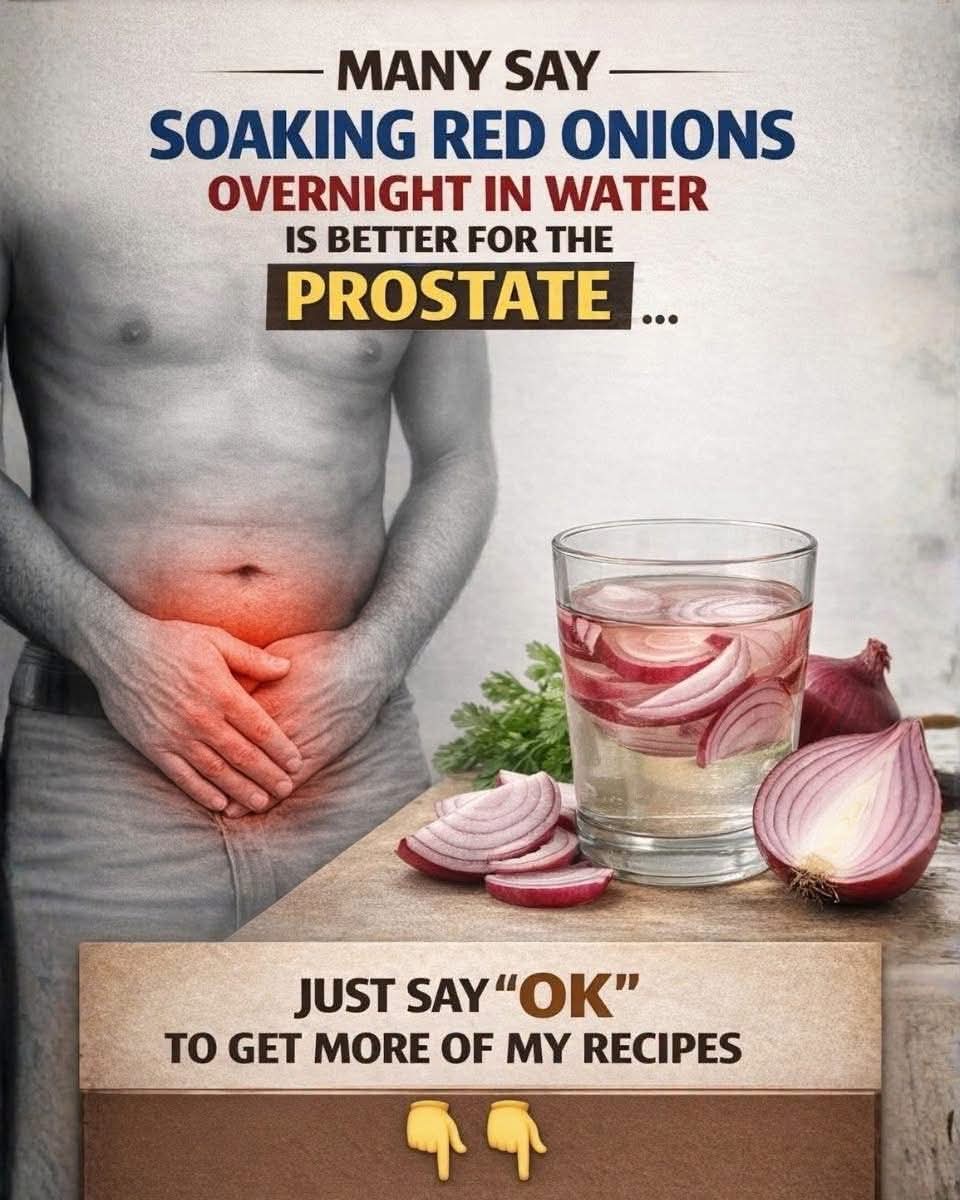
Soaking Red Onions Overnight in Water for Prostate Health: Benefits, Recipe, Nutrition, and What Science Really Says
The idea of soaking red onions overnight in water and drinking the resulting liquid has become popular online, especially in posts claiming that it can support prostate health. The image accompanying this topic suggests that overnight-soaked red onions may be “better for the prostate.” Red onions are certainly nutritious and contain interesting plant compounds, including quercetin and sulfur-containing compounds. However, the specific claim that red onion water soaked overnight is a proven treatment or special remedy for prostate problems is not established by clinical research.
That distinction is important. A food can be nutritious without being a treatment for a medical condition.
Onions are members of the Allium family, along with garlic, leeks, shallots, and chives. Research has investigated Allium vegetables and their compounds in relation to inflammation, oxidative stress, cardiovascular health, and cancer. Quercetin, a flavonoid found in onions, has also been studied extensively in laboratory and clinical research involving prostate conditions.
At the same time, studies specifically examining onion consumption and prostate cancer have produced mixed results. One systematic review found an association between higher overall Allium vegetable intake and lower prostate cancer risk, but the onion-specific association was not statistically significant. Another systematic review of fruit and vegetable consumption found no significant overall relationship between vegetable intake and prostate cancer risk.
So, where does that leave red onion water?
It can be viewed as a simple food-based drink that some people may enjoy, but it should not replace medical evaluation, prescribed treatment, or appropriate prostate screening.
Introduction
The prostate is a small gland found below the bladder in men. It surrounds part of the urethra and plays an important role in the reproductive system. As men age, prostate-related concerns become increasingly common. Some men experience benign prostatic hyperplasia, commonly called BPH, while others may develop prostatitis or prostate cancer.
Symptoms such as frequent urination, difficulty starting urination, weak urine flow, getting up several times during the night to urinate, or feeling that the bladder has not completely emptied can have several possible causes.
This is one reason natural remedies should be approached carefully.
If a person notices urinary changes, it is better to determine the cause rather than simply assume that the prostate is enlarged. NIDDK explains that prostate problems can include BPH, prostatitis, and prostate cancer, with treatment depending on the specific condition.
Red onions can absolutely be part of a healthy diet. They provide plant compounds and nutrients, and their strong color comes partly from naturally occurring pigments and polyphenols.
The popular overnight soaking method involves slicing red onion, placing it in water, leaving it covered for several hours or overnight, and then drinking the water. The question is whether soaking creates a special prostate medicine.
At present, there is not good clinical evidence showing that overnight red onion water treats an enlarged prostate, prostatitis, or prostate cancer.
What Is Red Onion Water?
Red onion water is simply water in which pieces or slices of red onion have been soaked.
A typical homemade preparation might contain:
- Red onion
- Clean drinking water
- A covered glass or jar
- Refrigeration during the soaking period
Some recipes recommend soaking the onion overnight and drinking the liquid the following morning. Others add lemon, ginger, honey, or other ingredients.
The important point is that this preparation should be considered a food or traditional home preparation, not a medically proven prostate treatment.
When onion is placed in water, some water-soluble compounds may move into the liquid. However, the amount and type of compounds transferred depend on factors such as the onion variety, amount of onion, temperature, soaking time, cutting method, and storage conditions.
There is therefore no scientifically established “correct” overnight soaking time that guarantees a particular prostate benefit.
Why Are Red Onions Interesting?
Red onions contain several biologically active compounds.
Among the most studied is quercetin, a flavonoid found in onions and other plant foods. Reviews of onion chemistry describe onions as sources of phenolic compounds, organosulfur compounds, quercetin, and quercetin glycosides.
Quercetin has attracted attention because laboratory experiments suggest antioxidant and anti-inflammatory activities. Researchers have also investigated its effects on prostate cells and prostate-related inflammatory processes.
However, there is an important difference between:
“This compound affects cells in a laboratory study”
and
“Eating this food cures a disease in humans.”
The second claim requires clinical evidence.
Reviews of quercetin and prostate cancer describe promising laboratory and experimental findings, but they also emphasize issues such as bioavailability and the need for further research.
Therefore, red onions are interesting from a nutritional and research perspective, but they should not be marketed as a cure for prostate disease.
Red Onion and Prostate Health
1. Antioxidant Compounds
Red onions contain plant compounds with antioxidant activity.
Oxidative stress occurs when reactive molecules overwhelm the body’s antioxidant defenses. Scientists have investigated oxidative stress in many chronic diseases, including conditions affecting the urinary and reproductive systems.
Eating a variety of vegetables supplies many different compounds that contribute to an overall nutritious diet.
However, drinking onion water is not the same thing as receiving a clinically established antioxidant treatment.
2. Quercetin
Quercetin is probably the compound most frequently discussed when onions and prostate health are mentioned together.
Research has examined quercetin in prostate cancer cells and in inflammatory prostate conditions. A review of nutraceuticals in prostate disease describes preliminary research involving quercetin and chronic prostatitis symptoms.
Another review describes quercetin as a compound found in foods including onions and discusses its potential biological effects in prostate cancer research.
But these findings do not establish that red onion water can prevent or cure prostate cancer.
3. Possible Anti-Inflammatory Properties
Some onion compounds have been studied for their effects on inflammatory pathways.
Inflammation can be involved in numerous conditions, and chronic prostatitis is one prostate-related disorder in which inflammation and pain may be important.
There has been clinical research involving concentrated quercetin supplements in men with chronic prostatitis symptoms. That research should not be interpreted as evidence that ordinary onion water produces the same dose or effect.
A supplement containing a measured amount of quercetin is very different from water in which a sliced onion has been soaked.
Does Red Onion Water Treat an Enlarged Prostate?
There is currently no strong clinical evidence demonstrating that overnight-soaked red onion water can shrink an enlarged prostate.
BPH is extremely common as men age. Symptoms can include:
- Frequent urination
- Urgency
- Weak urine stream
- Difficulty beginning urination
- Dribbling
- Feeling that the bladder has not emptied
- Waking at night to urinate
NIDDK notes that treatment for BPH may include watchful waiting, lifestyle changes, medicines, or surgery depending on the person’s situation.
A person with significant urinary symptoms should therefore not rely exclusively on onion water.
If symptoms are mild, a doctor may discuss lifestyle measures. If symptoms are severe or worsening, medical assessment becomes particularly important.
Does It Prevent Prostate Cancer?
This is another area where online claims can go too far.
Researchers have studied Allium vegetables, including onions and garlic, in relation to prostate cancer.
A 2013 systematic review involving more than 132,000 subjects found an association between higher Allium vegetable intake and lower prostate cancer risk overall. However, when the researchers examined onions separately, the association was not statistically significant.
This means the evidence cannot support the statement:
“Eating or drinking red onion water prevents prostate cancer.”
There is also no established evidence that overnight soaking concentrates onion compounds sufficiently to provide cancer prevention.
A healthy diet may contribute to overall health, but no single food or homemade drink should be presented as protection against cancer.
How to Make Red Onion Water
If you enjoy trying this preparation as a food-based drink, the recipe is simple.
Ingredients
- ½ medium red onion
- 1 cup to 2 cups clean drinking water
- Optional: a small squeeze of lemon for flavor
Instructions
- Wash the red onion thoroughly.
- Peel away the outer dry skin.
- Slice the onion into thin pieces.
- Place the slices in a clean glass or covered container.
- Add the drinking water.
- Cover the container.
- Refrigerate it overnight.
- The next morning, strain the water.
- Drink it if you enjoy the flavor and tolerate onion well.
- Discard the soaked onion or use it in food rather than keeping it for several days.
The preparation should be kept refrigerated rather than left sitting at room temperature overnight.
A Better Way to Eat Red Onion
If the goal is nutrition, there is no clear reason to believe that removing the onion and drinking only the soaking water is superior to eating the onion itself.
Whole red onions provide fiber and a broader range of nutrients and plant compounds than plain soaking water.
You can include red onions in:
- Salads
- Tomato salads
- Bean salads
- Lentil dishes
- Vegetable soups
- Omelets
- Sandwiches
- Wraps
- Grain bowls
- Homemade salsa
- Roasted vegetables
- Mediterranean-style meals
This approach also makes it easier to consume onions as part of an overall healthy dietary pattern.
Raw Red Onion vs. Soaked Red Onion
There are several practical differences.
Raw red onion
Raw onion provides its naturally occurring compounds along with fiber and other nutrients. It also has a strong flavor and may cause digestive discomfort in some people.
Soaked red onion
Soaking may soften the onion and reduce some of its sharpness. Some compounds may enter the water, but the amount is variable.
Cooked red onion
Cooking changes the chemical composition of vegetables. Some compounds can decrease with heat, while others may become more available depending on the cooking method.
There is no strong evidence establishing overnight-soaked red onion as the superior preparation for prostate health.
Nutrition and Red Onions
Red onions are generally a low-calorie vegetable and can contribute to a balanced diet.
They contain:
- Water
- Carbohydrates
- Dietary fiber
- Small amounts of protein
- Vitamin C
- Folate
- Potassium
- Various phytochemicals
- Flavonoids such as quercetin
- Sulfur-containing compounds
The exact nutritional content varies according to the size and variety of the onion.
One major advantage of eating the onion rather than only drinking the soaking water is the fiber. Fiber supports digestive health and can help make meals more satisfying.
The Role of a Healthy Diet in Prostate Health
Prostate health should not be reduced to one ingredient.
A 2025 systematic review of dietary patterns and prostate cancer included 63 studies and found that healthy dietary patterns, including plant-based and lower-inflammatory patterns, were generally associated with lower total prostate cancer risk in men without prostate cancer. Among men with prostate cancer, Mediterranean, plant-based, and lower-inflammatory patterns were more consistently associated with lower risks of progression and prostate cancer-specific mortality, although randomized trials of dietary patterns produced mixed findings and the researchers noted important limitations.
This is a much broader concept than drinking onion water.
A balanced eating pattern can include:
- Vegetables
- Fruits
- Beans
- Lentils
- Whole grains
- Nuts and seeds
- Fish
- Healthy fats
- Moderate portions of lean protein
Red onion can easily fit into such a pattern.
Other Foods Commonly Included in a Prostate-Friendly Diet
Instead of focusing on one homemade drink, consider variety.
Tomatoes
Tomatoes provide lycopene, a carotenoid that has been investigated extensively in relation to prostate health.
Cruciferous vegetables
Broccoli, cabbage, cauliflower, kale, and similar vegetables contain several phytochemicals. A 2023 systematic review and meta-analysis reported an association between higher cruciferous vegetable consumption and lower prostate cancer risk, although observational evidence cannot prove causation.
Beans and lentils
These provide plant protein and dietary fiber.
Nuts and seeds
They can provide healthy fats, minerals, and other nutrients.
Fish
Fatty fish provide omega-3 fatty acids and can fit into a balanced dietary pattern.
Berries
Berries provide fiber and polyphenols.
The important concept is dietary variety, rather than searching for a single “miracle” ingredient.
Red Onion Water and Urination
Some people may report that onion water makes them urinate more frequently.
This does not automatically mean that the drink is “cleansing the prostate.”
Urination is controlled by fluid intake, kidney function, bladder function, hormones, medications, and many other factors.
If someone suddenly develops frequent urination, urgency, pain, burning, blood in the urine, or difficulty passing urine, the symptom deserves attention rather than being interpreted as a detox effect.
When Prostate Symptoms Should Not Be Ignored
Natural drinks may be harmless for many people, but urinary symptoms can sometimes signal a condition that needs treatment.
Contact a healthcare professional if you experience persistent:
- Difficulty urinating
- Weak or interrupted urine flow
- Frequent nighttime urination
- Painful urination
- Pelvic discomfort
- Blood in the urine
- Blood in semen
- Persistent pelvic pain
- Sudden worsening of urinary symptoms
NIDDK emphasizes that prostate problems have different causes and treatments, which is why identifying the underlying condition matters.
Inability to urinate at all can require urgent medical attention.
Red Onion Water Is Not a Replacement for Prostate Evaluation
One of the biggest problems with viral health posts is that they can make a simple food appear to replace medical care.
For example, a person may have urinary symptoms caused by BPH but assume the symptoms are normal aging. Another person may have prostatitis and delay treatment because they believe a homemade drink will remove the inflammation.
Still another person may have an elevated PSA level and assume that a dietary remedy can make the issue disappear.
PSA interpretation also requires medical context. An elevated PSA can occur with prostate cancer, but it can also occur with conditions such as an enlarged prostate and prostatitis.
Therefore, diet and medical care should not be treated as competing choices.
A healthy diet can complement appropriate healthcare.
Prostate Cancer Screening
Prostate cancer screening is an individual medical decision rather than something that can be replaced with a food or drink.
The U.S. Preventive Services Task Force recommends that men aged 55 to 69 discuss the potential benefits and harms of PSA-based screening with a clinician and make an individual decision. For men aged 70 and older, it recommends against routine PSA-based screening.
These recommendations apply to the U.S. population and should not be automatically treated as the only screening guidance in every country.
Age, family history, previous test results, symptoms, and individual risk factors can influence medical decisions.
The important message is that a person should not assume that a healthy food makes screening or medical assessment unnecessary.
Possible Benefits of Including Red Onion in Your Diet
Even though red onion water is not a proven prostate treatment, red onion itself can still be a useful food.
1. Adds flavor
Red onion can make healthy meals more enjoyable without requiring large amounts of added fat or salt.
2. Provides plant compounds
Onions contain quercetin and other phytochemicals.
3. Provides fiber
Eating the onion supplies dietary fiber that is largely absent from strained onion water.
4. Supports dietary variety
Eating many different vegetables exposes the body to a wide range of nutrients and plant compounds.
5. Easy to use
Red onions can be eaten raw, cooked, grilled, roasted, or incorporated into salads and other dishes.
Who Should Be Careful With Red Onion Water?
Most people can eat onions safely as part of a normal diet, but onions can cause digestive symptoms in some individuals.
People with sensitive digestion may experience:
- Gas
- Bloating
- Abdominal discomfort
- Heartburn
- Changes in bowel habits
The response varies from person to person.
If red onion consistently causes digestive symptoms, drinking concentrated onion water may not be comfortable either.
People taking medications or managing a medical condition should also avoid assuming that a food remedy is automatically appropriate simply because it is natural.
Common Myths About Overnight Red Onion Water
Myth 1: “It flushes the prostate.”
There is no established medical concept in which drinking onion water “flushes” the prostate.
The prostate is not an organ that needs to be flushed with a special drink.
Myth 2: “It shrinks an enlarged prostate.”
There is insufficient clinical evidence that overnight red onion water reduces prostate size.
Myth 3: “It prevents prostate cancer.”
Research into onions and Allium vegetables is interesting, but it does not establish onion water as a cancer-prevention treatment.
Myth 4: “The longer you soak it, the stronger the medicine.”
There is no established clinical formula showing that longer soaking produces a more effective prostate remedy.
Myth 5: “Natural means risk-free.”
Natural foods can still cause digestive problems, allergies, or interactions in certain circumstances.
How to Make This Drink More Enjoyable
If you want to try red onion water simply as a food preparation, flavor can be improved without turning it into a supposed medical treatment.
You can add:
- A small amount of lemon
- Fresh mint
- Cucumber
- A few slices of ginger
However, adding ingredients does not make the drink a proven prostate treatment.
For many people, an easier option is simply to use red onion in meals.
A fresh salad containing tomato, cucumber, parsley, red onion, olive oil, and lemon is a much more substantial nutritional choice than drinking strained onion water alone.
A Simple Red Onion Salad for Everyday Nutrition
Ingredients
- 1 small red onion
- 2 tomatoes
- 1 cucumber
- Fresh parsley
- 1 tablespoon olive oil
- Lemon juice
- A small amount of salt, if desired
Method
Slice the red onion thinly and chop the tomatoes and cucumber. Add fresh parsley. Mix everything together with olive oil and lemon juice.
This provides a variety of vegetables rather than relying on one ingredient.
The salad can be served alongside beans, lentils, grilled fish, chicken, or whole grains.
Formation: How the Popular Remedy Became So Common
The idea of soaking vegetables, fruits, herbs, or spices in water is not new.
Traditional food cultures have long used infused waters and herbal preparations. Modern social media has expanded these practices dramatically.
A short video or graphic can turn a traditional preparation into a strong health claim within a few seconds.
The image associated with this topic uses an emotionally powerful combination: red onions, a glass of water, and a person holding the lower abdomen. It presents the preparation as being “better for the prostate.”
The visual, however, is not scientific evidence.
Health claims should ideally be evaluated by asking:
- What exactly is being claimed?
- Has the preparation been tested in humans?
- Was the study randomized?
- How many people participated?
- Was the actual food or drink studied?
- Was the amount standardized?
- Were the results reproduced?
- Could another explanation account for the findings?
These questions help separate promising nutrition research from exaggerated social-media claims.
History of Onions
Onions have been cultivated and consumed for thousands of years.
The plant belongs to the Allium family, which includes garlic and other related vegetables. Onions have been valued historically not only as food but also in traditional medicine systems.
Modern science has investigated onion chemistry in much greater detail.
Researchers have identified numerous compounds, including sulfur-containing molecules and polyphenols such as quercetin. Reviews of Allium cepa describe a wide range of experimental research into antioxidant, anti-inflammatory, cardiovascular, metabolic, and other potential biological effects.
The existence of traditional uses does not automatically prove modern medical effectiveness, but it helps explain why onions continue to attract scientific interest.
What Science Really Supports
The most reasonable conclusion is relatively simple.
Red onions are nutritious foods that contain biologically active compounds.
Quercetin found in onions has been investigated in prostate-related research.
Some research involving Allium vegetables has found potentially interesting associations with prostate cancer risk.
But:
There is not sufficient clinical evidence to say that soaking red onions overnight in water is a treatment for prostate disease.
The distinction matters.
Research on quercetin supplements cannot automatically be transferred to onion water.
Laboratory research cannot automatically be transferred to humans.
Animal studies cannot automatically establish effectiveness in people.
Observational studies cannot prove that a food caused a reduction in disease risk.
And a viral image cannot substitute for clinical evidence.
Conclusion
Soaking red onions overnight in water is a simple traditional-style preparation that can be consumed by people who enjoy it and tolerate onions well. Red onions themselves are nutritious and contain compounds such as quercetin that researchers have studied for their antioxidant, anti-inflammatory, and potential prostate-related effects.
However, the popular claim that overnight red onion water is specifically “better for the prostate” goes beyond the available evidence.
There is currently no established clinical evidence showing that this drink can shrink an enlarged prostate, cure prostatitis, or prevent prostate cancer.
For prostate health, the bigger picture matters much more. A varied diet rich in vegetables, fruits, legumes, whole grains, nuts, seeds, and other minimally processed foods can support general health. Recent research on dietary patterns also suggests that overall healthy eating patterns may be more relevant than focusing on one particular food.
If you enjoy red onions, there is no need to avoid them. Use them in salads, soups, vegetable dishes, sandwiches, and other meals.
And if you are experiencing persistent urinary symptoms, pelvic pain, blood in the urine, or other prostate-related concerns, seek medical advice rather than depending on a homemade remedy.
Final Thoughts for Red Onion Lovers
Red onions deserve a place in the kitchen because they are flavorful, versatile, and naturally rich in plant compounds.
You can soak them in water if you enjoy the preparation, but you do not need to think of the resulting liquid as a prostate “cleanse.”
The healthiest approach is usually the simplest: eat a variety of nutritious foods, maintain healthy lifestyle habits, pay attention to persistent symptoms, and use medical care when it is needed.
The science surrounding onions and prostate health is interesting and continues to develop. Quercetin and other onion compounds remain subjects of laboratory and clinical research, but researchers have not established overnight red onion water as a medical treatment.
So, rather than promising a miracle cure, red onions can be appreciated for what they are: a nutritious vegetable that can be part of a balanced diet and a healthy lifestyle.
Important: This article is for general educational purposes and is not a diagnosis or treatment plan. Prostate symptoms can have different causes, and persistent or severe urinary symptoms should be evaluated by a qualified healthcare professional.