Swollen Prostate: Can Daily Oil Really Flatten an Enlarged Prostate in 6 Hours?
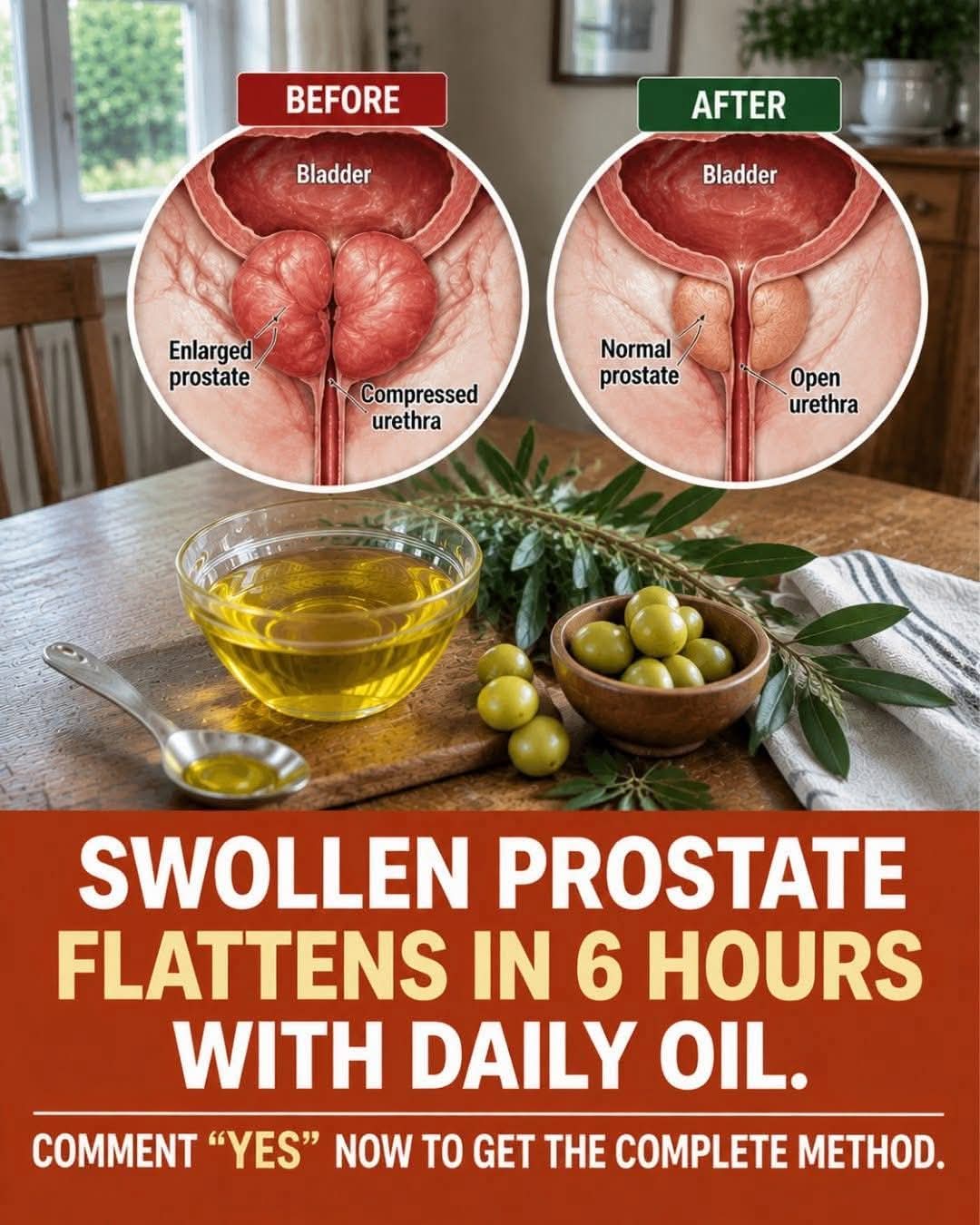
The image above makes a very dramatic promise: “Swollen prostate flattens in 6 hours with daily oil.” It shows a comparison between an enlarged prostate compressing the urethra and a smaller prostate with an apparently open urinary passage. The message is attractive because many men experience urinary symptoms and naturally look for simple, inexpensive solutions.
However, there is an important distinction between a healthy-food claim and a medical treatment claim. There is currently no reliable clinical evidence showing that drinking or taking an ordinary cooking oil can shrink an enlarged prostate and reopen the urethra within six hours. An enlarged prostate is a genuine medical condition, and persistent urinary symptoms deserve proper evaluation rather than relying on a social-media promise.
That does not mean that diet is irrelevant. A balanced diet, healthy weight, regular physical activity, adequate hydration, and sensible lifestyle habits can be valuable parts of overall men’s health. But these should not be confused with a treatment that rapidly reverses prostate enlargement.
This article explains what an enlarged prostate is, why it can affect urination, what the “daily oil” claim means, what foods may fit into a prostate-friendly diet, which treatments have actual medical evidence, and when urinary symptoms require urgent attention.
What Is an Enlarged Prostate?
The prostate is a small gland located below the bladder. It surrounds part of the urethra, the tube that carries urine from the bladder through the penis.
As some men get older, the prostate can gradually become larger. This condition is commonly called benign prostatic hyperplasia (BPH). The enlargement itself is not prostate cancer, although urinary symptoms should not automatically be assumed to be caused by BPH.
When prostate tissue enlarges around the urethra, it can contribute to difficulty passing urine. Men may notice a weaker stream, difficulty beginning urination, stopping and starting during urination, increased nighttime urination, urgency, or a feeling that the bladder has not completely emptied.
The important point is that prostate symptoms are not always simply a matter of prostate size. The bladder, prostate, urethra, pelvic muscles, medications, infections, and other conditions can contribute to lower urinary tract symptoms. The European Association of Urology emphasizes that these symptoms have multiple possible causes.
The “Flattens in 6 Hours” Claim
The most attention-grabbing part of the image is the statement that an enlarged prostate can “flatten in 6 hours.”
This should be treated with considerable skepticism.
There is no established medical treatment in which a spoonful of ordinary dietary oil reliably changes an enlarged prostate from the size shown on the “before” illustration to the “after” appearance within six hours.
Actual prostate-shrinking medications work over much longer periods. For example, medicines called 5-alpha-reductase inhibitors, including finasteride and dutasteride, can stop prostate growth and shrink the prostate in some men, but they are not six-hour treatments.
Other medications, such as alpha-blockers, can improve urinary symptoms by relaxing muscles around the bladder neck and prostate. They are intended to improve urine flow and symptoms rather than instantly remove prostate tissue.
Therefore, a rapid “before and after” prostate transformation shown in an online graphic should not be interpreted as proof that an oil has physically reduced prostate tissue.
What Might the Oil in the Picture Be?
The photograph appears to show a golden-colored oil together with green fruits and leaves. The image does not establish exactly what oil is being recommended, and the photograph itself is not scientific evidence.
If the intended ingredient is olive oil, it is certainly possible to include extra-virgin olive oil as part of a balanced eating pattern. Olive oil contains predominantly unsaturated fats and is widely used in Mediterranean-style diets.
But there is a major difference between saying:
“Olive oil can be part of a healthy diet.”
and saying:
“Olive oil will flatten an enlarged prostate in six hours.”
The first is a reasonable nutritional statement. The second is an unsupported medical claim.
A food can be nutritious without being a medication.
Can Olive Oil Be Part of a Prostate-Friendly Diet?
Yes.
Olive oil can be used as one source of dietary fat in a balanced diet. It can replace some sources of saturated fat, such as large amounts of butter or certain highly processed foods.
A healthy eating pattern generally emphasizes:
- Vegetables
- Fruits
- Whole grains
- Beans and lentils
- Nuts and seeds
- Fish and other nutritious protein sources
- Unsaturated fats such as olive oil
- Reasonable portions
- Limited highly processed foods
However, eating olive oil does not mean that a person can diagnose or treat BPH at home.
The purpose of a healthy diet is to support overall health rather than provide an instant mechanical solution to urethral obstruction.
Why Does an Enlarged Prostate Cause Urinary Problems?
Imagine the urethra as a tube passing through the prostate.
When prostate tissue grows around that tube, the outlet can become more restricted. The bladder then has to work harder to push urine through the narrowed passage.
This can produce symptoms such as:
1. Weak urine stream
Instead of a strong stream, urine may come out slowly.
2. Difficulty starting
A man may feel that he needs to urinate but have difficulty getting the stream started.
3. Stopping and starting
The stream may become intermittent.
4. Dribbling
A small amount of urine may continue to leak after urination.
5. Frequent urination
The person may need to visit the bathroom more frequently.
6. Nighttime urination
Some men with prostate-related urinary symptoms wake several times during the night.
7. Urgency
A strong, sudden need to urinate can occur.
8. Incomplete emptying
A person may finish urinating but still feel that urine remains in the bladder.
These symptoms are recognized features of prostate and lower urinary tract problems.
Is Every Enlarged Prostate Dangerous?
No.
Benign prostatic enlargement is common, especially with increasing age, and it is not itself prostate cancer. Some men have prostate enlargement with very mild symptoms and may not require immediate treatment.
The NHS explains that an enlarged prostate does not always require treatment; management depends largely on symptoms and how significantly they affect daily life.
Nevertheless, persistent urinary symptoms should not simply be ignored.
The goal is to determine what is causing the symptoms and whether treatment is appropriate.
What Doctors May Check
When a man has urinary symptoms, a healthcare professional may ask questions about:
- How often he urinates
- Whether he wakes at night
- Whether the stream is weak
- Whether starting is difficult
- Whether there is urgency
- Whether there is pain
- Whether blood is present in the urine
- Whether the bladder feels completely empty
- Current medicines
- Previous urinary problems
Depending on the situation, evaluation can include a physical examination, urine testing, blood testing such as PSA, and sometimes ultrasound or other urinary tests.
This is important because urinary symptoms can have several different causes.
Can Food Shrink the Prostate?
Food should not be described as a guaranteed prostate-shrinking treatment.
Nutrition can support general health, but a dietary ingredient should not be presented as a replacement for proven medical treatment.
This distinction becomes especially important when a social-media post promises a dramatic result in only a few hours.
Clinical guidelines evaluate treatments using evidence from clinical studies. The European Association of Urology notes that evidence for many plant extracts is variable, and mechanisms observed in laboratory research do not necessarily translate into proven clinical benefits.
The American Urological Association similarly notes that many supplements and nutraceuticals marketed for BPH have variable evidence and that study quality has been inconsistent.
What About Herbal Remedies?
Herbal products are frequently promoted online for prostate health.
Some have been investigated in clinical studies, including saw palmetto and extracts from other plants.
But “natural” does not automatically mean “effective,” and it does not mean “proven to work quickly.”
The 2026 European Association of Urology guideline continues to review plant extracts as a category, but the evidence depends heavily on the specific plant, preparation, extraction method, dosage, and clinical research behind the particular product.
That is an important distinction.
A laboratory study involving an isolated plant compound is not equivalent to demonstrating that a person drinking an oil at home will experience prostate shrinkage.
What Lifestyle Changes May Help?
Lifestyle changes can sometimes reduce urinary symptoms, particularly when symptoms are mild.
Some practical strategies include:
Reduce excessive evening fluids
If nighttime urination is a major problem, avoiding large quantities of fluid immediately before bed may help.
Watch caffeine intake
Coffee, tea, energy drinks, and other caffeinated beverages can worsen urinary frequency or urgency in some people.
Moderate alcohol
Alcohol can affect urinary habits and sleep and may contribute to nighttime bathroom visits.
Stay physically active
Regular physical activity supports cardiovascular and metabolic health and is generally beneficial as part of a healthy lifestyle.
Maintain a healthy weight
Excess weight is associated with several metabolic and health problems that can influence urinary symptoms and general wellbeing.
Review medications
Some over-the-counter cold and allergy medicines can affect urinary symptoms. NIDDK specifically notes that certain medicines can affect the bladder and urinary function.
However, medication should never be stopped without professional advice.
What Are the Medical Treatments for an Enlarged Prostate?
Treatment depends on the severity of symptoms, the underlying cause, prostate characteristics, age, other medical conditions, and personal preferences.
1. Watchful Waiting
Men with mild symptoms may not need immediate medication or surgery.
Instead, a healthcare professional may monitor symptoms and recommend lifestyle modifications.
This approach is appropriate for some men but does not mean ignoring symptoms indefinitely.
2. Alpha-Blockers
Medicines such as tamsulosin, doxazosin, and alfuzosin can help improve urination by relaxing smooth muscle in the prostate and bladder outlet.
These medicines are primarily aimed at improving symptoms and urine flow.
They do not work by magically dissolving prostate tissue in a few hours.
3. 5-Alpha-Reductase Inhibitors
Finasteride and dutasteride belong to this group.
They can reduce the hormonal stimulation responsible for prostate growth and can stop growth or shrink the prostate in some men.
Their effects are measured over a substantially longer period than six hours.
4. Combination Treatment
Some men benefit from combinations of medicines.
The decision depends on symptoms, prostate characteristics, risks, and response to treatment.
5. Procedures and Surgery
When symptoms are severe, complications occur, or medications do not provide sufficient relief, procedures may be considered.
Examples include procedures that remove, vaporize, or otherwise reduce prostate tissue.
TURP, or transurethral resection of the prostate, is one established procedure for relieving obstruction caused by prostate enlargement.
Modern treatment options can also include laser procedures and other minimally invasive techniques.
The appropriate procedure depends on individual anatomy and clinical circumstances.
The Difference Between Symptom Relief and Prostate Shrinkage
This is one of the most important concepts to understand.
A man may urinate more easily without his prostate becoming dramatically smaller.
For example, a medication that relaxes the muscles around the prostate and bladder outlet can improve urine flow.
Conversely, a medication that reduces prostate volume may take much longer to produce a meaningful change.
Therefore, an improvement in urinary symptoms after drinking something does not prove that the prostate itself has “flattened.”
Urination is affected by several interacting structures, including the bladder and urethra.
Why the “Before and After” Graphic Can Be Misleading
Medical illustrations can be useful educational tools, but a graphic is not a clinical trial.
The picture shows:
Before: enlarged prostate + compressed urethra
After: smaller prostate + open urethra
The illustration communicates a simple visual message, but it does not demonstrate that the pictured oil caused the anatomical change.
There is no measurement of prostate volume.
There is no ultrasound before and after.
There is no clinical trial.
There is no comparison group.
There is no information about dosage, participants, medical diagnoses, or follow-up.
Without these things, the graphic cannot establish that the proposed treatment works.
A Better Way to Think About “Natural Prostate Remedies”
Instead of asking:
“Which oil will flatten my prostate fastest?”
a better question is:
“What is causing my urinary symptoms, and what evidence-based treatment is appropriate for me?”
That change in perspective can prevent unnecessary delays in diagnosis.
Natural foods can certainly be part of a healthy lifestyle, but they should not be expected to perform the same role as medical treatment.
A Simple Prostate-Friendly Daily Eating Pattern
For general health, a balanced day might look like this:
Breakfast
Whole-grain bread or oats, fruit, plain yogurt, and a small portion of nuts.
Lunch
Vegetables, lentils or beans, fish or another nutritious protein source, and whole grains.
A moderate amount of olive oil can be used in cooking or dressing.
Snack
Fruit, unsalted nuts, or yogurt.
Dinner
Vegetable soup, beans, fish, eggs, poultry, or another protein source with vegetables and a moderate portion of whole grains or potatoes.
Drinks
Water should generally be the main beverage.
If frequent urination is a problem, excessive evening fluid intake may be worth discussing with a healthcare professional.
This is a general healthy eating example, not a treatment for BPH.
How Much Oil Should You Take?
There is no medically established dose of ordinary cooking oil that will shrink an enlarged prostate in six hours.
That means readers should be cautious about online recipes that specify unusually large amounts of oil or claim that a particular timing will produce a dramatic prostate transformation.
More is not necessarily better.
Oil is calorie-dense, and excessive consumption can make it harder to maintain a healthy energy balance.
The sensible approach is to use healthy fats as part of a balanced diet rather than treating them like medication.
When Should You See a Doctor?
If urinary symptoms are persistent, bothersome, or worsening, arrange a medical evaluation.
You should especially seek medical attention for:
- Difficulty starting urination
- Increasingly weak urine flow
- Frequent nighttime urination
- Persistent urgency
- Incomplete bladder emptying
- Painful urination
- Blood in the urine
- Recurrent urinary infections
- Pelvic or lower abdominal pain
- Significant changes in urinary habits
These symptoms do not automatically mean cancer or serious disease, but they deserve appropriate assessment.
When Is It an Emergency?
One symptom deserves particular attention:
Complete inability to urinate
If you suddenly cannot urinate at all, this can represent acute urinary retention and requires urgent medical attention.
NIDDK specifically advises seeking medical help if you cannot urinate at all.
Do not attempt to solve acute urinary retention with olive oil, herbal drinks, supplements, or an internet remedy.
A healthcare professional may need to drain the bladder and identify the underlying cause.
Can an Enlarged Prostate Become Smaller Naturally?
Prostate size and urinary symptoms do not always follow the same pattern.
Some men with prostate enlargement have few symptoms, while others with relatively modest enlargement may experience significant urinary problems.
This is why treatment decisions should not be based solely on a picture or the idea that the prostate must be physically “flattened.”
A proper evaluation considers symptoms, examination findings, urinary function, prostate characteristics, and other relevant health factors.
The Role of Olive Oil in a Healthy Lifestyle
Although olive oil should not be marketed as a six-hour prostate cure, it can still have a useful place in a healthy eating pattern.
A Mediterranean-style approach commonly uses olive oil alongside:
- Vegetables
- Fruits
- Whole grains
- Beans
- Lentils
- Nuts
- Seeds
- Fish
- Moderate portions of other protein foods
This type of eating pattern is much more meaningful than focusing on one “miracle” ingredient.
The key principle is overall dietary quality, not a single spoonful of oil.
Common Myths About Prostate Health
Myth 1: “If I urinate better after a drink, my prostate has shrunk.”
Not necessarily.
Urinary symptoms can fluctuate, and urine flow depends on more than prostate size.
Myth 2: “Natural means safe and proven.”
No.
Natural substances can have biological effects, side effects, drug interactions, and uncertain effectiveness.
Myth 3: “An enlarged prostate is the same as prostate cancer.”
No.
Benign prostate enlargement is different from prostate cancer, although urinary symptoms still warrant appropriate evaluation.
Myth 4: “A supplement can replace a urologist.”
No.
Supplements should not be used as a substitute for diagnosis or evidence-based treatment.
Myth 5: “Six hours is enough to prove that a remedy works.”
No.
Anecdotal improvement does not demonstrate that prostate tissue has changed.
What Science Actually Tells Us
The strongest message from modern prostate guidelines is that treatment should be individualized.
The European Association of Urology’s current guidance emphasizes evidence-based assessment and treatment of male lower urinary tract symptoms and recognizes that symptoms can have multiple causes.
NIDDK lists lifestyle changes, medicines, and surgery among the established approaches for BPH depending on the individual situation.
The American Urological Association also notes that evidence for many supplements marketed for BPH is inconsistent, meaning consumers should be cautious about strong claims made by supplement sellers and social-media posts.
This does not mean that every natural product is useless. It means that claims need to be judged according to the quality of the evidence behind the specific product.
Frequently Asked Questions
Can olive oil flatten an enlarged prostate in six hours?
There is no reliable clinical evidence establishing that ordinary olive oil can shrink an enlarged prostate and reopen the urethra within six hours.
Can olive oil be included in a healthy diet?
Yes. It can be used as a source of unsaturated fat as part of a balanced eating pattern.
What is BPH?
BPH is benign prostatic hyperplasia, a non-cancerous enlargement of prostate tissue that can contribute to urinary symptoms.
Does every enlarged prostate require treatment?
No. Some men have mild symptoms and can be monitored with lifestyle measures and regular medical follow-up.
What medicines can shrink the prostate?
Finasteride and dutasteride are examples of 5-alpha-reductase inhibitors that can stop growth or shrink the prostate in some men. Their effect is not an instant six-hour process.
What if I cannot urinate?
Seek urgent medical attention. Complete inability to urinate can be acute urinary retention.
Final Thoughts
The photograph’s message is simple and appealing: take a daily oil and supposedly watch a swollen prostate become flat within six hours.
Unfortunately, the evidence does not support that promise.
A healthy oil such as olive oil can have a place in a balanced diet, but it should not be presented as a rapid treatment for prostate enlargement. There is no established evidence that drinking an ordinary dietary oil can physically shrink an enlarged prostate and decompress the urethra within six hours.
For men experiencing urinary symptoms, the smarter approach is to identify the cause and choose treatment according to the severity of the problem. Lifestyle improvements can be useful for some men, while medications or procedures may be appropriate for others.
Most importantly, do not allow a viral “miracle remedy” to delay medical care. If symptoms are persistent or worsening, speak with a healthcare professional. And if you suddenly cannot urinate, seek urgent medical attention rather than waiting for an oil, tea, supplement, or home remedy to work.
A prostate-friendly lifestyle is not about finding one magical ingredient. It is about combining good nutrition, regular physical activity, healthy weight management, sensible fluid habits, appropriate medical screening, and evidence-based treatment when necessary.
**The best prostate advice is therefore simple: use healthy foods as part of a healthy lifestyle, but do not mistake a food or oil for a proven six-hour medical cure.**