A Few Things We Blame on Aging Really Aren’t — And They’re Easier to Avoid Than You’d Think
From under-eye changes and wrinkles to dullness, dryness, and spots, not every visible change is simply an unavoidable part of getting older.
We often look in the mirror, notice a new line, dark circle, tiny bump, or patch of dry skin, and immediately blame aging.
Sometimes, of course, aging really is part of the explanation. Skin naturally becomes thinner, less elastic, and often drier over time as collagen, elastin, and oil production change. But there is an important distinction between natural aging and premature or preventable damage. Years of ultraviolet exposure, smoking, harsh skin care, repeated irritation, and other lifestyle factors can make certain changes appear earlier or look more severe.
That distinction matters.
Because while we cannot stop the passage of time, we can often reduce unnecessary damage. Many of the habits that support healthier-looking skin are surprisingly simple: consistent sun protection, gentle cleansing, moisturizing, avoiding tobacco, adequate sleep, and treating persistent skin concerns appropriately rather than attacking them with harsh products.
The eye area is a perfect example. Because the skin around the eyes is delicate, changes there often attract attention first. Fine lines, dryness, puffiness, uneven tone, and small bumps may all be blamed on “getting old,” even when other factors are contributing.
This article explores some of the common things we blame on aging that may be influenced by our daily habits—and what you can realistically do about them.
Aging Is Real, but “Aging” Is Not Always the Whole Story
Healthy aging changes the skin in several ways. With time, skin can become thinner and less elastic, and it may produce less natural oil. Fine lines and changes in texture can therefore become more noticeable.
But our biological age is only part of the story.
Dermatologists often use the term photoaging to describe premature skin changes caused by ultraviolet radiation. Repeated sun exposure can contribute to wrinkles, uneven texture, dark spots, and other visible signs that many people assume are simply the result of getting older.
In other words, two people of exactly the same age can have very different-looking skin.
Genetics matter. Environment matters. Smoking matters. Sun exposure matters. Skin-care habits matter. Health conditions can matter. Stress, sleep, and repeated irritation may also affect how the skin looks.
That is actually encouraging news.
It means that while you cannot control everything, you can control some important things.
1. Not Every Wrinkle Is “Just Age”
Wrinkles are strongly associated with aging, and it is true that they naturally become more common over time.
But premature wrinkles may be influenced by external factors.
The sun is one of the biggest contributors to visible skin aging. Ultraviolet radiation damages the skin over time and can accelerate wrinkles and changes in texture. The American Academy of Dermatology recommends daily broad-spectrum sun protection and identifies sun protection as the foundation of an anti-aging skin-care plan.
What can you do?
A simple daily approach may include:
- Broad-spectrum sunscreen
- SPF 30 or higher
- Protection for exposed areas, including the face and neck
- Reapplication when spending extended time outdoors
- Hats and protective clothing
- UV-protective sunglasses
Sunglasses are especially useful because they help protect the eyes from ultraviolet exposure while also reducing the need to squint constantly in bright sunlight.
The simple lesson
You cannot promise to prevent every wrinkle. But preventing unnecessary ultraviolet damage is very different from trying to “defeat aging.”
2. Dry Skin Is Not Always an Age Problem
Dryness becomes more common as people age, partly because the skin may produce less oil. But dry skin can also be made worse by everyday habits.
Some common contributors include:
- Spending too much time in the sun
- Smoking
- Hot showers
- Harsh soaps
- Excessive cleansing
- Very dry indoor air
- Using irritating products
A person may think, “My skin is dry because I’m getting older,” when the problem is partly being reinforced by a long, hot shower and an aggressive cleanser.
A gentler approach
The National Institute on Aging recommends moisturizing regularly and using mild soap with warm—not hot—water for dry skin.
Try this:
- Wash with a gentle cleanser.
- Avoid aggressive scrubbing.
- Pat the skin dry rather than rubbing it harshly.
- Apply moisturizer regularly.
- Adjust your routine if a product repeatedly causes burning or irritation.
The best routine is not necessarily the longest one.
Often, it is the one your skin can tolerate consistently.
3. The Skin Around the Eyes Needs a Different Kind of Care
The skin around the eyes is delicate, which is why fine lines, dryness, and irritation can be especially noticeable there.
The first mistake many people make is assuming that every change around the eyes requires an expensive “anti-aging miracle.”
The second mistake is the opposite: doing nothing to protect the area at all.
A balanced approach is usually better.
Common problems around the eye area
People may notice:
- Fine lines
- Dryness
- Puffiness
- Uneven color
- Crepey-looking texture
- Small raised bumps
- Increased sensitivity
Not all of these are caused by aging alone, and not all require the same treatment.
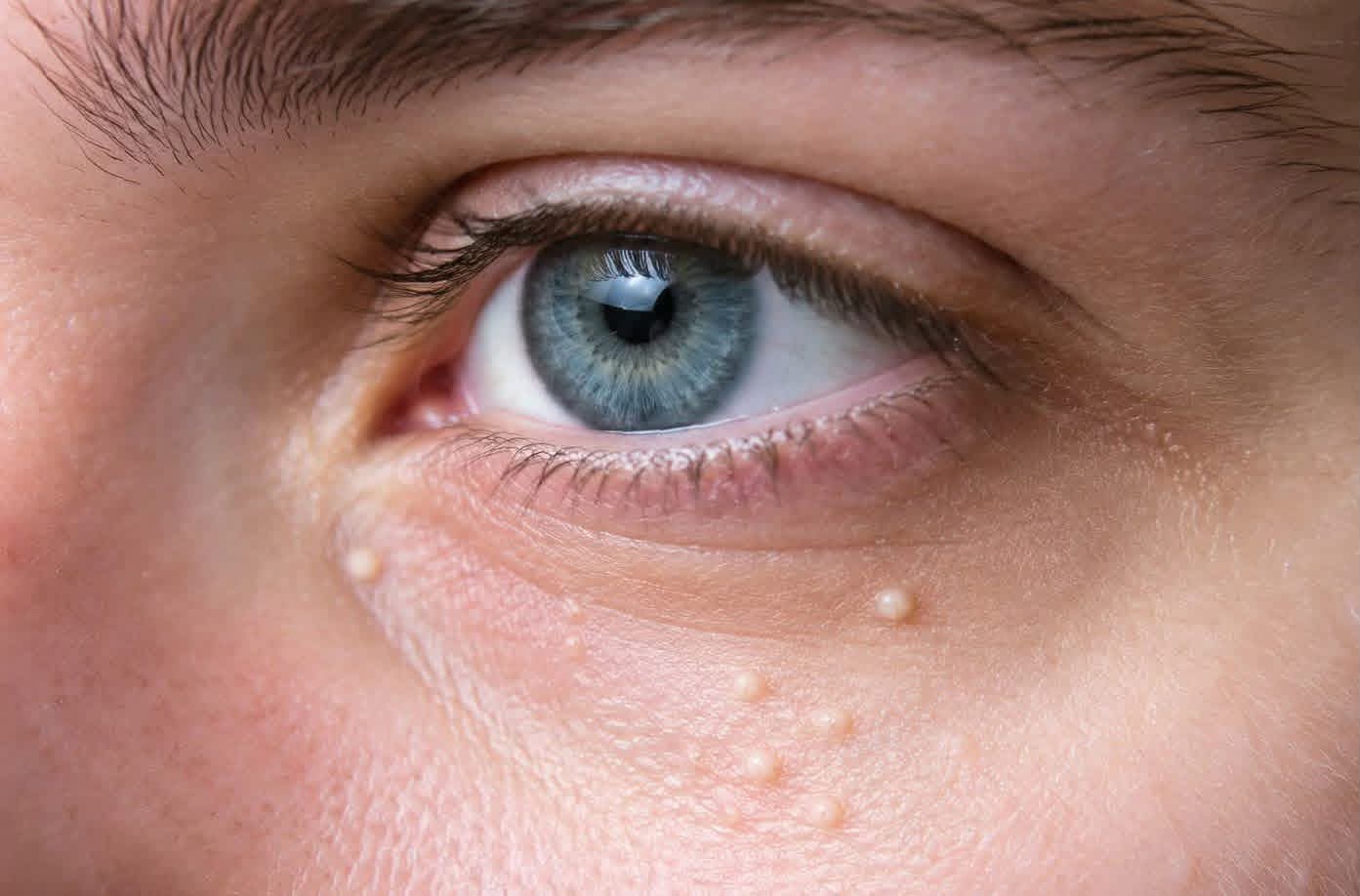
For example, persistent small bumps around the eyes should not automatically be treated as wrinkles or “old age.” The image associated with this topic shows small raised bumps under the eye area, which can have several causes and may require professional evaluation if they persist, spread, or change.
What not to do
Avoid:
- Squeezing bumps near the eye
- Scrubbing the delicate skin aggressively
- Applying strong products too close to the eye
- Using multiple irritating treatments at once
A product that works well on the forehead or chin may be too irritating for the eye area.
4. Puffiness May Have More Than One Cause
Morning puffiness is another thing people often blame on age.
Age can change the appearance of the face, but short-term puffiness can also be influenced by sleep position, fluid retention, allergies, irritation, and individual anatomy.
This does not mean that every puffy eye has a simple home solution. Persistent, sudden, painful, or one-sided swelling should be evaluated by a health professional.
But for ordinary, temporary puffiness, gentle habits can make a difference.
These may include:
- Getting adequate sleep
- Avoiding known allergens or irritants
- Using a cool compress if appropriate
- Avoiding rubbing the eyes
- Being gentle when applying or removing makeup
The goal is not to promise that one habit will eliminate puffiness forever. It is to recognize that not every morning change in your face is an unavoidable sign of aging.
5. Darker Under-Eye Skin Is Not Always a Sign That You’re Getting Old
Dark circles can be frustrating because people often assume they are caused by one thing.
In reality, under-eye darkness can have many contributors, including natural pigmentation, facial anatomy, shadows, allergies, fatigue, and lifestyle factors.
That means the popular phrase “just get more sleep” is often too simplistic.
Getting enough sleep is important for overall health, and adequate sleep can help people look more rested. But sleep alone may not erase under-eye pigmentation that is largely related to genetics or natural facial structure.
This is another important lesson:
A visible problem can have several possible causes.
When people blame everything on aging, they may miss a cause that could actually be addressed.
6. Sun Damage Can Look Like “Normal Aging”
This is perhaps one of the most important points.
Many visible skin changes that people associate with aging may be strongly influenced by years of ultraviolet exposure.
Sun exposure can contribute to:
- Wrinkles
- Uneven texture
- Dark spots
- Blotchy complexion
- Premature skin aging
The National Institute on Aging notes that ultraviolet damage accumulates over time and can contribute to premature skin aging, wrinkles, and changes in skin texture.
That is why daily sun protection is not simply a cosmetic habit.
It is also part of protecting the skin’s long-term health.
A practical sun-protection routine
You do not need to hide indoors.
Instead:
- Use broad-spectrum sunscreen.
- Choose SPF 30 or higher when appropriate.
- Wear sunglasses outdoors.
- Seek shade when practical.
- Wear protective clothing.
- Avoid intentional tanning and tanning beds.
The goal is consistency, not perfection.
A person who protects their skin regularly for years may be doing more for their future appearance than someone who owns a cabinet full of expensive anti-aging products but ignores sun exposure.
7. Smoking Can Make Skin Look Older Earlier
Some people blame a dull, dry, wrinkled appearance entirely on aging when tobacco exposure may be contributing.
Dermatologists warn that smoking can contribute to premature signs of aging and reduced skin firmness.
Quitting smoking is not merely about appearance, of course. It is an important health decision with benefits far beyond the skin.
But when discussing premature aging, smoking belongs in the conversation.
The point is simple:
Sometimes what looks like “age” is partly accumulated exposure.
8. More Skin-Care Products Do Not Always Mean Better Skin
One of the biggest modern misconceptions is that complicated routines automatically produce better results.
Not necessarily.
Using too many active products can irritate the skin. Irritation can create redness, dryness, flaking, and an uneven appearance—problems that may then be mistaken for accelerated aging.
The American Academy of Dermatology advises people to focus on their main concern and warns that using multiple anti-aging products over a short period can irritate the skin.
A sensible routine can often be built around a few basics:
Morning
- Gentle cleansing, if needed
- Moisturizer
- Broad-spectrum sunscreen
Evening
- Gentle cleansing
- Moisturizer
- A carefully chosen treatment, if appropriate
The exact products depend on your skin type and concerns.
A person with acne-prone skin, very dry skin, eczema-prone skin, pigmentation concerns, or sensitivity may need different strategies.
9. Stronger Is Not Always Better
A product that tingles, burns, peels, or causes intense redness is not necessarily “working better.”
Sometimes it is simply irritating your skin.
This is particularly important with retinoids and retinol products. Retinoids can be useful for concerns such as mild fine lines, uneven texture, and pigmentation, but they can also cause irritation. Dermatology guidance recommends starting carefully and notes that retinoids may not be appropriate for everyone.
If you are considering a retinoid:
- Start slowly.
- Use the product as directed.
- Support the skin with moisturizer.
- Use sun protection during the day.
- Avoid placing irritating products too close to the eyes.
- Seek professional guidance if you are unsure whether the product is appropriate.
Retinoids should not be used during pregnancy.
10. Dull Skin Does Not Always Mean You’re “Getting Old”
A dull complexion can develop for many reasons.
Dryness can make skin appear rougher and less reflective. Sun exposure can contribute to uneven tone and texture. Smoking can contribute to a dull appearance. Poor skin-care habits can also leave skin looking irritated.
The answer is not necessarily a harsh exfoliating treatment.
Sometimes the answer is more basic:
- Gentle cleansing
- Regular moisturizing
- Sun protection
- Avoiding tobacco
- A healthy overall lifestyle
Dermatologists emphasize that moisturizer can temporarily improve the appearance of fine lines by trapping water in the skin and supporting a brighter, smoother-looking complexion.
That does not mean moisturizer erases aging.
It means hydration and healthy skin-barrier care can change how aging looks.
11. Sleep Is Important—but It Is Not a Magic Cosmetic Treatment
We often hear about “beauty sleep,” and there is some truth behind the phrase.
Adequate sleep supports general health and gives the body time for normal restorative processes. Dermatologists include sufficient sleep among healthy habits that support skin health.
But it is important not to oversell the idea.
One good night of sleep will not permanently remove every wrinkle.
At the same time, chronic poor sleep may leave you looking tired and may make concerns such as puffiness or a dull appearance more noticeable.
The healthiest approach is to see sleep as part of a bigger picture.
12. Eye Changes Should Not Always Be Dismissed as “Getting Older”
The appearance of the skin around the eyes is one thing.
Changes in vision are another.
As people age, some visual changes are common, such as increasing difficulty seeing up close or taking longer to adapt to changes in light. However, other eye problems can be more serious, and some have few or no early symptoms.
Regular eye examinations can help detect certain conditions early.
Do not simply assume that a major change in vision is “just old age.”
Seek professional care for concerns such as:
- Sudden vision changes
- Persistent eye pain
- Significant redness or swelling
- New flashes or a sudden increase in floaters
- A sudden dark area or loss of vision
- Persistent symptoms that do not improve
Healthy aging includes paying attention to changes—not automatically dismissing everything.
A Realistic Prevention Routine
The good news is that prevention does not have to be complicated.
Here is a practical foundation.
Every morning
1. Cleanse gently if needed.
Avoid aggressive scrubbing.
2. Moisturize.
Choose a product appropriate for your skin type.
3. Use sun protection.
Broad-spectrum SPF 30 or higher is a common dermatologist recommendation for exposed skin.
4. Protect your eyes.
Wear UV-protective sunglasses and consider a hat outdoors.
During the day
- Avoid unnecessary tanning.
- Stay hydrated according to your needs.
- Eat a generally balanced diet.
- Avoid smoking.
- Manage stress in realistic ways.
- Take breaks from prolonged screen focus.
The National Institute on Aging recommends a 20-20-20-style approach for eye strain: when focused on a screen or one object for a long period, take a break every 20 minutes and look about 20 feet away for 20 seconds.
In the evening
- Remove makeup and sunscreen.
- Cleanse gently.
- Apply moisturizer.
- Use targeted treatments carefully rather than applying several new products at once.
Consistency usually matters more than constantly switching products.
What About Expensive “Anti-Aging” Products?
Marketing often creates the impression that aging can be reversed by one luxurious cream.
Reality is more complicated.
The National Institute on Aging warns consumers to be skeptical of dramatic anti-aging claims and recommends discussing appropriate products with a dermatologist or health professional.
A simple sunscreen and moisturizer can be more valuable than an expensive product with dramatic promises.
The American Academy of Dermatology identifies sunscreen and moisturizer as two of the most effective anti-aging products and recommends addressing specific concerns rather than expecting one product to treat every sign of skin aging.
When You Should See a Dermatologist
Home care is appropriate for many ordinary concerns, but not every problem should be handled with trial and error.
Consider professional advice if you have:
- A changing mole or skin spot
- A sore that does not heal
- A new or unexplained growth
- Persistent bumps around the eyes
- Severe irritation from skin-care products
- Persistent itching or unusual dryness
- Rapid or unexplained skin changes
The National Institute on Aging also recommends checking the skin regularly and discussing concerning changes with a doctor.
The Biggest Mistake: Giving Up Because You Think It’s “Too Late”
Perhaps the most harmful aging myth is the belief that prevention only matters when you are young.
That is not true.
You can begin better habits at many stages of life.
You may not erase decades of past exposure, and no routine can stop natural aging completely. But improving your habits can still help protect the skin and support healthier aging.
You do not need a perfect routine.
You need a realistic one.
Start with:
- Daily sun protection
- Gentle cleansing
- Regular moisturizing
- No intentional tanning
- No smoking
- Adequate sleep
- A healthy lifestyle
- Professional help when something unusual persists
Final Thoughts
Aging is natural. Wrinkles are natural. Changes in skin texture are natural. Dryness and changes in elasticity can be natural too.
But not everything we blame on aging is caused by aging alone.
Years of ultraviolet exposure can accelerate visible skin changes. Smoking can contribute to premature aging. Harsh products can irritate the skin. A lack of moisturizing can make fine lines more noticeable. Persistent eye or skin changes may sometimes point to something that deserves professional attention.
The goal should not be to chase an impossible promise of never getting older.
The better goal is to protect your health, reduce preventable damage, and care for your skin and eyes with evidence-based habits.
Sometimes the most effective changes are also the simplest ones.
You cannot stop the clock—but you can stop making it harder on yourself.
*This article is for general informational purposes and is not a substitute for medical diagnosis or personal medical advice.*