What Happens When You Sleep on Your Left Side? Benefits, Digestion, Acid Reflux, Pregnancy, and More
Meta Description: Discover what really happens when you sleep on your left side. Learn how left-side sleeping may affect acid reflux, digestion, pregnancy comfort, snoring, sleep apnea, shoulder pain, and overall sleep quality.
Introduction: Is Sleeping on Your Left Side Really Better?
The way you sleep can affect far more than how comfortable you feel in the morning. Your sleeping position may influence nighttime heartburn, breathing, pressure on your joints, comfort during pregnancy, and even how well you rest.
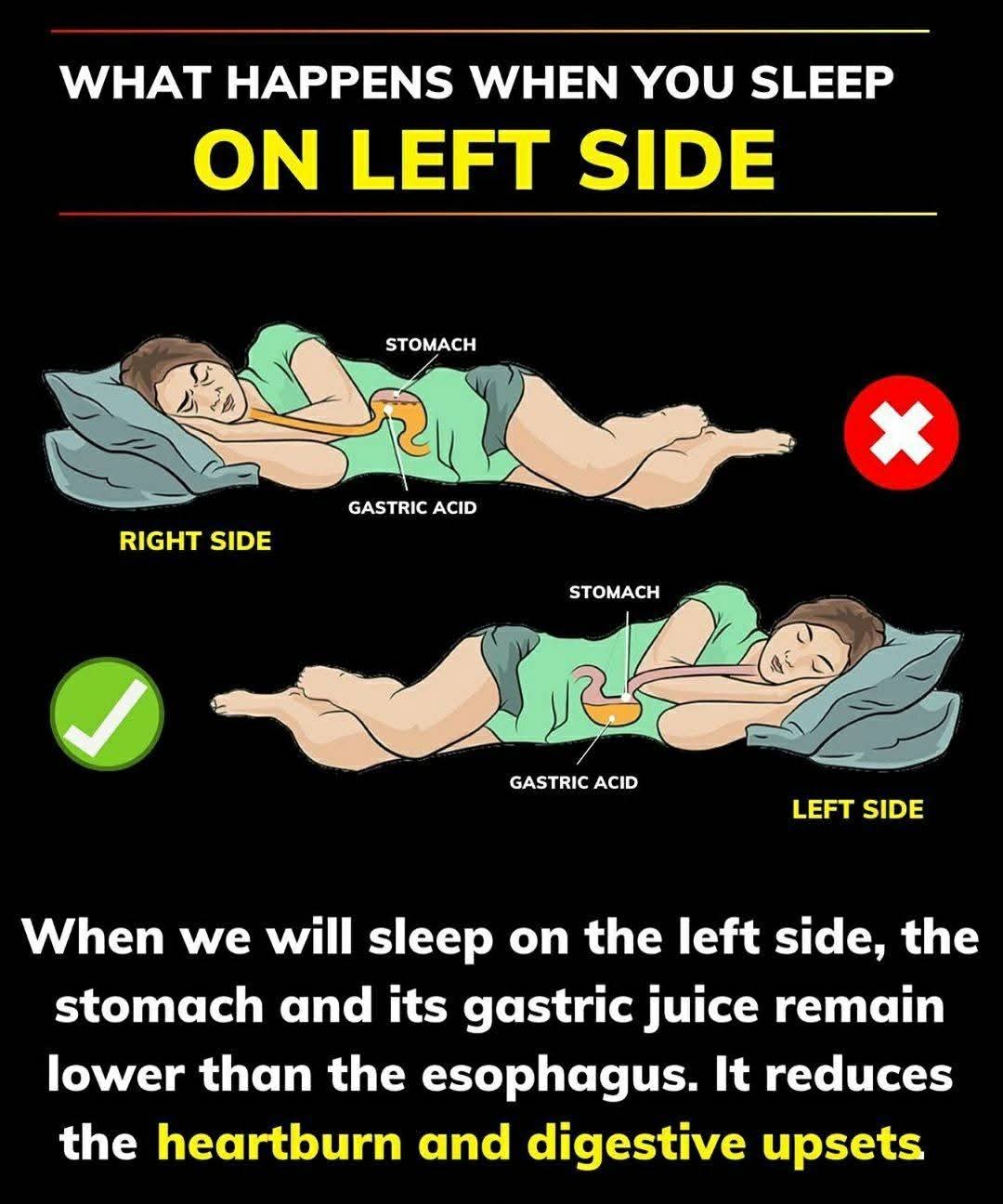
One popular claim is that sleeping on your left side is the healthiest position. Images and social media posts often show the stomach on the left side of the body and suggest that this position prevents stomach acid from reaching the esophagus.
There is some truth to this—but it is important to separate evidence-based benefits from exaggerated health claims.
Sleeping on the left side can be particularly helpful for people who experience acid reflux or nighttime heartburn. The anatomy of the stomach and esophagus means that the left-side position may make it harder for stomach contents to flow upward into the esophagus. Clinical guidance and research support left-side sleeping as a useful strategy for reducing nighttime reflux in some people.
However, this does not mean that everyone must sleep on the left side. For many healthy people, the best sleeping position is simply the one that allows them to sleep comfortably and consistently.
Let’s explore what actually happens when you sleep on your left side and who may benefit most from this position.
Understanding Your Body Position During Sleep
Before discussing the benefits of left-side sleeping, it helps to understand why body position matters.
Your stomach is located primarily in the upper-left area of your abdomen. The esophagus connects your throat to your stomach, and the lower esophageal sphincter acts like a valve that helps prevent stomach contents from flowing backward.
When you lie down, gravity no longer helps keep stomach contents in place as effectively as when you are standing or sitting. This is one reason some people experience heartburn or reflux at night.
The relationship between the stomach and esophagus changes depending on whether you lie:
- On your left side
- On your right side
- On your back
- On your stomach
Research suggests that lying on the left side may reduce nighttime acid exposure compared with lying on the right side. The American College of Gastroenterology’s GERD guideline discusses left-side sleeping as a potentially beneficial lifestyle strategy, particularly for nighttime reflux.
1. Sleeping on Your Left Side May Help Reduce Acid Reflux
This is probably the best-supported benefit of left-side sleeping.
Acid reflux occurs when stomach contents travel upward into the esophagus. The result may be:
- Burning in the chest
- Sour taste in the mouth
- Regurgitation
- Throat irritation
- Nighttime coughing
- Difficulty sleeping
Because of the position of the stomach, lying on the left side may place the junction between the stomach and esophagus in a position that makes reflux less likely.
Cleveland Clinic explains that sleeping on the left side can help keep the lower esophageal sphincter above the level of stomach contents, while back or right-side sleeping may allow this area to be more exposed to stomach contents.
Why the Left Side May Help
Think of your stomach as a curved container. Its shape and location mean that when you lie on your left side, the stomach contents may settle in a way that is less likely to reach the esophagus.
When you lie on your right side, the stomach and its contents may be positioned differently, potentially making reflux easier in susceptible people.
Clinical evidence summarized in the American College of Gastroenterology guideline indicates that right-side sleeping can increase nighttime reflux compared with left-side sleeping.
A Simple Positioning Strategy
If you have frequent nighttime heartburn, try:
- Sleeping on your left side.
- Avoiding large meals shortly before bedtime.
- Avoiding lying down immediately after eating.
- Raising your upper body when appropriate.
- Using a supportive pillow that keeps your neck and spine comfortable.
Sleeping on the left side may be even more helpful when combined with elevating the upper body. A wedge that supports the torso can help some people with nighttime reflux.
2. Left-Side Sleeping May Support More Comfortable Digestion
Many popular health posts claim that sleeping on the left side dramatically “improves digestion” or causes food to move through the digestive system more quickly.
The reality is more complicated.
Your digestive system continues functioning whether you sleep on your left side, right side, back, or stomach. Your body does not require the left-side position to digest food.
However, the position may help some people feel more comfortable, especially if they are prone to reflux.
For people with GERD or frequent heartburn, left-side sleeping may reduce the uncomfortable sensation of acid moving upward. This can make the digestive system feel calmer during the night—not because the body has suddenly become dramatically more efficient, but because the position may reduce reflux episodes.
So, a more accurate statement is:
Sleeping on the left side may be helpful for nighttime reflux and digestive comfort, but it is not a magical cure for all digestive problems.
3. It May Be Helpful During Pregnancy
Sleeping can become increasingly uncomfortable as pregnancy progresses. The growing abdomen, back discomfort, hip pressure, and changes in circulation can all make finding a comfortable position difficult.
Side sleeping is commonly recommended later in pregnancy.
However, an important myth needs to be corrected:
You Do Not Necessarily Have to Sleep Only on the Left Side
The American College of Obstetricians and Gynecologists explains that people do not need to spend the entire pregnancy sleeping exclusively on the left side. In later pregnancy, sleeping on either side is generally acceptable, while prolonged back sleeping may become uncomfortable and can place pressure on major blood vessels as the uterus grows.
The left side may feel particularly comfortable for some people, but either side can be acceptable.
How to Sleep More Comfortably During Pregnancy
Try:
- A pillow between the knees.
- A pillow supporting the abdomen.
- A supportive pillow behind the back.
- A full-length body pillow.
- Keeping the knees slightly bent.
ACOG notes that side sleeping later in pregnancy may be more comfortable, and pillows can help support the body.
The most important thing is comfort and following the guidance of your maternity care provider.
4. Side Sleeping May Help Some People With Snoring and Sleep Apnea
Sleeping position can affect the airway.
When you lie on your back, gravity can encourage the tongue and soft tissues in the throat to move backward. For some people, this can narrow the airway and contribute to snoring or obstructive breathing events.
Side sleeping may help keep the airway in a more favorable position.
This benefit is not exclusive to the left side. Both left- and right-side sleeping may be useful compared with sleeping on the back, depending on the individual.
However, it is important to understand that:
Changing your sleeping position is not a substitute for medical treatment for sleep apnea.
If you experience:
- Loud, frequent snoring
- Pauses in breathing during sleep
- Gasping or choking at night
- Extreme daytime sleepiness
- Morning headaches
you should consider speaking with a healthcare professional.
5. Left-Side Sleeping Can Reduce Pressure on the Lower Back—If You Use Proper Support
Some people find side sleeping extremely comfortable for the back. Others wake up with hip, shoulder, or lower-back pain.
The difference often comes down to body alignment.
When you sleep on your side without adequate support, your upper leg may rotate forward and pull your hips and lower spine out of alignment.
A pillow between the knees can help keep the pelvis more neutral.
A Good Side-Sleeping Position
Try this setup:
- Keep your head supported so your neck remains aligned with your spine.
- Bend your knees slightly.
- Place a pillow between your knees.
- Keep your shoulders relaxed.
- Avoid curling excessively into a tight ball.
If there is a large gap between your waist and the mattress, some people find a small pillow against the body helpful for support.
6. Your Heart Is Not “Crushed” When You Sleep on Your Left Side
Another common myth is that sleeping on the left side is dangerous because it places pressure on the heart.
For most healthy people, this is not something to worry about.
You may sometimes feel your heartbeat more strongly when lying on your left side. This sensation can make people feel as though the heart is under pressure, but feeling your heartbeat more prominently does not mean that the position is damaging your heart.
People with specific heart or circulatory conditions may receive individual advice from their healthcare providers. If you have a diagnosed heart condition and have been told to follow a particular sleeping position, follow your clinician’s recommendations.
For healthy individuals, sleeping on the left side is generally a normal position.
7. Your Shoulder May Become Sore
The biggest disadvantage of side sleeping is pressure on the shoulder.
When you sleep on your left side, your:
- Left shoulder
- Left arm
- Hip
carry more of your body weight.
Over many hours, this pressure can contribute to discomfort, especially if your mattress is very firm or your pillow is not supportive.
How to Reduce Shoulder Pain
You may find relief by:
- Using a mattress that cushions pressure points.
- Choosing a pillow with the right height.
- Avoiding sleeping directly on the shoulder if it is injured.
- Hugging a pillow in front of your chest.
- Switching sides naturally during the night.
A pillow that is too thin can cause the head to tilt downward. A pillow that is too thick can push the head upward.
The goal is to keep the head, neck, and spine in a relatively neutral line.
8. Left-Side Sleeping May Feel Better for Some People With Nighttime Reflux
GERD can interfere with sleep in several ways.
A person may wake up with:
- Burning in the chest
- Coughing
- Throat irritation
- A sour or bitter taste
- Difficulty swallowing
- Hoarseness
Nighttime reflux may be worse after:
- A large evening meal
- A high-fat meal
- Lying down soon after eating
- Certain individual food triggers
Left-side sleeping can be one tool among several. It should not necessarily be the only strategy.
Cleveland Clinic notes that reflux can worsen while lying down and after large or fatty meals, while positioning changes may help reduce nighttime symptoms.
A Better Evening Routine for Reflux
Consider:
Eat Earlier
Avoid going to bed immediately after a large meal. Giving yourself time before lying down may help.
Keep Meals Moderate
Very large meals can increase stomach pressure and discomfort.
Identify Personal Triggers
Common triggers vary from person to person.
Consider Upper-Body Elevation
A supportive wedge or elevated bed setup may help some people with nighttime reflux.
Try the Left Side
If reflux occurs mainly at night, try beginning the night on your left side.
These strategies should be adjusted according to your symptoms and healthcare provider’s advice.
9. The Left Side Does Not “Detox” Your Body
Some online posts claim that sleeping on the left side:
- Cleans toxins from the body
- Flushes the lymphatic system
- Cleans the brain
- Completely improves organ function
- Removes waste faster
These claims are often exaggerated.
Your body already has sophisticated systems for removing waste and maintaining balance, including the:
- Kidneys
- Liver
- Lungs
- Digestive system
- Lymphatic system
You do not need to sleep in one specific position to “detox” your body.
That does not mean sleep position is irrelevant. Position can affect comfort, reflux, airway mechanics, and pressure on joints. But it is not a miracle detoxification treatment.
10. Does Sleeping on the Left Side Improve Circulation?
The relationship between sleep position and circulation is more complicated than social media graphics often suggest.
During pregnancy, side sleeping may be recommended because lying flat on the back later in pregnancy can become uncomfortable and may place pressure on major blood vessels. Side sleeping can therefore be a more comfortable alternative as the uterus grows.
But for the average healthy person, sleeping on the left side is not proven to produce a dramatic improvement in circulation throughout the entire body.
The best position is one that allows you to sleep comfortably without causing unnecessary pain or numbness.
11. What Happens When You Sleep on Your Right Side?
The right side is not automatically unhealthy.
In fact, many people sleep comfortably on their right side every night.
The main reason left-side sleeping gets more attention is its potential relationship with acid reflux.
For people with GERD, right-side sleeping may allow more nighttime reflux than left-side sleeping because of the relationship between the stomach and esophagus.
However, if you do not have reflux and you sleep comfortably on your right side, there is usually no reason to force yourself to sleep on the left side.
12. What Happens When You Sleep on Your Back?
Back sleeping can be very comfortable for some people.
Potential benefits include:
- Less pressure on the shoulders.
- A neutral position for the spine in some people.
- Less facial contact with the pillow.
However, back sleeping may worsen:
- Snoring
- Obstructive sleep apnea
- Acid reflux in some individuals
The effect varies between people. If you have loud snoring or diagnosed sleep apnea, your healthcare provider may discuss positional strategies as part of your overall treatment plan.
13. What About Sleeping on Your Stomach?
Sleeping on the stomach may help some people feel comfortable, but it can also create problems with neck positioning.
To breathe while lying on the stomach, the head usually has to turn to one side. This can place the neck in a rotated position for many hours.
Some people experience:
- Neck stiffness
- Shoulder discomfort
- Lower-back strain
If stomach sleeping is your preferred position and you wake up without pain, you may not need to change. But if you regularly experience neck or back discomfort, experimenting with side or back sleeping may be worthwhile.
How to Train Yourself to Sleep on Your Left Side
Changing your preferred sleeping position can take time.
Here are several simple strategies.
1. Start the Night on Your Left Side
You naturally move during sleep, and that is completely normal. You do not need to remain perfectly still all night.
Simply start by falling asleep on your left side.
2. Hug a Pillow
Holding a pillow can support your upper arm and make the position feel more stable.
It may also prevent the upper shoulder from rolling too far forward.
3. Place a Pillow Between Your Knees
This is one of the easiest ways to make side sleeping more comfortable.
A knee pillow may help:
- Support the hips
- Reduce twisting
- Improve comfort
- Reduce pressure between the knees
4. Support Your Neck
Your pillow should fill the space between your head and the mattress without forcing your neck upward or allowing it to drop too far downward.
Pillow needs vary depending on:
- Shoulder width
- Mattress firmness
- Body size
- Personal preference
5. Use a Body Pillow
A full-length body pillow can provide support for:
- The arms
- The knees
- The abdomen
- The back
This can be particularly useful during pregnancy or for people who find side sleeping uncomfortable.
Who May Benefit Most From Sleeping on the Left Side?
Left-side sleeping may be worth trying if you have:
Frequent nighttime acid reflux
This is one of the strongest reasons to try the position.
Heartburn that becomes worse when you lie down
The position may reduce nighttime reflux symptoms for some people.
Pregnancy-related sleeping discomfort
Side sleeping is commonly recommended later in pregnancy, although the left side is not the only acceptable side.
Snoring that is worse when lying on your back
Side sleeping may be helpful, although both sides can be beneficial.
Lower-back discomfort
With proper pillow support, side sleeping may feel more comfortable.
Who Should Be Careful With Left-Side Sleeping?
Left-side sleeping may not be ideal if you have:
- Significant left shoulder pain
- A recent shoulder injury
- Certain postoperative restrictions
- A medical condition for which your healthcare provider has recommended a specific position
In these situations, follow individualized medical advice.
If left-side sleeping causes numbness, severe shoulder pain, shortness of breath, or significant discomfort, you do not need to force yourself to remain in that position.
Frequently Asked Questions
Is it good to sleep on your left side every night?
It can be a good position for many people, particularly those with nighttime reflux. But there is no universal rule that everyone must sleep on the left side.
Comfort and sleep quality are important.
Does sleeping on the left side help GERD?
It may. Evidence and clinical guidance indicate that left-side sleeping can reduce nighttime acid exposure compared with right-side sleeping in people with reflux.
Is left-side sleeping good during pregnancy?
Side sleeping is commonly recommended later in pregnancy. However, current ACOG guidance emphasizes that people do not need to sleep exclusively on the left side; either side is generally acceptable, while back sleeping later in pregnancy may become less comfortable.
Can sleeping on the left side cure acid reflux?
No. It may help reduce nighttime symptoms, but it does not cure every case of GERD.
Persistent reflux may require lifestyle changes, medication, or medical evaluation.
Does sleeping on the left side detox your body?
No evidence supports the idea that sleeping on the left side produces a special whole-body “detox.” Your organs already perform waste-removal and metabolic functions continuously.
Is sleeping on the right side bad?
Not for most people. The right side is a normal and comfortable sleeping position. However, people with nighttime reflux may find that the left side reduces symptoms more effectively.
When to See a Doctor
Occasional heartburn is common, but persistent symptoms should not be ignored.
Seek medical advice if you have:
- Frequent heartburn
- Difficulty swallowing
- Food feeling stuck
- Unexplained weight loss
- Persistent vomiting
- Chest pain
- Black or bloody stools
- Severe nighttime coughing
- Symptoms that regularly interrupt sleep
Also seek evaluation for loud snoring, breathing pauses during sleep, or excessive daytime sleepiness.
Sleeping position can improve comfort, but it should not replace proper diagnosis and treatment.
Final Thoughts: Is Sleeping on the Left Side the Best Position?
For many people, sleeping on the left side can be a useful and comfortable position.
Its most important potential benefit is its effect on nighttime acid reflux. Because of the body’s anatomy, the left-side position may help reduce the amount of stomach acid reaching the esophagus, making it a helpful strategy for people with GERD or nighttime heartburn.
It may also be comfortable during pregnancy and can be part of a side-sleeping strategy for people whose breathing or snoring is worse on their back.
But left-side sleeping is not a miracle position. It does not automatically detox the body, cure digestive disease, or dramatically improve every organ.
The best approach is simple:
- Sleep in a position that is comfortable.
- Use supportive pillows.
- Keep your neck and spine aligned.
- Try the left side if nighttime reflux is a problem.
- Avoid forcing yourself into a painful position.
- Follow medical advice when you have a specific health condition.
Sometimes, a small change in how you sleep can make a noticeable difference. If you frequently wake with heartburn, a sore throat, or a burning sensation in your chest, try starting the night on your left side and see whether it improves your comfort.
Good sleep is about more than finding the “perfect” side—it is about finding a safe, supportive, comfortable position that helps your body rest.
Disclaimer: This article is for general educational purposes and is not a substitute for professional medical advice, diagnosis, or treatment. If you have persistent digestive symptoms, breathing problems, pregnancy concerns, or a diagnosed medical condition, consult a qualified healthcare professional.