Castor Oil and Baking Soda for Seniors: What the Viral Remedy Really Does, What the Science Says, and How to Stay Safe
Introduction
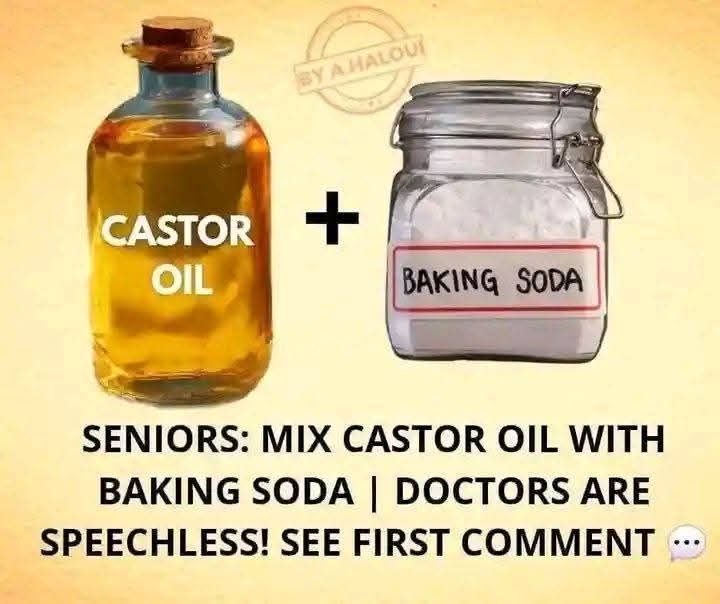
A simple image circulating online shows a bottle of castor oil beside a jar of baking soda with a bold message encouraging seniors to mix the two ingredients. The wording suggests that the combination is so powerful that “doctors are speechless,” while directing readers to a comment for the supposed recipe.
Posts like this are extremely appealing because they promise a simple answer to problems that become more common with age: stiff joints, dry skin, muscle discomfort, aches, and other everyday complaints. Castor oil is inexpensive and familiar, while baking soda is already found in many kitchens. It is easy to understand why a mixture made from two common household products might sound attractive.
But there is an important distinction between a traditional home remedy, an interesting possibility, and a medically proven treatment.
There is currently no strong clinical evidence showing that mixing castor oil with baking soda creates a special treatment for seniors or that the combination can cure arthritis, reverse aging, remove inflammation, repair joints, or treat a wide range of diseases. A small clinical study has examined oral castor oil for knee osteoarthritis, but that study does not prove that a topical mixture of castor oil and baking soda works in the same way.
That does not mean castor oil has no useful properties. It has a long history in cosmetics and traditional medicine, and recent dermatological literature continues to investigate possible topical applications. At the same time, allergic contact dermatitis from castor oil has been documented, meaning that “natural” does not automatically mean “risk-free.”
Baking soda also has legitimate household and medical uses, but applying large amounts to the skin is not automatically harmless. Poison Control has documented skin irritation and dryness following baking-soda-containing baths, while excessive exposure can create additional problems.
This article takes a closer look at the viral castor-oil-and-baking-soda claim, explains what each ingredient actually is, discusses possible uses, examines the evidence, and offers practical safety advice—especially for older adults.
What Is Castor Oil?
Castor oil is a vegetable oil obtained from the seeds of the castor plant, Ricinus communis. It has been used for generations in cosmetics, traditional medicine, manufacturing, and pharmaceutical formulations.
One of the main fatty acids in castor oil is ricinoleic acid. This unusual fatty acid contributes to many of the physical characteristics that make castor oil different from common cooking oils.
Castor oil is thick and highly viscous. When applied to the skin, it can form an oily layer that reduces water loss and makes the skin feel softer.
That moisturizing characteristic is one reason castor oil appears in many cosmetic products.
A 2026 narrative review published in Cureus examined dermatological uses of castor oil and reported potential applications involving skin hydration, hair care, cosmetic formulations, and other areas. However, the authors also emphasized the need for additional clinical research, and rare adverse reactions such as contact dermatitis have been reported.
So, castor oil is not simply a useless household liquid. It has properties that may make it useful in certain cosmetic applications. But those properties should not be confused with proof that castor oil can cure medical diseases.
What Is Baking Soda?
Baking soda is sodium bicarbonate, a mildly alkaline compound commonly used in cooking, cleaning, and some medical preparations.
Because it is alkaline, baking soda can alter the pH of substances it contacts.
Its popularity as a home remedy comes partly from its versatility. People use it for cleaning, odors, cooking, and various traditional skin applications.
However, the fact that baking soda is common in the kitchen does not mean that it should automatically be applied to every part of the body.
Skin has its own protective barrier and its own natural chemical environment. Repeatedly applying substances that disturb that environment can cause dryness or irritation.
Research into skin cleansing has demonstrated that formulation and pH can influence skin dryness and irritation, which is one reason dermatological products are generally designed carefully rather than created by simply combining household ingredients.
Why Do People Mix Castor Oil and Baking Soda?
The viral remedy is based on a simple idea.
Castor oil provides an oily base, while baking soda provides a fine alkaline powder. When combined, they produce a thick paste that can be spread over the skin.
Supporters of the remedy may claim that this mixture can:
- soothe aching joints;
- reduce inflammation;
- soften dry skin;
- improve the appearance of rough skin;
- remove dead skin cells;
- reduce age-related skin changes;
- relieve muscle discomfort;
- help with swelling;
- “draw out toxins”;
- improve circulation;
- or even treat arthritis.
The problem is that these claims are often presented as though they have all been scientifically established.
They have not.
There is a major difference between saying, “Some people find this mixture soothing,” and saying, “This mixture treats arthritis.”
The first is an observation that may be worth discussing.
The second is a medical claim requiring appropriate clinical evidence.
Does Castor Oil and Baking Soda Really Treat Arthritis?
This is one of the most important questions surrounding the viral post.
The answer is: there is not enough evidence to say that a topical castor-oil-and-baking-soda mixture treats arthritis.
There has been research involving castor oil and osteoarthritis, but the details matter.
A randomized double-blind clinical trial published in 2009 compared castor oil capsules with diclofenac in people with knee osteoarthritis. Participants received oral castor oil or diclofenac for four weeks. The study reported symptom improvement in both groups.
However, this study does not establish that rubbing castor oil on the knee works.
More importantly, it does not establish that mixing castor oil with baking soda improves the effect.
The route of administration matters enormously in medical research.
A substance swallowed as a capsule is not automatically equivalent to the same substance rubbed onto the skin.
And castor oil alone is not equivalent to castor oil combined with another household substance.
Therefore, using that older study as proof that the viral topical mixture is an arthritis cure would be an overinterpretation of the evidence.
What About Joint Pain?
Older adults commonly experience joint pain for many different reasons.
Osteoarthritis can affect the knees, hips, hands, spine, and other joints. Other causes of pain include previous injuries, bursitis, tendon problems, inflammatory arthritis, gout, nerve disorders, and infections.
Because the causes are different, there cannot be one universal home remedy for all joint pain.
A warm massage may feel pleasant. A moisturizing oil may make the skin feel comfortable. Gentle massage itself may temporarily change the perception of discomfort.
But feeling temporary comfort does not necessarily mean that a treatment has changed the underlying disease.
This distinction is particularly important for seniors.
If persistent joint pain is caused by osteoarthritis, rheumatoid arthritis, gout, an injury, or another medical condition, identifying the cause is much more useful than repeatedly experimenting with unproven mixtures.
Could Castor Oil Moisturize Older Skin?
This is a much more reasonable possibility.
Skin naturally becomes thinner and drier with age. Older adults may experience increased dryness, roughness, itching, and sensitivity.
An oily substance such as castor oil can reduce the feeling of dryness by creating an occlusive layer over the skin.
Recent dermatological research has investigated castor oil in areas such as hydration and cosmetic skin care. A 2026 narrative review described possible dermatological benefits but also emphasized that further clinical investigation is necessary.
So if someone applies a small amount of castor oil to intact, dry skin and finds that the skin feels softer, that is plausible.
But this does not mean that castor oil reverses aging.
It does not mean that it removes wrinkles permanently.
And it does not mean that adding baking soda automatically makes it more effective.
What About Baking Soda for Skin?
Baking soda has been used in various traditional skin applications.
However, it is important to understand that household usefulness does not equal universal dermatological safety.
Poison Control has reported a case in which a person developed itchy, red, swollen skin after using a bath containing baking soda along with other substances. The recommendation was to discontinue the baking soda and other irritating ingredients.
This is especially relevant when people recommend applying concentrated mixtures directly to the skin.
Older skin may already be dry or fragile. Scrubbing it with a powder or applying an irritating substance can make the problem worse.
A person with eczema, psoriasis, open wounds, ulcers, very dry skin, or a compromised skin barrier should be particularly cautious.
Can the Mixture “Remove Toxins”?
This is another common claim that deserves skepticism.
The human body already has sophisticated systems for processing and eliminating waste, particularly through the liver and kidneys.
There is no established scientific evidence that rubbing castor oil and baking soda onto the skin “pulls toxins” out of the body.
Sometimes a person may notice redness, sweating, residue, or a change in the appearance of the skin after applying a home remedy. These changes can easily be interpreted online as evidence that toxins are leaving the body.
They are not proof of detoxification.
The word “detox” is frequently used in online wellness marketing because it sounds scientific and reassuring. But a claim that a substance removes unspecified “toxins” should always prompt the question:
Which toxin? By what biological mechanism? And where is the clinical evidence?
Without clear answers, the claim should not be treated as established medicine.
Can It Reduce Inflammation?
Castor oil contains ricinoleic acid, and laboratory research has investigated biological effects associated with this fatty acid.
But laboratory findings do not automatically translate into proven treatment for inflammatory diseases in humans.
This distinction is essential.
A substance can demonstrate an interesting biological effect in a laboratory and still fail to provide meaningful clinical benefits when used by real patients.
The same principle applies to baking soda.
There is no strong evidence demonstrating that a castor-oil-and-baking-soda paste is a reliable anti-inflammatory treatment for arthritis or other chronic inflammatory conditions.
People should therefore avoid replacing prescribed treatment with this mixture.
Is the Mixture Safe for Seniors?
This question may be more important than whether the remedy works.
Older adults often have additional factors that can affect skin and overall health, including:
- thinner skin;
- reduced skin moisture;
- slower wound healing;
- diabetes;
- circulation problems;
- allergies;
- multiple medications;
- chronic illnesses;
- previous skin reactions;
- and reduced ability to notice or respond quickly to injuries.
A product that causes only mild irritation in one person may create a more serious problem in another.
Natural products can also cause allergic reactions.
Medical literature contains documented cases of allergic contact dermatitis associated with castor oil.
Therefore, people should not assume that castor oil is harmless simply because it comes from a plant.
Why a Patch Test Matters
If someone chooses to use castor oil cosmetically, a cautious approach is preferable.
Instead of immediately covering a large area of skin, test a small amount on a limited area of intact skin first.
Wait and observe for signs such as:
- redness;
- burning;
- itching;
- swelling;
- rash;
- blistering;
- or worsening dryness.
If a reaction occurs, wash the area and stop using the product.
A patch test is not a guarantee that a product is safe everywhere, but it is a more cautious approach than applying an unfamiliar mixture over a large area.
People with a history of severe allergic reactions should discuss new topical products with a healthcare professional.
Never Apply the Mixture to Broken Skin
One of the simplest safety rules is also one of the most important.
Do not apply a homemade castor-oil-and-baking-soda mixture to:
- open wounds;
- infected skin;
- fresh cuts;
- burns;
- ulcers;
- bleeding areas;
- severe rashes;
- or areas with unexplained lesions.
Broken skin has a compromised protective barrier.
Household substances may irritate damaged tissue and potentially complicate healing.
If an older adult has a wound that is not healing normally, particularly on the foot or lower leg, it should not be treated casually with internet remedies.
Do Not Use It Around the Eyes
The skin around the eyes is delicate.
Baking soda particles can be irritating, and accidental contact with the eye can cause discomfort.
Castor oil products may also contain additional ingredients depending on the formulation.
For that reason, the mixture should not be used around the eyes or on the eyelids as a homemade anti-aging or skin treatment.
If a substance gets into the eye and causes persistent pain, redness, vision changes, or significant irritation, seek medical attention.
Do Not Ingest the Mixture
The viral image promotes a topical-looking mixture, but some social media posts about castor oil encourage oral consumption.
These are entirely different uses.
Castor oil has historically been used as a stimulant laxative, but ingesting it can cause abdominal cramps, diarrhea, nausea, dizziness, and other adverse effects. MedlinePlus also notes that allergic reactions are possible.
Baking soda should not be consumed as a casual “detox” treatment either.
Large amounts of sodium bicarbonate can disturb the body’s acid-base balance and create serious health problems. A published medical case even documented metabolic alkalosis associated with liberal baking soda use.
Therefore:
Do not turn a topical internet recipe into an oral remedy.
What About People Taking Many Medications?
Seniors are more likely than younger adults to take several medications.
That makes experimentation with unproven treatments more complicated.
Although a topical product may have different risks from an oral supplement, people with chronic medical conditions should still discuss complementary treatments with their doctor or pharmacist.
The National Center for Complementary and Integrative Health emphasizes that complementary products and practices should be considered individually and that safety, interactions, and product quality need to be taken seriously.
This is especially important for people taking medication for:
- blood pressure;
- diabetes;
- heart disease;
- kidney disease;
- blood clotting;
- arthritis;
- or other chronic conditions.
What Is the Biggest Problem With Viral Health Posts?
The biggest problem is often not the ingredient itself.
It is the exaggerated promise.
Phrases such as:
“Doctors are speechless!”
“Miracle remedy!”
“Seniors must try this!”
“Pain disappears instantly!”
“Doctors don’t want you to know!”
are designed to create urgency and curiosity.
They are not scientific evidence.
A legitimate medical claim should be supported by appropriately designed research.
The stronger the claim, the stronger the evidence should be.
A social-media image is not a clinical trial.
A personal testimonial is not a clinical trial.
A before-and-after photograph is not automatically a clinical trial.
And a recipe that has been shared thousands of times is not necessarily effective.
Why Testimonials Can Be Misleading
Suppose someone applies castor oil and baking soda to a painful knee and feels better.
That experience may be completely genuine.
But there are many possible explanations.
Pain can naturally fluctuate.
Warmth and massage can temporarily change pain perception.
Rest can reduce symptoms.
Expectations can influence how people perceive discomfort.
The original pain may have been mild.
And the condition may have improved independently.
This is why scientific studies use comparison groups, randomization, blinding, and other methods to determine whether a treatment truly causes the observed improvement.
One person’s experience cannot establish that a treatment works for everyone.
What Can Seniors Do Instead for Joint Pain?
If the goal is managing chronic joint discomfort, there are evidence-based approaches worth discussing with a healthcare professional.
Depending on the diagnosis, these may include:
- appropriate physical activity;
- strength exercises;
- physical therapy;
- weight management when appropriate;
- assistive devices;
- heat or cold therapy;
- prescribed or recommended medications;
- topical treatments with established evidence;
- and treatment of the underlying condition.
The correct approach depends on the individual.
For example, someone with osteoarthritis may need an entirely different strategy from someone with rheumatoid arthritis or gout.
This is why diagnosis matters.
The Role of Gentle Movement
One of the most valuable habits for healthy aging is appropriate movement.
People sometimes become afraid of movement because they associate pain with damage.
However, carefully selected physical activity can be an important part of maintaining strength, balance, mobility, and independence.
For someone with arthritis, a healthcare professional or physical therapist can recommend exercises that match their condition and ability.
Movement should be individualized.
Severe pain, sudden swelling, an acute injury, fever, or inability to bear weight warrants medical evaluation rather than experimentation with home remedies.
When Joint Pain Needs Medical Attention
Do not rely on castor oil, baking soda, or any other home remedy when joint pain is accompanied by warning signs.
Seek professional evaluation if there is:
- sudden severe pain;
- major swelling;
- redness and warmth of a joint;
- fever;
- unexplained weight loss;
- severe weakness;
- inability to walk;
- a recent significant injury;
- persistent nighttime pain;
- unexplained numbness;
- or rapidly worsening symptoms.
These signs can indicate conditions requiring proper diagnosis and treatment.
A home remedy should never delay medical care.
What If Someone Still Wants to Try Castor Oil?
For a healthy adult interested in castor oil as a cosmetic moisturizer, the safest approach is to keep expectations modest.
Think of it as a skin-care product, not a cure.
Use a commercially prepared, appropriately labeled product.
Apply only a small amount to intact skin.
Avoid the eyes and mucous membranes.
Do not apply to infected or broken skin.
Stop immediately if irritation develops.
And do not assume that adding baking soda improves the benefits.
There is no established medical recipe showing that the combination produces a special therapeutic effect.
Is There a Proven “Best Ratio”?
Viral posts often provide recipes with precise measurements.
That can make the remedy look scientific.
But a precise ratio is not evidence of effectiveness.
There is no well-established clinical standard demonstrating that a particular ratio of castor oil to baking soda treats arthritis or age-related disease.
Therefore, readers should be skeptical when a social-media post gives an exact recipe while providing no clinical references, no diagnosis, no safety information, and no explanation of how the treatment was tested.
Can Baking Soda Exfoliate the Skin?
Because baking soda is a powder, some people use it as a homemade exfoliant.
However, older skin can be more vulnerable to irritation.
Physical scrubbing can damage the skin barrier if performed too aggressively or too frequently.
For dry or sensitive skin, gentle cleansers and fragrance-free moisturizers are generally more predictable choices than homemade abrasive mixtures.
If someone has a chronic skin condition, a dermatologist can recommend appropriate products based on the diagnosis.
Castor Oil Is Not the Same as Ricin
Another important clarification concerns the castor plant.
The seeds of Ricinus communis contain ricin, a highly toxic substance.
Commercially produced castor oil is processed differently and should not be confused with consuming raw castor beans.
This is another reason never to experiment with homemade preparations involving castor seeds.
Use commercially produced castor oil from a reputable source rather than attempting to extract oil from the seeds yourself.
The “Natural Means Safe” Myth
One of the most persistent myths in health discussions is that natural substances cannot be harmful.
That is simply not true.
Poisonous substances occur naturally.
Allergic reactions can occur to natural ingredients.
Plants can interact with medications.
Essential oils can irritate skin.
Household substances can become dangerous when used incorrectly.
The NCCIH specifically cautions that “natural” does not automatically mean safer or better.
The right question is not:
“Is it natural?”
The better questions are:
Does it work?
For what condition?
At what dose or concentration?
How was it studied?
What are the risks?
Who should avoid it?
Those questions lead to better health decisions.
A Better Way to Read Viral Remedy Posts
Before trying any health remedy seen online, use this simple checklist.
- Identify the exact claim
Is the post claiming that the remedy moisturizes skin, or is it claiming that it cures arthritis?
Those are very different claims.
- Look for human clinical trials
Laboratory research and animal studies are useful, but they do not prove that something works in people.
- Check how the ingredient was administered
Was it swallowed, injected, applied to the skin, or used in a bath?
The route matters.
- Look for safety information
A trustworthy health article should explain possible adverse effects and who should avoid the remedy.
- Be suspicious of absolute promises
Words like “cures,” “guaranteed,” “instant,” and “works for everyone” deserve skepticism.
- Consider the source
A medical institution, peer-reviewed journal, or qualified healthcare professional is generally more useful than an anonymous social-media account.
Frequently Asked Questions
Can castor oil and baking soda cure arthritis?
There is not sufficient evidence to say that this combination cures arthritis. Research involving castor oil and osteoarthritis does not establish that a topical castor-oil-and-baking-soda mixture is an effective arthritis treatment.
Can the mixture reduce knee pain?
It might feel soothing for some people, particularly if massage is involved, but there is no strong evidence establishing the mixture as a reliable treatment for knee pain.
Is castor oil safe on the skin?
Many people tolerate castor oil, but allergic contact dermatitis has been reported.
Is baking soda safe on skin?
It can be irritating, especially when used improperly or excessively. Reports have documented irritation and dryness associated with baking-soda-containing applications.
Can seniors use this remedy?
Age alone does not determine whether someone can tolerate a topical product. However, older adults may have more fragile or sensitive skin and more medical conditions, so extra caution is appropriate.
Should I drink castor oil and baking soda?
No. Do not combine or ingest household substances as a medical treatment based on a viral post. Castor oil ingestion can cause gastrointestinal side effects, while excessive sodium bicarbonate can cause serious disturbances.
Can it remove toxins?
There is no good evidence that rubbing this mixture onto the skin removes unspecified “toxins” from the body.
Can it make wrinkles disappear?
Castor oil may moisturize skin and can make dry skin temporarily appear smoother, but that is not the same as permanently removing wrinkles.
A Sensible Approach to Home Remedies
Home remedies do not have to be completely rejected.
Many traditional practices are harmless when used appropriately, and some natural substances eventually become subjects of scientific research.
The key is to separate comfort care from medical treatment.
If a small amount of castor oil helps moisturize dry skin, that may be a reasonable cosmetic use.
If gentle massage makes a stiff area feel temporarily more comfortable, that can be useful.
But neither experience proves that the underlying disease has been cured.
The safest mindset is:
Use simple remedies for simple comfort, but seek medical care for medical problems.
Final Thoughts
The viral image claiming that seniors should mix castor oil with baking soda is an excellent example of how health information can become exaggerated online.
Both ingredients are real and familiar.
Castor oil has genuine cosmetic and traditional uses, and scientific research continues to investigate its potential applications. Baking soda also has legitimate uses.
But there is a major gap between those facts and the dramatic claim that mixing the two produces a powerful treatment that leaves doctors “speechless.”
There is currently no strong clinical evidence demonstrating that a castor-oil-and-baking-soda mixture cures arthritis, reverses aging, removes toxins, or treats multiple diseases.
Research involving castor oil and osteoarthritis exists, but it should not be misrepresented as proof for a topical baking-soda mixture.
Safety matters just as much as effectiveness. Castor oil can occasionally cause allergic contact dermatitis, while baking soda can irritate or dry the skin when used improperly.
For seniors, the best approach is not to chase every viral remedy. Instead, focus on proven foundations of healthy aging: appropriate movement, good nutrition, adequate sleep, regular medical care, skin protection, medication review, and early attention to new or persistent symptoms.
If someone wants to experiment with castor oil as a cosmetic moisturizer, a small amount on intact skin is a much more reasonable concept than treating serious disease with a homemade paste. Anyone with chronic illness, fragile skin, allergies, or significant symptoms should speak with a healthcare professional before trying unfamiliar treatments.
The most important lesson is simple:
A remedy does not become medically proven because it is natural, inexpensive, traditional, or viral.
Good health decisions come from balancing curiosity with evidence—and hope with safety.
Important Disclaimer
This article is for general educational purposes and should not be considered a diagnosis or personal medical advice. The information discussed here does not replace evaluation by a doctor, pharmacist, dermatologist, or other qualified healthcare professional. If you have persistent pain, unexplained symptoms, an injury, a wound, severe skin irritation, or a chronic medical condition, seek appropriate professional care rather than relying on an internet remedy.