How Many Oranges Are in This Image? The Viral Puzzle That Tricks Almost Everyone
Have you ever looked at a simple picture and felt completely confident that you knew the answer—only to discover that the puzzle was designed to make you think twice?
The image above is a perfect example.
At first glance, the question seems incredibly easy:
“How many oranges are in this image?”
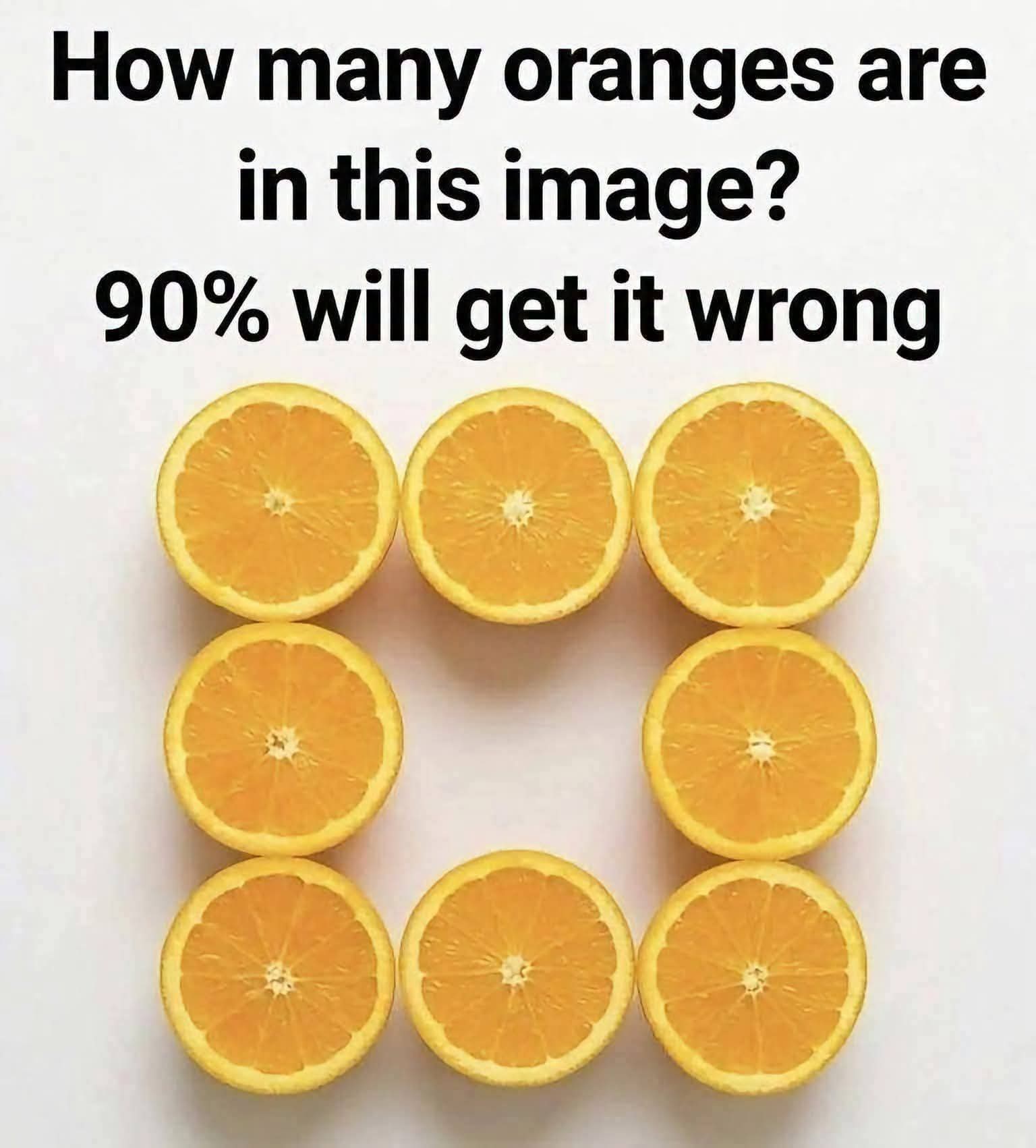
There are several orange halves arranged in a square-like pattern. Most people immediately start counting what they can see and quickly arrive at an answer. But this apparently simple visual puzzle has a clever twist that makes the wording of the question important.
So, how many oranges are actually in the picture?
The image shows eight visible orange halves.
But if each half represents one-half of a whole orange, then eight halves could represent four whole oranges.
That is exactly why this puzzle can cause so much confusion.
In this article, we will carefully examine the image, count every visible piece, explain the mathematical trick behind the puzzle, discuss why people make mistakes when solving visual brain teasers, and explore several possible interpretations of the answer.
The Answer at a Glance
Before going into the details, let’s make the basic observation clear.
Looking at the image from top to bottom:
- There are 3 orange halves across the top.
- There are 2 orange halves in the middle, one on the left and one on the right.
- There are 3 orange halves across the bottom.
That gives:
3 + 2 + 3 = 8 visible orange halves.
Therefore, if the question is asking how many orange pieces are visibly present, the answer is:
8 orange halves
However, if the question literally means the number of complete oranges that were used to produce those halves, then:
8 halves ÷ 2 = 4 whole oranges.
So the puzzle has two reasonable answers depending on how the word “oranges” is interpreted.
Why Does This Puzzle Trick People?
Visual puzzles often depend on one simple psychological principle: we tend to see the overall picture before analyzing individual details.
When people look at this image, their eyes immediately recognize the circular orange shapes. Because the question asks how many oranges there are, the brain naturally begins counting the circles.
The arrangement makes this even easier.
The oranges are positioned almost like a frame:
🍊 🍊 🍊

🍊     🍊

🍊 🍊 🍊
The arrangement contains:
3 + 2 + 3 = 8
The calculation is simple.
The difficult part is noticing exactly what is being counted.
Are we counting:
- Visible orange halves?
- Whole oranges?
- Orange slices?
- Original oranges before they were cut?
The picture itself does not tell us how the oranges were cut. That is where the puzzle becomes interesting.
A Careful Look at the Image
Let’s break the picture into sections.
The Top Row
At the top of the arrangement, there are three visible orange halves.
From left to right:
- First orange half
- Second orange half
- Third orange half
So the top row contains:
3 pieces
The Middle Row
The center of the arrangement is deliberately left open.
There is one orange half on the left and one orange half on the right.
That gives:
2 pieces
The empty space between them is important because it creates the appearance of a square or frame.
The Bottom Row
At the bottom, there are three more orange halves:
- Left
- Center
- Right
So the bottom row contains:
3 pieces
The Simple Count
Now add everything together:
Top: 3
Middle: 2
Bottom: 3
Therefore:
3 + 2 + 3 = 8
So there are eight visible orange halves in the photograph.
This is the straightforward visual answer.
But there is another layer to the puzzle.
Eight Halves Do Not Necessarily Mean Eight Whole Oranges
This is where the wording becomes important.
The image does not show eight complete oranges.
It shows what appear to be eight cross-sectional halves.
If two halves came from one orange, then two pieces would represent one whole orange.
For example:
2 halves = 1 whole orange
Therefore:
8 halves = 4 whole oranges
That means a person interpreting the question literally could answer:
4 whole oranges
This is not necessarily a mistake. It depends on what the puzzle creator intended by the word “oranges.”
Why the Wording Matters
The exact wording says:
“How many oranges are in this image?”
It does not say:
- “How many orange halves are visible?”
- “How many orange pieces are shown?”
- “How many whole oranges are shown?”
- “How many oranges were used to create the picture?”
That ambiguity is what makes the puzzle more interesting.
If someone asks, “How many apples are on the table?” and you see four whole apples, the answer is obviously four.
But if you see eight apple halves, the answer becomes less straightforward.
You might say there are:
8 apple halves
But you could also say they represent:
4 whole apples
The same reasoning applies here.
The Most Common Answer: 8
For a viral visual brain teaser, the expected answer is generally based on what can be directly counted in the image.
There are eight visible orange pieces.
Therefore, if this is presented as a counting puzzle, the intended answer is most likely:
8
This is because the puzzle asks the viewer to count the objects that are visibly displayed.
The arrangement contains eight circular orange pieces, and each one can be individually identified.
So if someone responds:
“There are 8 oranges.”
they are following the visual counting method.
The Clever Alternative Answer: 4
However, someone who pays close attention to the fact that the oranges are cut in half may argue that the image contains only four original oranges.
Why?
Because:
8 halves ÷ 2 = 4 oranges
This interpretation turns the puzzle from a simple counting exercise into a question about language and assumptions.
It also explains why different people may give different answers while both having logical reasoning behind their answers.
Is There Actually a Correct Answer?
That depends on the rules of the puzzle.
If the puzzle is asking:
“How many orange halves can you see?”
Then the answer is definitely:
8
If the puzzle is asking:
“How many complete oranges would be represented by these eight halves?”
Then the answer could be:
4
But if the question simply asks:
“How many oranges are in this image?”
the safest response is to explain the distinction.
There are 8 visible orange halves, representing 4 whole oranges if every two halves came from one orange.
That answer acknowledges both interpretations.
Why Visual Brain Teasers Are So Popular
Puzzles like this have become extremely popular on social media because they are easy to understand and easy to share.
A person can see the image for only a few seconds and immediately form an answer.
Then the puzzle creates curiosity:
“Did you get it right?”
That question encourages people to comment.
Some people answer immediately.
Others inspect the image carefully.
And some notice the hidden ambiguity and begin debating the answer.
That discussion is exactly what makes these puzzles so engaging.
The Psychology Behind Quick Answers
Our brains are constantly trying to process information efficiently.
When we see a group of similar objects, we usually don’t analyze every object individually. Instead, we recognize the pattern and count the obvious elements.
In this image, all the orange halves are similar in size, shape, and color.
The brain therefore quickly organizes them into a recognizable pattern.
This is useful in everyday life.
Imagine walking into a supermarket and seeing a display of oranges. You don’t necessarily inspect every fruit individually. Your brain quickly recognizes the group.
But puzzles exploit this natural tendency.
They encourage us to make an immediate assumption before we examine the details.
The Importance of Looking at the Whole Image
One of the best strategies for solving visual puzzles is to avoid answering immediately.
Instead, ask yourself:
What exactly am I being asked to count?
Then examine the image systematically.
For this puzzle, start at the top.
Step 1: Count the top row
There are three.
Step 2: Move to the middle
There are two.
Step 3: Check the bottom
There are three.
Step 4: Add them together
3 + 2 + 3 = 8.
Step 5: Examine the shape of each object
They appear to be halves rather than whole oranges.
Step 6: Consider the wording
The question asks about “oranges,” not specifically “halves.”
Now you understand why the puzzle can generate two different interpretations.
The Square Arrangement Is Another Part of the Trick
The oranges are not placed randomly.
They form a shape resembling a square or rectangular frame.
There are three across the top, two on the sides, and three across the bottom.
This arrangement makes the image visually balanced.
It also makes counting easier once you recognize the pattern.
You can think of it as:
3 + 2 + 3
rather than trying to count all the pieces at once.
The empty center makes the arrangement particularly noticeable.
Your eyes are naturally drawn to the center, even though there is nothing there.
That creates an additional visual effect.
Why Some People Count 7 or 9
Interestingly, visual counting puzzles sometimes produce incorrect answers that are not close to the mathematical interpretation.
Someone may accidentally skip one orange because two pieces overlap visually.
Another person may count an object twice while moving their eyes around the arrangement.
This is why a systematic counting method is useful.
Instead of scanning randomly, count in rows.
For this image:
Top row = 3
Middle row = 2
Bottom row = 3
Total:
8
This approach reduces the possibility of missing an object.
A Simple Brain Exercise
Although this puzzle is mainly for entertainment, visual counting challenges can be useful as small exercises in attention.
They encourage you to:
- Observe carefully
- Break complicated information into smaller groups
- Avoid rushing
- Question assumptions
- Pay attention to wording
- Compare visual information with logical reasoning
These are useful skills beyond puzzles.
For example, when reading instructions, a person who rushes may overlook an important word.
When checking a document, someone may see what they expect to see rather than what is actually written.
When comparing products, prices, or measurements, careful observation can prevent mistakes.
A simple orange puzzle can therefore demonstrate a broader lesson:
Slow down before making assumptions.
What Makes a Good Visual Puzzle?
A good visual brain teaser usually contains three elements:
1. A Simple Question
The question should be easy to understand.
In this case:
“How many oranges are in this image?”
There is nothing complicated about the wording.
2. A Clear Visual Pattern
The image contains recognizable objects arranged in an intentional pattern.
Here, the orange halves form a square-like shape.
3. A Twist
The best puzzles make you question your first answer.
Here, the twist is the difference between counting visible halves and counting whole oranges.
The Difference Between Counting Objects and Counting Whole Items
This puzzle teaches an important concept that appears in many everyday situations.
Imagine someone puts six slices of pizza on a plate.
How many pizzas are there?
You cannot necessarily say six pizzas.
The six pieces might have come from:
- One large pizza
- Two pizzas
- Three pizzas
- Six small pizzas
Without additional information, the original number of pizzas cannot be determined with certainty.
The same principle applies to the oranges.
Eight halves tell us that there are eight visible pieces.
But they do not necessarily prove that exactly four whole oranges were used.
For all we know, the pieces could have come from different oranges, or some could have been cut differently.
Therefore, the mathematically safest description is:
Eight visible orange halves.
Why “4” Is an Assumption
It is tempting to divide eight by two and immediately declare that there are four oranges.
But that calculation assumes that:
Every pair of halves came from the same orange.
The picture does not actually show the original fruit before cutting.
Therefore, saying there are exactly four whole oranges involves an assumption.
This is an important distinction between what the image proves and what we infer from it.
What can we directly observe?
Eight orange halves.
What might those halves represent?
Four whole oranges, if paired normally.
That is why saying “8 visible halves, equivalent to 4 whole oranges” is more precise than simply saying “4.”
A Fun Way to Challenge Your Friends
Want to use this puzzle as a quick challenge?
Show the image to your friends and ask:
“How many oranges do you see?”
Do not immediately explain the trick.
Give everyone a few seconds to answer.
You may hear:
- “Eight!”
- “Four!”
- “Eight halves!”
- “It depends!”
- “This is a trick question!”
Then reveal the explanation.
The best part is that the discussion can continue because both eight and four have a logical basis depending on the interpretation.
What Is the Best Answer for This Viral Puzzle?
If you are answering the image as a social media brain teaser, the most appropriate response is:
8 oranges are visible in the image.
There are:
3 on top + 2 in the middle + 3 on the bottom = 8.
However, there is an important clarification:
Those eight visible pieces are orange halves, so they could represent four whole oranges if each pair came from one fruit.
Therefore, the complete answer is:
8 visible orange halves — equivalent to 4 whole oranges if paired into complete fruits.
That is the most accurate way to solve the puzzle without ignoring its visual trick.
Don’t Let “90% Get It Wrong” Fool You
The text on the image claims:
“90% will get it wrong.”
Statements like this are common in viral puzzles.
They are designed to increase curiosity and encourage people to test themselves.
But there is no need to take the percentage literally.
The real challenge is not whether 90% of people fail.
The interesting part is understanding why the question creates confusion.
The image demonstrates how a small wording difference can change the interpretation of a problem.
That is much more valuable than simply knowing whether you got a number right.
A Lesson in Critical Thinking
The orange puzzle is a miniature example of critical thinking.
Critical thinking means not simply accepting the first answer that comes to mind.
Instead, you ask:
What do I know?
What am I assuming?
Is the question precise?
Could there be another interpretation?
In this case:
What do we know?
There are eight visible orange halves.
What might we assume?
That every two halves came from one whole orange.
What does that assumption produce?
Four whole oranges.
What is the safest observation?
Eight visible orange halves.
This is a great example of why careful reasoning matters.
Try Solving It Without Counting
Here is another way to recognize the answer.
Instead of counting each orange individually, identify the pattern.
The arrangement is:
3 – 2 – 3
Now add the groups:
3 + 2 + 3 = 8
This is faster and reduces the chance of missing one.
Visual grouping is a useful mental strategy.
When objects are arranged in predictable groups, our brains can process them more efficiently.
Why the Image Looks Like a Frame
The empty center gives the oranges the appearance of a border.
There are three pieces across the top.
Two vertical pieces form the sides.
Three pieces complete the bottom.
This makes the arrangement visually resemble a square frame made from oranges.
The unusual arrangement is part of what makes the image memorable.
If the eight halves were simply placed in two straight rows, the puzzle would feel much less interesting.
The frame-like design creates an expectation that there might be something hidden in the middle.
But there isn’t.
The empty center is simply part of the pattern.
Could There Be More Than Four Whole Oranges?
Yes, theoretically.
This is another reason to be careful with the wording.
Eight halves could have originated from four oranges if each orange was cut into two halves.
But if some oranges were cut into more than two pieces and only certain pieces were shown, the original number could be different.
The photograph alone does not establish the history of the pieces.
This may sound overly technical for a simple puzzle, but it demonstrates a fundamental reasoning principle:
Do not claim more than the evidence supports.
The evidence supports eight visible pieces.
Anything beyond that requires an assumption.
The Difference Between Observation and Interpretation
This distinction is useful in many situations.
Observation
“I can see eight orange halves.”
This is directly supported by the image.
Interpretation
“These eight halves came from four whole oranges.”
This is reasonable, but it depends on an assumption.
Conclusion
“There are exactly four oranges in the picture.”
This is less certain because the photograph does not show the original fruit before cutting.
Understanding this difference is a valuable thinking skill.
Why People Love “Gotcha” Questions
People naturally enjoy discovering that something they thought was obvious was actually more complicated.
These questions create a small surprise.
The viewer thinks:
“That’s easy.”
Then they notice the twist:
“Wait a minute…”
That moment of realization is what makes brain teasers satisfying.
The orange puzzle works particularly well because there is no complicated mathematics.
The entire challenge comes from observation and language.
Other Questions You Can Ask About the Image
Once you understand the puzzle, you can create additional challenges.
For example:
How many orange halves are visible?
Answer: 8
How many oranges might they represent if each orange was cut in half?
Answer: 4
How many orange halves are on the top row?
Answer: 3
How many are on the bottom row?
Answer: 3
How many are on the sides of the middle section?
Answer: 2
How many spaces are there in the center?
Answer: 1 large central space
These variations show how the same image can support multiple questions.
Final Verdict
So, after carefully examining the image, what is the answer?
There are eight visible orange halves arranged in a square-like pattern.
The count is:
3 + 2 + 3 = 8
If you treat every visible half as an individual orange piece, the answer is:
8
If you assume that every two halves came from one complete orange, then those pieces represent:
8 ÷ 2 = 4 whole oranges
Therefore, the most precise answer is:
There are 8 visible orange halves, which could represent 4 whole oranges.
And that is the clever trick behind the puzzle.
The real lesson isn’t simply whether you answered eight or four. The real lesson is to look carefully, read the question precisely, and separate what you can actually observe from what you assume.
Sometimes the easiest-looking questions are the ones that deserve a second look.
So, did you answer 8 immediately—or did you stop and think about the fact that each orange is cut in half?
Share this puzzle with a friend and ask them to answer before you reveal the explanation. You may be surprised by how differently people interpret the exact same image!
Quick Answer for Social Media
Answer: 8 visible orange halves! 🍊🍊🍊
There are 3 across the top, 2 in the middle, and 3 across the bottom:
3 + 2 + 3 = 8
But here’s the trick: because each visible piece is a half orange, those 8 halves could represent 4 whole oranges if every two halves came from the same fruit.
So the safest answer is:
🍊 8 visible orange halves = potentially 4 whole oranges.
The puzzle is less about mathematics and more about careful observation and the wording of the question.
Did you get 8, 4, or did you spot the trick? 👇