Can One Leaf Really Cure Diabetes, High Blood Pressure, Pain, High Cholesterol, and Poor Circulation? The Truth Behind the Viral Claim
Introduction
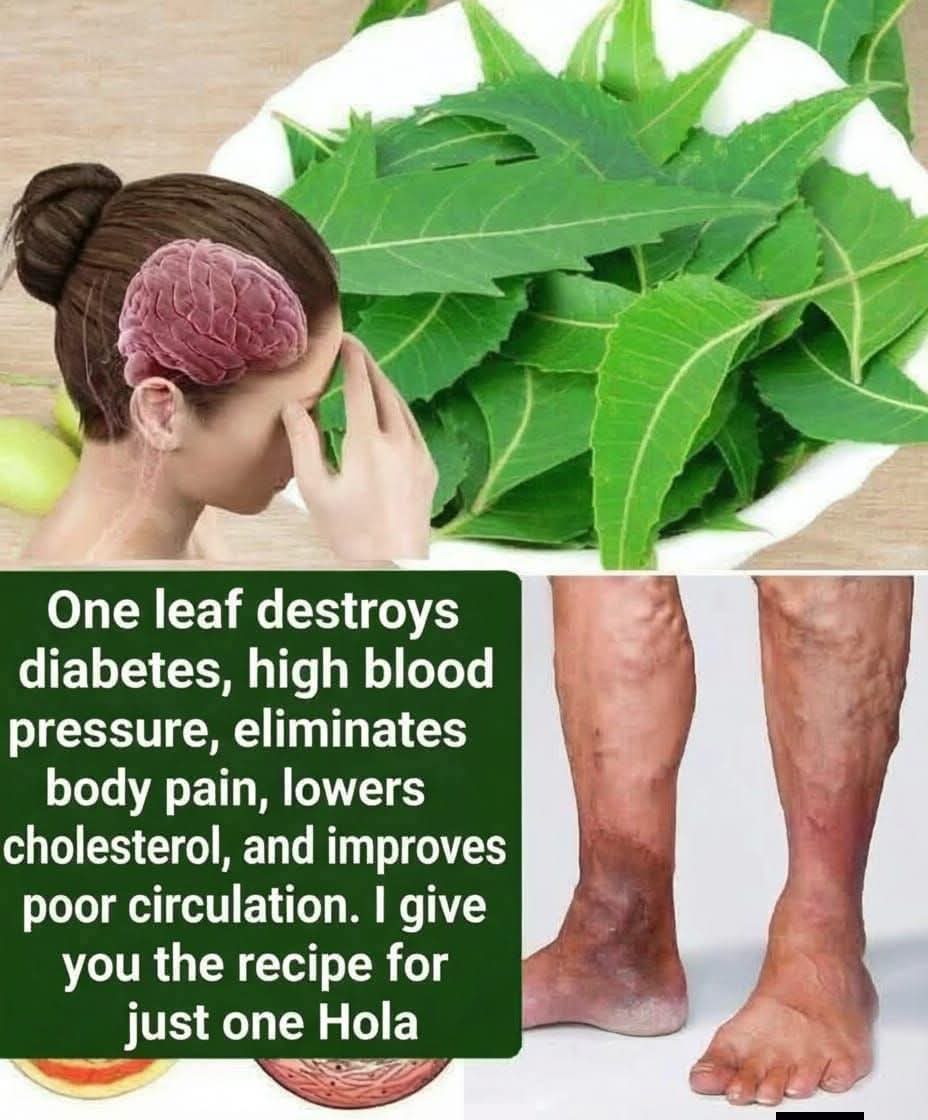
A dramatic health claim is circulating widely on social media: “One leaf destroys diabetes, high blood pressure, eliminates body pain, lowers cholesterol, and improves poor circulation.” The accompanying image shows a woman, green leaves, and illustrations suggesting diabetes, circulation problems, and other health conditions.
Claims like this are attractive because they promise something many people desperately want: a simple, inexpensive, natural solution to several difficult health problems at once. Instead of taking multiple medications, changing eating habits, exercising, monitoring blood pressure, checking blood glucose, or attending medical appointments, the message suggests that one ordinary leaf may be enough.
But there is an important difference between a plant having potentially useful compounds and a plant being capable of curing a disease.
No single leaf should be presented as a proven cure for diabetes, hypertension, high cholesterol, chronic pain, or poor circulation without strong clinical evidence. Some plants are being studied for their effects on blood glucose, blood pressure, inflammation, or cholesterol, but laboratory findings and small studies do not automatically mean that consuming the plant will safely treat a medical condition in humans.
This article examines the viral claim, explains why these promises can be misleading, discusses the possible role of medicinal plants, and offers safer ways to think about natural remedies.
What Does the Viral Image Claim?
The image makes several extremely broad promises. It suggests that one leaf can:
- “destroy” diabetes,
- lower high blood pressure,
- eliminate body pain,
- lower cholesterol,
- improve poor circulation,
- and potentially address several conditions with one preparation.
These are very serious claims because each condition has different causes, mechanisms, complications, and treatments.
Diabetes involves problems with blood glucose regulation and insulin. High blood pressure is influenced by factors such as genetics, kidney function, blood vessels, diet, weight, medications, stress, and other medical conditions. High cholesterol involves blood lipids and cardiovascular risk. Poor circulation can have many causes, including peripheral artery disease and other vascular problems. Body pain may result from muscle strain, arthritis, nerve disorders, injuries, infections, autoimmune diseases, or numerous other conditions.
A single plant preparation cannot reasonably be assumed to treat all of these conditions simply because it contains biologically active compounds.
The wording “destroys diabetes” is especially misleading. Diabetes is not something that can simply be destroyed by eating a leaf. Some people can achieve excellent blood glucose control through lifestyle changes, medication, weight management, or other treatments, but that is very different from claiming that a particular leaf permanently cures diabetes.
Why “Natural” Does Not Automatically Mean “Safe”
One of the most common misunderstandings surrounding herbal remedies is the idea that natural products are automatically harmless.
That is not true.
Plants contain chemicals. Some of those chemicals may have beneficial biological effects, while others can cause side effects, allergic reactions, toxicity, or interactions with medications.
For example, a plant that appears to lower blood glucose could potentially cause blood sugar to become too low when combined with diabetes medication. A plant that affects blood pressure could potentially contribute to excessively low blood pressure when taken alongside antihypertensive drugs.
The same principle applies to supplements and concentrated herbal extracts. A plant used traditionally as a food or tea is not necessarily equivalent to a concentrated capsule, tincture, extract, or homemade preparation.
This is why “natural remedy” should never automatically be interpreted as “risk-free remedy.”
Could the Leaves Shown in the Image Be Neem?
The leaves shown in the image resemble neem leaves, which come from the neem tree (Azadirachta indica). Neem has a long history of traditional use in parts of South Asia, Africa, and other regions.
Neem has attracted scientific interest because researchers have investigated various compounds found in different parts of the plant. Laboratory and animal research has explored possible antimicrobial, anti-inflammatory, antioxidant, and metabolic effects.
However, this does not establish the social-media claim that one neem leaf can cure diabetes, high blood pressure, cholesterol problems, pain, and circulation disorders.
There is a major difference between:
“Researchers are studying this plant because it contains biologically active compounds.”
and:
“This plant cures multiple chronic diseases.”
The first statement can be scientifically reasonable. The second requires strong clinical evidence and should not be accepted simply because it appears in a viral graphic.
Diabetes Cannot Be Safely Treated by Social-Media Recipes
Diabetes is one of the most important conditions mentioned in the viral claim.
High blood glucose can damage blood vessels and nerves over time. Poorly controlled diabetes can increase the risk of complications involving the eyes, kidneys, nerves, heart, and blood vessels.
Treatment depends on the type of diabetes and the individual’s circumstances.
Some people manage type 2 diabetes through dietary changes, physical activity, weight management, and medication. Others require insulin or other glucose-lowering treatments. Type 1 diabetes requires insulin because the body cannot produce sufficient insulin.
This is why someone with diabetes should not stop prescribed medication because they have discovered a plant remedy online.
Even if an herbal product genuinely has glucose-lowering effects, replacing proven treatment with an unverified preparation could allow blood glucose to remain dangerously high.
A more responsible approach is to think of plants as potential components of a healthy diet or subjects of scientific research, rather than automatic replacements for medical treatment.
What About High Blood Pressure?
High blood pressure is another condition that can remain silent for years.
A person may feel completely normal while blood pressure is damaging the cardiovascular system. Over time, uncontrolled hypertension can contribute to serious complications, including heart disease, stroke, kidney problems, and other vascular conditions.
This is why treating hypertension requires more than judging how someone feels after drinking a tea or eating a leaf.
Blood pressure needs to be measured accurately.
If a person repeatedly has elevated readings, the appropriate response is to discuss them with a healthcare professional. Depending on the situation, treatment may involve reducing sodium intake, increasing physical activity, improving sleep, managing weight, limiting alcohol, stopping smoking, and using prescribed medication when appropriate.
A plant preparation should not be used as a substitute for monitoring and treatment.
Can a Leaf Lower Cholesterol?
Some plants and foods contain compounds that may influence lipid metabolism. Dietary patterns rich in vegetables, fruits, legumes, whole grains, nuts, seeds, and other minimally processed foods can support cardiovascular health.
But lowering cholesterol is not the same thing as taking one special leaf.
Cholesterol levels are influenced by genetics, diet, physical activity, body weight, certain medical conditions, and medications. For people at elevated cardiovascular risk, cholesterol-lowering medications may be recommended because they have been studied extensively for their ability to reduce cardiovascular events.
If a person has been prescribed such medication, they should not discontinue it simply because a viral post claims that a plant can do the same job.
The right question is not:
“What leaf can replace my treatment?”
A better question is:
“What dietary and lifestyle changes can safely support my cardiovascular health alongside the treatment recommended for me?”
“Poor Circulation” Is Not a Diagnosis by Itself
The phrase “poor circulation” is frequently used online, but it can describe many different symptoms and conditions.
Cold hands and feet, leg discomfort, swelling, numbness, heaviness, or changes in skin color can have many possible causes.
One important condition is peripheral artery disease, in which narrowed arteries reduce blood flow to the limbs. Other causes of swelling or discomfort can involve veins, nerves, muscles, medications, or systemic illnesses.
This matters because treating “poor circulation” with a homemade herbal drink without discovering the underlying cause could delay appropriate care.
For example, persistent leg pain when walking, wounds that heal poorly, changes in skin color, or a cold and unusually painful limb can warrant medical assessment.
The goal should be to identify why circulation appears abnormal rather than simply masking the symptom.
What About Body Pain?
The viral image also claims that the leaf can eliminate body pain.
Pain is a symptom, not a single disease.
A person may experience pain because of arthritis, an injury, muscle overuse, nerve compression, infection, inflammation, migraine, autoimmune disease, or many other causes.
A remedy that seems to reduce pain temporarily does not necessarily treat the underlying problem.
This is especially important when pain is persistent, severe, worsening, associated with fever, accompanied by weakness or numbness, or associated with chest discomfort, shortness of breath, unexplained weight loss, or other concerning symptoms.
Instead of relying on a viral recipe, persistent pain deserves an appropriate evaluation.
Why These Claims Spread So Quickly
Health misinformation often spreads because it combines several powerful elements.
- It promises simplicity
People naturally prefer simple solutions to complicated problems.
“One leaf” sounds much easier than monitoring blood pressure, checking blood glucose, improving diet, exercising regularly, taking medication, and attending appointments.
- It uses dramatic language
Words such as “destroys,” “cures,” “eliminates,” and “never again” attract attention.
But dramatic wording is not evidence.
- It uses pictures that appear scientific
The image includes anatomical illustrations and health-related graphics. This can make the information look authoritative even when the underlying claim has not been established.
- It appeals to traditional knowledge
Many medicinal plants genuinely have long histories of traditional use. Respecting traditional knowledge is valuable, but traditional use does not automatically prove that a remedy can cure a modern medical diagnosis.
- It offers a recipe
Providing a simple preparation makes a claim feel practical and believable.
But the presence of instructions does not establish safety or effectiveness.
Traditional Medicine and Modern Research Can Coexist
It is important not to dismiss traditional medicine simply because a particular viral claim is exaggerated.
Humans have used plants as food and medicine for thousands of years. Modern pharmacology has also benefited from compounds originally discovered in plants.
The important question is how strong the evidence is.
Scientists generally look at several levels of evidence.
Laboratory research
Scientists may study a plant compound in cells or biochemical systems.
This can reveal interesting mechanisms, but laboratory effects do not prove that eating the plant produces the same effect in a human body.
Animal research
Animal studies can provide additional information about possible effects and toxicity.
However, animals are not humans, and results do not automatically translate into human treatment.
Small human studies
Early clinical studies may investigate whether a preparation appears safe or whether it changes a particular measurement.
Small studies can be useful, but they may not be large enough to establish whether a treatment prevents complications or improves survival.
Large clinical trials
Large, well-designed trials provide much stronger evidence about effectiveness and safety.
Systematic reviews and guidelines
Researchers can evaluate multiple studies together. Medical guidelines may then consider the overall evidence when making recommendations.
This is why a social-media post should not be treated as equivalent to clinical evidence.
A Plant May Affect Blood Sugar Without “Curing” Diabetes
This distinction is worth emphasizing.
Suppose researchers discover that a plant extract lowers blood glucose in a laboratory experiment.
That does not mean:
- the raw leaf works the same way,
- the correct dose is known,
- the effect is strong enough to treat diabetes,
- the preparation is safe,
- the plant prevents diabetic complications,
- or the plant can replace medication.
At most, it suggests that further research may be worthwhile.
This is how responsible science progresses: an interesting observation becomes a research question, not an immediate medical recommendation.
The Danger of Stopping Medication
Perhaps the most concerning consequence of viral herbal claims is medication abandonment.
Someone with diabetes might stop their medication because they believe a leaf is enough.
Someone with hypertension might stop blood-pressure medicine because they begin drinking an herbal preparation.
Someone with high cardiovascular risk might stop a prescribed cholesterol-lowering medication.
These decisions can be dangerous.
Medications are prescribed based on individual risk factors, laboratory results, medical history, and evidence from clinical trials. If a person wants to use an herbal product, the safest approach is to tell their doctor or pharmacist.
The goal should be integration when appropriate, not replacement without evidence.
How to Approach a Viral Health Claim
Before trying a remedy promoted online, ask several questions.
Who is making the claim?
Is it a qualified medical professional, a university, a recognized health organization, or an anonymous social-media account?
What evidence is provided?
Does the post link to human clinical trials, or does it simply say that “studies show” something?
Is the study actually about the same preparation?
A laboratory extract is not necessarily equivalent to chewing one fresh leaf.
What is the dose?
A scientific study may use a carefully measured extract. A social-media recipe may provide no reliable dose at all.
Are side effects discussed?
A credible health source should discuss risks as well as possible benefits.
Are medication interactions mentioned?
This is especially important for people taking drugs for diabetes, blood pressure, cholesterol, blood clotting, or other chronic conditions.
Does the claim promise to cure many unrelated diseases?
This should immediately make you cautious.
The more conditions a single remedy supposedly cures, the more important it is to demand strong evidence.
Safer Ways to Support Blood Sugar and Cardiovascular Health
Rather than searching for a miracle leaf, focus on habits with established health benefits.
Build meals around minimally processed foods
Vegetables, fruits, beans, lentils, whole grains, nuts, seeds, and appropriate protein sources can form the foundation of a balanced diet.
Pay attention to added sugars
Regularly consuming large amounts of sugary drinks, sweets, and highly processed foods can make healthy blood glucose management more difficult.
Include regular physical activity
Walking, cycling, swimming, strength training, and other appropriate activities can support cardiovascular and metabolic health.
People with medical conditions should choose activity appropriate for their abilities and circumstances.
Maintain a healthy weight when appropriate
For people who are overweight, even modest weight loss can improve several metabolic risk factors.
Do not smoke
Smoking damages blood vessels and substantially increases cardiovascular risk.
Sleep adequately
Poor sleep can affect appetite, metabolism, blood pressure, and overall health.
Monitor important numbers
For people with diabetes or hypertension, regular monitoring can help identify problems before they become serious.
When a Herbal Remedy May Be Reasonable
There are circumstances in which herbs can be included safely.
For example, culinary herbs and spices can add flavor without requiring large amounts of salt, sugar, or unhealthy fats. Herbal teas may also be enjoyable beverages for many people.
The important distinction is between using a plant as part of normal food or beverage consumption and using it as a medical treatment for a chronic disease.
If someone wants to take concentrated herbal products for a medical purpose, professional advice is particularly important.
Pregnant or breastfeeding people, children, older adults, and people taking multiple medications may need additional caution.
What If Someone Already Tried the Remedy?
There is no reason to panic simply because someone consumed a small amount of a plant traditionally used as food or tea.
However, if an herbal preparation causes symptoms such as severe vomiting, confusion, fainting, difficulty breathing, swelling, severe dizziness, abnormal heartbeat, or other concerning reactions, medical attention may be necessary.
People with diabetes should also be cautious about unexplained changes in blood glucose after using any product claimed to lower sugar.
Likewise, anyone taking medication for blood pressure should monitor for symptoms such as unusual dizziness or fainting if they begin a product that may affect blood pressure.
The Important Difference Between “May Help” and “Cures”
This is one of the most useful lessons for evaluating health information.
Consider these three statements:
“This plant contains compounds that are being studied for possible metabolic effects.”
This is a cautious scientific statement.
“This plant may have an effect on blood glucose in certain circumstances.”
This may be reasonable if supported by appropriate research.
“One leaf destroys diabetes and cures high blood pressure.”
This is an extraordinary medical claim requiring extraordinary evidence.
Unfortunately, social media frequently jumps from the first type of statement to the third.
That jump is where misinformation begins.
Can You Still Enjoy the Plant?
If the leaves pictured in the viral post are indeed neem, people should not assume that identifying the plant automatically makes it appropriate to consume.
Plant identification matters because different plants can look similar, and some can be toxic.
Preparation also matters. The safety of a traditional food preparation does not automatically establish the safety of concentrated extracts or large quantities.
Anyone interested in using a medicinal plant should make sure the plant has been correctly identified and should consider discussing its use with a qualified healthcare professional, particularly when treating an existing medical condition.
Red Flags That Mean You Should Not Rely on a Home Remedy
Certain symptoms deserve medical attention rather than experimentation with herbal remedies.
These include:
- chest pain or pressure,
- sudden shortness of breath,
- fainting,
- sudden weakness or numbness,
- difficulty speaking,
- sudden vision changes,
- severe or rapidly worsening pain,
- a suddenly cold or pale limb,
- severe swelling,
- infected or non-healing wounds,
- very high or very low blood glucose,
- confusion,
- persistent unexplained weight loss,
- or symptoms that are rapidly getting worse.
These signs may indicate serious illness.
A social-media recipe should never delay emergency care.
What the Viral Message Gets Right
It is possible to extract a few positive ideas from the viral message without accepting its unsupported conclusion.
Plants can contain useful compounds.
A diet rich in plant foods can contribute to overall health.
Traditional knowledge can inspire scientific research.
Some medications have their origins in natural compounds.
And lifestyle choices absolutely can influence blood sugar, blood pressure, cholesterol, inflammation, and cardiovascular health.
The mistake is turning these truths into the claim that one leaf cures everything.
Health is usually the result of many interacting factors rather than a single magical ingredient.
What the Viral Message Gets Wrong
The most problematic parts of the message are its absolute promises.
There is no good reason to assume that one leaf can simultaneously eliminate diabetes, hypertension, high cholesterol, chronic pain, and circulation problems.
These are distinct medical issues.
Even when a plant demonstrates a promising biological effect, that does not establish that consuming it will treat a diagnosed disease.
The message also fails to discuss dose, preparation, side effects, drug interactions, contraindications, or the importance of professional diagnosis.
Those omissions are significant.
A Better Way to Think About “Miracle Remedies”
Instead of asking:
“Which leaf cures my disease?”
ask:
“What evidence exists for this plant, what preparation was studied, what dose was used, what are the risks, and how does it compare with established treatments?”
That question encourages better health decisions.
It is possible to appreciate traditional remedies while still demanding evidence.
It is possible to enjoy healthy plant foods without claiming that they cure disease.
And it is possible to use complementary approaches responsibly without abandoning proven medical care.
Frequently Asked Questions
Can one leaf cure diabetes?
There is no basis for assuming that one leaf can cure diabetes. Diabetes requires appropriate diagnosis, monitoring, and management. Treatment depends on the type of diabetes and the individual.
Can neem leaves replace diabetes medication?
They should not be assumed to replace prescribed diabetes medication. Anyone considering neem or another herbal product should discuss it with a healthcare professional.
Can herbal remedies lower blood pressure?
Some plants may have compounds that influence blood pressure, but that does not mean every herbal remedy is effective or safe for hypertension. People taking blood-pressure medication should be particularly cautious about possible interactions.
Can a leaf lower cholesterol?
Some plant compounds may affect cholesterol metabolism, but a viral claim is not enough evidence to recommend a specific leaf as a cholesterol treatment.
Is natural medicine always safe?
No. Natural substances can have powerful biological effects, side effects, toxicities, and medication interactions.
Why do these claims become viral?
They are simple, inexpensive, emotionally appealing, and easy to demonstrate in short videos and graphics. Unfortunately, simplicity and popularity do not prove effectiveness.
Should people stop their medications after trying a plant remedy?
No. Prescription medication should not be stopped or changed without discussing the decision with the prescribing healthcare professional.
Final Thoughts
The image claiming that “one leaf destroys diabetes, high blood pressure, eliminates body pain, lowers cholesterol, and improves poor circulation” is an example of a health message that makes far stronger promises than the evidence can justify.
Some plants, including neem and many other traditional medicinal plants, contain interesting compounds and deserve scientific investigation. Research into their possible effects may eventually lead to useful therapies or complementary approaches.
But scientific interest is not the same as proof of a cure.
Diabetes, hypertension, high cholesterol, circulation disorders, and chronic pain all deserve appropriate evaluation. They can have serious consequences when ignored or inadequately treated.
The safest approach is not to reject every traditional remedy, nor is it to believe every viral health claim. The better approach is to ask questions, look for reliable human evidence, understand possible risks, and discuss herbal products with qualified healthcare professionals when they are being used for medical purposes.
A healthy lifestyle remains far more dependable than a supposed miracle ingredient: balanced nutrition, regular physical activity, adequate sleep, avoiding tobacco, maintaining appropriate weight, monitoring important health measurements, and following evidence-based treatment when needed.
A leaf can be interesting. A traditional remedy can be worth studying. But “natural” is not synonymous with “cure,” and a viral image should never replace medical evidence or professional care.