Aloe Vera: What Is It Really Used For? Benefits, Safety, Myths, and the Truth Behind Viral Health Claims
Aloe vera has been used for centuries and is one of the most recognizable medicinal plants in the world. Its thick green leaves contain a clear gel that is commonly used in skincare products, burn treatments, cosmetics, and some dietary products. Because aloe vera is natural and easy to grow, it has also become a popular ingredient in home remedies and traditional medicine.
But there is an important difference between traditional use, promising research, and proven medical treatment.
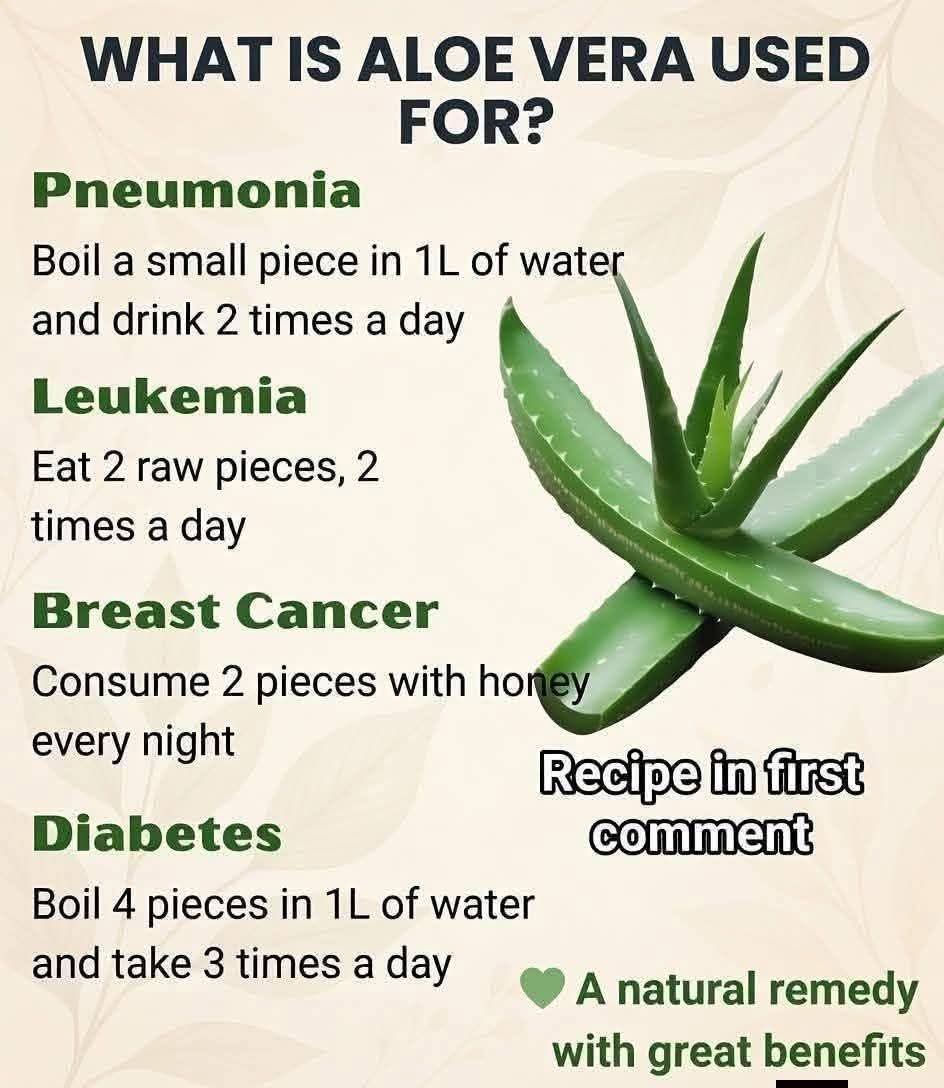
A viral image circulating online claims that aloe vera can be prepared in specific ways to treat serious diseases such as pneumonia, leukemia, breast cancer, and diabetes. Those claims should not be accepted as medical advice. There is currently no good evidence that eating pieces of raw aloe vera, drinking boiled aloe water, or mixing aloe with honey can cure leukemia, breast cancer, or pneumonia. Aloe should never be used as a replacement for appropriate medical diagnosis and treatment.
At the same time, dismissing aloe vera completely would also be misleading. Research has found some potentially useful applications, particularly when aloe gel is applied to the skin. Evidence suggests that topical aloe may help with certain burns and some skin conditions, while research into oral aloe remains more limited.
This article explains what aloe vera is, what parts of the plant are used, what science actually says about its benefits, why some viral claims are dangerous, how to use aloe more safely, and when professional medical care is essential.
What Is Aloe Vera?
Aloe vera is a succulent plant that grows in warm and dry climates. Its long, fleshy leaves store water and contain several different substances.
The leaf is not simply one uniform ingredient. It contains different layers, and this distinction is extremely important.
The inner leaf gel is the clear, slippery material found inside the leaf. This is the part most commonly used in topical aloe products.
The latex is a yellowish substance found closer to the outer portion of the leaf. Aloe latex contains compounds called anthraquinones, including aloin, which have laxative effects.
There are also whole-leaf preparations, which may contain components from both the gel and outer parts of the plant.
These different forms should not be treated as interchangeable.
The National Center for Complementary and Integrative Health explains that aloe products can be made from inner-leaf gel, latex, or whole crushed leaf. Their safety profiles can be very different.
That is one reason why simply saying “aloe vera is healthy” is too broad. The exact product, preparation, amount, and method of use matter.
Aloe Vera and Skin Care
One of the best-known uses of aloe vera is topical skincare.
The clear gel has a cooling and soothing texture, which is why it is frequently included in after-sun products, moisturizers, creams, lotions, and preparations designed for irritated skin.
Research suggests that topical aloe gel may have some benefits for certain burns and wounds. The evidence is not perfect, and aloe is not appropriate for every wound, but studies have found potential benefits for healing and discomfort associated with some burns.
Aloe has also been investigated for conditions such as acne, psoriasis, oral lichen planus, and some other skin problems. In several of these areas, research is promising but still limited.
This is a much more reasonable way to think about aloe:
Aloe vera may be a useful supportive skincare ingredient for certain conditions, but it is not a universal cure.
Aloe Vera for Burns
Aloe vera is traditionally associated with soothing burns.
Topical aloe gel can provide a cooling sensation and may help support healing in some minor burns. Mayo Clinic notes that applying aloe gel to first- and second-degree burns and wounds may speed healing.
However, not every burn should be treated at home with aloe.
Large burns, deep burns, electrical burns, chemical burns, burns involving the face or major joints, and burns with signs of serious injury require medical evaluation.
For a minor burn, appropriate first aid is much more important than immediately reaching for a plant remedy. Cool running water is generally recommended for initial cooling, while ice should not be placed directly on the skin.
Aloe can potentially be considered afterward as a soothing topical product when appropriate.
Can Aloe Vera Treat Pneumonia?
This is one of the most important claims in the viral image.
The image suggests boiling a piece of aloe vera in one liter of water and drinking it twice a day for pneumonia.
There is no reliable evidence that this preparation cures pneumonia.
Pneumonia is an infection or inflammation affecting the lungs and can be caused by different organisms. Bacterial pneumonia may require antibiotics, while viral causes may require different management. The appropriate treatment depends on the cause and severity.
The NHS notes that pneumonia can cause cough, shortness of breath, fever, chest pain, fatigue, and other symptoms. Severe breathing difficulty, blue or pale lips or skin, or sudden confusion can require emergency care.
This is why relying on aloe tea for suspected pneumonia could be dangerous. Someone might delay medical treatment while an infection becomes more severe.
Aloe vera may be consumed as a food or supplement in certain circumstances, but that is completely different from proving that it treats a lung infection.
If someone has symptoms that could indicate pneumonia, especially shortness of breath, chest pain, high fever, confusion, worsening symptoms, or coughing blood, medical evaluation should take priority.
Can Aloe Vera Cure Leukemia?
The viral image also recommends eating raw aloe pieces for leukemia.
This claim is not supported by established clinical evidence.
Leukemia is a group of cancers affecting blood-forming tissues and blood cells. Treatment can involve chemotherapy, targeted therapy, immunotherapy, radiation in certain circumstances, stem-cell transplantation, or combinations of treatments depending on the type and characteristics of the disease.
Aloe vera should not replace any cancer treatment prescribed by an oncology team.
Laboratory research may investigate individual plant compounds for biological effects, but results from laboratory experiments do not automatically mean that eating the plant will treat cancer in humans.
This distinction is essential.
A substance can show activity against cancer cells in a laboratory while having no proven ability to cure cancer in a human being. Researchers must establish appropriate dosage, absorption, safety, effectiveness, interactions, and clinical outcomes through carefully designed studies.
Therefore, claims that eating raw aloe can cure leukemia should not be presented as medical fact.
Can Aloe Vera Cure Breast Cancer?
Another claim in the image recommends eating aloe vera with honey every night for breast cancer.
Again, there is no established evidence that this combination cures breast cancer.
Breast cancer is a complex disease with many different subtypes. Treatment depends on factors such as tumor characteristics, stage, hormone receptor status, HER2 status, overall health, and previous treatment.
Modern breast cancer care can include surgery, radiation therapy, hormone therapy, chemotherapy, targeted medicines, and immunotherapy.
Aloe vera and honey can be foods or ingredients, but they are not substitutes for evidence-based cancer treatment.
People with cancer should also be particularly careful about herbal supplements. Natural products can interact with medicines or affect the body in ways that are not always obvious.
The safest approach is to tell the oncology team about every supplement, herbal preparation, tea, or concentrated plant product being used.
Aloe Vera and Diabetes
The diabetes claim in the viral image is somewhat more complicated.
Research has investigated whether orally consumed aloe may affect blood glucose levels. According to NCCIH, a small amount of research suggests that oral aloe may reduce blood sugar and HbA1c in people with diabetes. However, the evidence is limited, and this does not establish aloe as a replacement for diabetes treatment.
This distinction is extremely important.
A person taking diabetes medication who suddenly adds an oral aloe product could potentially experience changes in blood sugar. Mayo Clinic also warns that taking aloe gel orally alongside diabetes medicines may increase the risk of low blood sugar.
Therefore, someone with diabetes should not follow a social-media recipe such as boiling several pieces of aloe in water and drinking it multiple times per day without discussing it with a healthcare professional.
Diabetes management involves much more than one ingredient. Depending on the person, it can involve nutrition, physical activity, monitoring blood glucose, medication, weight management, and regular medical follow-up.
Why “Natural” Does Not Automatically Mean Safe
One of the biggest misconceptions surrounding herbal remedies is that natural substances cannot cause harm.
That is not true.
Plants contain biologically active chemicals. Some can be beneficial. Others can cause side effects, interact with medications, or become harmful at higher doses.
Aloe is an excellent example.
Topical aloe gel is generally well tolerated, although some people may develop burning, itching, rash, or eczema. Short-term oral use of certain aloe gel preparations has been studied, but oral aloe latex can cause abdominal cramps and diarrhea. Oral aloe preparations have also been associated with cases of acute hepatitis.
Mayo Clinic specifically warns that oral aloe latex can be dangerous and that high amounts may cause serious kidney problems.
So the fact that aloe grows naturally in a garden does not make every preparation safe to eat.
Aloe Gel vs. Aloe Latex: A Crucial Difference
Many people refer to everything inside an aloe leaf as “aloe gel,” but the distinction between gel and latex is important.
The clear inner gel is generally the part used in topical products.
Aloe latex is different. It contains compounds that stimulate the bowel and can act as a laxative.
Historically, aloe latex was used for constipation. However, safety concerns led to restrictions on its use in over-the-counter laxative products in the United States.
The risk becomes especially important when people prepare whole aloe leaves at home.
Removing the outer skin and yellow latex carefully is not necessarily equivalent to using a standardized commercial product. Homemade preparations can vary considerably in composition and concentration.
That is another reason not to assume that a viral recipe is harmless simply because it uses a plant.
Can You Eat Raw Aloe Vera?
Some commercially prepared aloe products are designed for oral consumption, but eating raw pieces directly from a plant is different.
The leaf contains latex and other compounds that may cause adverse effects if consumed.
People who want to consume aloe should therefore avoid experimenting with large quantities of raw leaf or homemade whole-leaf preparations.
The form of aloe matters, and commercially prepared products may undergo processing intended to remove or reduce unwanted compounds.
Even then, “commercial” does not automatically mean “appropriate for everyone.”
People taking medications or living with chronic conditions should discuss oral aloe with a healthcare professional.
Aloe Vera and Digestion
Aloe has a long history of traditional use for digestive complaints, but its effects depend strongly on which part of the plant is consumed.
Aloe latex can stimulate bowel movements because of its laxative compounds. That does not mean that drinking aloe water is a general digestive-health treatment.
Using laxatives unnecessarily can lead to diarrhea, dehydration, abdominal cramping, and disturbances in electrolyte balance.
For occasional constipation, dietary fiber, adequate fluids, physical activity, and appropriate medical guidance are usually more sensible starting points than experimenting with raw aloe leaves.
Persistent constipation should also be evaluated because it can sometimes signal an underlying medical problem.
Aloe Vera and Acne
Aloe is frequently included in skincare products aimed at acne-prone skin.
Some research suggests that topical aloe, particularly when combined with conventional acne treatment, may provide additional benefits. Mayo Clinic notes evidence that aloe gel used with tretinoin may work better than the acne medication alone in some circumstances.
However, aloe should not be considered a replacement for proven acne treatments.
Acne can range from occasional pimples to severe inflammatory disease that can cause permanent scarring. People with persistent or severe acne may benefit from professional dermatological advice.
Aloe can potentially be part of a gentle skincare routine, but it is not a miracle acne cure.
Aloe Vera and Psoriasis
Psoriasis is another condition for which topical aloe has been studied.
Some evidence suggests aloe preparations may help symptoms of mild to moderate psoriasis, but results are not strong enough to consider aloe a universal treatment.
Psoriasis is a chronic inflammatory condition, and treatment often needs to be individualized.
Aloe may be used as a complementary skincare product if tolerated, but people should not discontinue prescribed treatment simply because a natural remedy appears to help temporarily.
Aloe Vera and Inflammation
Aloe contains numerous compounds that researchers have investigated for antioxidant and anti-inflammatory activity.
These laboratory findings are interesting, but they need to be interpreted carefully.
A chemical effect observed in a test tube does not prove that consuming the plant will produce the same effect throughout the human body.
The human digestive system changes many substances, and absorption varies. A compound can also have different effects at different concentrations.
This is why scientific evidence relies heavily on human clinical studies rather than laboratory observations alone.
What About Aloe Vera and Cancer Research?
There is legitimate scientific interest in aloe and cancer research, but that interest should not be confused with proof that aloe cures cancer.
Researchers have studied aloe components in laboratory and animal models. Some biological effects have generated questions worth investigating.
However, patients need evidence from well-designed human clinical trials before a treatment can be considered an established cancer therapy.
NCCIH also highlights an important safety issue: certain non-decolorized whole-leaf aloe extracts have raised cancer-related concerns in animal studies, and the International Agency for Research on Cancer has classified non-decolorized whole-leaf extract as possibly carcinogenic to humans.
This is one more reason why casually consuming homemade whole-leaf aloe is not a good idea.
Aloe Vera and Honey: A Popular Combination
Aloe and honey are often combined in traditional remedies.
Honey has its own nutritional and culinary uses, and it may soothe a cough in some situations. Aloe has its own history of topical use.
But combining two natural ingredients does not automatically create a medicine capable of treating cancer, pneumonia, leukemia, diabetes, or another serious disease.
A recipe can be pleasant or culturally meaningful without being a proven medical treatment.
The key question should always be:
What does human clinical research actually show?
That question helps separate traditional practices from exaggerated internet claims.
Who Should Be Especially Careful With Oral Aloe?
People taking medications should speak with a healthcare professional before using oral aloe.
Mayo Clinic lists several potential interactions, including concerns involving diabetes medicines, digoxin, anticoagulant or antiplatelet medicines, diuretics, and other laxatives.
People who are pregnant or breastfeeding should also avoid oral aloe unless specifically advised by their healthcare professional. NCCIH notes that aloe taken orally may be unsafe during pregnancy and breastfeeding.
Children should not be given homemade aloe preparations simply because an online recipe recommends them.
People with kidney, liver, heart, digestive, or other chronic conditions should also discuss oral herbal products with a qualified professional.
How to Use Aloe More Responsibly
If you enjoy aloe vera and want to include it in your lifestyle, focus on uses that have the strongest evidence and the lowest unnecessary risk.
1. Choose topical products for skincare
A properly formulated aloe gel can be useful as a soothing skincare ingredient.
2. Avoid drinking homemade whole-leaf preparations
The concentration of latex and other compounds can vary, making homemade preparations unpredictable.
3. Don’t use aloe instead of prescribed medicine
This is particularly important for cancer, pneumonia, diabetes, and other serious diseases.
4. Read product labels
Look at whether the product contains inner-leaf gel, whole-leaf extract, or latex.
5. Watch for skin reactions
Stop using a topical product if it causes significant burning, itching, swelling, or a rash.
6. Tell your healthcare professional about supplements
Even natural products can interact with medicines.
When a Viral Health Claim Should Raise a Red Flag
There are several warning signs that an online remedy may be unreliable.
Be cautious when a post says an ingredient:
- Cures multiple unrelated diseases.
- Works for cancer without clinical evidence.
- Replaces prescription medication.
- Works “for everyone.”
- Requires no medical diagnosis.
- Has a secret or “miracle” recipe.
- Promises guaranteed results.
- Says doctors do not want people to know about it.
- Uses dramatic testimonials instead of scientific evidence.
The viral aloe image contains several of these characteristics because it presents one plant as a treatment for very different serious illnesses.
That should encourage readers to pause and verify the information before trying the remedy.
What Should You Do If You Suspect Pneumonia?
Do not attempt to manage suspected pneumonia solely with aloe.
Pneumonia can become serious, particularly in older adults, babies, and people with heart or lung conditions or weakened immune systems.
Symptoms can include:
- Cough
- Fever
- Shortness of breath
- Chest pain
- Fatigue
- Loss of appetite
- Body aches
- Confusion, particularly in older adults
Severe breathing difficulty, blue or pale skin or lips, or sudden confusion can be signs of an emergency.
Treatment depends on the cause. Bacterial pneumonia may require antibiotics, while antibiotics do not treat viral infections.
Aloe tea cannot be relied upon to eliminate a lung infection.
The Importance of Evidence-Based Cancer Treatment
Cancer treatment can be emotionally and physically difficult, which makes miracle-cure claims especially appealing.
When someone is frightened after receiving a cancer diagnosis, a simple natural remedy can sound comforting.
Unfortunately, replacing effective treatment with an unproven remedy can allow a disease to progress.
Aloe may be used as a cosmetic or complementary product in some situations, but it should not be presented as a cure for leukemia or breast cancer.
Anyone diagnosed with cancer should discuss complementary therapies with their oncology team before starting them.
This is not about rejecting traditional medicine. It is about making sure traditional practices and modern medical care can coexist safely.
The Real Benefits of Aloe Vera
After separating the facts from exaggerated claims, aloe vera still has several interesting potential uses.
Its strongest practical role is probably in topical skincare.
Potential applications supported by at least some research include:
- Soothing certain minor skin irritations
- Supporting healing of some burns
- Helping with certain acne treatments
- Supporting symptoms of mild psoriasis
- Providing a moisturizing or cooling sensation
- Supporting some other topical skin conditions under appropriate circumstances
NCCIH notes that research has also explored aloe for several other conditions, but evidence is insufficient to determine whether it is genuinely helpful.
That is a perfectly reasonable conclusion: aloe is useful in some contexts, but it is not a cure-all.
Frequently Asked Questions
Is aloe vera a medicine?
Aloe vera is used in healthcare products, cosmetics, foods, and dietary supplements. However, different aloe preparations have different effects and safety profiles.
Can aloe cure cancer?
There is no established evidence that eating aloe vera cures leukemia, breast cancer, or other cancers.
Can aloe treat pneumonia?
There is no reliable evidence that boiled aloe water cures pneumonia. Suspected pneumonia should be evaluated medically.
Can aloe lower blood sugar?
Some small studies suggest oral aloe may modestly lower blood glucose or HbA1c, but evidence is limited. It should not replace diabetes treatment, and it may interact with diabetes medicines.
Is it safe to eat raw aloe?
Raw whole aloe leaves can contain latex and other compounds that may cause side effects. Homemade oral preparations are therefore not recommended as a general health remedy.
Is aloe good for the skin?
Topical aloe gel is generally well tolerated and has evidence supporting certain uses, including some burns and skin conditions.
Can aloe cause side effects?
Yes. Topical aloe can occasionally cause skin irritation. Oral aloe latex can cause abdominal cramps and diarrhea, and more serious adverse effects have been reported with some oral preparations.
Final Thoughts
Aloe vera is a fascinating plant with a long history of traditional use and several legitimate modern applications. Its clear inner gel can be useful in skincare, and research suggests potential benefits for certain burns and other skin conditions.
But the viral claims that aloe vera can cure pneumonia, leukemia, breast cancer, or diabetes should not be treated as established medical advice.
The most important lesson is that the preparation matters, the dose matters, and the disease matters.
Aloe gel applied to the skin is very different from swallowing raw pieces of an entire aloe leaf. Aloe latex is different from inner-leaf gel. A commercially formulated product is different from a homemade mixture. And a traditional remedy is not automatically a clinically proven treatment.
For serious conditions such as pneumonia and cancer, delaying appropriate medical care can have serious consequences. For diabetes, adding oral aloe without professional guidance can potentially affect blood sugar or interact with medication.
So rather than asking whether aloe vera is simply “good” or “bad,” a better question is:
What form of aloe is being used, for what purpose, in what amount, and what does the evidence actually show?
That approach allows us to appreciate the genuine benefits of aloe vera without turning a traditional plant into a miracle cure.
Aloe vera can have a place in a healthy lifestyle and skincare routine, but it should be used responsibly. Natural remedies can complement good health practices in appropriate situations; they should not replace diagnosis, prescription treatment, or professional medical care when those are needed.
Important health note: This article is for educational purposes and does not diagnose, treat, or cure any disease. Anyone with symptoms of pneumonia, a cancer diagnosis, diabetes, or another serious condition should consult a qualified healthcare professional rather than relying on an aloe vera remedy.
Evidence and Further Reading
The information above is based primarily on guidance from the National Center for Complementary and Integrative Health and Mayo Clinic regarding aloe vera’s uses, evidence, safety, and potential interactions, as well as NHS guidance concerning pneumonia and antibiotic treatment.