Baking Soda for Dark Spots on the Face: What It Can and Cannot Do
Dark spots, uneven skin tone, and small areas of discoloration are among the most common skincare concerns. When people discover a simple household ingredient such as baking soda, it can be tempting to believe that a quick homemade treatment can make those marks disappear.
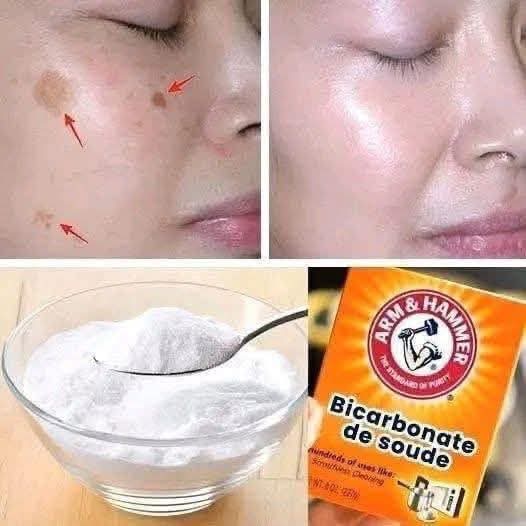
The image accompanying this article shows baking soda being promoted as a possible treatment for facial spots. Although baking soda is inexpensive and widely available, it is important to understand that applying baking soda directly to the face is not a proven or gentle treatment for hyperpigmentation. In fact, because facial skin can be sensitive, baking soda may cause dryness, irritation, redness, or damage to the skin barrier.
This does not mean that people with dark spots have no options. There are many safer ways to improve uneven skin tone, protect the skin from further discoloration, and gradually reduce the appearance of certain types of pigmentation.
In this article, we will explore what dark spots are, why they appear, what baking soda actually does, why some people use it on the skin, the potential problems with DIY baking-soda treatments, safer alternatives, skincare habits that can help, and when it is important to see a dermatologist.
What Are Dark Spots?
Dark spots are areas of skin that appear darker than the surrounding skin. They are commonly referred to as hyperpigmentation.
Hyperpigmentation occurs when the skin produces or accumulates more melanin in a particular area. Melanin is the natural pigment responsible for much of the color of our skin, hair, and eyes.
Dark spots can appear almost anywhere, but they are especially noticeable on the face because the face receives frequent exposure to sunlight and is often affected by acne, irritation, and cosmetic products.
Common causes include:
- Sun exposure
- Previous acne
- Inflammation
- Skin injuries
- Hormonal changes
- Certain medications
- Irritating skincare products
- Picking or squeezing pimples
- Natural aging
- Some skin conditions
Not every dark spot has the same cause. Therefore, a remedy that appears to work for one person may not work for another.
Why Do Dark Spots Develop?
Understanding the cause of pigmentation is more useful than simply trying to lighten the skin.
1. Sun Exposure
Ultraviolet radiation can stimulate melanin production. Over time, repeated sun exposure can contribute to freckles, sun spots, and uneven pigmentation.
This is one reason daily sun protection is so important when trying to improve dark spots.
Even if a product helps lighten pigmentation, continued unprotected sun exposure can make discoloration darker again.
2. Acne and Pimples
One of the most common reasons people develop dark marks on the face is acne.
After a pimple heals, inflammation can leave behind a flat brown, gray, or reddish mark. This is often called post-inflammatory hyperpigmentation.
The mark may remain long after the original pimple has disappeared.
3. Picking at the Skin
Squeezing or scratching pimples can increase inflammation and potentially increase the likelihood of lingering discoloration.
A gentle skincare routine is usually preferable to aggressive scrubbing.
4. Hormonal Changes
Hormonal changes can contribute to melasma, a type of pigmentation that often appears as larger patches on areas such as the cheeks, forehead, nose, and upper lip.
Melasma can be particularly persistent and may require professional treatment.
5. Irritation
Skin irritation itself can contribute to discoloration.
This is particularly important when discussing homemade treatments. A substance that causes burning, peeling, or inflammation may ultimately make pigmentation more noticeable rather than less noticeable.
What Is Baking Soda?
Baking soda is also known as sodium bicarbonate.
It is a white, alkaline powder commonly used for:
- Baking
- Household cleaning
- Odor control
- Certain food preparations
Because it has mild abrasive properties and is alkaline, some people have experimented with using it as a facial scrub or homemade skincare ingredient.
However, something being useful around the house does not automatically make it appropriate for facial skin.
The skin has its own protective barrier and a naturally acidic environment. Applying strongly alkaline substances can interfere with that environment.
Can Baking Soda Remove Dark Spots?
This is where the popular internet claim needs to be treated carefully.
There is not good evidence that rubbing ordinary household baking soda directly onto the face safely removes dark spots.
Baking soda does not function like a medically established pigmentation treatment.
Some people may notice that their skin looks temporarily smoother or brighter after using a powdery scrub. This can happen because surface dead skin and oil are removed.
However, temporary surface smoothness is not the same as treating the underlying cause of pigmentation.
If the baking soda causes irritation, the result may actually be counterproductive.
Why Do Some Homemade Baking Soda Treatments Appear to Work?
There are several reasons why people may believe that baking soda has removed their dark spots.
Exfoliation
Baking soda has a fine texture. When rubbed against the skin, it can physically remove some surface material.
This may make the skin feel smoother.
Temporary Brightness
Removing surface buildup can make the skin appear temporarily cleaner or brighter.
Natural Fading
Many dark marks naturally become lighter over time, particularly marks left after acne.
If someone begins using baking soda while a spot is already naturally fading, they may associate the improvement with the homemade treatment.
Photography and Lighting
Before-and-after photographs can also be misleading.
Different lighting, camera exposure, skin hydration, makeup, and image quality can make pigmentation appear dramatically different.
For this reason, a photograph alone is not reliable evidence that a homemade remedy treats pigmentation.
The Problem With Baking Soda on Facial Skin
The most important issue is not whether baking soda can make the skin temporarily look cleaner.
The bigger question is whether it can be used without causing unnecessary irritation.
Facial skin has a protective barrier made up of lipids, proteins, and skin cells. This barrier helps retain moisture and protects the skin from environmental irritants.
Repeatedly exposing the skin to irritating or excessively alkaline substances can interfere with this barrier.
Possible reactions include:
- Dryness
- Tightness
- Burning
- Stinging
- Redness
- Flaking
- Increased sensitivity
- Irritation
- Worsening inflammation
For someone already dealing with pigmentation, irritation can be especially undesirable because inflammation may contribute to additional discoloration.
Why Scrubbing Dark Spots Is Not Always a Good Idea
One of the most common DIY skincare mistakes is assuming that darker skin marks can simply be “scrubbed away.”
A dark spot is not necessarily dirt sitting on the surface of the skin.
Pigmentation can be located deeper within the skin and may be related to increased melanin production following inflammation, sun exposure, or hormonal changes.
Aggressive scrubbing does not solve the underlying cause.
Instead, excessive friction can irritate the skin.
A useful skincare principle is:
Gentle and consistent is usually better than harsh and aggressive.
Baking Soda and the Skin Barrier
The skin barrier plays a major role in maintaining healthy-looking skin.
A healthy barrier helps the skin:
- Retain moisture
- Resist irritation
- Maintain its natural protective function
- Reduce excessive dryness
- Tolerate skincare products more comfortably
When the barrier becomes irritated, people may notice dryness, sensitivity, roughness, or burning.
This is why adding multiple DIY ingredients to a skincare routine can sometimes create more problems than benefits.
Instead of trying to make the strongest homemade treatment possible, it is generally better to focus on ingredients and habits designed specifically for facial skin.
What About Baking Soda Mixed With Lemon Juice?
Another popular internet remedy combines baking soda with lemon juice.
This combination is not recommended as a facial treatment.
Lemon juice contains acids and can irritate the skin. Sun exposure after using citrus substances on the skin can also create additional problems in some circumstances.
Combining an alkaline powder with an acidic juice does not magically create a scientifically proven skin-lightening treatment.
The resulting mixture can still be irritating, especially on sensitive skin.
If the goal is to reduce dark spots, there are safer approaches than experimenting with kitchen ingredients.
What About Baking Soda and Honey?
Honey is commonly used in homemade skincare recipes because it can feel soothing and moisturizing.
However, adding honey to baking soda does not turn baking soda into a proven pigmentation treatment.
If someone enjoys using a simple honey-based skincare product and their skin tolerates it, that is a separate matter. But it should not be presented as a guaranteed treatment for dark spots.
What About Baking Soda and Water?
Some DIY recipes recommend mixing baking soda with water to create a paste.
This is one of the simplest versions of the trend shown in the image.
However, even when diluted with water, baking soda remains alkaline.
Dilution may change the strength and texture of the mixture, but it does not transform baking soda into a clinically proven treatment for facial hyperpigmentation.
Safer Ways to Improve Dark Spots
If you want to reduce the appearance of pigmentation, a gentle skincare routine is a much better starting point.
1. Wear Sunscreen
Sun protection is one of the most important parts of managing pigmentation.
Choose a broad-spectrum sunscreen with an appropriate SPF and apply it consistently.
Sunscreen is important because ultraviolet exposure can contribute to pigmentation and can make existing discoloration more persistent.
For people prone to pigmentation, consistent sun protection can make a significant difference over time.
2. Use a Gentle Cleanser
A harsh cleanser can leave the skin dry and irritated.
A gentle cleanser can remove sweat, oil, sunscreen, and environmental debris without unnecessary scrubbing.
Avoid washing the face repeatedly throughout the day unless specifically recommended for your skin needs.
3. Moisturize Regularly
A moisturizer helps support the skin barrier.
Look for a product appropriate for your skin type and use it consistently.
If your skin becomes dry and irritated, simplify your routine rather than adding more exfoliating products.
4. Consider Proven Brightening Ingredients
Several cosmetic and dermatological ingredients have more evidence behind them for improving uneven skin tone than kitchen remedies.
Depending on the type of pigmentation and your skin’s tolerance, products may contain ingredients such as:
- Niacinamide
- Vitamin C
- Azelaic acid
- Retinoids
- Certain exfoliating acids
- Other dermatologist-recommended treatments
Not every ingredient is appropriate for everyone.
It is also important to introduce active ingredients gradually rather than using several strong products at once.
Niacinamide for Uneven Skin Tone
Niacinamide is a form of vitamin B3 commonly used in skincare.
It is popular because it can support the skin barrier and may help improve the appearance of uneven skin tone over time.
One advantage of niacinamide is that it is available in many formulations, including moisturizers and serums.
However, more is not necessarily better.
A simple routine used consistently is often easier to tolerate than a complicated routine containing numerous active ingredients.
Vitamin C and Dark Spots
Vitamin C is another popular skincare ingredient.
Topical vitamin C products are used in cosmetic routines aimed at improving brightness and uneven pigmentation.
Because vitamin C products vary considerably in formulation and stability, choosing a reputable product and following its instructions is preferable to trying to create a homemade vitamin C treatment.
Fresh lemon juice is not an equivalent substitute for a properly formulated skincare product.
Azelaic Acid
Azelaic acid is another ingredient commonly used in skincare and dermatology.
It may be useful for people dealing with acne-prone skin and certain forms of discoloration.
Unlike a homemade baking soda paste, azelaic acid is specifically formulated for topical skin use.
People with sensitive skin should still introduce active products carefully and stop using them if significant irritation occurs.
Retinoids and Skin Renewal
Retinoids are vitamin A derivatives used in many dermatological routines.
They can help with several concerns, including acne and changes in skin texture, and some retinoid products may contribute to improvement in pigmentation over time.
Because retinoids can cause irritation and are not suitable for every person or situation, professional advice may be appropriate, particularly when using stronger formulations.
Don’t Forget About Acne
If dark marks are caused by acne, treating the acne itself is extremely important.
Otherwise, new pimples can continue creating new areas of post-inflammatory pigmentation.
A successful routine therefore needs to address both:
existing discoloration + the reason new discoloration is forming.
This is much more effective than repeatedly trying to scrub away old marks.
Avoid Picking Your Pimples
It can be difficult to leave pimples alone, but picking and squeezing can increase inflammation and may contribute to scarring and lingering discoloration.
Instead, use appropriate acne products and allow blemishes to heal.
If acne is persistent, painful, or causing scars, professional treatment may be worthwhile.
How Long Does It Take for Dark Spots to Fade?
There is no universal timeline.
Some superficial marks gradually become less noticeable over weeks or months.
Others can persist much longer, especially when pigmentation is deeper or when the cause continues.
Melasma, for example, can be persistent and may fluctuate with sun exposure and hormonal factors.
This is why claims promising that a homemade ingredient will remove every dark spot in a few days should be treated skeptically.
Healthy skin changes gradually.
Why “Instant Results” Can Be Misleading
Many viral skincare posts use dramatic before-and-after photographs.
However, several factors can influence the appearance of skin:
- Lighting
- Camera angle
- Makeup
- Moisturizer
- Skin hydration
- Image editing
- Different exposure settings
- Natural changes over time
A genuine skincare improvement generally requires consistent use over time.
The safest approach is to judge progress gradually rather than expecting an overnight transformation.
What Should You Do If You Already Used Baking Soda?
If you have already applied baking soda to your face, there is no reason to panic.
If your skin feels comfortable and looks normal, gently rinse the area and return to a simple skincare routine.
If you experience irritation, burning, redness, or significant dryness:
- Stop using the baking soda.
- Rinse gently with lukewarm water.
- Avoid scrubbing the area.
- Avoid adding more active ingredients.
- Use a gentle moisturizer if tolerated.
- Protect the area from sunlight.
- Seek professional medical advice if the reaction is severe or persistent.
Do not try to “neutralize” the skin by applying another kitchen ingredient.
Who Should Be Especially Careful?
People with sensitive or easily irritated skin should be particularly cautious with DIY exfoliation.
Extra caution is also appropriate for people who:
- Have eczema-prone skin
- Have a damaged skin barrier
- Recently had a cosmetic procedure
- Use prescription skin treatments
- Have active dermatitis
- Have significant acne inflammation
- Have unexplained pigmentation
If you are already using several active skincare products, adding baking soda may increase irritation without providing a meaningful benefit.
When Should You See a Dermatologist?
Most ordinary pigmentation is not an emergency, but some skin changes should be evaluated by a professional.
See a dermatologist or other qualified healthcare professional if a spot:
- Changes rapidly
- Changes in shape
- Has an unusual border
- Has several different colors
- Bleeds
- Crusts repeatedly
- Becomes painful
- Does not heal
- Looks significantly different from your other spots
A dermatologist can also determine whether pigmentation is related to acne, sun exposure, melasma, medication, inflammation, or another skin condition.
A Simple Daily Routine for Uneven Skin Tone
You do not need a complicated routine.
Morning
Step 1: Gentle cleanser, if needed.
Step 2: A suitable antioxidant or brightening product, such as vitamin C or niacinamide.
Step 3: Moisturizer.
Step 4: Broad-spectrum sunscreen.
Evening
Step 1: Gentle cleanser.
Step 2: A suitable treatment product, depending on your skin and the cause of pigmentation.
Step 3: Moisturizer.
The most important thing is consistency.
A simple routine followed regularly is generally more practical than constantly changing products.
Natural Does Not Always Mean Safe
One of the biggest lessons from viral DIY skincare recipes is that the word “natural” does not automatically mean “gentle.”
Many substances found in nature can irritate or damage skin.
Likewise, a household product may be perfectly useful for cooking or cleaning but unsuitable for cosmetic application.
Baking soda is a good example.
Its usefulness in the kitchen does not prove that it is appropriate for treating facial pigmentation.
Why the Skin’s pH Matters
Healthy skin has a naturally acidic surface environment.
This environment contributes to the skin’s normal barrier function and microbial balance.
Baking soda is alkaline.
That difference is one reason applying baking soda to the face may not be ideal, particularly when it is used repeatedly or aggressively.
Skincare products are generally formulated with the intended application area in mind.
That is an important distinction between a professionally formulated facial product and a homemade kitchen mixture.
The Importance of Patience
Dark spots rarely appear overnight, and they often do not disappear overnight.
A good skincare strategy focuses on:
- Preventing new pigmentation
- Protecting the skin from sunlight
- Treating acne and inflammation
- Supporting the skin barrier
- Using appropriate active ingredients
- Avoiding unnecessary irritation
- Giving the skin enough time to respond
Patience is especially important because aggressive treatments can sometimes create the very inflammation that makes pigmentation worse.
Common Myths About Dark Spots
Myth 1: Baking soda can erase every dark spot.
There is no good evidence supporting this claim.
Myth 2: Stronger burning means the treatment is working.
Absolutely not.
Burning and irritation are signs that the skin may be reacting negatively.
Myth 3: Scrubbing harder produces faster results.
Aggressive scrubbing can damage the skin barrier and increase irritation.
Myth 4: Lemon and baking soda are a powerful natural bleaching treatment.
This is an unsafe oversimplification and should not be treated as established skincare advice.
Myth 5: Every dark spot is simply dead skin.
Pigmentation can have many different causes and may involve changes deeper than the surface layer of the skin.
Myth 6: A viral before-and-after photo proves a treatment works.
A photograph does not establish that a particular ingredient caused the improvement.
A Better Approach Than the Baking Soda Trend
Instead of asking, “What can I put on this dark spot to make it disappear immediately?” ask:
“Why did this pigmentation appear, and how can I prevent it from getting darker while supporting healthy skin?”
That change in thinking can make skincare much more effective.
If the spot appeared after acne, control the acne.
If it is associated with sun exposure, prioritize sun protection.
If it resembles melasma, consider professional assessment.
If it appeared after irritation, focus on repairing the skin barrier.
The cause determines the best approach.
A Gentle Homemade Skincare Philosophy
If you enjoy natural skincare, you do not necessarily need to abandon it completely.
The important principle is to avoid assuming that every food or household ingredient belongs on the face.
Before applying a DIY mixture, consider:
- Is it formulated for skin?
- Could it irritate the skin?
- Could it increase sensitivity to sunlight?
- Is there evidence supporting its intended use?
- Could it make pigmentation worse?
- Is there a safer alternative?
These questions can prevent many unnecessary skincare problems.
Final Thoughts
The baking soda method shown in the image is an example of a popular DIY skincare trend, but baking soda should not be considered a proven treatment for facial dark spots.
Although baking soda may remove some surface buildup and temporarily make skin feel smoother, there is a significant difference between exfoliating the surface and treating hyperpigmentation.
Using baking soda repeatedly on the face can cause dryness and irritation, and irritation may potentially contribute to more discoloration.
For people concerned about dark spots, a safer strategy is to protect the skin from the sun, use gentle cleansing and moisturizing, avoid picking at acne, and consider well-formulated skincare ingredients such as niacinamide, vitamin C, azelaic acid, or appropriate retinoid products.
Most importantly, remember that healthy skincare does not need to hurt. Burning, excessive peeling, and redness are not signs that a treatment is successfully removing pigmentation.
If a dark spot is unusual, changing, bleeding, painful, or persistent, professional evaluation is the safest choice.
Your skin does not need the harshest treatment—it needs the right treatment for the right cause, used consistently and gently.
Frequently Asked Questions
Can I put baking soda directly on my face?
It is generally better to avoid applying household baking soda directly to facial skin, particularly as a scrub or repeated treatment. It can cause dryness and irritation.
Does baking soda lighten skin?
Baking soda is not a proven skin-lightening treatment. Any temporary brightening may be related to surface exfoliation rather than a reduction of the underlying pigmentation.
Can baking soda remove acne marks?
There is no strong evidence that baking soda safely removes post-acne pigmentation. Treating the acne and protecting the skin from sunlight are more useful strategies.
How can I fade dark spots safely?
Daily sun protection, gentle skincare, avoiding picking and irritation, and appropriately formulated ingredients can help. Persistent pigmentation may benefit from professional dermatological advice.
Is lemon and baking soda safe for the face?
It is not recommended as a facial treatment. Both homemade mixtures and acidic citrus ingredients can cause irritation, and irritation can worsen pigmentation in some people.
Can dark spots disappear naturally?
Some forms of post-inflammatory pigmentation gradually fade with time. However, the duration varies depending on the cause, depth of pigmentation, skin type, and ongoing sun exposure.
Should I scrub dark spots?
Aggressive scrubbing is not recommended. Excessive friction can irritate the skin and potentially worsen discoloration.
What is the most important habit for preventing dark spots from getting darker?
Consistent sun protection is one of the most important habits, especially for pigmentation that is worsened by ultraviolet exposure.
SEO Title
Baking Soda for Dark Spots on Face: Does It Really Work? Safe Skincare Guide
Meta Description
Can baking soda remove dark spots on the face? Learn what baking soda can and cannot do, why it may irritate skin, and safer ways to manage uneven skin tone and pigmentation.
Suggested WordPress Tags
Baking Soda for Skin, Dark Spots, Hyperpigmentation, Skincare Tips, Natural Skincare, Uneven Skin Tone, Acne Marks, Facial Care, Skin Barrier, Sunscreen, DIY Skincare, Beauty Tips