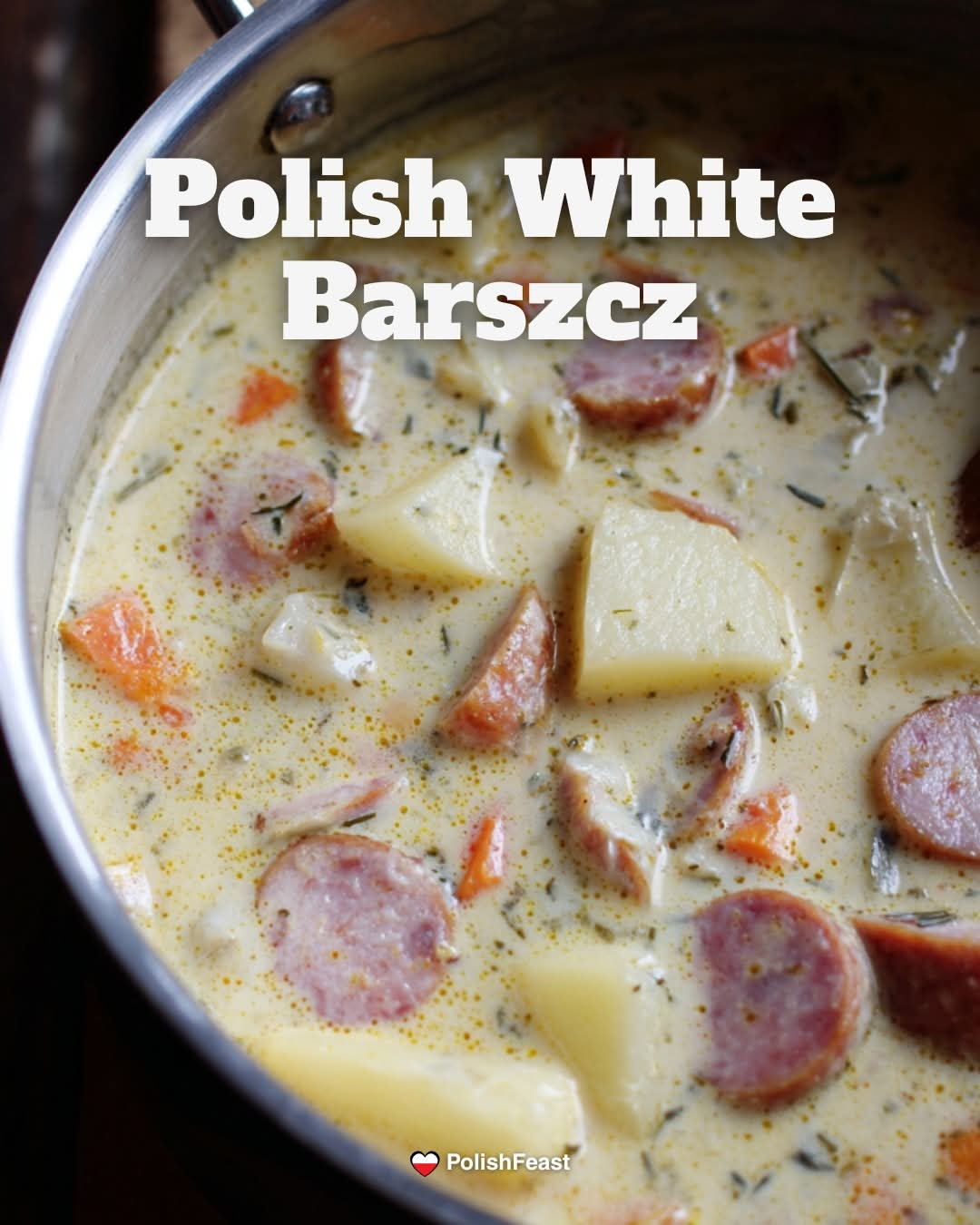
The Soul of Polish Comfort: Mastering Traditional Polish White Barszcz (Barszcz Biały)
When most people outside of Eastern Europe hear the word “borscht” or “barszcz,” their minds immediately conjure images of a deep, ruby-red soup staining a dollop of sour cream pink. This famous red variant, built on the sweet, earthy foundation of fermented or roasted beets, is a culinary masterpiece in its own right. However, nestled deep within the heart of Polish culinary tradition lies another soup—one that trades the vibrant red of beets for an elegant, creamy ivory hue, and swaps mellow sweetness for a sharp, deeply comforting tang.
This is Barszcz Biały, or Polish White Barszcz.
Often confused with its close culinary cousin Żurek, White Barszcz is a foundational cornerstone of Polish comfort food. It is a dish intrinsically tied to family gatherings, changing seasons, and major celebrations—most notably Easter Sunday breakfast, where it takes center stage on tables across Poland.
Crafting an authentic Barszcz Biały requires stepping away from industrial convenience foods and embracing the ancient art of wild fermentation. The soul of this soup relies on a fermented liquid starter made from wheat flour, garlic, and water, known as a zakwas. When this sour starter is married to a rich, aromatic broth steeped with smoked meats, pungent garlic, earthy marjoram, and finished with local dairy, the result is an incredibly complex flavor profile that is simultaneously sour, savory, smoky, and deeply warming.
This comprehensive guide explores the history, science, ingredients, and precise culinary techniques required to master traditional Polish White Barszcz from scratch in your home kitchen.
Section 1: The Historical Context and Culinary Evolution
To appreciate a bowl of White Barszcz, one must first understand its place in the historical tapestry of Central European cuisine. For centuries, preservation was the defining challenge of northern and eastern European kitchens. Long, brutal winters meant that fresh produce was unavailable for months out of the year. To survive, early Slavic cultures relied heavily on fermentation, root vegetables, smoking, and curing.
The Origins of Sour Soups
The human palate has a natural, evolutionary affinity for sour flavors. In the centuries before refrigeration, controlled acidity was a primary defense mechanism against food spoilage. Lactic acid fermentation—the same process that creates sauerkraut, kimchi, and sourdough bread—not only preserved food but also unlocked bioavailable nutrients and generated deep, complex umami flavors.
Early Slavic communities discovered that leaving grain flours mixed with water in a warm corner of the kitchen would attract wild lactobacillus bacteria and yeasts from the environment. This mixture would ferment into a sour, bubbling liquid asset. This fermented starter became the base for everyday breakfast gruels and soups, providing a burst of energy, digestive enzymes, and warmth to agrarian workers before they headed into cold fields.
Barszcz Biały vs. Żurek: Clearing up the Confusion
Even within Poland, the line between Barszcz Biały and Żurek can occasionally blur, leading to passionate debates at family dinner tables. While they look similar and share an overlapping flavor profile, they are distinct dishes defined by their specific grains.
- Żurek: This soup is exclusively made with a fermented starter made from rye flour (zakwas żytni). Rye flour yields a darker, thicker starter with a rustic, intensely earthy, and aggressively sour profile. It is traditionally brewed with smoked pork products and wild mushrooms.
- Barszcz Biały: This soup is made using a fermented starter made from wheat flour (zakwas pszenny). Wheat flour produces a lighter, milder, and more delicate acidity with a cleaner finish. Historically, White Barszcz was often brewed using a poultry or vegetable base alongside pork, and it frequently includes a more pronounced presence of garlic, marjoram, and fresh cream.
Today, while the terms are occasionally used interchangeably in certain regions of Poland, purists maintain that the choice of flour in the zakwas is what dictates the true identity of the soup.
Section 2: The Heart of the Dish: How to Make a Wild Wheat Zakwas
You can occasionally find bottled, commercially pasteurized zakwas in specialized Eastern European grocery stores, but these store-bought shortcuts pale in comparison to a living, home-fermented starter. Making your own zakwas pszenny is an effortless five-minute task that simply requires a few days of patience.
The Science of the Starter
When you combine unbleached wheat flour with water, enzymes in the flour begin breaking down complex starches into simple sugars. Wild Lactobacillus bacteria present on the grain hulls and in your kitchen environment consume these sugars, producing lactic acid as a byproduct. This acid drops the pH of the liquid, creating an environment that kills off harmful pathogens while preserving the starter and giving it that signature clean, vibrant tang.
Ingredients for a Classic Wheat Zakwas
- 1 cup high-quality whole wheat flour or unbleached white flour (Whole wheat provides more wild microbes and yields a deeper flavor).
- 3 to 4 cups filtered water (Chlorinated tap water can kill the beneficial bacteria; use spring or filtered water warmed to room temperature).
- 4 to 5 large cloves of fresh garlic, peeled and lightly smashed to release their oils.
- 2 to 3 dried bay leaves.
- 5 to 6 whole allspice berries (ziele angielskie).
- 1 teaspoon black peppercorns.
- Optional: A small piece of dried rye bread crust (must be real sourdough, without preservatives) to accelerate the fermentation process.
   [ Flour + Water + Aromatics ]
                 ↓
      Stir thoroughly in a clean jar
                 ↓
    Cover with a breathable cloth
                 ↓
   Ferment for 4-5 days at room temp
                 ↓
   Result: Living, sour Wheat Zakwas
Step-by-Step Fermentation Method
- Sterilize Your Vessel: Thoroughly wash a large glass jar or ceramic crock with hot, soapy water and rinse it completely. Any residual soap or contaminants can disrupt the wild fermentation.
- Combine the Ingredients: Pour the wheat flour into the bottom of the jar. Slowly pour in the room-temperature water while whisking constantly to eliminate any dry flour lumps. Drop in the smashed garlic cloves, bay leaves, allspice, and peppercorns.
- Cover and Breathe: Do not seal the jar with a tight lid; the fermenting mixture needs to breathe and release carbon dioxide gas. Cover the mouth of the jar with a clean piece of cheesecloth, a paper towel, or a clean kitchen linen, and secure it with a rubber band.
- The Daily Stir: Place the jar in a warm, dark spot in your kitchen (ideally between 68°F and 74°F). Once every 24 hours, use a clean wooden or plastic spoon to stir the mixture thoroughly. This redistributes the settling flour and prevents mold from forming on the surface.
- Evaluating Readiness: By day 2 or 3, you should notice small bubbles rising to the surface, and the mixture will take on a pleasantly sour, garlicky, and slightly yeasty aroma. By day 4 or 5, the liquid will taste cleanly tart and acidic.
- Storage: Once your zakwas has reached your preferred level of sourness, strain out the solids (or leave them in for a rustic touch), seal the jar with a lid, and store it in the refrigerator. The cold temperature slows bacterial activity, allowing you to keep the starter preserved for up to two to three weeks until you are ready to cook your soup.
Section 3: Anatomy of the Ideal Stock: Building Layers of Umami
A sour starter alone does not make a great soup. The tartness of the zakwas must be balanced by a profoundly rich, savory, and aromatic stock. A traditional Barszcz Biały relies on a dual-purpose stock built from smoked pork and aromatic root vegetables.
Choosing Your Proteins
The meats used in the stock pull double duty: they infuse the broth with rich fats and smoky proteins, and they are later sliced up to serve as the structural filling of the soup itself.
- Biała Kiełbasa (Polish White Sausage): This is a raw, unsmoked pork sausage seasoned heavily with garlic and marjoram. Poaching it directly in the soup stock keeps it incredibly juicy while imparting its distinct spice profile directly into the liquid.
- Smoked Pork Ribs or Smoked Bacon (Boczek): Smoked pork provides the backbone of the soup. The rendering fat and phenols from the smoking process cut through the sharp acidity of the wheat starter, creating a balanced flavor profile.
The Vegetable Foundation: Polish Włoszczyzna
In Polish culinary tradition, a standard soup base always begins with a specific bundle of root vegetables known as włoszczyzna. This combination includes:
- Carrots: Provide a touch of natural sweetness to balance the sour notes.
- Parsnips or Parsley Root (Pietruszka): Adds a distinct, herbal, woody depth.
- Celery Root (Celeriac): Imparts a robust, savory, and aromatic undercurrent.
- Leeks: Offer a soft, buttery allium sweetness that pairs perfectly with garlic.
Section 4: Master Recipe: Authentic Polish White Barszcz
Now that you understand the core components, let us walk through the precise formulation and cooking workflow to bring this traditional masterpiece to life.
Ingredient Specification List
For the Stock Base:
- 1 pound high-quality raw white Polish sausage (biała kiełbasa)
- ½ pound smoked pork ribs or high-quality thick-cut smoked bacon
- 1 large leek, white and light green parts washed and sliced in half
- 1 medium celery root (celeriac), peeled and cut into quarters
- 2 medium carrots, peeled and cut into large chunks
- 1 large parsley root (or parsnip), peeled and cut in half
- 8 to 10 cups cold water
- 3 dried bay leaves
- 5 whole allspice berries
- 10 whole black peppercorns
For the Finishing Stage:
- 2 to 3 cups homemade wheat zakwas (shaken well before measuring)
- 4 cloves fresh garlic, microplaned or finely minced
- 2 tablespoons dried Polish marjoram (majeranek)
- ½ cup high-fat heavy cream or sour cream (ideally 18% to 36% fat content)
- Salt and freshly cracked black pepper to taste
Traditional Accompaniments:
- 4 to 6 hard-boiled eggs, peeled and sliced into halves or quarters
- 4 large Yukon Gold potatoes, peeled, cubed, and boiled separately in salted water
- Freshly grated horseradish root (chilled, for a sharp table-side kick)
Step-by-Step Cooking Workflow
[ Simmer Smoked Meats & Root Veg ] ➔ [ Remove Solids & Strain Broth ]
                                              ↓
[ Add Zakwas, Garlic & Marjoram ]  ➔ [ Temper Cream & Whisk into Soup ]
                                              ↓
                                   [ Assemble with Eggs & Potatoes ]
Step 1: Simmering the Foundational Stock
Place the smoked ribs or bacon, the raw white sausages, the prepared carrots, parsley root, celery root, leek, bay leaves, allspice berries, and whole peppercorns into a large, heavy-bottomed stockpot. Pour in 8 to 10 cups of cold water, ensuring all ingredients are completely submerged.
Place the pot over medium-high heat and bring it just to a gentle boil. As it approaches a boil, use a fine skimmer or spoon to remove any grey foam or impurities (szumowiny) that rise to the surface. Once clear, immediately reduce the heat to low, cover the pot with a lid left slightly ajar, and let it simmer gently for roughly 45 to 60 minutes. The raw white sausages should be completely cooked through, and the smoked meat should be tender.
Step 2: Processing the Solids
Using tongs and a slotted spoon, carefully remove all the meats and vegetables from the stockpot and set them aside on a clean cutting board or rimmed baking sheet.
Strain the remaining broth through a fine-mesh sieve into a clean pot to remove the spent peppercorns and allspice berries. Place the strained broth back on the stove over low heat.
- The Meat: Once the meat has cooled slightly, remove the casings from the white sausage if desired (or leave them intact) and slice them into uniform, bite-sized rounds. Shred the meat off the smoked ribs or dice the bacon into small pieces. Cover them with foil to keep them warm.
- The Vegetables: The carrots can be diced into small cubes to be added back into the soup later for color and texture. The remaining root vegetables can be saved for other dishes or discarded, as they have surrendered their flavors to the stock.
Step 3: Introducing the Zakwas
Give your jar of wheat zakwas a vigorous shake to ensure the settled flour is completely redistributed into the liquid. Pour 2 cups of the starter directly into the simmering broth while stirring constantly.
Let the soup come back up to a bare simmer for 3 to 5 minutes. As the starch in the zakwas cooks, it will swell, transforming the thin broth into a silky, velvety soup with a light cream color. Taste the soup. If you prefer a sharper, more pronounced sour flavor, add the remaining cup of zakwas.
Step 4: Activating the Aromatics
The defining aromatic note of an authentic Barszcz Biały is marjoram. Dried marjoram can occasionally taste dusty or muted straight out of the jar. To unlock its volatile essential oils, pour the two tablespoons of marjoram into the palm of your hand. Aggressively rub your hands together over the pot, crushing the dried leaves into a fine powder as they fall into the liquid.
Add the finely minced or microplaned fresh garlic directly into the soup along with the sliced sausages, diced bacon, and cubed carrots. Keep the heat low; boiling garlic and marjoram too aggressively can diminish their bright flavors.
Step 5: Tempering and Adding the Cream
Adding cold cream directly into a hot, acidic soup will cause the dairy proteins to instantly coagulate, resulting in an unappealing curdled appearance. To achieve a flawless, glossy emulsion, you must temper the dairy:
- Ladle roughly one cup of the hot soup liquid into a heatproof bowl or measuring pitcher.
- Slowly whisk your heavy cream or sour cream into this hot liquid until completely smooth and uniform.
- Gradually pour this warm, stabilized dairy mixture back into the large stockpot while whisking the soup continuously.
Remove the pot from the heat immediately. Taste the soup one final time, seasoning generously with kosher salt and freshly cracked black pepper to achieve your preferred balance of savory, sour, and aromatic notes.
Section 5: The Art of Traditional Plating and Presentation
A proper Polish Barszcz Biały is never served as a simple bowl of liquid. It is a hearty, interactive meal composed of specific textures and structural layers.
Structural Assembly
When preparing to serve, do not mix your starch and eggs directly into the master pot, as they will break down and cloud the soup over time. Instead, assemble each individual serving bowl with precision:
- The Potato Bed: Place a generous spoonful of warm, freshly boiled, cubed Yukon Gold potatoes into the bottom of a wide, shallow soup bowl.
- The Protein Crown: Arrange several slices of the juicy white sausage and smoked bacon directly alongside the potatoes.
- The Egg Finale: Nest two to four halves of hard-boiled eggs cut-side up on top of the elements. The bright yellow yolks provide a stunning visual contrast against the creamy ivory soup.
- The Ladle: Carefully ladle the piping hot, aromatic soup broth over and around the ingredients, ensuring the tops of the eggs remain beautifully visible.
- Garnish: Finish with a tiny pinch of fresh marjoram or a delicate sprinkle of finely chopped fresh dill or chives.
+------------------------------------------+
|                 [Bowl]                   |
|                                          |
|         [Egg Half]      [Egg Half]       |
|             (Yolk Side Up)               |
|                                          |
|   [Cubed Potatoes]   [Sausage Slices]    |
|                                          |
|      ~~~~~ Creamy White Broth ~~~~~      |
+------------------------------------------+
Table-Side Customization
In Poland, it is customary to place a small dish of freshly grated, chilled horseradish root (chrzan) on the table alongside the soup. Horseradish contains a compound called sinigrin, which delivers a sharp, sinus-clearing heat that cuts through the rich fat of the pork and dairy, brightening the entire flavor profile of the dish. Guests can stir a half-teaspoon of horseradish directly into their individual bowls according to their personal preference.
Section 6: Nutritional Architecture and Health Dynamics
Beyond its comforting flavor, Barszcz Biały crafted via traditional wild fermentation methods offers a surprisingly robust array of nutritional benefits.
Probiotic Heritage and Digestive Health
While the boiling process of cooking the soup eliminates the live, active cultures present in the raw wheat zakwas, the fermentation process itself acts as a form of pre-digestion.
- The wild lactobacilli break down complex carbohydrates and gluten proteins in the wheat flour, making the resulting soup significantly easier on the human digestive tract than standard flour-thickened soups.
- The lactic acid generated during fermentation creates a highly bioavailable environment, optimizing the absorption of essential minerals—such as iron, zinc, and magnesium—found within the root vegetables and grains.
Macro and Micronutrient Profile
| Ingredient Component | Primary Nutritional Contribution |
|---|---|
| Wheat Zakwas Base | B-complex vitamins (Thiamine, Niacin), lactic acid, and easily digestible carbohydrates. |
| Włoszczyzna Roots | High concentrations of Vitamin A (Beta-carotene from carrots), Vitamin C, potassium, and dietary fiber. |
| Hard-Boiled Eggs | Complete bioavailable proteins, healthy lipids, choline for cognitive function, and essential amino acids. |
| Smoked Pork & Sausage | Iron, zinc, and essential fats that provide sustained energy and satiety. |
Section 7: Troubleshooting and Pro-Tips for Culinary Success
Fermented foods and dairy-enriched soups can occasionally present challenges for modern cooks. Here is how to navigate common hiccups seamlessly.
Problem A: The Soup Looks Curdled or Grainy
- The Cause: You likely added cold dairy directly to the boiling, acidic soup, or you allowed the soup to boil vigorously after the cream was introduced.
- The Solution: If the curdling is minor, you can pass the liquid through a fine-mesh strainer to remove the larger protein clumps. For a complete fix, transfer the liquid base into a high-powered blender and process on high for 30 seconds to re-emulsify the fats and liquids into a smooth texture before adding the meat and vegetable pieces back in.
Problem B: The Zakwas Developed a Thin White Film During Fermentation
- The Cause: This is almost always Kahm yeast, a harmless, non-toxic wild yeast that thrives on the surface of fermented foods when exposed to oxygen. It is not mold.
- The Solution: Simply use a clean spoon to carefully skim the white film off the surface and discard it. As long as the liquid underneath smells cleanly sour and garlicky, and does not exhibit fuzzy green, black, or blue mold patches, your zakwas is perfectly healthy and safe to use.
Problem C: The Soup is Too Sour
- The Cause: Your zakwas may have fermented for too long, creating an exceptionally high concentration of lactic acid, or you added too much starter relative to the volume of your stock.
- The Solution: You can easily balance excess acidity by adding a small pinch of granulated sugar or baking soda (a tiny fraction of a teaspoon at a time) to neutralize a portion of the acid. Alternatively, dilute the soup by whisking in a cup of un-soured beef, poultry, or vegetable broth along with an extra splash of heavy cream.
Section 8: Storing, Reheating, and Enhancing Leftovers
Like many complex stews and braises, Barszcz Biały often tastes even better the next day. As the soup rests in the cold, the smoky pork notes, pungent garlic, and earthy marjoram blend together, mellowing the sharp edges of the zakwas.
Refrigeration Protocol
Allow the soup to cool down to room temperature before transferring it into airtight glass storage containers. Store the soup in the refrigerator for up to 3 to 4 days. Keep your leftover hard-boiled eggs and boiled potatoes stored in separate containers; adding them directly to the soup container will cause the potatoes to absorb too much salt and turn mushy, while the eggs can take on an unappealing, rubbery texture.
The Reheating Ritual
When you are ready to enjoy another bowl, transfer the desired portion of soup into a small saucepan. Place it over low heat and warm it gradually, stirring occasionally.
Critical Rule: Do not allow the soup to reach a rolling, violent boil. Because the soup contains cream and starch, high radiant heat will break the delicate emulsion, causing the sauce to separate or curdle. Warm it just until it is steaming hot, then pour it over fresh potatoes and eggs.
Creative Leftover Repurposing
If you find yourself with excess broth, it can be used as an exceptional braising liquid. Use the sour, smoky broth to braise pork chops, pork medallions, or chicken thighs in a skillet. The natural acidity of the wheat starter works as a built-in tenderizer, while the cream and marjoram reduce down into a luxurious sauce that pairs perfectly with buckwheat groats (kasza) or rice.
Conclusion: A Living Legacy in a Bowl
Mastering traditional Polish Barszcz Biały is a rewarding journey into the roots of European food preservation. It reminds us that before modern technology, great flavor was achieved through time, patience, and a partnership with nature.
By taking the time to ferment your own wheat zakwas, drawing out the deep smoky fats of quality pork, and balancing it all with fresh garlic and marjoram, you create far more than just a soup. You craft an authentic culinary experience that has brought families together around the dinner table for centuries. Grab a jar, mix your flour and water, and welcome the time-honored soul of Polish comfort food into your kitchen.