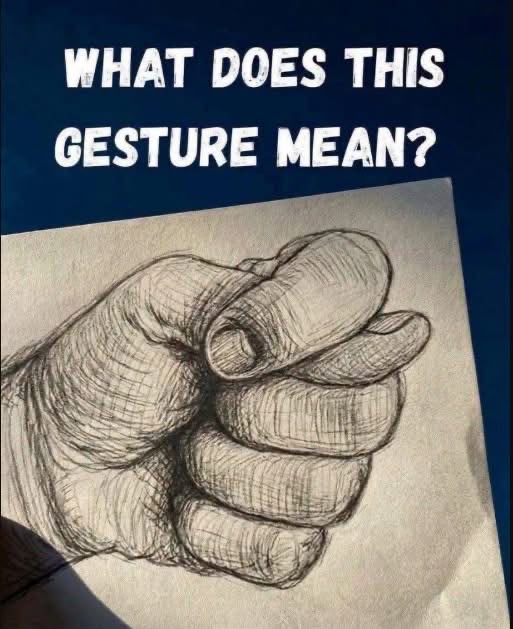
A closed fist. Two fingers curled inward. A thumb tucked between them.
It’s such a small gesture that you might barely notice someone making it.
But this unusual hand position, commonly known as the fig sign or fig gesture, has carried surprisingly different meanings across cultures and throughout history.
Depending on the place and context, it has been associated with protection, rejection, fertility, superstition, and even insult.
And that’s what makes this tiny gesture so fascinating.
Something as simple as positioning your thumb between your fingers could communicate a message without a single word.
What Is the Fig Gesture?
The fig gesture is generally made by closing the hand into a fist and placing the thumb between the index and middle fingers.
The result resembles a small fig—hence the name.
In different traditions, the gesture has been interpreted in very different ways. It has sometimes been used as an obscene or insulting sign, while in other cultural contexts it has been associated with warding off bad luck or the evil eye.
So if you’ve ever seen someone make this gesture and wondered what it meant, the answer isn’t quite as simple as you might expect.
Context matters.
Why Is It Called the “Fig” Gesture?
The name comes from the resemblance of the hand configuration to a fig.
The gesture has also been known by names referring to its shape or its use in different languages and traditions.
Its symbolism isn’t universal, either.
That’s an important point because modern explanations of ancient gestures sometimes make them sound as though they had exactly one meaning everywhere.
They didn’t.
Like many forms of body language, the meaning of the fig gesture could change dramatically depending on the culture, period, and situation.
A Gesture With More Than One Meaning
A Gesture With More Than One Meaning
One of the most intriguing things about the fig sign is its contradictory symbolism.
In some traditions, it has been understood as a protective gesture.
In others, it has been considered vulgar or insulting.
That may sound strange, but human gestures often work this way.
A particular hand position can be comforting in one culture and offensive in another.
The fig gesture is a perfect example.
A Symbol of Protection
In some Mediterranean and European folk traditions, making the fig gesture was associated with protection against the evil eye or bad fortune.
The evil eye is a longstanding folk belief in which envy or an envious gaze is thought to bring misfortune.
People developed many protective customs around this belief, including amulets, charms, prayers, and gestures.
The fig sign became one of the gestures associated with that protective tradition in some settings.
In this interpretation, the hand becomes almost like a tiny personal talisman.
A person doesn’t need an object to carry with them.
Their own hand becomes the protective symbol.
The Fig Sign as a Gesture of Rejection
The gesture has also been connected with rejection and refusal.
In some historical and cultural contexts, making the sign could communicate something along the lines of:
“No.”
“I reject this.”
Or, more symbolically, “Keep this away from me.”
That protective meaning and the idea of rejection actually fit together rather naturally.
Whether someone was attempting to ward off misfortune, reject an unwanted influence, or simply express refusal, the gesture could serve as a silent response.
When a Small Gesture Becomes an Insult
There’s another side to the fig gesture that is considerably less innocent.
In certain cultures and periods, the gesture has carried obscene or insulting connotations.
Its symbolism has sometimes been interpreted sexually…