Onion Juice: How to Make It, Potential Benefits, Nutrition, Uses, and What You Should Know
Introduction
Onions are one of the most familiar ingredients in kitchens around the world. They are inexpensive, easy to find, flavorful, and useful in countless recipes. But beyond cooking, onions have also been used traditionally in home remedies and wellness practices. One preparation that has attracted attention is fresh onion juice, made by blending or crushing raw onions and extracting their liquid.
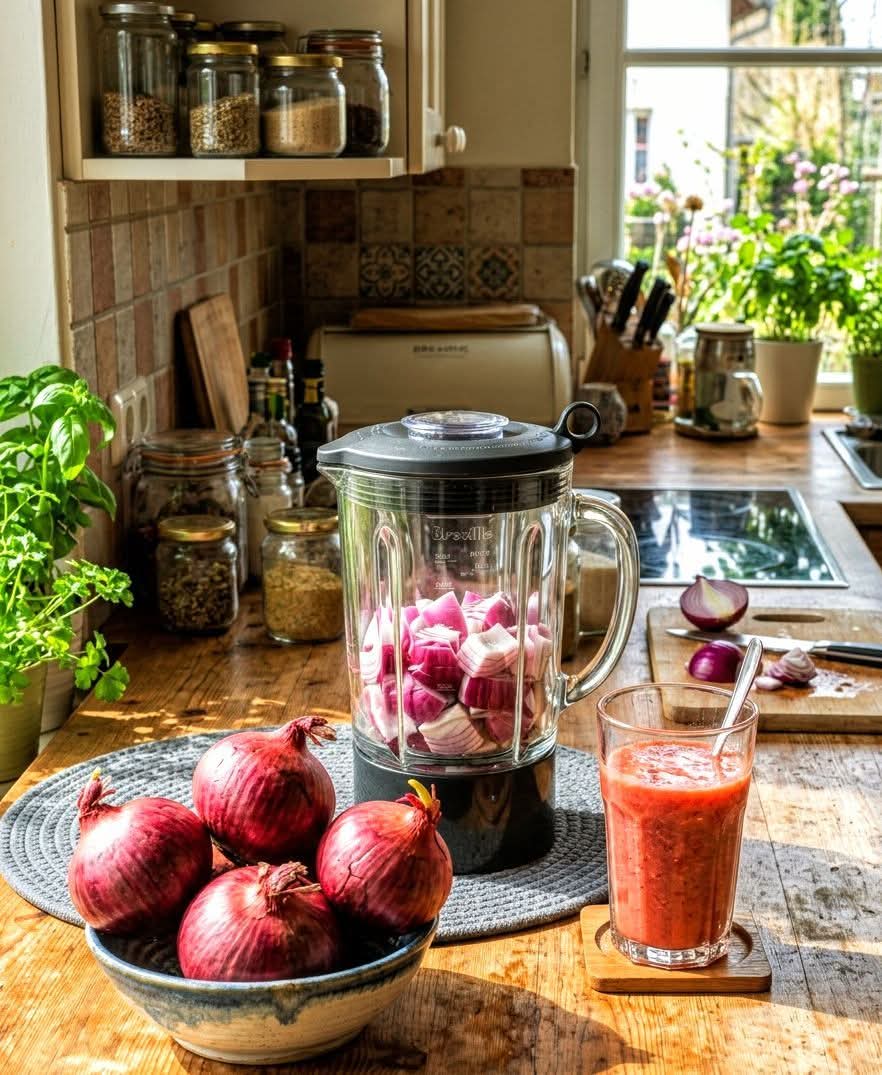
The image above shows a simple homemade onion juice preparation, with red onions being blended into a smooth mixture. Red onions are particularly attractive for this type of preparation because they contain naturally occurring plant compounds, including sulfur-containing compounds and flavonoids such as quercetin.
Onion juice has a strong, sharp flavor and aroma, so it is not a beverage that everyone enjoys on its own. Some people dilute it with water or combine a small amount with other ingredients. Others use onion juice externally as part of traditional hair and scalp routines.
It is important, however, to separate traditional uses from scientifically established health effects. Onion juice can provide compounds naturally present in onions, but it should not be considered a cure for disease or a replacement for medical treatment.
This article explores onion juice from several angles, including its history, preparation, nutrition, potential benefits, traditional uses, practical methods, safety considerations, and ways to incorporate onions into a balanced diet.
What Is Onion Juice?
Onion juice is the liquid extracted from raw onions. It can be prepared using a blender, food processor, juicer, grater, or even a simple kitchen cloth or strainer.
The basic process is straightforward:
- Peel fresh onions.
- Wash them.
- Chop them into smaller pieces.
- Blend or crush them.
- Strain the mixture.
- Collect the liquid.
- Dilute it if desired.
The result is usually a pale purple, pinkish, or whitish liquid depending on the type of onion used.
Red onions can produce a colorful juice because of their natural pigments. Yellow and white onions can also be used.
Because raw onions contain sulfur-containing compounds, fresh onion juice has a distinctive smell and a strong taste. This is one reason many people prefer using relatively small quantities.
Ingredients
For a basic homemade onion juice, you need only a few ingredients.
Basic Onion Juice
- 1 medium fresh red onion
- ½ to 1 cup clean water, depending on desired strength
- Optional: a small amount of lemon juice for flavor
- Optional: ginger for a stronger flavored drink
- Optional: honey for sweetness
For a simple preparation, however, onion and water are enough.
If you are preparing onion juice specifically for a food or wellness article, it is best to keep the recipe simple so that the flavor and natural compounds of the onion remain the main focus.
How to Make Fresh Onion Juice
Step 1: Choose Fresh Onions
Start with firm onions that have no visible mold, soft spots, or unpleasant odors.
Red onions work particularly well because of their flavor and naturally occurring pigments, but white and yellow onions are perfectly suitable.
Step 2: Peel and Wash
Remove the dry outer skin.
Wash the onion under clean running water. Although you are removing the outer layer, washing the onion helps reduce dirt that could otherwise transfer to the knife or cutting board.
Step 3: Chop the Onion
Cut the onion into quarters or smaller pieces.
Smaller pieces make blending easier and can help produce a more consistent mixture.
Step 4: Blend
Place the onion pieces into a clean blender.
Add a small amount of water. Start with a few tablespoons and add more if necessary.
Blend until the onion becomes a smooth or mostly smooth pulp.
Step 5: Strain
Place a fine-mesh strainer over a clean bowl.
Pour the blended onion mixture into the strainer and press gently with a spoon.
For an even clearer juice, you can strain it through clean cheesecloth.
Step 6: Serve
The juice can be consumed immediately.
Because fresh onion juice has a powerful flavor, some people dilute it with additional water.
If adding lemon or another ingredient, use a small amount so that the mixture remains pleasant and easy to drink.
Methods of Preparing Onion Juice
There are several ways to make onion juice at home.
Blender Method
This is one of the easiest methods.
Blend chopped onion with a little water and strain.
This method is useful when you do not own a juicer.
Juicer Method
A vegetable juicer can extract onion liquid directly.
This method can produce a relatively concentrated juice with less pulp.
Grating Method
You can grate the onion using a fine grater and then squeeze the grated onion through cheesecloth.
This method is useful for making a small amount.
Food Processor Method
A food processor can chop the onion into a fine pulp. The pulp can then be strained.
Why Do People Use Onion Juice?
Onion juice has several traditional and modern uses.
Some people drink it because they enjoy experimenting with vegetable-based drinks. Others use it as part of traditional home remedies.
Onion juice is also frequently discussed in relation to hair and scalp care.
However, these uses should be understood separately from medically proven treatments.
A food can contain beneficial nutrients without being a treatment for a particular medical condition.
Potential Nutritional Benefits of Onions
Onions are naturally low in calories and provide several nutrients and plant compounds.
Depending on the variety and amount consumed, onions can contribute:
- Vitamin C
- Folate
- Vitamin B6
- Potassium
- Fiber when the whole onion is consumed
- Flavonoids
- Sulfur-containing compounds
- Other antioxidant compounds
One important point is that whole onions provide fiber that strained onion juice does not provide in the same amount.
Therefore, eating onions as part of meals can be nutritionally different from drinking their juice.
Antioxidant Compounds in Onions
One of the most interesting features of onions is their concentration of plant compounds.
Red onions contain flavonoids and pigments that contribute to their color. One well-known onion flavonoid is quercetin.
Antioxidants are compounds that participate in protecting cells from oxidative stress. Fruits and vegetables contain many different antioxidant compounds, and researchers study their potential roles in maintaining health.
However, drinking onion juice should not be presented as a way to “remove toxins” or cure illnesses. The human body already has sophisticated systems for processing and eliminating waste, primarily involving organs such as the liver and kidneys.
The best approach is to consume a variety of vegetables rather than relying on one particular drink.
Onion Juice and Digestive Health
Onions contain carbohydrates called fructans, which belong to a group of fermentable carbohydrates.
For some people, these compounds can support the growth and activity of beneficial gut microorganisms. However, the same compounds can cause digestive symptoms in sensitive individuals.
Some people may experience:
- Gas
- Bloating
- Abdominal discomfort
- Heartburn
- Changes in bowel habits
This is particularly important for people who are sensitive to certain fermentable carbohydrates.
Because onion juice is concentrated compared with using a small amount of onion as a seasoning, drinking large quantities may be uncomfortable.
Onion Juice and Heart Health
Onions are commonly included in dietary patterns associated with cardiovascular health.
Their plant compounds are one reason researchers are interested in onions and other vegetables.
However, it would be inaccurate to say that onion juice alone prevents heart disease or lowers cholesterol in everyone.
Heart health depends on many factors, including:
- Overall diet
- Physical activity
- Blood pressure
- Cholesterol levels
- Blood sugar
- Smoking
- Body weight
- Sleep
- Family history
- Medical conditions
Including onions as part of a vegetable-rich diet is a more reasonable approach than relying on concentrated onion juice.
Onion Juice and Immune Health
Onions contain vitamin C and other plant compounds that contribute to a nutritious diet.
Vitamin C plays several important roles in normal immune function.
However, onion juice should not be described as an immune-system cure or as a substitute for appropriate medical care.
A healthy immune system depends on adequate nutrition, sleep, physical activity, and management of underlying health conditions.
A varied diet containing vegetables, fruits, legumes, whole grains, nuts, seeds, and appropriate protein sources is generally more valuable than focusing on one drink.
Onion Juice for Hair and Scalp Care
Perhaps one of the most popular traditional uses of onion juice is for hair and scalp care.
People have used onion juice on the scalp because onions contain sulfur-containing compounds and other plant substances.
Some small studies have investigated onion-based preparations for certain types of hair loss, but the evidence is limited and should not be interpreted as proof that homemade onion juice can regrow hair for everyone.
If someone chooses to try onion juice topically, it should be approached as a cosmetic or traditional practice rather than a guaranteed medical treatment.
How to Use Onion Juice on the Scalp
If using onion juice externally, preparation should be simple.
Method
- Peel one fresh onion.
- Wash it.
- Blend or grate it.
- Strain the mixture.
- Apply a small amount to the scalp.
- Leave it for a short period if tolerated.
- Wash thoroughly with a mild shampoo.
Before applying onion juice widely, perform a small patch test.
If burning, severe itching, swelling, redness, or irritation occurs, wash the area and stop using it.
Avoid applying onion juice to broken, irritated, or infected skin.
Why Onion Juice Can Irritate the Skin
Raw onion contains compounds that can irritate sensitive skin.
The eyes often react strongly to onions because cutting onions releases volatile compounds that interact with the eyes and cause tearing.
The same general principle explains why concentrated raw onion preparations may not be comfortable on the skin.
People with sensitive skin should be especially cautious.
Natural does not automatically mean irritation-free.
Onion Juice and Blood Sugar
Onions are frequently included in meals for people interested in balanced nutrition because they are relatively low in calories and can add flavor without requiring large amounts of added fat or sugar.
However, drinking onion juice should not be promoted as a treatment for diabetes.
People taking glucose-lowering medication should be cautious about making major dietary changes based on home remedies, particularly if they are replacing meals or medications with drinks.
Medical treatment should always be followed as prescribed.
Onion Juice and Weight Management
Onion juice is sometimes promoted online as a “fat-burning” drink.
There is no reason to treat onion juice as a magic weight-loss beverage.
Successful weight management generally depends on sustainable eating habits, physical activity, sleep, and overall calorie balance.
Onions themselves can be very useful in a balanced diet because they add flavor and volume to meals while contributing relatively few calories.
For example, onions can make vegetables, soups, beans, eggs, fish, chicken, and whole grains more flavorful without requiring large quantities of high-calorie sauces.
That practical role may be much more useful than viewing onion juice as a weight-loss remedy.
The History of Onions
Onions have a very long history as both food and traditional medicine.
They have been cultivated and used by human societies for thousands of years. Ancient civilizations valued onions because they were flavorful, relatively easy to store, and useful in cooking.
Over generations, onions became an important ingredient in cuisines throughout Europe, Asia, Africa, the Middle East, and the Americas.
Different varieties developed according to climate, soil, agricultural practices, and culinary traditions.
The use of onions in traditional remedies also developed independently in different cultures.
This long history helps explain why onion-based home remedies remain popular today.
Red Onion Versus White and Yellow Onion
Different onion varieties have slightly different flavors and plant compounds.
Red Onion
Red onions are often sharper and sweeter when cooked. Their deep color comes from natural pigments called anthocyanins.
They are especially attractive for fresh salads, pickles, sandwiches, and raw preparations.
Yellow Onion
Yellow onions are versatile and become sweeter when cooked.
They are commonly used in soups, sauces, stews, and roasted dishes.
White Onion
White onions tend to have a sharper flavor and are common in many fresh preparations and savory dishes.
All three varieties can be used to make onion juice.
Formation of Onion Juice
The formation of onion juice begins when onion cells are damaged through cutting, crushing, grating, or blending.
Once the cells are broken, their contents mix together.
Water naturally present in the onion combines with soluble plant compounds and produces a liquid mixture.
Blending with water creates a thinner juice, while using a juicer can produce a more concentrated liquid.
Straining removes much of the solid material.
The final result is influenced by:
- Onion variety
- Onion size
- Freshness
- Amount of water
- Blending time
- Straining method
Best Time to Drink Onion Juice
There is no scientifically established “perfect time” to drink onion juice.
Some wellness websites recommend drinking it in the morning or on an empty stomach, but these recommendations should not be confused with established medical evidence.
If someone chooses to consume onion juice, drinking a small amount with food may be more comfortable if raw onion causes stomach irritation.
There is no requirement to drink it immediately after waking up.
How Much Onion Juice Should You Drink?
There is no universally established therapeutic dose of homemade onion juice.
More is not necessarily better.
Because onion juice can be strong and may cause digestive discomfort, starting with a small amount is more sensible than drinking a large glass.
People who have digestive sensitivities may prefer getting onions through normal meals instead.
If you have a medical condition or take medication, discuss significant dietary changes with a qualified healthcare professional.
Ways to Improve the Flavor
Pure onion juice can be difficult for many people to drink.
If you want a more pleasant version, you can dilute it with water.
You can also combine a small quantity with other food ingredients.
Lemon and Onion Drink
- Small amount of fresh onion juice
- Water
- Small amount of lemon juice
Onion and Ginger Drink
- Small amount of onion juice
- Fresh ginger
- Water
Onion and Honey
A small amount of honey can soften the sharp flavor, although it also adds sugar.
These combinations are primarily about flavor and convenience rather than creating a medically powerful drink.
Safety Considerations
Although onions are common foods, concentrated onion juice is not appropriate for everyone.
Possible problems include:
- Stomach irritation
- Gas
- Bloating
- Heartburn
- Bad breath
- Mouth irritation
- Skin irritation when used externally
People who know that onions cause digestive symptoms should be particularly cautious.
If you experience severe or persistent symptoms after consuming onion juice, discontinue it and seek appropriate medical advice.
Who Should Be Careful With Onion Juice?
People with sensitive digestive systems may find raw onion particularly difficult to tolerate.
Individuals with conditions affected by certain fermentable carbohydrates may also need to limit onions.
People taking medication should avoid treating onion juice as a replacement for prescribed therapy.
Pregnant or breastfeeding individuals should also avoid using concentrated home remedies as substitutes for professional medical advice.
Children should not be encouraged to consume strong homemade remedies without appropriate parental and professional guidance.
Storage
Fresh onion juice is highly perishable.
For food safety, it is best to prepare only the amount you intend to use.
If you need to keep it temporarily, place it in a clean, sealed container and refrigerate it promptly.
Do not leave fresh onion juice sitting at room temperature for long periods.
Discard it if it develops an unusual smell, appearance, or texture.
Fresh preparation is generally preferable because it reduces unnecessary storage time.
Onion Juice Versus Whole Onions
A common question is whether drinking onion juice is better than eating onions.
In many situations, whole onions are the more practical choice.
Whole onions provide:
- Fiber
- Water
- Plant compounds
- Vitamins and minerals
- Flavor
- Texture
When onions are strained into juice, some of the solid material and fiber is removed.
This does not make onion juice useless, but it does mean that juice and whole onions are nutritionally different.
Adding onions to soups, salads, omelets, sandwiches, rice dishes, beans, stews, and roasted vegetables can be an easy way to include them regularly.
Onion Juice in Everyday Cooking
You do not necessarily have to drink onion juice to benefit from onions as part of your diet.
Onions can be used in:
- Soups
- Stews
- Salads
- Sauces
- Stir-fries
- Omelets
- Rice dishes
- Bean dishes
- Roasted vegetables
- Homemade salsa
- Sandwiches
- Burgers
- Meat marinades
Cooking onions also changes their flavor and texture, making them sweeter and milder.
For people who dislike raw onion juice, cooked onions may be a much more enjoyable option.
Nutrition
The exact nutritional value of onion juice varies depending on the onion variety, amount used, and how much pulp is removed.
Whole onions generally provide modest amounts of several nutrients while being relatively low in calories.
Important nutritional components include:
Vitamin C
Vitamin C contributes to normal immune function and collagen formation.
Folate
Folate is important for normal cell division and other physiological processes.
Vitamin B6
Vitamin B6 participates in numerous metabolic processes.
Potassium
Potassium is an essential mineral involved in normal nerve and muscle function.
Plant Compounds
Onions contain flavonoids and sulfur-containing compounds that contribute to their characteristic aroma and flavor.
Because homemade juice recipes vary considerably, nutrition information should be viewed as approximate rather than a fixed value.
Common Myths About Onion Juice
Myth 1: Onion Juice Can Cure Every Disease
There is no scientific basis for treating onion juice as a universal cure.
Onions can be part of a nutritious diet, but they are not a replacement for medical treatment.
Myth 2: Onion Juice Automatically Causes Weight Loss
There is no magic fat-burning effect that makes onion juice a substitute for healthy eating and physical activity.
Myth 3: More Onion Juice Means More Benefits
Large quantities can increase the chance of digestive discomfort.
Myth 4: Natural Remedies Are Always Safe
Natural ingredients can cause irritation, allergies, digestive problems, and interactions with individual circumstances.
Myth 5: Onion Juice Guarantees Hair Regrowth
Evidence for onion juice and hair growth remains limited. It should not be presented as a guaranteed treatment for hair loss.
Tips for Making Better Onion Juice
For the best homemade preparation:
- Use fresh onions.
- Wash the onions before preparation.
- Use clean equipment.
- Avoid adding excessive water.
- Strain carefully.
- Prepare small quantities.
- Refrigerate promptly if not consuming immediately.
- Stop using it if it causes unpleasant symptoms.
If you are using onion juice on the scalp, always perform a small skin test first.
Lovers of Onion Juice
People who enjoy strong savory flavors may appreciate onion juice more than others.
Some people like it because it feels like a simple, traditional preparation made from an inexpensive ingredient.
Others prefer incorporating onion into food rather than drinking it.
The most important thing is not to force yourself to consume a food or drink simply because it is popular online.
A healthy diet can include onions in many different forms.
A Simple Daily Approach
Rather than making onion juice the center of your wellness routine, consider using onions as one part of a balanced diet.
For breakfast, onions can be added to eggs or vegetables.
At lunch, they can be included in a salad, soup, rice dish, or sandwich.
At dinner, onions can be cooked with vegetables, beans, chicken, fish, or meat.
This provides a practical and enjoyable way to consume onions regularly.
If you still want to experiment with onion juice, keep the portion modest and pay attention to how your body responds.
Conclusion
Onion juice is a simple homemade preparation made by blending or crushing fresh onions and extracting their liquid. The image shown represents a classic kitchen-style preparation using red onions, which are valued for their strong flavor and naturally occurring plant compounds.
Onions contain vitamin C, folate, potassium, flavonoids, and sulfur-containing compounds. They can be a valuable part of a varied and balanced diet.
At the same time, onion juice should not be treated as a miracle cure. Claims that it can detoxify the body, guarantee weight loss, cure chronic disease, or provide guaranteed hair regrowth go beyond what the available evidence supports.
For most people, eating onions as part of ordinary meals may be a simpler and more enjoyable way to include their nutrients and plant compounds. Fresh onion juice can be an optional preparation for people who tolerate it well, but it is not essential for good health.
Final Thoughts
The popularity of onion juice demonstrates how traditional foods can continue to inspire modern wellness practices. There is nothing complicated about making it: fresh onions, a blender or grater, clean water, and a strainer are enough.
The key is balance.
Enjoy onions as food, understand what they can realistically contribute to your diet, and avoid exaggerated claims about home remedies. If you have a medical condition, persistent symptoms, significant hair loss, or another health concern, professional medical advice is more appropriate than relying solely on onion juice.
Whether you choose to drink it, use it in cooking, or simply enjoy onions in salads and soups, this humble vegetable remains one of the most versatile ingredients in the kitchen.