Can Any Leaf Cure Cancer in 24 Hours? The Truth Behind Viral Herbal Cancer Claims
Introduction
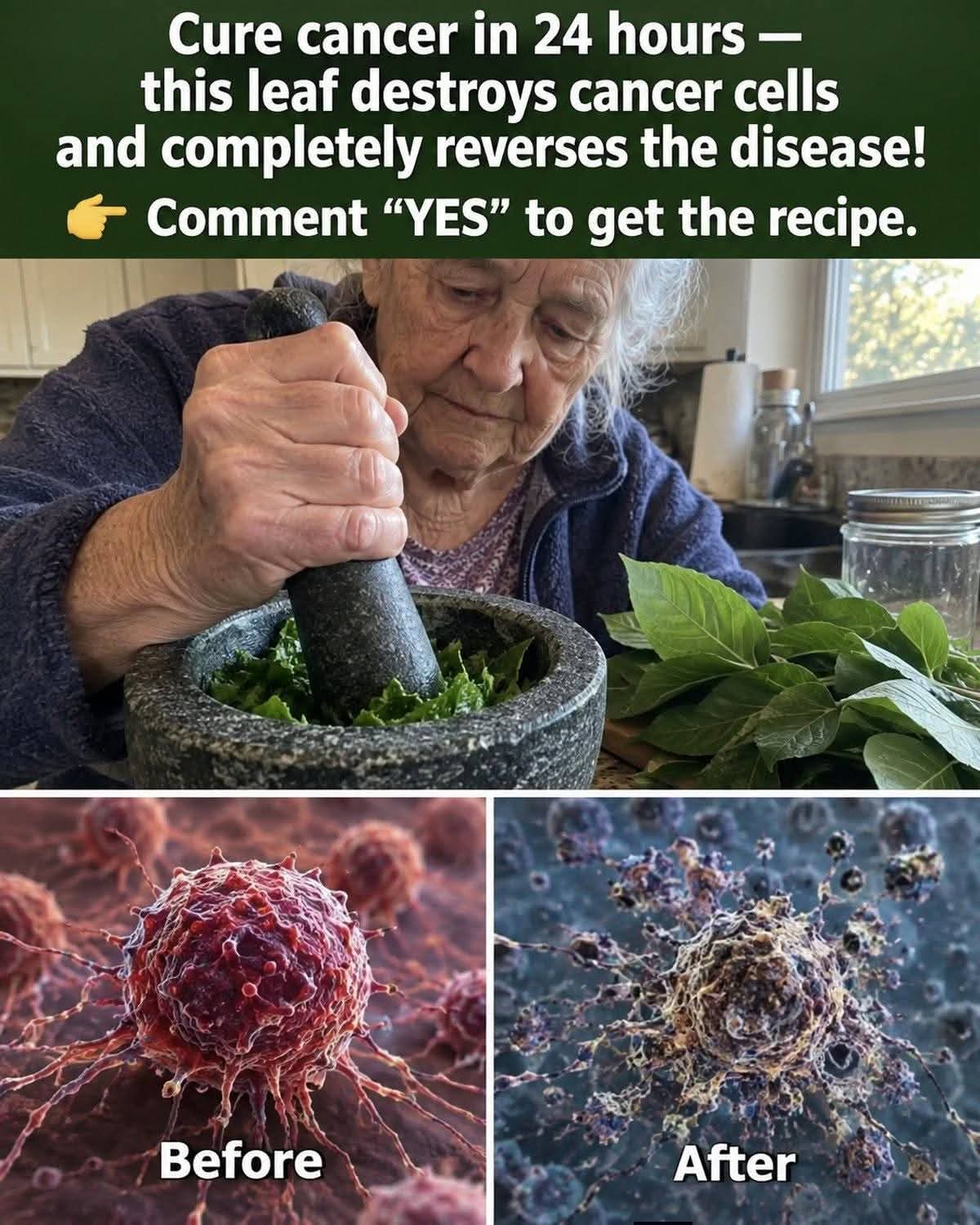
A striking health claim is circulating online with a photograph of an older woman crushing green leaves in a mortar and pestle. The message promises something extraordinary: “Cure cancer in 24 hours — this leaf destroys cancer cells and completely reverses the disease!” It then encourages readers to comment “YES” to receive a supposed recipe.
The image is designed to be attention-grabbing, but the medical claim requires a much more careful examination.
There is currently no scientifically established leaf, herb, tea, juice, or homemade recipe that can cure cancer in 24 hours or completely reverse cancer. The National Cancer Institute states that there is no proof that any food, vitamin, mineral, dietary supplement, herb, or combination of these can slow cancer, cure it, or prevent it from returning.
That does not mean plants are uninteresting to cancer researchers. Quite the opposite. Many modern medicines have been developed from substances found in plants, and scientists continue to investigate plant-derived compounds for possible anticancer activity. However, discovering that a chemical from a plant affects cancer cells in a laboratory is very different from proving that eating or drinking the whole plant cures cancer in a human being.
This distinction is extremely important.
The photograph itself also does not provide enough information to safely identify the leaves. Different plants can look similar, and consuming an unidentified plant can sometimes cause poisoning, medication interactions, or other complications.
This article explains what the viral claim means, what science actually says about herbs and cancer, why laboratory results can be misleading, how cancer treatments work, and how people can approach herbal remedies safely.
The Viral “24-Hour Cancer Cure” Claim
The central statement in the image is that a particular leaf can:
- destroy cancer cells,
- cure cancer in 24 hours,
- completely reverse the disease.
These are extremely strong medical claims.
A genuine cancer treatment must be evaluated through scientific research involving appropriate laboratory studies, clinical trials, safety testing, dosing information, and outcomes in people.
A social-media photograph does not establish any of these things.
Cancer is also not one single disease. There are many different cancers, including breast cancer, prostate cancer, lung cancer, colorectal cancer, skin cancer, blood cancers, brain tumors, pancreatic cancer, liver cancer, and many others. They differ in their biology, genetic changes, growth rates, spread, and response to treatment.
Therefore, a statement that one unidentified leaf can cure all cancer within 24 hours should immediately be treated with skepticism.
The National Center for Complementary and Integrative Health says that no complementary health approach has been shown to prevent or cure cancer. It also warns that unproven products should not replace or delay appropriate cancer treatment.
Can a Leaf Really Destroy Cancer Cells?
This question needs an important distinction.
Laboratory research is not the same as cancer treatment
Researchers sometimes take a chemical extracted from a plant and expose cancer cells to it in a laboratory.
If the cells stop growing or die, researchers may describe the substance as having anticancer activity.
That can be an interesting scientific finding.
But it does not automatically mean that eating the plant will have the same effect inside a human body.
There are many steps between a laboratory discovery and an approved treatment.
For example, researchers must determine:
- Whether the substance works in living organisms.
- How much of the substance is required.
- Whether the body can absorb it.
- Where it goes after absorption.
- How quickly it is broken down.
- Whether it reaches a tumor at an effective concentration.
- Whether it harms healthy cells.
- Whether it interacts with other medications.
- Whether it improves outcomes in human clinical trials.
- Whether the benefits outweigh the risks.
A laboratory result is therefore a starting point for research, not proof of a cure.
Why “Kills Cancer Cells” Can Be Misleading
The phrase “kills cancer cells” sounds convincing, but it can hide a major scientific problem.
Many substances can kill cells under laboratory conditions.
Some household chemicals can kill cancer cells in a dish.
That does not mean those substances are safe or effective cancer medicines.
The challenge is to selectively affect cancer cells while protecting healthy tissues and achieving the correct concentration inside the human body.
Cancer treatments are carefully studied partly because cancer cells exist inside a complicated biological system involving blood vessels, immune cells, organs, hormones, enzymes, and other tissues.
A plant compound that appears powerful in a laboratory may:
- be poorly absorbed,
- be rapidly broken down,
- fail to reach the tumor,
- require an unsafe dose,
- affect healthy tissues,
- interact with medication,
- or simply fail to work in humans.
This is why responsible cancer research cannot stop at a laboratory experiment.
What the National Cancer Institute Says About Herbs and Cancer
The National Cancer Institute specifically addresses claims involving herbs, supplements, and special diets.
According to the NCI, there is no proof that any nutritional trend, food, vitamin, mineral, dietary supplement, herb, or combination of these can slow cancer, cure it, or keep it from returning.
The NCI also explains that some supplements may interfere with cancer treatment.
This is especially important because many people assume that “natural” automatically means “safe.”
It does not.
The NCI warns that some herbal products can interact with medicines, including cancer drugs.
For someone undergoing chemotherapy, radiation, surgery, immunotherapy, targeted therapy, or another cancer treatment, adding an herbal product without medical guidance may therefore create an unexpected problem.
Natural Does Not Always Mean Safe
The word “natural” is frequently used in online health advertising.
A product may be described as:
- natural,
- traditional,
- herbal,
- chemical-free,
- ancient,
- detoxifying,
- cleansing,
- powerful,
- or medicinal.
None of these words proves that the product is safe or effective against cancer.
Plants contain chemicals.
Some plant chemicals are useful.
Others can be toxic.
Some can interact with prescription medicines.
Some can affect the liver or kidneys.
Some can alter how medications are metabolized.
The NCI specifically notes that herbal supplements can be harmful by themselves, with other substances, or in large doses. It also warns that certain herbs can interfere with cancer drugs.
That is why someone with cancer should discuss supplements with their doctor, oncology team, pharmacist, or another qualified healthcare professional before using them.
What About Traditional Herbal Medicine?
Traditional medicine has an important cultural and historical role around the world.
People have used leaves, roots, flowers, seeds, bark, fruits, and spices for generations.
Some traditional plants have subsequently become subjects of modern scientific research.
That history is valuable.
But traditional use and clinical proof are not identical.
A plant being used for hundreds of years does not automatically prove that it cures a specific cancer.
Modern researchers still need to determine:
- the active ingredients,
- appropriate dosage,
- preparation,
- purity,
- safety,
- interactions,
- effectiveness,
- and which patients might benefit.
This is particularly important for cancer because delaying effective treatment can have serious consequences.
Why Cancer Cannot Be “Reversed” in 24 Hours
Cancer develops through complex biological processes.
Cancer cells can acquire genetic and molecular changes that allow them to grow uncontrollably, avoid normal cellular controls, invade surrounding tissues, and sometimes spread to distant parts of the body.
Different cancers behave differently.
Even two people with the same general cancer diagnosis may have different tumor characteristics and treatment responses.
This makes the idea of a universal 24-hour cure biologically implausible.
Cancer treatment may sometimes produce dramatic responses, but those responses depend on the type and stage of cancer and the specific treatment being used.
Treatment can involve:
- surgery,
- chemotherapy,
- radiation therapy,
- immunotherapy,
- targeted therapy,
- hormone therapy,
- combinations of treatments,
- or carefully monitored clinical trials.
The National Cancer Institute describes these established treatment approaches and encourages patients to discuss treatment options and clinical trials with their healthcare teams.
What Does “Cancer Cure” Actually Mean?
Another problem with viral posts is that they often use the word cure without defining it.
Cancer doctors may use terms such as:
- remission,
- complete remission,
- partial response,
- stable disease,
- progression,
- recurrence,
- and long-term survival.
These terms have specific meanings.
A reduction in tumor size is not necessarily the same thing as a cure.
A person feeling better is not necessarily evidence that cancer has disappeared.
A scan showing no detectable cancer does not always mean that every cancer cell has been eliminated.
Cancer care therefore relies on medical examinations, imaging, laboratory testing, pathology, and long-term follow-up rather than social-media claims.
The Important Difference Between Complementary and Alternative Medicine
The NCI distinguishes between complementary and alternative approaches.
Complementary medicine is used alongside standard medical treatment.
Alternative medicine is used instead of standard treatment.
This difference matters enormously.
For example, a person might use meditation or an appropriately supervised complementary approach to help manage stress while continuing prescribed cancer treatment.
That is very different from abandoning chemotherapy or surgery in favor of an unproven herbal drink.
NCCIH specifically warns people not to use unproven products or practices to replace or delay medical treatment for cancer.
Could Herbs Still Have a Role in Cancer Care?
Potentially, but the role must be understood correctly.
Researchers investigate plants and plant-derived compounds for many reasons.
Some may eventually become medicines.
Others may help scientists understand biological pathways.
Some complementary approaches may help manage symptoms or treatment side effects.
For example, NCCIH notes that certain complementary approaches have been studied for symptoms such as pain, fatigue, nausea, stress, and other treatment-related problems.
That is very different from saying that an herbal remedy cures cancer.
The scientific question should always be:
What evidence exists for this particular plant, preparation, dose, cancer type, and outcome?
What About Ginger, Turmeric, Garlic, or Other Popular Plants?
Many common foods and herbs have compounds that researchers study.
Ginger, turmeric, garlic, green tea, and numerous other plants have been investigated in laboratory and clinical research.
This research can be fascinating.
But it should not be converted into exaggerated claims.
For example, a compound may demonstrate biological activity in laboratory experiments while there is insufficient evidence to recommend it as a cancer treatment.
NCCIH notes that herbal supplements and plant-derived substances remain an active area of research, but evidence is often limited and some products can interact with medicines.
Therefore, the responsible statement is not:
“This plant cures cancer.”
A more accurate statement would be:
“Scientists are studying compounds from this plant to determine whether they have potential health effects.”
Those are very different claims.
Why Viral Before-and-After Cancer Images Can Be Misleading
The image accompanying the claim contains a “Before” and “After” representation of what appears to be a cancer cell.
This type of visual can be persuasive because viewers naturally interpret it as proof.
But an image is not a clinical trial.
A picture cannot tell us:
- what cancer type was involved,
- whether the images represent the same cancer,
- whether they came from a human patient,
- what treatment was given,
- how the images were produced,
- whether the cells were laboratory cultures,
- whether the images are computer-generated,
- or whether the “after” image represents treatment at all.
Scientific evidence requires much more than attractive imagery.
The Plant in the Photograph
The image shows green leaves being crushed in a mortar and pestle.
However, the photograph alone is not sufficient to safely identify the plant.
This is an important point for anyone who sees similar posts online.
Several unrelated plants can have similar-looking leaves. Some edible plants also have poisonous relatives or varieties.
Before consuming any unidentified plant, the plant should be correctly identified by a reliable source.
And even if the plant is correctly identified, identification alone does not establish that it treats cancer.
Why You Should Not Stop Cancer Treatment for a Herbal Remedy
This is perhaps the most important practical message in the entire article.
Someone diagnosed with cancer may understandably want a simple, natural, inexpensive solution.
Cancer treatment can be difficult.
It may involve appointments, procedures, side effects, expenses, uncertainty, and emotional stress.
That vulnerability can make dramatic online promises especially persuasive.
But replacing proven cancer treatment with an unproven remedy can be dangerous.
The NCI has reported research showing substantially worse survival among certain cancer patients who selected alternative medicine instead of conventional treatment as their initial treatment.
This does not mean that every complementary therapy is dangerous.
It means that unproven alternative treatment should not replace evidence-based cancer care.
What Someone With Cancer Should Do Before Trying an Herbal Remedy
If someone with cancer is considering an herb, tea, supplement, juice, or plant preparation, several questions are worth asking.
1. What exactly is the plant?
Find out the precise species and plant part.
2. What is the proposed benefit?
Is it supposed to treat nausea, appetite, sleep, pain, stress, or the cancer itself?
3. What human evidence exists?
Laboratory research is not enough.
4. What dose is being used?
A food quantity and a concentrated supplement can be very different.
5. Could it interact with cancer treatment?
This is especially important.
6. Could it affect surgery?
Some supplements can influence bleeding, blood pressure, sedation, or other factors.
7. Is the product contaminated?
Supplements may vary in quality and composition.
8. Has the patient’s healthcare team reviewed it?
This should be part of the decision.
The NCI recommends discussing supplements and medicinal herbs with healthcare professionals because they can potentially alter treatment effects.
Nutrition During Cancer Treatment
Although no special food has been proven to cure cancer, nutrition remains important.
Cancer and its treatment can affect:
- appetite,
- taste,
- digestion,
- body weight,
- hydration,
- muscle mass,
- energy,
- and nutritional needs.
A healthy eating pattern may help support general health, but nutritional needs can vary significantly depending on the cancer and treatment.
Some people may need additional calories or protein.
Others may have difficulty swallowing or digesting certain foods.
Some may experience nausea or mouth sores.
For these reasons, personalized nutrition advice from a doctor or oncology dietitian can be much more useful than a generic social-media recipe.
The NCI emphasizes the importance of a healthy, well-balanced diet while also making clear that diet alone has not been proven to control cancer.
Food Versus Concentrated Supplements
Eating a normal amount of a food and taking a concentrated extract are not necessarily equivalent.
For example, a person may eat a small amount of a culinary herb without problems.
A supplement might contain a much larger amount of selected compounds.
Concentrated products can therefore behave differently in the body.
This is one reason why people should not assume:
“If a little is healthy, a lot must be better.”
That logic can be particularly risky during cancer treatment.
Can Healthy Lifestyle Habits Prevent Cancer?
Although no single leaf or recipe can guarantee protection against cancer, many established lifestyle factors are relevant to cancer prevention and overall health.
Important areas include:
- avoiding tobacco,
- limiting alcohol,
- maintaining a healthy body weight,
- eating a balanced diet,
- staying physically active,
- protecting skin from excessive ultraviolet exposure,
- receiving recommended vaccinations,
- and participating in appropriate cancer screening.
These strategies do not provide absolute protection because cancer has many causes and risk factors.
Nevertheless, they are very different from promising a 24-hour cure.
How to Recognize a Fake Cancer Cure Claim
Certain warning signs appear repeatedly in misleading health posts.
“Cures cancer in 24 hours”
Cancer biology is complex, and such an absolute promise should be treated as a major warning sign.
“Doctors don’t want you to know”
This type of wording attempts to create distrust of medical professionals.
“Big Pharma is hiding it”
This shifts attention away from evidence and toward conspiracy.
“Scientists proved it”
Ask:
Which scientists? Where was the research published? Was it performed in humans?
“Thousands of people have been cured”
Testimonials are not equivalent to controlled clinical trials.
“It kills cancer cells”
Ask whether the evidence came from a laboratory, animal study, or human clinical trial.
“Comment YES for the recipe”
This is a common engagement strategy on social media.
A comment prompt does not establish medical credibility.
What Scientific Evidence Should Look Like
When evaluating a cancer claim, look for evidence from reputable sources.
Useful questions include:
- Was the research published in a peer-reviewed scientific journal?
- Was it conducted in humans?
- How many participants were involved?
- What type of cancer was studied?
- What treatment was compared?
- What was the dosage?
- What were the side effects?
- Did the treatment improve survival?
- Was the research independently replicated?
- Has a recognized medical organization evaluated the evidence?
The strongest evidence usually comes from well-designed clinical trials and systematic reviews rather than testimonials or social-media posts.
Why Clinical Trials Matter
Clinical trials are essential because promising ideas can fail when tested in people.
A treatment might appear effective in a laboratory but not work in humans.
A treatment might work in a small group but cause serious side effects when given more broadly.
A treatment might improve one measurement but fail to improve survival or quality of life.
Clinical research helps answer these questions.
The National Cancer Institute provides information about cancer treatment and clinical trials for patients who want to learn about scientifically evaluated options.
Can Natural Products Become Real Cancer Medicines?
Yes.
This is an important nuance.
The fact that a viral claim is unsupported does not mean that every plant-derived cancer discovery is meaningless.
Scientists have identified biologically active substances from plants and other natural sources, and some have contributed to modern medicine.
The difference is that a promising compound must undergo rigorous testing.
Researchers need to establish:
- effectiveness,
- dosage,
- safety,
- pharmacology,
- interactions,
- manufacturing standards,
- and appropriate clinical use.
A plant can therefore be the starting point for medical research without being a ready-made cancer cure.
Why Patients Need Individualized Cancer Treatment
Cancer treatment depends on many factors.
These can include:
- cancer type,
- stage,
- tumor location,
- genetic characteristics,
- previous treatments,
- overall health,
- age,
- treatment goals,
- and response to therapy.
There is no universal cancer treatment.
That is why a single herbal recipe claiming to cure every form of cancer should not be considered a substitute for individualized medical care.
A Safer Way to Think About Herbal Remedies
Rather than asking:
“What herb cures cancer?”
a more scientifically useful question is:
“Is there evidence that this specific herb or compound can safely help with this specific symptom or aspect of cancer care?”
That question allows room for legitimate research without creating false hope.
For example, an herb might eventually be shown to help with a particular symptom.
That would be useful.
But it would not mean that the herb cures cancer.
Keeping these categories separate protects patients from misinformation.
Frequently Asked Questions
Can cancer really be cured in 24 hours by a leaf?
There is no credible scientific evidence that an unidentified leaf can cure cancer in 24 hours. Major cancer organizations state that no herbal product has been shown to cure cancer.
Does “kills cancer cells” prove that an herb works?
No. A laboratory finding that a substance affects cancer cells does not prove that consuming the plant will treat cancer in humans.
Is the plant in the photograph safe?
The photograph alone does not provide enough information to safely identify the plant or establish its safety.
Can herbal remedies be taken during chemotherapy?
Some may interfere with cancer treatment. Patients should discuss any herb or supplement with their healthcare team before using it.
Are natural remedies always safer than medicine?
No. Natural products can have side effects, toxicity, and drug interactions.
Can healthy foods be part of a cancer patient’s diet?
Yes. Good nutrition can be an important part of overall cancer care, but diet should not be presented as a substitute for cancer treatment.
Should someone stop cancer treatment to try a plant remedy?
No. Unproven products should not replace or delay appropriate cancer treatment.
Benefits of Using Reliable Health Information
Reliable information can help patients:
- avoid dangerous misinformation,
- recognize exaggerated claims,
- discuss supplements with healthcare professionals,
- understand treatment options,
- reduce unnecessary risks,
- make informed decisions,
- and distinguish scientific research from advertising.
The goal is not to reject traditional knowledge or plant research.
The goal is to understand what has actually been demonstrated.
Formation: How a Viral Cancer Claim Can Spread
A typical viral health post can follow a simple formula.
First, an emotionally powerful photograph is selected.
Second, an extraordinary claim is placed over the image.
Third, scientific-sounding language such as “destroys cancer cells” is added.
Fourth, a before-and-after picture is included.
Finally, the reader is encouraged to comment, share, or request a secret recipe.
This format can generate enormous engagement even when the medical claim has not been demonstrated.
That is why readers should evaluate the evidence rather than the emotional impact of the presentation.
The Most Important Lesson From the Image
The image should not be interpreted as evidence that a particular leaf cures cancer.
Instead, it can be used as an opportunity to discuss an important health-literacy lesson:
Extraordinary medical claims require extraordinary evidence.
Cancer is a serious disease.
People living with cancer deserve hope, but they also deserve accurate information.
False certainty can be harmful.
A responsible health article should never promise a guaranteed cure when no such evidence exists.
Conclusion
The viral claim that an unidentified leaf can “cure cancer in 24 hours” and completely reverse the disease is not supported by established scientific evidence.
The National Cancer Institute states that there is no proof that foods, herbs, supplements, vitamins, or special diets can cure cancer. The NCI also warns that some herbal products can interfere with cancer treatments. NCCIH similarly advises people not to use unproven products instead of appropriate cancer treatment.
Plants absolutely deserve scientific investigation. Some plant compounds may have interesting biological properties, and researchers continue to study them. But laboratory observations, traditional use, testimonials, and social-media images cannot establish that a plant cures cancer.
Most importantly, the leaves shown in the photograph should not be consumed simply because an online post makes a dramatic claim about them.
If you or someone you love has cancer, the safest approach is to discuss every proposed herbal remedy or supplement with the cancer-care team. Complementary approaches may sometimes have a role in supportive care, but they should not replace proven cancer treatment.
The strongest form of hope is informed hope: understanding the evidence, asking questions, working with qualified healthcare professionals, and choosing treatments based on reliable scientific information rather than viral promises.