Can You Find the Hidden Man? What This Classic Optical Illusion Reveals About Your Brain
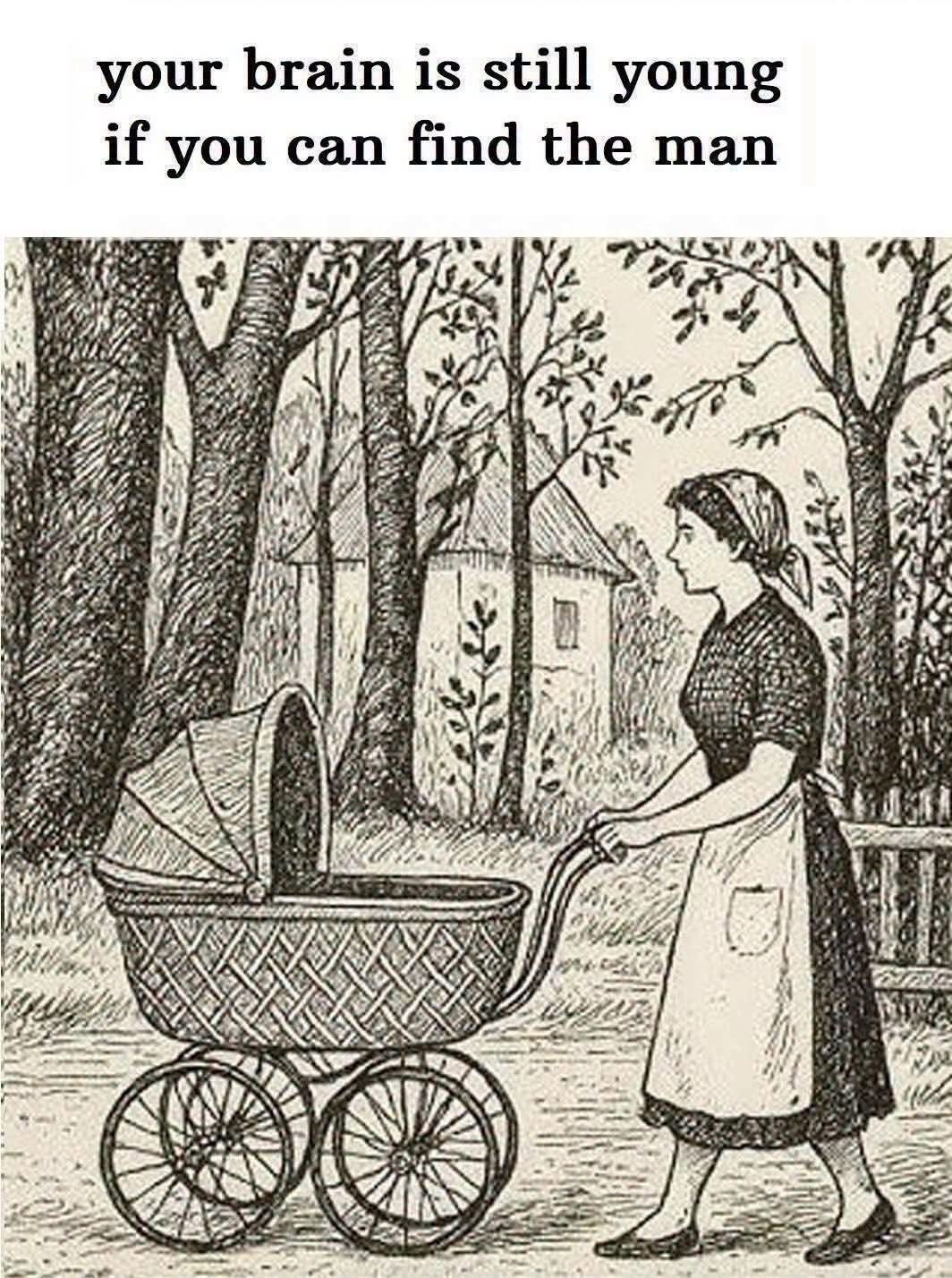
At first glance, this vintage pen-and-ink illustration appears to show nothing more than a woman in an apron pushing a baby carriage through a peaceful park. Trees line the background, a quaint cottage sits in the distance, and everything seems perfectly ordinary. But look a little closer — there is a hidden man concealed somewhere within this image, and whether or not you can spot him may say something fascinating about how your brain processes visual information.
Optical illusions like this one have been captivating curious minds for well over a century. They are not just fun party tricks — they are genuine windows into the way our brains interpret, filter, and reconstruct the world around us. So, did you find him? If not, don’t worry. We’re going to break down exactly what’s happening and what it all means.
Where Is the Hidden Man?
If you look carefully at the large tree trunk on the left side of the image, you will notice that the bark and shadowing form the distinct facial profile of a man. The natural curves and lines of the tree’s texture come together to create what appears to be a human face looking outward. Once you see it, it becomes almost impossible to unsee — which is itself a clue about how perception works.
Why Can Some People See It Instantly and Others Cannot?
The ability to spot hidden figures in images like this one is closely tied to a cognitive function called pattern recognition. Our brains are hardwired to search for meaningful shapes — especially human faces — within complex visual environments. This is actually an ancient survival instinct. Early humans who could quickly spot a predator or another person hiding in the trees had a better chance of survival.
Younger brains, or brains that are more cognitively flexible and visually sharp, tend to pick up on these hidden patterns more quickly. Children and young adults often spot the man in seconds. As we age, our visual processing can slow slightly, and we may become more anchored to the “dominant” interpretation of an image — in this case, the woman and the carriage — making it harder to switch perspective and find the secondary image.
What Does This Say About Brain Health?
Can You Find the Hidden Man? What This Classic Optical Illusion Reveals About Your Brain
At first glance, this vintage pen-and-ink illustration appears to show nothing more than a woman in an apron pushing a baby carriage through a peaceful park. Trees line the background, a quaint cottage sits in the distance, and everything seems perfectly ordinary. But look a little closer — there is a hidden man concealed somewhere within this image, and whether or not you can spot him may say something fascinating about how your brain processes visual information.
Optical illusions like this one have been captivating curious minds for well over a century. They are not just fun party tricks — they are genuine windows into the way our brains interpret, filter, and reconstruct the world around us. So, did you find him? If not, don’t worry. We’re going to break down exactly what’s happening and what it all means.
Where Is the Hidden Man?
If you look carefully at the large tree trunk on the left side of the image, you will notice that the bark and shadowing form the distinct facial profile of a man. The natural curves and lines of the tree’s texture come together to create what appears to be a human face looking outward. Once you see it, it becomes almost impossible to unsee — which is itself a clue about how perception works.
Why Can Some People See It Instantly and Others Cannot?
The ability to spot hidden figures in images like this one is closely tied to a cognitive function called pattern recognition. Our brains are hardwired to search for meaningful shapes — especially human faces — within complex visual environments. This is actually an ancient survival instinct. Early humans who could quickly spot a predator or another person hiding in the trees had a better chance of survival.
Younger brains, or brains that are more cognitively flexible and visually sharp, tend to pick up on these hidden patterns more quickly. Children and young adults often spot the man in seconds. As we age, our visual processing can slow slightly, and we may become more anchored to the “dominant” interpretation of an image — in this case, the woman and the carriage — making it harder to switch perspective and find the secondary image.
What Does This Say About Brain Health?
The speed at which you spot a hidden image in an optical illusion can be a rough, informal indicator of visual cognitive sharpness. It is not a medical test by any means, but researchers have noted that flexible thinking, quick perceptual switching, and strong pattern recognition are all associated with good cognitive health. People who regularly challenge their brains with puzzles, visual games, and creative thinking tend to maintain these abilities longer into life.
If it took you a while to find the man, that is completely normal and does not mean anything is wrong. Many factors influence how we see optical illusions, including lighting conditions, the device screen you are viewing the image on, and even how tired or distracted you are in the moment.
The Science Behind Hidden Image Illusions
This type of illusion is known as a figure-ground illusion, where the brain struggles to decide which part of an image is the main subject (the figure) and which part is the background (the ground). The most famous example is the classic vase-and-faces illusion, where a single image can be interpreted as either two faces looking at each other or a vase, depending on how your brain organizes the visual information.
In this vintage illustration, the detailed crosshatching and shading used to draw the tree trunk serve double duty — they realistically depict bark texture while simultaneously forming the contours of a human face. The artist cleverly embedded the hidden figure in a place where the eye is not naturally drawn to look first.
How to Keep Your Brain Sharp and Visually Agile
Whether you found the hidden man in two seconds or two minutes, the good news is that brain agility is something you can actively maintain and even improve. Here are some well-supported habits that help keep your mind sharp and your visual perception keen:
Solve puzzles regularly — jigsaw puzzles, crosswords, Sudoku, and visual brain teasers all challenge different areas of the brain.
Read widely and often to keep language and abstract thinking skills engaged.
Get regular physical exercise, which increases blood flow to the brain and supports cognitive function.
Practice mindfulness or meditation to improve focus and attention to detail.
Sleep well — the brain consolidates learning and repairs itself during deep sleep cycles.
Try drawing or sketching, which trains the brain to observe details more carefully.
Challenge yourself with new skills or hobbies that are outside your comfort zone.
A Brief History of Hidden Image Puzzles
Hidden image illustrations like this one were enormously popular in the late 19th and early 20th centuries, appearing in newspapers, puzzle books, and parlor games. Artists of the era delighted in embedding secondary images — faces, animals, or figures — into detailed scenes, knowing that viewers would spend long minutes searching for the concealed elements. These puzzles were considered a form of wholesome mental entertainment and were enjoyed by people of all ages.
Today, optical illusions have moved online and spread rapidly because they tap into something deeply human — the desire to test ourselves, to share the experience with others, and to feel that little burst of satisfaction when the hidden image suddenly reveals itself.
Final Thoughts
Whether your eyes landed on the hidden man immediately or whether you needed a nudge in the right direction, the real takeaway here is not about passing or failing a test. It is about appreciating the remarkable complexity of human perception. Your brain is constantly making split-second decisions about what it sees, filtering out noise, and constructing a coherent picture of reality from an overwhelming flood of visual data. Optical illusions simply reveal the seams in that process — and that is what makes them so endlessly fascinating.
So the next time you come across a hidden image puzzle, take a moment to really look. Relax your eyes, let your focus soften, and allow your brain to explore the image without locking onto the obvious. You might be surprised by what suddenly appears.