The Small Cabinet Detail Many People Overlook: What This Hardware Does, Why It Matters, and How to Fix Common Problems
If you have ever opened a kitchen cabinet and noticed a small metal mechanism attached to the inside of the cabinet door, you may have wondered what it is actually doing. The hardware can look simple, but it plays an important role in keeping the door properly aligned, securely attached, and easy to open and close.
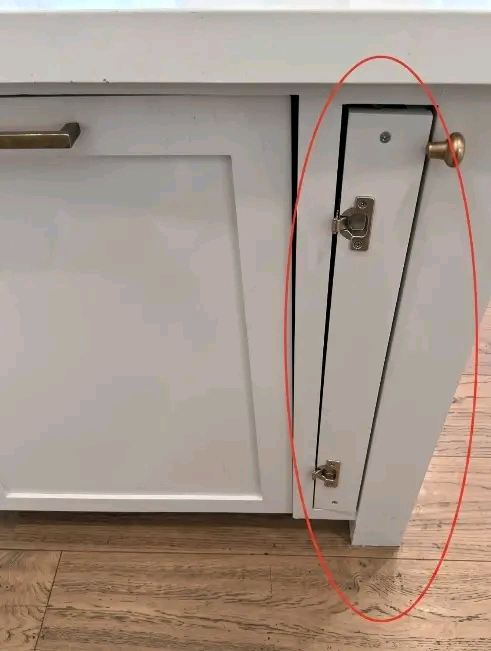
The photograph above highlights the hinge and mounting area of a white cabinet. This small section of hardware is easy to ignore when everything works correctly. However, when a cabinet door begins to sag, rub against another door, refuse to close properly, or develop an uneven gap, the hinge is often one of the first places you should inspect.
This guide explains what the circled cabinet hardware is, how it works, why cabinet doors become misaligned, how to make basic adjustments, and how to maintain cabinet hinges so your doors continue working smoothly.
Important: Cabinet hardware varies by manufacturer and design. The image appears to show a concealed-style cabinet hinge and mounting hardware, but the exact hinge mechanism should be identified before replacing parts. If the cabinet is damaged or the hardware is unsafe, professional repair may be appropriate.
What Is the Hardware Shown in the Picture?
The circled area shows the hinge and hinge mounting area of a cabinet.
A cabinet hinge has a relatively simple job: it connects the cabinet door to the cabinet structure while allowing the door to swing open and closed.
Modern kitchen and bathroom cabinets frequently use concealed hinges. Unlike traditional decorative hinges that remain visible on the outside of the door, concealed hinges are largely hidden when the cabinet is closed.
A typical concealed hinge system can include several components:
- The hinge cup attached to the cabinet door
- A hinge arm
- A mounting plate attached to the cabinet
- Adjustment screws
- Screws or fasteners holding the components in place
Depending on the cabinet design, the hardware may look slightly different from one cabinet to another.
The circled portion in the photograph is particularly important because it is where the cabinet door’s movement and alignment are controlled.
Why Cabinet Hinges Are So Important
Cabinet hinges do much more than simply allow a door to swing.
A properly installed hinge helps control:
- Door alignment
- Closing position
- Door spacing
- Door height
- Door depth
- Opening angle
- Overall stability
When the hinge is properly adjusted, the cabinet door should normally sit evenly within the cabinet opening.
You should see relatively consistent gaps around the door. The door should also open without excessive resistance and close without needing to be pushed or lifted.
When something changes, the problem may not necessarily be the door itself.
It could be:
- A loose screw
- A shifted mounting plate
- A worn hinge
- A damaged cabinet panel
- A warped door
- Excessive weight
- Incorrect adjustment
- A hinge that has become bent
This is why understanding the hinge can save you time and prevent unnecessary repairs.
Why Do Cabinet Doors Become Crooked?
One of the most common cabinet problems is a door that gradually becomes misaligned.
You might notice that one corner is lower than the other, or that the door appears to lean toward the neighboring cabinet.
There are several possible causes.
1. Loose Screws
Cabinet doors are opened and closed repeatedly. Over months or years, this movement can cause screws to loosen.
A slightly loose screw may not be noticeable at first.
Eventually, however, the hinge can shift enough to change the position of the door.
The solution may be as simple as tightening the appropriate screw.
Be careful not to overtighten it. Excessive force can strip the screw or damage the cabinet material.
2. Hinge Adjustment Has Changed
Many modern cabinet hinges are adjustable.
This allows installers and homeowners to fine-tune the position of the door.
A hinge may have several adjustment points that control different directions.
Depending on the hinge design, you may be able to adjust the door:
- Up and down
- Left and right
- Forward and backward
This is extremely useful when two cabinet doors are not lining up correctly.
Understanding the Three Basic Hinge Adjustments
Although hinge designs vary, many concealed cabinet hinges provide three general adjustment directions.
Vertical Adjustment
Vertical adjustment changes the height of the door.
If one cabinet door appears lower than another, the hinge mounting position may need to be adjusted.
The goal is to make the top and bottom edges line up correctly.
Horizontal Adjustment
Horizontal adjustment moves the door from side to side.
This is useful when:
- The gap between two doors is uneven
- The door is too close to the cabinet next to it
- The door overlaps another door
- The cabinet opening looks asymmetrical
Small adjustments can make a surprisingly large visual difference.
Depth Adjustment
Depth adjustment moves the door slightly inward or outward relative to the cabinet frame.
This can help when the door:
- Sits too far outside the cabinet
- Appears recessed too deeply
- Does not sit flush with neighboring doors
- Has an uneven surface position
Not every hinge has exactly the same adjustment mechanism, so inspect the hardware carefully.
How to Tell If Your Cabinet Hinge Needs Attention
You don’t necessarily need special tools to identify a hinge problem.
Start by opening and closing the door several times.
Pay attention to how it moves.
A hinge may need adjustment or replacement if you notice:
- The door scrapes against the cabinet
- The door rubs against another door
- The door will not remain closed
- The door sits lower than before
- The gaps around the door are uneven
- The door moves excessively
- The hinge makes unusual noises
- Screws appear loose
- The hinge is visibly bent
- The cabinet material around the screws is damaged
Sometimes the problem is obvious.
Other times, you may need to compare the door with neighboring cabinets.
A Simple Cabinet Hinge Inspection
Before making adjustments, take a few minutes to inspect the entire hinge area.
Step 1: Open the Cabinet Door
Open the door enough to see the hinge clearly.
Do not force the door if it feels stuck.
Step 2: Check the Screws
Look for loose or missing screws.
If a screw turns freely without tightening, the surrounding material may be damaged.
Step 3: Examine the Hinge
Look for:
- Bent metal
- Cracks
- Rust
- Missing components
- Unusual movement
Step 4: Check the Cabinet Panel
The hinge can be perfectly functional while the cabinet itself is damaged.
Inspect the area around the mounting screws for cracks or enlarged holes.
Step 5: Compare Neighboring Doors
If another cabinet door uses the same hinge, compare the two.
This can help you understand how the hardware should normally look.
How to Tighten a Loose Cabinet Hinge
If the hinge is simply loose, the repair may be straightforward.
You’ll generally need an appropriately sized screwdriver.
In some cases, a drill/driver with a suitable bit can be used, but a hand screwdriver provides better control for small cabinet hardware.
Basic procedure:
- Open the cabinet door.
- Support the door if it feels unstable.
- Identify the loose screw.
- Turn the screw gently clockwise.
- Stop when it is secure.
- Avoid excessive force.
- Close the door and check its alignment.
If tightening the screw does not solve the problem, don’t keep turning it.
The screw hole may be stripped.
What Happens When a Screw Hole Is Stripped?
A common problem with particleboard or fiberboard cabinets is a screw hole that no longer grips properly.
This can happen when:
- A screw is overtightened
- The hinge has been pulled repeatedly
- The cabinet is old
- The door is unusually heavy
- The hinge has been installed incorrectly
When the hole becomes enlarged, simply inserting the same screw may not provide enough holding power.
Depending on the damage, possible repairs include:
- Using an appropriate replacement fastener
- Repairing the damaged wood material
- Installing a suitable hinge repair plate
- Moving the mounting point when structurally appropriate
- Replacing a damaged cabinet component
For significant damage, a cabinetmaker or experienced handyman can determine the best repair.
Should You Replace the Entire Hinge?
Not necessarily.
A hinge should generally be replaced when it is physically damaged, worn, corroded, or no longer holds the door correctly after proper adjustment.
Before buying a replacement, identify:
- Hinge type
- Mounting style
- Door thickness
- Hinge opening angle
- Mounting plate style
- Screw spacing
- Manufacturer, if identifiable
Two hinges can look almost identical while having different dimensions.
Replacing a hinge with an incompatible model may create new alignment problems.
Why Replacing Only One Hinge Can Sometimes Be a Bad Idea
If a cabinet door uses multiple hinges and one fails, you might think that replacing only the damaged hinge is the obvious solution.
Sometimes that is perfectly reasonable.
However, if the hinges are old and all have experienced similar wear, replacing just one can result in slightly different movement between the hinges.
For a matching appearance and consistent operation, some homeowners prefer replacing the complete set.
The important thing is to compare the new hinge with the existing hardware before installation.
How to Keep Cabinet Hinges Working Smoothly
Cabinet hinges usually require very little maintenance.
Nevertheless, simple care can extend their useful life.
Keep Them Clean
Dust, cooking grease, and residue can accumulate around cabinet hardware.
Use a soft cloth to remove surface dirt.
For kitchen cabinets, a mild cleaning solution appropriate for the cabinet material can help remove grease.
Avoid soaking the hinge or allowing water to remain around screws and mounting points.
Don’t Hang Heavy Objects From Cabinet Doors
Cabinet doors are designed to carry their intended hardware and normal use.
Adding excessive weight can put extra stress on the hinges.
Avoid hanging heavy bags, utensils, or other objects from the door unless the cabinet system was specifically designed for that purpose.
Open and Close Doors Normally
Slamming a cabinet door repeatedly places unnecessary stress on the hinge.
If your cabinet has soft-close hinges, allow the mechanism to do its job.
If a door suddenly stops closing correctly, investigate the cause instead of repeatedly forcing it.
What Is a Soft-Close Cabinet Hinge?
Many newer cabinets use soft-close hinges.
A soft-close mechanism slows the door during the final part of its movement.
Instead of slamming shut, the door gradually closes.
This has several advantages:
- Less noise
- Reduced impact
- More comfortable daily use
- Less stress from repeated slamming
- A more refined feel
Soft-close hinges can also eventually require adjustment or replacement.
If the soft-close feature stops working, the hinge itself may be worn or the mechanism may have been damaged.
Why the Cabinet Door Gap Matters
One of the easiest ways to identify an alignment problem is by looking at the gaps around the cabinet door.
A well-aligned door usually has a consistent visual gap.
If the gap becomes noticeably wider on one side, the door may have shifted.
For example, imagine a cabinet door where the top-left corner is close to the neighboring door but the bottom-left corner has a large gap.
That pattern can indicate a positional adjustment issue.
However, don’t assume that every uneven gap is caused by the hinge.
Cabinet boxes can also move, especially if they are improperly installed or have been exposed to moisture.
Moisture Can Cause Cabinet Problems
Kitchen and bathroom cabinets can be particularly vulnerable to moisture.
Water can cause some wood-based cabinet materials to swell.
Once the material changes shape, hinges may no longer sit exactly where they originally did.
Look for:
- Swollen edges
- Bubbling laminate
- Discoloration
- Soft material
- Peeling surfaces
- Warped panels
If the cabinet material around the hinge is swollen or deteriorated, adjusting the hinge alone may not solve the problem.
The Importance of Proper Cabinet Installation
A cabinet door can have perfectly good hinges and still look crooked if the cabinet itself is not properly installed.
Cabinet boxes should be securely positioned and appropriately leveled.
If the cabinet is leaning, the doors may also appear uneven.
This is especially noticeable when several cabinets are installed next to each other.
Before spending money on new hinges, determine whether the problem is:
Door → Hinge → Cabinet box → Installation
Identifying the actual source of the problem is more effective than simply replacing parts.
Common Mistakes People Make With Cabinet Hinges
Mistake 1: Turning Every Screw
Many homeowners see several screws and start adjusting all of them.
This can make the original problem harder to diagnose.
Instead, make one small adjustment at a time and observe the result.
Mistake 2: Overtightening
Cabinet hardware does not need enormous amounts of force.
Overtightening can strip screws or damage the cabinet material.
Firm and controlled is better than excessive force.
Mistake 3: Ignoring the Cabinet Structure
If the cabinet panel is cracked or the screw holes are damaged, adjusting the hinge won’t provide a permanent solution.
Inspect the surrounding material.
Mistake 4: Buying a Random Replacement Hinge
A hinge that looks similar may not be compatible.
Measure the existing hardware and compare specifications before purchasing replacements.
Mistake 5: Adjusting Too Much at Once
Make small changes.
After each adjustment, close the door and check its position.
This makes it much easier to understand what each adjustment does.
A Useful Method for Aligning Cabinet Doors
If you’re adjusting a cabinet with multiple hinges, patience is important.
Start with the hinge that appears to have the greatest effect on the door position.
Make a very small adjustment.
Close the cabinet.
Look at the top, bottom, and side gaps.
Then make another small adjustment if necessary.
Continue until the door sits correctly.
The key is to avoid making large changes without checking the result.
When You Should Stop and Call a Professional
Most basic cabinet adjustments are relatively simple.
However, some situations require more expertise.
Consider professional assistance if:
- The cabinet is pulling away from the wall
- The cabinet door is unusually heavy
- The hinge has torn out of the cabinet
- The surrounding material is severely damaged
- The cabinet box is badly warped
- The cabinet contains electrical or plumbing equipment
- You are dealing with expensive custom cabinetry
- You cannot identify the correct replacement hardware
A professional can often diagnose the problem quickly and prevent further damage.
Can Cabinet Hinges Be Lubricated?
Some hinge mechanisms may benefit from appropriate lubrication, but lubrication is not always necessary.
Before applying anything, check the manufacturer’s recommendations.
Avoid spraying large amounts of general-purpose lubricant around the cabinet.
Excess lubricant can attract dust and grease.
For ordinary concealed hinges, cleaning and proper adjustment are often more important than lubrication.
Why You Should Pay Attention to Small Hardware
The photograph is a good reminder that small pieces of hardware can have a major effect on a household item.
A cabinet door may weigh several kilograms, yet its entire movement is controlled by relatively small components.
When those components are properly installed, you rarely think about them.
When something goes wrong, however, the hinge suddenly becomes one of the most noticeable parts of the cabinet.
This is true throughout the home.
Small screws, brackets, catches, hinges, and mounting plates often determine whether larger objects work correctly.
How Often Should You Check Cabinet Hinges?
There is no universal schedule because cabinet usage varies.
A cabinet opened several dozen times a day will experience considerably more movement than a rarely used storage cabinet.
A practical approach is to inspect your cabinet hardware whenever you notice:
- New movement
- A change in door alignment
- Squeaking
- Difficulty closing
- Loose hardware
- Visible damage
During a general home maintenance check, you can also quickly inspect frequently used cabinets.
Early detection is usually easier than repairing a hinge after it has completely pulled away.
A Quick Cabinet Hinge Maintenance Checklist
Use this simple checklist once or twice a year or whenever you notice a problem:
Visual inspection
☐ Check for loose screws
☐ Check for bent metal
☐ Look for cracks
☐ Look for rust or corrosion
☐ Inspect the cabinet material around the hinge
Door operation
☐ Open the door slowly
☐ Close it normally
☐ Check for rubbing
☐ Check for unusual noise
☐ Look at the gaps around the door
Hardware
☐ Tighten loose screws carefully
☐ Adjust alignment only when necessary
☐ Replace visibly damaged hardware
☐ Use matching replacement components
This simple routine can help prevent minor problems from becoming major repairs.
Frequently Asked Questions
What is the circled part on a cabinet?
The circled area appears to show the cabinet’s hinge and hinge mounting hardware. This hardware connects the door to the cabinet and controls its movement and alignment.
Why is my cabinet door crooked?
A crooked cabinet door can be caused by loose screws, hinge adjustment, worn hardware, a damaged mounting point, a warped door, or an improperly aligned cabinet box.
Can I adjust a cabinet hinge myself?
Many modern cabinet hinges are designed to be adjusted by homeowners. Make small adjustments and check the door after each change.
How do I know if my hinge needs replacing?
If the hinge is bent, cracked, badly worn, corroded, or no longer operates correctly after adjustment, replacement may be appropriate.
Why won’t my cabinet door stay closed?
Possible causes include incorrect hinge adjustment, a damaged hinge, an obstructed cabinet interior, a warped door, or a cabinet that is not properly aligned.
Can I tighten cabinet hinge screws?
Yes, provided the screw and mounting material are in good condition. Tighten gently and avoid stripping the screw or damaging the cabinet.
What if the screw keeps spinning?
The screw hole may be stripped or enlarged. At that point, simply tightening the same screw usually will not provide a reliable repair.
Are all cabinet hinges the same?
No. Cabinet hinges differ in size, mounting method, adjustment range, opening angle, and construction. Always match replacement hardware carefully.
Final Thoughts
The small hinge shown in the photograph may not look particularly important, but it is one of the most functional components of a cabinet.
It controls how the door opens, where it sits when closed, and how well it aligns with the rest of the cabinetry. When a door starts sagging, rubbing, or developing uneven gaps, the hinge and its mounting area are excellent places to begin your inspection.
The good news is that many cabinet-door problems are relatively minor. A loose screw or small alignment issue can sometimes be corrected with a simple adjustment.
The important thing is to diagnose before replacing. Look at the hinge, the screws, the cabinet material, the door, and the overall cabinet installation. Make small adjustments rather than turning every screw at once, and avoid overtightening.
If the hinge or cabinet material is seriously damaged, replacement or professional repair may be the safest option.
So, the next time you notice that little piece of metal inside your cabinet, don’t dismiss it. It may be small, but it is doing an important job every time you open and close the door.
A little attention to cabinet hardware can keep your kitchen looking better, reduce annoying door problems, and extend the life of your cabinets for years to come.