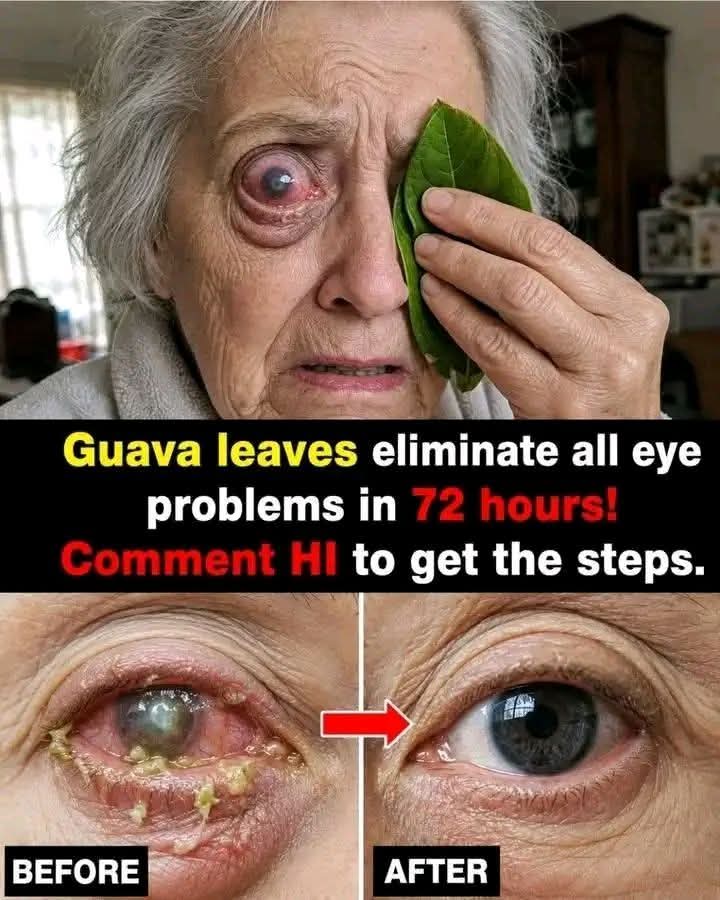
Guava Leaves for Eye Problems: Can They Really Cure Red, Irritated Eyes in 72 Hours?
Introduction
A striking health image circulating online claims that guava leaves can eliminate all eye problems in just 72 hours. The picture shows a person with a severely irritated eye holding a guava leaf, followed by dramatic “before and after” photographs. The message encourages readers to comment for instructions.
The claim is attention-grabbing, especially for people who prefer natural remedies. Guava leaves have a long history of traditional use and contain plant compounds that have been studied for antioxidant and antimicrobial properties. However, there is a major difference between saying that a plant contains potentially useful compounds and proving that putting the plant, its juice, or a homemade preparation into the eye can safely treat an eye disease.
There is currently no established medical evidence that placing guava leaves or homemade guava-leaf preparations on the eye can eliminate all eye problems within 72 hours.
That distinction matters because the eye is an extremely delicate organ. Redness, swelling, discharge, pain, blurred vision, or light sensitivity can have many different causes. Some are minor and temporary, while others require prompt professional treatment to prevent corneal damage or vision loss.
The Centers for Disease Control and Prevention (CDC) explains that conjunctivitis, commonly called pink eye, can be caused by viruses, bacteria, allergens, chemicals, contact-lens problems, foreign bodies, fungi, parasites, and other conditions. Because different causes can produce similar symptoms, assuming that every red eye is the same condition can be dangerous.
This article examines the viral claim about guava leaves, explains what guava leaves can and cannot realistically do, discusses common causes of eye redness, and provides safer approaches for protecting your vision.
What Does the Viral Claim Say?
The image makes several powerful promises:
- Guava leaves can eliminate eye problems.
- The improvement supposedly happens within 72 hours.
- A simple natural remedy is presented as an alternative to medical care.
- A dramatic before-and-after photograph is used as visual evidence.
- Readers are encouraged to comment to receive the “steps.”
These are common characteristics of viral health posts. A dramatic photograph can make a claim appear convincing even when the photograph does not prove what caused the improvement.
A before-and-after image cannot establish that guava leaves produced the result. We generally do not know:
- What condition the person actually had.
- Whether the photographs show the same person.
- Whether the photographs were taken at the stated times.
- Whether medical treatment was also used.
- Whether lighting or image editing changed the appearance.
- Whether the eye improved naturally.
- Whether the photographs were taken from unrelated sources.
Therefore, the photograph should not be treated as clinical evidence.
Most importantly, the phrase “all eye problems” is medically unrealistic. Eye diseases are not one single condition. An allergy, bacterial infection, viral infection, dry eye, corneal injury, glaucoma, cataract, foreign body, or retinal disorder requires a completely different approach.
What Are Guava Leaves?
Guava, scientifically known as Psidium guajava, is a tropical plant widely grown in many parts of the world. Its fruits are nutritious and its leaves have been used traditionally in various cultures.
Guava leaves contain naturally occurring plant compounds, including polyphenols and flavonoids. Laboratory research has investigated extracts of guava leaves for antioxidant and antimicrobial activity.
That scientific interest is legitimate.
However, laboratory activity is not the same as a proven treatment for human eye disease.
For example, if an extract demonstrates antimicrobial activity in a laboratory experiment, that does not automatically mean that placing raw leaves or homemade extract into an infected eye will kill the responsible organism. Researchers must establish the appropriate concentration, formulation, sterility, absorption, safety, dosage, and effectiveness in humans.
The eye is particularly sensitive to contamination and chemical irritation. A substance that is harmless when eaten may not be safe when placed directly onto the cornea or conjunctiva.
Why You Should Not Put Raw Guava Leaves in Your Eye
The most important point is simple:
Do not place raw guava leaves, crushed leaves, leaf juice, homemade tea, or unsterilized plant extracts directly into the eye.
A leaf from a tree may look clean, but it is not sterile.
It may carry:
- Soil particles
- Dust
- Bacteria
- Fungi
- Pesticide residues
- Plant debris
- Environmental contaminants
- Other microorganisms
Introducing these materials directly to the eye can cause irritation or potentially introduce infection.
There is also a risk of scratching the surface of the eye. Even tiny particles can be uncomfortable, particularly if they become trapped underneath the eyelid.
Another problem is dosage. A homemade preparation has no standardized concentration. One person may use a few leaves, another may use many. One preparation may be diluted, another concentrated. There is no reliable way for a person preparing a remedy in the kitchen to know whether the resulting mixture is safe for ocular use.
“Natural” Does Not Automatically Mean Safe
One of the biggest misconceptions surrounding viral health remedies is the belief that natural products are automatically harmless.
Nature contains many substances that can be beneficial, but nature also contains irritants, allergens, toxins, and microorganisms.
The important question is not simply:
“Is it natural?”
The better questions are:
“Is it proven to work for this specific condition?”
“Is it safe when used in this particular way?”
“Has the preparation been tested for sterility and concentration?”
“Could delaying proper treatment cause permanent damage?”
These questions are especially important for the eyes.
A plant may be perfectly suitable as a food ingredient while being inappropriate for direct ocular application.
Understanding Red Eyes
Red eyes are a symptom rather than a diagnosis.
The CDC lists redness, swelling, watering, discharge, itching, irritation, burning, and crusting among common symptoms associated with conjunctivitis.
But similar symptoms can occur for many other reasons.
Viral conjunctivitis
Viral conjunctivitis is often associated with watery discharge and may occur alongside a cold or respiratory infection. Many uncomplicated viral cases improve on their own.
The CDC notes that most viral pink-eye cases are mild and typically clear within 7 to 14 days, although some can last two to three weeks or longer. Antibiotics do not treat viral infections.
This is important because an eye may improve after several days even without a particular remedy. If someone applies guava leaves and the eye subsequently improves, that does not prove that the leaves caused the recovery.
Bacterial conjunctivitis
Bacterial conjunctivitis can produce thicker discharge and may cause the eyelids to stick together.
Some mild cases improve without antibiotics, while others may benefit from antibiotic treatment depending on the cause and circumstances. The CDC explains that bacterial conjunctivitis can be caused by several different bacteria and that symptoms can overlap with other forms of conjunctivitis, making diagnosis difficult.
Allergic conjunctivitis
Allergies can cause intense itching, watering, redness, and swelling. Both eyes are commonly affected.
In this situation, putting plant material into the eye could potentially make irritation worse rather than better, particularly if the person is sensitive to pollen or plant compounds.
Irritation
Smoke, dust, chemicals, pollution, foreign bodies, and contact-lens problems can irritate the eyes.
Treatment depends on the cause.
If a chemical enters the eye, a homemade herbal remedy is not an appropriate substitute for proper first aid and medical assessment.
What About the “72-Hour” Promise?
The 72-hour promise is one of the most questionable parts of the viral message.
Medicine rarely works according to a universal three-day guarantee for “all eye problems.”
Different eye conditions have completely different natural histories.
A mild irritation might improve within hours after the irritant is removed. Some viral conjunctivitis cases take one to two weeks or longer. Allergic symptoms may fluctuate according to exposure. Bacterial infections vary. Corneal injuries and serious infections can require urgent treatment.
Therefore, a fixed claim such as “all eye problems disappear in 72 hours” should be treated with skepticism.
A person’s eye appearing better after three days also does not prove that a remedy cured the underlying condition.
The Difference Between Traditional Use and Medical Evidence
Traditional medicine has an important cultural and historical role. Many modern medicines originated from natural compounds or traditional observations.
However, traditional use alone does not establish that a particular preparation is safe and effective for a specific disease.
Scientific evaluation generally requires several stages.
First, researchers may study a plant’s chemical composition.
Then they may investigate biological activity in laboratory experiments.
Animal studies may sometimes be conducted to examine toxicity or biological effects.
Finally, properly designed human studies are necessary to determine whether a treatment actually works and whether its benefits outweigh its risks.
For an eye treatment, safety standards are particularly important because ocular tissues are sensitive and because contamination can have serious consequences.
A homemade guava-leaf preparation has not undergone the same manufacturing and quality controls as sterile ophthalmic products.
Why the Before-and-After Photograph Can Be Misleading
Before-and-after photographs are emotionally powerful.
The “before” photograph may show redness, swelling, discharge, or another striking abnormality. The “after” photograph may show a clearer-looking eye.
But photographs alone cannot establish a medical diagnosis or treatment effect.
Consider how many factors can change the appearance of an eye:
- Camera exposure
- Lighting
- Flash
- Camera angle
- Distance
- Eye position
- Time of day
- Makeup
- Facial expression
- Image processing
- Different photographs of different people
Even if the two photographs really are from the same person, the images do not prove that guava leaves caused the change.
A scientific clinical trial would compare appropriately selected patients, define the condition, use standardized treatment protocols, monitor outcomes, and compare results against an appropriate control group.
A social-media collage does none of these things.
What Can You Safely Do for Mild Eye Irritation?
For mild pink-eye symptoms, the CDC recommends supportive measures such as cold compresses and artificial tears to help relieve inflammation and dryness.
A clean, cool compress can be placed gently over closed eyelids.
It is also important to avoid rubbing the eyes.
If discharge accumulates around the eyelids, clean hands and a clean, wet washcloth can be used to gently remove it. The CDC recommends careful hand hygiene before and after cleaning an infected eye.
Contact lenses should not be worn while symptoms are present unless an eye-care professional advises otherwise.
These simple measures do not “cure everything,” but they can help reduce discomfort while the underlying condition resolves or while appropriate medical care is obtained.
When Should You See an Eye-Care Professional?
Some eye symptoms should never be dismissed as a simple case of pink eye.
According to the CDC, medical evaluation is particularly important when pink-eye symptoms occur with:
- Eye pain
- Sensitivity to light
- Blurred vision that does not improve after discharge is removed
- Intense eye redness
- Symptoms that become worse
- Symptoms that fail to improve
- A weakened immune system
- Certain pre-existing eye conditions
Newborns with symptoms of conjunctivitis should be evaluated promptly.
Contact-lens wearers deserve particular caution because some infections involving the cornea can become serious. The CDC notes that contact-lens wearers with bacterial conjunctivitis are at increased risk of bacterial keratitis and should be promptly evaluated.
Severe bacterial eye infections can progress rapidly. The CDC describes hyperacute bacterial conjunctivitis as a rare but serious condition that can cause pain, reduced vision, corneal damage, and even vision loss if not treated promptly.
This is why a viral post should never be allowed to delay appropriate medical attention.
Eye Pain Is Different From Simple Irritation
Mild itching can occur with allergies.
Mild burning can occur with dryness or irritation.
But significant pain is more concerning.
Pain may indicate a problem involving deeper or more sensitive structures of the eye, including the cornea.
Similarly, reduced vision should not be assumed to be a normal feature of ordinary pink eye.
If your vision changes, the eye becomes extremely sensitive to light, or significant pain develops, seek professional evaluation rather than experimenting with household remedies.
What If Something Has Already Been Put in the Eye?
If you have already placed guava leaves, guava juice, herbal tea, or another homemade preparation in your eye and it is now irritated, stop using the preparation.
Do not continue applying it simply because a social-media post says that irritation is part of the healing process.
If a substance has entered the eye, appropriate flushing may be necessary depending on what the substance was. If significant pain, persistent redness, blurred vision, light sensitivity, or other concerning symptoms develop, seek urgent medical advice.
Do not put additional substances into the eye in an attempt to “neutralize” the first substance.
How to Prevent the Spread of Pink Eye
If the cause is viral or bacterial, conjunctivitis can spread easily.
Good hygiene is therefore extremely important.
Wash your hands frequently with soap and water for at least 20 seconds, particularly after touching the eyes or cleaning discharge.
Avoid rubbing your eyes.
Do not share:
- Towels
- Washcloths
- Pillowcases
- Eye makeup
- Makeup brushes
- Eye drops
- Contact lenses
- Contact-lens cases
- Other personal items that come into contact with the eyes
The CDC specifically recommends avoiding the sharing of personal items and practicing careful hand hygiene to reduce transmission.
These measures are far more reliable for preventing transmission than using an unproven herbal preparation.
Can Guava Leaves Still Be Part of a Healthy Lifestyle?
Guava leaves do not need to be portrayed as useless simply because the viral eye claim is unsupported.
Plants can contain interesting bioactive compounds, and guava leaves have been studied scientifically for various properties.
The key is using them appropriately.
Eating guava fruit as part of a balanced diet is very different from putting a raw guava leaf into the eye.
The fruit provides nutrients and can be incorporated into normal meals. The leaves, meanwhile, may have traditional culinary or herbal uses in some cultures.
But traditional use should not be confused with a clinically proven eye treatment.
Why “One Remedy for Every Eye Problem” Is a Warning Sign
A credible health claim usually identifies a specific condition.
For example:
“Treatment for allergic conjunctivitis”
is a more medically meaningful statement than:
“Cures every eye problem.”
The eye has many different diseases and structures.
Problems can involve:
- The eyelids
- Tear glands
- Conjunctiva
- Cornea
- Iris
- Lens
- Retina
- Optic nerve
- Surrounding tissues
A single leaf cannot reasonably be expected to eliminate every condition affecting all these structures.
Whenever a social-media post claims that one ingredient can cure an unusually broad range of diseases, it is worth pausing before trying it.
Common Questions About Guava Leaves and Eye Health
Can guava leaves cure pink eye?
There is not sufficient clinical evidence to recommend guava leaves as a treatment for conjunctivitis. The cause of pink eye matters, and treatment varies according to whether the problem is viral, bacterial, allergic, or caused by another irritant or condition.
Can I place guava-leaf juice in my eye?
It is not recommended to put homemade guava-leaf juice into the eye. Homemade plant preparations are not sterile and may irritate or contaminate the eye.
Can guava leaves improve eyesight?
There is no established evidence that placing guava leaves on the eye can improve vision or reverse common causes of reduced eyesight.
Does guava leaf tea cure eye infections?
Guava-leaf tea should not be used as an eye drop unless a qualified medical professional has specifically recommended a sterile, appropriately prepared product. Ordinary homemade tea is not equivalent to a sterile ophthalmic preparation.
Why did someone’s eye look better after using guava leaves?
The improvement may have occurred for many reasons. Some eye conditions improve naturally, symptoms may fluctuate, or other treatments may have been used. A before-and-after photograph cannot determine causation.
Is guava itself healthy?
Guava fruit can be part of a healthy, balanced diet. That does not mean every preparation made from guava is appropriate for every part of the body.
A Better Way to Think About Natural Remedies
Natural remedies should not be judged only by whether they are traditional or popular.
Instead, ask five questions:
- What exact condition is being treated?
“Eye problems” is too broad. A diagnosis matters.
- Is there reliable human evidence?
Laboratory research and personal testimonials are not enough.
- Is the preparation sterile?
This is especially important for anything that touches the eye.
- What are the potential risks?
Even a potentially beneficial plant compound can cause irritation, allergy, contamination, or other problems.
- Could using the remedy delay effective treatment?
This may be the biggest risk of all.
A harmless home remedy for mild discomfort is one thing. Replacing professional treatment for a potentially serious eye infection is another.
The Most Important Lesson From the Viral Image
The message behind the image may appear simple:
“Use guava leaves and your eye problems will disappear in 72 hours.”
But eye health is much more complicated.
Guava leaves are interesting plants with a history of traditional use and scientific research into their chemical properties. That does not prove that they can cure eye disease.
There is no reliable basis for promising that guava leaves eliminate all eye problems in 72 hours.
Instead of putting raw leaves or homemade preparations into your eyes, pay attention to your symptoms and use appropriate, evidence-based care.
For mild symptoms, supportive measures such as cool compresses and artificial tears may provide relief. For persistent, severe, or unusual symptoms, an eye-care professional can determine the cause and recommend appropriate treatment.
Final Conclusion
The viral claim that guava leaves eliminate all eye problems within 72 hours is not supported by established clinical evidence.
Guava leaves contain biologically active compounds and have been investigated for various potential properties, but that is very different from proving that a raw leaf or homemade guava preparation can safely treat the human eye.
The eye is too valuable to experiment with casually.
Redness, swelling, itching, discharge, pain, light sensitivity, and blurred vision can have many different causes. Some conditions are mild and resolve naturally, while others require prompt treatment to protect the cornea and preserve vision. The CDC emphasizes that viral and bacterial conjunctivitis can be contagious and that certain symptoms—including pain, light sensitivity, blurred vision, intense redness, or worsening symptoms—warrant medical evaluation.
So, rather than following a viral “72-hour cure,” choose a safer approach:
Do not put raw guava leaves or homemade plant preparations directly into your eyes.
Do not rely on before-and-after photographs as proof of a treatment.
Do not assume every red eye has the same cause.
Practice good hand hygiene and avoid rubbing or sharing personal eye-care items.
Use appropriate supportive care for mild symptoms when suitable.
Seek professional eye care when symptoms are severe, persistent, worsening, or associated with pain or vision changes.
Guava can certainly be part of a healthy lifestyle, but a social-media claim should never replace proper eye care.
Your eyesight is worth more than a viral promise.
Important Health Disclaimer
This article is for general educational purposes and does not diagnose or treat eye disease. If you have eye pain, significant redness, discharge, light sensitivity, blurred or reduced vision, an eye injury, chemical exposure, or symptoms that are worsening or not improving, seek advice from a qualified healthcare professional or eye-care specialist. People who wear contact lenses should be especially cautious about new eye symptoms.