Vaseline and Baking Soda for Skin: What This Popular Home Remedy Can—and Cannot—Do
Introduction
A small jar of petroleum jelly and a box of baking soda are two inexpensive household products that have become popular in online beauty routines. Social-media posts often show a spoonful of baking soda being mixed with Vaseline and suggest that the combination can transform the appearance of the skin, remove dark areas, smooth rough patches, or make the complexion look brighter.
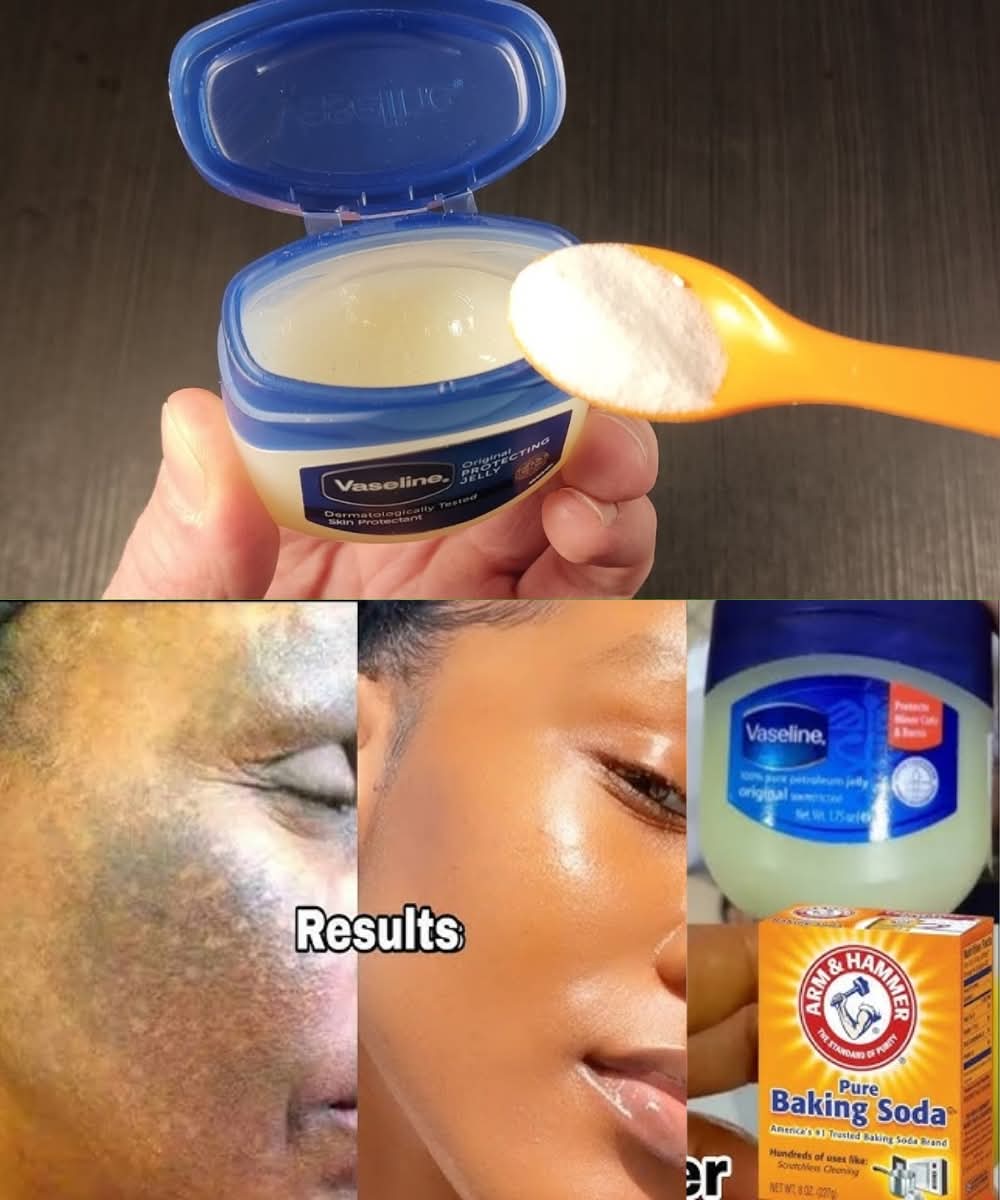
The photograph accompanying this article shows exactly that type of homemade mixture: petroleum jelly, commonly known by the brand name Vaseline, combined with baking soda. The promise is attractive because both ingredients are inexpensive and widely available. However, when it comes to skincare, a simple-looking home remedy is not automatically a safe or effective one.
Petroleum jelly and baking soda have very different properties. Petrolatum is an occlusive ingredient that helps reduce water loss from the skin and can be useful for protecting dry, irritated areas. Baking soda, on the other hand, is an alkaline powder that can act as a physical exfoliant. While gentle exfoliation can sometimes make skin temporarily feel smoother, baking soda can also disturb the skin’s normal protective barrier and cause dryness, burning, redness, or irritation—especially when it is rubbed onto the face.
So, is a Vaseline and baking soda mixture a miracle skin treatment? No. But understanding what each ingredient actually does can help you decide whether there is a safe place for either ingredient in your skincare routine.
This detailed guide explains the potential benefits, limitations, preparation considerations, safer alternatives, and important precautions surrounding this popular DIY skincare combination.
What Is Vaseline?
Vaseline is a well-known brand of petroleum jelly. Petroleum jelly is an occlusive substance that forms a protective layer over the surface of the skin.
Its main purpose is not to “feed” the skin or bleach it. Instead, it helps reduce water loss from the outer layer of the skin.
This makes petrolatum particularly useful for areas that are:
- Dry
- Rough
- Chapped
- Exposed to wind or cold
- Prone to cracking
- In need of additional moisture protection
Petrolatum is also widely used as a protective skin ointment. When applied over slightly damp skin, it can help keep moisture from evaporating too quickly.
Does Vaseline lighten dark skin?
There is an important distinction here.
Petroleum jelly does not function as a skin-lightening or bleaching ingredient. It does not directly remove melanin or erase pigmentation.
However, when dry skin becomes better moisturized, it may appear smoother, softer, and more radiant. Sometimes people interpret this healthier appearance as “lightening.”
If dark spots are caused by acne marks, sun exposure, hormonal pigmentation, inflammation, or another underlying condition, petroleum jelly alone is unlikely to eliminate them.
What Is Baking Soda?
Baking soda, also called sodium bicarbonate, is a fine white powder commonly used in cooking, cleaning, and household applications.
It is alkaline, meaning it has a relatively high pH compared with healthy skin.
The skin’s natural surface has a mildly acidic environment often referred to as the acid mantle. This environment contributes to the skin barrier and helps support normal skin function.
Applying strongly alkaline substances repeatedly to the skin may interfere with this environment.
Baking soda also has a slightly abrasive texture. When rubbed against the skin, it can physically remove some surface material.
That may create a temporary sensation of smoothness, but more exfoliation is not necessarily better.
Why Do People Mix Vaseline With Baking Soda?
The idea behind the combination is usually simple:
Baking soda = exfoliation
Vaseline = moisture and protection
The theory is that baking soda removes dead surface cells while petroleum jelly moisturizes the skin afterward.
This sounds reasonable at first, but skincare is more complicated than simply combining an exfoliant with an occlusive.
Baking soda can be too irritating for some skin types, especially on the face. Adding Vaseline does not automatically neutralize the potential irritation caused by baking soda.
The mixture may therefore produce a temporary smooth feeling without providing the long-term benefits claimed in viral posts.
Potential Benefits of Petroleum Jelly
Petroleum jelly has legitimate skincare uses when used appropriately.
- Helps Reduce Moisture Loss
One of the best-known properties of petrolatum is its ability to create an occlusive layer.
This layer helps slow the evaporation of water from the skin.
For people with dry skin, applying a small amount over moisturizer can help keep the skin feeling comfortable.
- Helps Protect Dry Areas
Petroleum jelly can be particularly useful on:
- Dry lips
- Dry hands
- Rough elbows
- Rough knees
- Dry heels
- Areas exposed to friction
It can help create a barrier between the skin and environmental irritants.
- Makes Rough Skin Feel Smoother
Very dry skin often feels rough because the outer layer has become dehydrated.
By reducing moisture loss, petroleum jelly can make the surface feel softer and more flexible.
This is different from physically exfoliating the skin.
- Useful for Chapped Skin
Cold weather, dry air, frequent hand washing, and environmental exposure can all contribute to chapping.
A protective layer of petroleum jelly can help reduce further moisture loss.
- Can Be Used as an Occlusive Layer
Some people use the “slugging” technique, in which a thin layer of petrolatum is applied as the final step of a nighttime skincare routine.
This can help people with dry skin retain moisture.
However, individuals with acne-prone or very oily skin may prefer lighter products.
Potential Benefits of Baking Soda—With Important Limitations
Baking soda is not a dedicated skincare exfoliant, and its use on the skin deserves caution.
Its physical texture can provide exfoliation when rubbed onto the skin.
That may temporarily make the skin feel:
- Smoother
- Softer
- Less rough
But this does not mean baking soda is an ideal exfoliating ingredient.
There are specially formulated exfoliating products designed for the skin that provide much more controlled concentrations and formulations.
Examples include products containing ingredients such as:
- Lactic acid
- Glycolic acid
- Salicylic acid
- Polyhydroxy acids
These ingredients are formulated specifically for topical skincare and can be easier to incorporate safely than household baking soda.
Can Vaseline and Baking Soda Remove Dark Spots?
This is one of the biggest claims associated with the mixture, but it should be treated with skepticism.
Dark spots can have many causes, including:
- Post-inflammatory hyperpigmentation
- Acne marks
- Sun exposure
- Hormonal changes
- Skin irritation
- Certain medications
- Melasma
- Previous injuries or inflammation
A homemade mixture of petroleum jelly and baking soda has not been established as a reliable treatment for these causes.
In fact, aggressive rubbing or repeated irritation can sometimes make pigmentation appear worse, particularly in people whose skin develops dark marks after inflammation.
This is an important point:
Irritating a dark spot does not necessarily make it disappear. It can make the skin more inflamed and potentially darker.
For persistent pigmentation, sun protection and properly formulated skincare ingredients are generally much more sensible approaches.
Can the Mixture Make Skin “Whiter”?
The term “whitening” is frequently used in viral beauty content, but it can be misleading.
Healthy skincare should focus on improving:
- Hydration
- Texture
- Barrier function
- Even appearance
- Protection from environmental damage
Rather than trying to change someone’s natural skin color, a safer goal is to maintain healthy skin and reduce uneven pigmentation where appropriate.
If skin appears brighter after using a product, that may simply be due to removing surface debris or increasing hydration—not a permanent change in natural skin color.
Why Baking Soda Can Be Problematic for Facial Skin
The face is not simply another surface on which household powders can be used.
Facial skin can be sensitive to changes in pH, friction, and harsh ingredients.
Baking soda can potentially cause:
- Dryness
- Stinging
- Redness
- Burning
- Irritation
- Increased sensitivity
- Barrier disruption
The risk can be greater when the powder is scrubbed vigorously.
People with eczema, rosacea, sensitive skin, or a damaged skin barrier should be especially cautious.
The Importance of the Skin Barrier
The outer layer of the skin acts as a protective barrier.
It helps:
- Keep water inside the skin
- Reduce penetration of unwanted substances
- Protect against environmental stress
- Support normal skin function
When this barrier becomes damaged, the skin may become dry, tight, flaky, itchy, or unusually sensitive.
This is why a skincare routine should not focus only on removing things from the skin.
Sometimes the best skincare strategy is actually to do less.
Gentle cleansing, moisturizing, and sun protection can be more valuable than aggressive scrubbing.
A Safer Way to Think About the Ingredients
Instead of treating Vaseline and baking soda as a magical combination, consider them separately.
Petroleum jelly
Useful primarily as a protective occlusive for dry skin.
Baking soda
A household alkaline powder that may provide physical exfoliation but can irritate the skin.
The safest conclusion is that petroleum jelly has a well-established practical role in skin moisturization and protection, while baking soda should not be considered a necessary facial exfoliant.
If You Still Want to Experiment With a DIY Mixture
If someone decides to try a homemade preparation despite the potential drawbacks, caution is essential.
Do not begin by applying it over the entire face.
A patch test on a small area of skin is a more cautious approach.
Avoid:
- Eyes
- Eyelids
- Lips
- Broken skin
- Cuts
- Freshly shaved skin
- Sunburned skin
- Areas with active irritation
Do not scrub aggressively.
Physical pressure is not required for an exfoliating effect, and aggressive rubbing can increase irritation.
If burning, swelling, significant redness, itching, or discomfort develops, wash the area gently and stop using the mixture.
A Better Alternative for Dry Skin
If your goal is simply softer, smoother skin, you do not need baking soda.
A simple routine can be much more effective.
Step 1: Cleanse Gently
Use a mild cleanser appropriate for your skin type.
Avoid harsh soaps that leave the skin feeling extremely tight.
Step 2: Apply Moisturizer
Choose a fragrance-free moisturizer containing ingredients such as:
- Ceramides
- Glycerin
- Hyaluronic acid
- Petrolatum
- Dimethicone
The best option depends on your skin type.
Step 3: Use Petroleum Jelly When Appropriate
For particularly dry areas, apply a thin layer of petroleum jelly over moisturizer.
This helps lock in hydration.
Step 4: Protect Your Skin From the Sun
Sun protection is extremely important if your goal is a more even-looking complexion.
Daily broad-spectrum sunscreen can help protect against ultraviolet radiation and reduce the development or worsening of many forms of pigmentation.
What About Rough Elbows and Knees?
Rough elbows and knees can sometimes tolerate richer products than the face.
A simple routine is:
- Wash the area gently.
- Apply a moisturizing cream.
- Seal with a thin layer of petroleum jelly if necessary.
- Repeat consistently.
For persistent roughness, a properly formulated body lotion containing urea, lactic acid, or salicylic acid may be a better choice than baking soda.
What About Dark Knees, Elbows, and Knuckles?
Darkening around joints is common and can have many causes.
Friction, dryness, previous inflammation, sun exposure, and individual pigmentation patterns can all contribute.
Scrubbing harder is not necessarily the answer.
Repeated irritation may actually make pigmentation more noticeable.
Instead, focus on:
- Gentle cleansing
- Regular moisturization
- Sun protection where exposed
- Avoiding unnecessary friction
- Properly formulated skincare products
If the discoloration is sudden, spreading, very thick, or associated with other symptoms, medical evaluation may be appropriate.
What About Acne?
Petroleum jelly itself is not an acne treatment.
Although petrolatum is generally considered an effective occlusive ingredient, applying thick layers over acne-prone skin may not be comfortable for everyone.
More importantly, baking soda should not be used as a substitute for proven acne treatments.
Common acne-care ingredients include:
- Benzoyl peroxide
- Salicylic acid
- Adapalene
- Azelaic acid
The appropriate choice depends on the type and severity of acne.
If acne is painful, severe, scarring, or persistent, professional advice is worthwhile.
What About Scars?
Another viral claim is that Vaseline and baking soda can erase scars.
That claim should not be taken literally.
A scar is a structural change in the skin resulting from healing.
Petroleum jelly can be useful for protecting healing skin in certain circumstances, but it does not magically erase established scars.
Baking soda cannot be relied upon to remove scars.
For raised, depressed, or significant scars, treatments may include silicone products, prescription treatments, procedures, or other approaches depending on the scar type.
What About Wrinkles?
Petroleum jelly can temporarily make dry lines appear less noticeable because hydrated skin often looks smoother.
However, that is different from reversing wrinkles.
Baking soda is not an established anti-aging treatment.
For long-term skin-aging prevention, some of the most important strategies include:
- Sun protection
- Avoiding smoking
- Gentle skincare
- Regular moisturization
- Adequate sleep
- A balanced diet
- Appropriate evidence-based topical products
Common Mistakes People Make With DIY Skincare
Mistake 1: Assuming Natural Means Safe
Baking soda is not a synthetic chemical created specifically for cosmetics, but that does not automatically make it safe for facial use.
Natural and household ingredients can still irritate skin.
Mistake 2: Scrubbing Too Hard
More pressure does not mean better exfoliation.
Aggressive rubbing can cause microscopic irritation.
Mistake 3: Using the Mixture Every Day
Repeated exposure can make irritation more likely.
Skin does not need constant aggressive exfoliation.
Mistake 4: Applying It Around the Eyes
The skin around the eyes is delicate.
Keep homemade abrasive mixtures away from the eye area.
Mistake 5: Expecting Overnight Results
Healthy skin changes gradually.
Claims that a homemade mixture will dramatically transform pigmentation in one night should be approached with skepticism.
How to Perform a Patch Test
Before using a new skincare product or homemade mixture, a small-area test can help identify obvious irritation.
Apply a small amount to an inconspicuous area, such as the inner forearm.
Leave the area alone and monitor for signs of irritation.
If you experience significant burning, swelling, redness, itching, or discomfort, do not continue using the product.
Remember that a patch test cannot guarantee that a product will never cause irritation on the face.
Who Should Avoid Baking Soda on the Face?
Extra caution is appropriate for people with:
- Very sensitive skin
- Eczema
- Rosacea
- Frequent facial irritation
- A damaged skin barrier
- Active sunburn
- Open wounds
- Recent cosmetic procedures
If your skin is already irritated, adding an abrasive alkaline powder is unlikely to improve the situation.
The priority should be restoring comfort and protecting the skin barrier.
Can Petroleum Jelly Be Used Every Day?
For many people, plain petroleum jelly can be used regularly on dry areas.
A small amount is usually enough.
You do not need to cover the skin with a thick layer.
For dry lips, heels, hands, or small rough patches, petroleum jelly can be a simple and inexpensive option.
On the face, whether it feels comfortable depends on your skin type and routine.
How to Build a Simple Healthy-Skin Routine
You do not need a cabinet full of products.
A basic routine can be surprisingly effective.
Morning
- Gentle cleanse
Clean the skin without excessive scrubbing.
- Moisturizer
Use a moisturizer suitable for your skin type.
- Sunscreen
Apply broad-spectrum sunscreen to exposed skin.
Evening
- Cleanse
Remove dirt, sweat, makeup, and sunscreen.
- Treatment if needed
Use a properly formulated product for your specific concern.
- Moisturizer
Support the skin barrier.
- Petroleum jelly when appropriate
Use a thin layer on particularly dry areas.
This simple approach is generally more sensible than repeatedly applying harsh homemade mixtures.
The Truth About Viral Beauty Remedies
Social media has made homemade skincare recipes incredibly popular.
A photograph showing a dramatic “before and after” can be persuasive.
But photographs do not always tell the whole story.
Lighting, camera settings, filters, makeup, skin hydration, facial position, and editing can dramatically change how skin appears.
Even when a photograph is genuine, it does not prove that a particular ingredient caused the result.
That is why it is important to separate:
What looks convincing online
from
What has actually been demonstrated to work safely.
Why Consistency Matters More Than Miracle Ingredients
Healthy skin rarely comes from one magical ingredient.
Instead, it is usually the result of consistent habits.
These include:
- Gentle cleansing
- Adequate moisturization
- Sun protection
- Avoiding unnecessary irritation
- Treating specific skin conditions appropriately
- Maintaining a healthy lifestyle
A simple routine followed consistently is usually more useful than constantly changing between viral remedies.
Nutrition and Skin Health
Skincare products are only one part of overall skin health.
A balanced diet can provide nutrients that support normal body function.
Include a variety of:
- Fruits
- Vegetables
- Whole grains
- Beans
- Nuts and seeds
- Lean protein
- Healthy fats
Staying adequately hydrated is also important for overall health.
However, drinking excessive amounts of water or consuming a particular “detox” drink will not magically erase pigmentation or wrinkles.
When a Dark Spot Should Be Checked
Not every dark patch is simply a cosmetic issue.
Seek professional evaluation if a skin mark:
- Changes rapidly
- Bleeds without an obvious reason
- Develops an irregular appearance
- Becomes painful
- Itches persistently
- Grows quickly
- Looks significantly different from surrounding marks
Likewise, widespread or unexplained pigmentation should be evaluated rather than repeatedly treated with home remedies.
Frequently Asked Questions
Can Vaseline and baking soda remove dark spots?
There is no good reason to consider this mixture a proven dark-spot treatment. Baking soda may irritate the skin, while petroleum jelly primarily acts as an occlusive moisturizer.
Can the mixture make the skin brighter?
It may temporarily make skin feel smoother, but it should not be expected to permanently lighten natural skin color or eliminate pigmentation.
Is baking soda a good facial scrub?
It is not an ideal facial exfoliant for many people because its alkalinity and abrasive texture can cause irritation.
Is Vaseline good for dry skin?
Yes. Petroleum jelly is an effective occlusive that helps reduce water loss and can protect dry skin.
Can I use Vaseline every night?
Many people can use it regularly on dry areas. A thin layer is generally sufficient.
Can baking soda remove acne scars?
No reliable evidence supports baking soda as a scar-removal treatment.
Can Vaseline remove wrinkles?
No. It can moisturize and temporarily make dry lines look less prominent, but it does not erase wrinkles.
Can this mixture be used under the eyes?
It is better to avoid putting baking soda near the eyes. The area is delicate and easily irritated.
Final Thoughts
The viral combination of Vaseline and baking soda is a good example of how a simple home remedy can become more dramatic online than the available evidence supports.
Petroleum jelly has a legitimate place in skincare. It is an effective occlusive that can help reduce moisture loss, protect dry areas, and support a comfortable skin barrier.
Baking soda is different. Although its texture can provide physical exfoliation, it is alkaline and can irritate facial skin. There is no need to use it as a daily facial scrub, and it should not be considered a proven treatment for dark spots, acne scars, wrinkles, or skin whitening.
If your goal is softer, healthier-looking skin, start with the basics: gentle cleansing, regular moisturization, appropriate sun protection, and carefully selected skincare products.
For dark spots or persistent skin changes, identifying the underlying cause is much more useful than repeatedly scrubbing the area with homemade mixtures.
The most important lesson is simple:
A skincare ingredient does not become more effective simply because it is popular on social media.
When it comes to your skin, gentle and consistent care is usually a better strategy than aggressive DIY treatments.
Important Safety Disclaimer
This article is for general educational purposes and is not a substitute for professional medical or dermatological advice. Everyone’s skin is different, and a product that seems comfortable for one person may irritate another. Stop using any preparation that causes burning, swelling, significant redness, itching, or other concerning symptoms. For persistent pigmentation, severe acne, unexplained skin changes, or other ongoing concerns, consult a qualified healthcare professional or dermatologist.
Share This Article
If you found this information useful, share it with someone who enjoys trying viral skincare remedies. A simple reminder can help others understand the difference between a popular home remedy and a treatment supported by evidence.
Remember: healthy skin is not about becoming a different color—it is about keeping your skin protected, comfortable, hydrated, and well cared for.