Can One Food Really Regenerate Knee Cartilage? The Truth About Cottage Cheese, Olive Oil, and Joint Health
Introduction
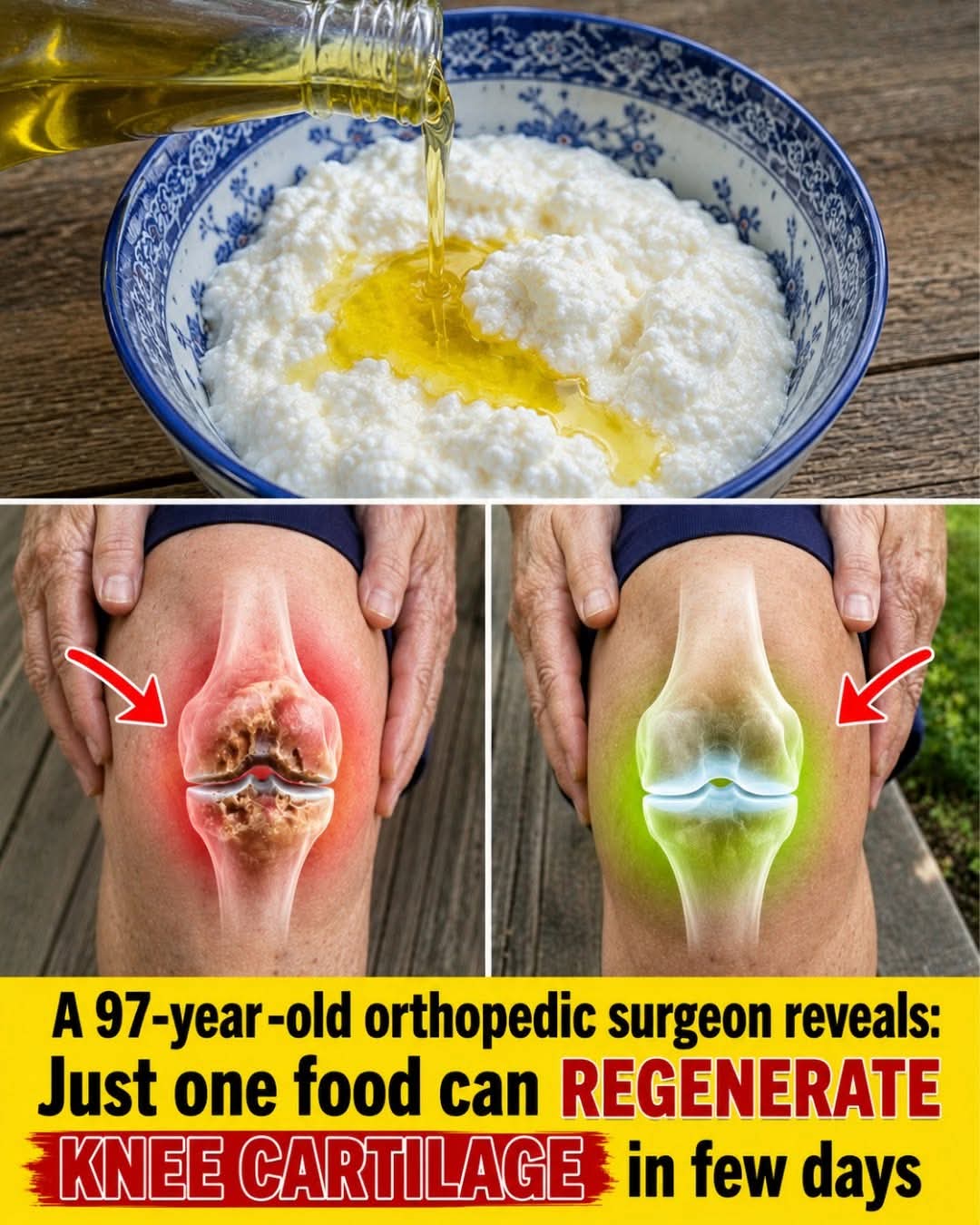
A striking health claim is circulating online: a 97-year-old orthopedic surgeon supposedly revealed that “just one food” can regenerate knee cartilage in only a few days. The accompanying image shows a bowl of cottage cheese topped with olive oil, alongside illustrations suggesting damaged knee cartilage becoming healthy again.
It is an appealing message, especially for anyone living with knee pain, stiffness, osteoarthritis, or concerns about aging joints. The idea that one inexpensive food could rebuild worn cartilage quickly sounds almost too good to be true.
And there is an important reason for that: the claim that a single food can regenerate damaged knee cartilage in a few days is not supported by good scientific evidence.
That does not mean cottage cheese or olive oil are unhealthy. Quite the opposite. Both can fit into a nutritious eating pattern. Cottage cheese can provide protein, calcium, and other nutrients, while extra-virgin olive oil is a major source of monounsaturated fat and plant compounds. A healthy dietary pattern may also contribute to better overall health and can be particularly useful when combined with appropriate physical activity and weight management.
Research increasingly suggests that dietary patterns can influence osteoarthritis symptoms and general musculoskeletal health. However, the evidence does not show that eating one particular food can rapidly rebuild cartilage that has already been lost.
A 2026 systematic review and meta-analysis found some potential benefits of Mediterranean-style eating patterns for musculoskeletal health and knee osteoarthritis pain, but the researchers also emphasized that more high-quality research is needed.
So what is the truth behind the viral claim?
Let’s examine what knee cartilage is, what happens in osteoarthritis, what cottage cheese and olive oil actually provide, which foods may support a healthy diet, and what evidence-based strategies can genuinely help people with knee osteoarthritis.
What Is Knee Cartilage?
Cartilage is a smooth, resilient tissue that covers the ends of bones where they meet inside a joint.
In the knee, articular cartilage helps the joint surfaces move smoothly and reduces friction. It also helps distribute loads when you walk, climb stairs, stand, or exercise.
Healthy cartilage is not simply a layer of “padding.” It is a specialized biological tissue containing a matrix of collagen, proteoglycans, water, and other components.
Unfortunately, cartilage has limited ability to repair itself after significant damage.
This is one reason osteoarthritis can become a long-term condition.
When cartilage deteriorates, the joint environment changes. The underlying bone may become affected, the joint lining can become irritated, and pain and stiffness may develop.
This process does not happen overnight.
And, importantly, it does not normally reverse within a few days because someone eats a particular food.
What Is Knee Osteoarthritis?
Knee osteoarthritis is a common joint condition involving changes to cartilage and other structures in and around the joint.
People with knee osteoarthritis may experience:
- Knee pain
- Stiffness
- Reduced range of motion
- Difficulty climbing stairs
- Discomfort when standing after sitting
- Swelling
- A feeling of grinding or cracking
- Difficulty walking for long periods
- Reduced ability to participate in favorite activities
Symptoms can vary considerably from person to person.
Some people have significant changes visible on an X-ray but relatively little pain. Others can have substantial pain even when imaging findings appear less dramatic.
This is one reason osteoarthritis treatment should focus on the whole person rather than a picture of cartilage alone.
Can Food Regenerate Knee Cartilage in a Few Days?
The short answer is no reliable evidence supports this claim.
There is no single food currently proven to regenerate severely damaged knee cartilage within a few days.
Cartilage biology is complex. Cartilage cells require an appropriate biological environment, nutrients, blood supply to surrounding tissues, mechanical stimulation, and many other factors.
Eating a nutritious food provides building blocks and energy that support normal body functions. But that does not mean those nutrients are immediately converted into new cartilage in a damaged knee.
Think of it this way:
Eating protein does not mean the protein travels directly to your knee and becomes cartilage.
Eating calcium does not mean calcium automatically rebuilds worn cartilage.
Eating olive oil does not mean it directly lubricates the knee.
Nutrition works through the entire body.
That distinction is essential when evaluating viral health claims.
What Is in Cottage Cheese?
The food shown in the image appears to be cottage cheese or a similar fresh cheese.
Cottage cheese can be a nutritious food, depending on the variety and serving size.
It commonly provides:
- Protein
- Calcium
- Phosphorus
- Vitamin B12
- Riboflavin
- Selenium
- Other nutrients
Its protein content is one reason it can be useful in meals for people trying to maintain muscle mass.
This is especially relevant as people age.
Maintaining strong muscles around the knee can help support physical function and mobility.
But cottage cheese should not be confused with a cartilage-regeneration medicine.
Why Protein Matters for Older Adults
Protein is important for maintaining muscle tissue.
As people get older, maintaining muscle strength becomes increasingly important. Reduced muscle mass and strength can make everyday movement more difficult.
Strong muscles surrounding the knee can help with activities such as:
- Walking
- Standing from a chair
- Climbing stairs
- Getting out of a car
- Maintaining balance
- Performing household activities
Therefore, a protein-rich food such as cottage cheese can have a legitimate place in a healthy eating pattern.
The benefit, however, is primarily nutritional rather than a direct cartilage-regeneration effect.
A balanced diet that supplies adequate protein supports muscles throughout the body—not just the knees.
What About Calcium?
Cottage cheese can also provide calcium.
Calcium is essential for maintaining healthy bones.
This is important because the knee is not made of cartilage alone. Bones, muscles, tendons, ligaments, and other tissues all contribute to joint function.
However, calcium is not a treatment that rebuilds articular cartilage.
Adequate calcium intake is important for skeletal health, but taking or eating more calcium than necessary does not mean damaged cartilage will grow back.
People should aim for appropriate calcium intake rather than assuming that more is always better.
What Is in Olive Oil?
The second ingredient shown in the image is olive oil.
Olive oil is a staple of the Mediterranean dietary pattern and contains predominantly monounsaturated fat.
Extra-virgin olive oil also contains various plant compounds, including polyphenols.
Research into Mediterranean-style eating patterns has produced interesting findings regarding osteoarthritis and inflammation.
A systematic review found that people following Mediterranean-style diets have shown associations with better quality of life and some favorable osteoarthritis-related outcomes, although the evidence base has limitations.
More recent research continues to investigate the relationship between Mediterranean-style eating and musculoskeletal health.
A 2026 meta-analysis reported that greater adherence to the Mediterranean diet may be associated with a modest reduction in knee osteoarthritis pain, while emphasizing the need for additional high-quality studies.
That is encouraging, but it is very different from saying:
“Olive oil regenerates knee cartilage in days.”
Why the Mediterranean Diet Is More Important Than One Food
One of the strongest lessons from nutrition research is that overall dietary patterns are usually more meaningful than individual foods.
A Mediterranean-style eating pattern typically emphasizes:
- Vegetables
- Fruits
- Beans and lentils
- Whole grains
- Nuts and seeds
- Olive oil
- Fish
- Moderate amounts of dairy
- Herbs and spices
- Limited highly processed foods
This pattern provides a wide variety of nutrients and plant compounds.
Research has found associations between Mediterranean-style diets and certain osteoarthritis outcomes. One systematic review reported that Mediterranean and prudent dietary patterns were associated with slower progression of symptomatic osteoarthritis, although evidence varied across outcomes.
Another umbrella review found that much of the dietary evidence in osteoarthritis research supports potential benefits from Mediterranean-style eating, while also noting limitations in the available studies.
This is a much more realistic message than claiming that one magical food can rebuild cartilage.
Could a Healthy Diet Help Knee Pain?
Potentially, yes.
Diet can influence health in several ways.
First, a balanced diet can help people maintain a healthy body weight.
Second, nutritious foods provide protein and micronutrients needed for normal body functions.
Third, dietary patterns rich in vegetables, fruits, whole grains, legumes, nuts, fish, and unsaturated fats may have favorable effects on cardiometabolic health and inflammatory processes.
Fourth, improving overall nutrition may make it easier to remain physically active.
All of these factors can matter for someone with knee osteoarthritis.
A recent meta-analysis of randomized clinical trials found that dietary interventions in osteoarthritis could improve pain, physical function, and body weight, although results differed substantially by dietary approach.
So diet can be part of osteoarthritis management.
But that is very different from cartilage regeneration.
The Importance of Body Weight
Body weight is an important consideration for knee osteoarthritis.
The knee experiences substantial mechanical forces during everyday activities.
For people who are overweight or obese, losing weight can reduce the load placed on the knees and may improve pain and function.
The American College of Rheumatology and Arthritis Foundation strongly recommend weight loss for people with knee or hip osteoarthritis who are overweight or obese.
The same guideline notes that benefits can increase with greater amounts of weight loss and that combining weight loss with exercise can enhance results.
This is a powerful reason to focus on sustainable eating habits rather than searching for a single “miracle” food.
Exercise May Be More Important Than a Miracle Food
Many people with knee osteoarthritis fear exercise because they believe movement will wear out the joint.
In most cases, appropriate exercise is actually an important component of treatment.
The American College of Rheumatology and Arthritis Foundation strongly recommend exercise for osteoarthritis.
Appropriate exercise can help improve:
- Muscle strength
- Mobility
- Physical function
- Confidence
- Balance
- General fitness
- Quality of life
Exercises may include:
- Walking
- Cycling
- Swimming
- Water exercise
- Strength training
- Range-of-motion exercises
- Balance activities
- Physical therapy exercises
The ideal program depends on the individual.
Someone with severe pain or significant mobility limitations may benefit from working with a physical therapist or healthcare professional.
Why Strong Leg Muscles Matter
The quadriceps and other muscles around the hip and knee play important roles in movement and stability.
When these muscles become weak, everyday activities can become more difficult.
Strengthening exercises can help people perform movements more efficiently and improve physical function.
This does not mean exercise regenerates cartilage.
Instead, exercise helps the body function better despite joint changes.
That is an important distinction.
Can Cottage Cheese Help Build Stronger Muscles?
Cottage cheese can contribute protein to the diet.
Protein supports muscle maintenance and repair when combined with appropriate physical activity.
For an older person concerned about knee health, maintaining muscle can be especially valuable.
A meal containing cottage cheese, vegetables, whole grains, fruit, or other nutritious foods may therefore be a sensible part of an overall healthy diet.
But again, the benefit is indirect.
The cottage cheese does not travel to the knee and become cartilage.
It supplies nutrients that the whole body can use.
Is Olive Oil Good for Joint Health?
Olive oil can be part of a heart-healthy dietary pattern.
Extra-virgin olive oil contains monounsaturated fat and various plant compounds.
Research into Mediterranean dietary patterns suggests potential benefits for people with osteoarthritis, although the evidence does not establish olive oil alone as a treatment.
A 2016 study involving thousands of participants found that higher adherence to a Mediterranean diet was associated with a lower prevalence of knee osteoarthritis.
Another longitudinal study found that greater Mediterranean diet adherence was associated with lower risk of pain worsening and symptomatic knee osteoarthritis, but not with development of radiographic osteoarthritis itself.
These findings illustrate why it is better to talk about dietary patterns rather than promising that a spoonful of oil can rebuild cartilage.
What Foods Should Be Included in a Joint-Friendly Diet?
There is no officially recognized “cartilage regeneration food.”
Instead, build meals around nutrient-rich foods.
Fatty Fish
Salmon, sardines, mackerel, and other fatty fish provide omega-3 fatty acids.
They can be part of a Mediterranean-style eating pattern and are also useful sources of protein and other nutrients.
Vegetables
Leafy greens, tomatoes, peppers, carrots, broccoli, cabbage, and other vegetables provide fiber, vitamins, minerals, and plant compounds.
Aim for variety.
Fruits
Berries, oranges, apples, pears, kiwi, and other fruits provide fiber and a range of vitamins and plant compounds.
Beans and Lentils
Legumes provide protein, fiber, minerals, and carbohydrates.
They can be especially useful as alternatives to highly processed foods.
Nuts and Seeds
Walnuts, almonds, chia seeds, flaxseeds, and other nuts and seeds provide healthy fats, fiber, minerals, and protein.
Whole Grains
Oats, barley, brown rice, whole-wheat bread, and other whole grains provide fiber and nutrients.
Yogurt and Other Dairy Foods
Dairy products can provide protein and calcium.
Choose options that fit your dietary needs.
Olive Oil
Extra-virgin olive oil can be used in place of some saturated fats.
The key is moderation because oils are energy-dense.
Foods to Limit
A healthy diet does not require completely eliminating every less-healthy food.
However, it can be helpful to reduce excessive intake of:
- Highly processed snacks
- Sugary drinks
- Excess added sugars
- Large amounts of refined carbohydrates
- Foods high in saturated fat
- Highly processed meats
- Excessive alcohol
The goal is not perfection.
The goal is a sustainable pattern that supports overall health.
What About Bone Broth and Collagen?
Another popular internet claim is that collagen-rich foods or bone broth can rebuild cartilage.
Collagen is indeed an important structural protein in connective tissues.
However, eating collagen does not mean it travels directly to a damaged knee and becomes new cartilage.
The body digests dietary proteins and uses their amino acids in many different processes.
Some studies have investigated collagen supplements for joint symptoms, but this is not the same thing as proving that collagen supplements regenerate severely damaged cartilage.
People should be skeptical of advertisements promising that collagen will “rebuild your knees in days.”
What About Glucosamine and Chondroitin?
Glucosamine and chondroitin have been extensively marketed for joint health.
Research on these supplements has produced mixed findings.
Some people report symptom improvement, while other studies have found limited or inconsistent benefits.
The important point is that supplements should not be treated as guaranteed cartilage-regeneration products.
Anyone considering supplements should discuss them with a healthcare professional, particularly if they take medications or have chronic medical conditions.
Why Cartilage Regeneration Takes More Than Nutrition
Cartilage is a specialized tissue with limited natural healing capacity.
Once significant cartilage loss has occurred, simply providing nutrients is not enough to recreate the complex architecture of the original tissue.
Cartilage contains organized layers and a sophisticated extracellular matrix.
Regenerating functional cartilage is an active area of medical research involving techniques such as:
- Tissue engineering
- Cell-based therapies
- Biomaterials
- Regenerative medicine
- Surgical cartilage procedures
These are very different from eating a particular food.
Scientific researchers continue to investigate ways of repairing cartilage, but these technologies should not be confused with ordinary dietary advice.
Why the “Few Days” Claim Is a Red Flag
The phrase “regenerate knee cartilage in a few days” should immediately make readers cautious.
Biological tissues generally do not undergo major structural regeneration in a matter of days simply because a person changes breakfast.
When a health claim promises dramatic results in an unusually short period, ask:
- What clinical trial proves this?
- How many people were studied?
- Was there a control group?
- Was cartilage measured with imaging?
- How long did the study last?
- Was the research published in a peer-reviewed journal?
- Were the results independently replicated?
Without strong evidence, a dramatic testimonial should not be considered proof.
What Should You Do If Your Knees Hurt?
If you have persistent knee pain, the first step is understanding what is causing it.
Knee pain can result from many conditions, including:
- Osteoarthritis
- Previous injuries
- Tendon problems
- Ligament injuries
- Bursitis
- Meniscus problems
- Inflammatory arthritis
- Gout
- Infection
- Other medical conditions
Not every painful knee has the same problem.
A healthcare professional can assess symptoms, physical findings, medical history, and, when appropriate, imaging.
Evidence-Based Ways to Manage Knee Osteoarthritis
Treatment should be individualized, but several approaches have good evidence.
Exercise
Regular appropriate exercise is one of the central recommendations for knee osteoarthritis.
Weight Management
If someone is overweight or obese, gradual weight loss can reduce symptoms and improve function.
Physical Therapy
A physical therapist can help develop an individualized strengthening and mobility program.
Self-Management
Learning about osteoarthritis and developing practical strategies can improve confidence and daily functioning.
Pain-Relief Treatments
Depending on the individual, clinicians may recommend topical or oral medications, injections, braces, walking aids, or other approaches.
The ACR/Arthritis Foundation guideline provides recommendations for several of these options.
A Simple Joint-Friendly Breakfast
Instead of treating cottage cheese and olive oil as a miracle cure, you can use them as components of a balanced meal.
Ingredients
- ½ to 1 cup cottage cheese
- 1 teaspoon extra-virgin olive oil
- Fresh tomatoes
- Cucumber
- Fresh herbs
- A small portion of whole-grain bread
- Optional fruit
Method
- Place cottage cheese in a bowl.
- Add chopped tomatoes and cucumber.
- Sprinkle with fresh herbs.
- Drizzle with a small amount of olive oil.
- Serve with whole-grain bread.
- Add fruit if desired.
This meal provides protein, vegetables, healthy fats, and other nutrients.
It supports a healthy diet without making unsupported promises.
Why This Is a Better Message for Readers
Health articles should give people hope without giving them false expectations.
It is reasonable to say:
“A nutritious diet may support overall health and can be part of an osteoarthritis management plan.”
It is not reasonable to say:
“Eat this one food and your knee cartilage will regenerate in three days.”
The first statement reflects what the evidence can support.
The second creates unrealistic expectations.
People living with chronic pain deserve accurate information because they may spend money on supplements, delay treatment, or stop effective therapies when they believe a miracle cure is available.
Frequently Asked Questions
Can cottage cheese regenerate knee cartilage?
There is no good evidence that cottage cheese can regenerate damaged knee cartilage. It can provide protein, calcium, and other nutrients that support normal nutrition.
Is olive oil good for arthritis?
Olive oil can be part of a Mediterranean-style diet, which has been associated with some favorable outcomes in osteoarthritis research. However, olive oil alone has not been proven to regenerate cartilage.
Can cartilage grow back naturally?
Cartilage has limited healing capacity. The ability to repair depends on the type and extent of damage, location, age, and other factors. Significant cartilage loss should not be expected to reverse simply through diet.
Can knee cartilage regenerate in a few days?
There is no credible evidence that a particular food can regenerate damaged knee cartilage within a few days.
Is cottage cheese good for older adults?
Cottage cheese can be a convenient source of protein and calcium. Whether it is appropriate depends on an individual’s overall diet and health needs.
Does weight loss help knee arthritis?
For people with knee osteoarthritis who are overweight or obese, weight loss is strongly recommended by the American College of Rheumatology and Arthritis Foundation and can improve symptoms and function.
Is exercise safe with knee osteoarthritis?
Appropriately selected exercise is generally an important part of osteoarthritis management. The exact type and intensity should be adjusted to the person’s symptoms and physical abilities.
What is the best food for knee cartilage?
There is no single best food proven to regenerate cartilage. A varied, nutrient-rich dietary pattern is a better goal.
The Truth Behind the Viral Image
The image makes a powerful visual argument: a damaged knee appears on one side, a healthy knee appears on the other, and cottage cheese with olive oil is presented as the solution.
But an illustration is not a clinical trial.
Images can communicate a health claim without providing evidence for it.
The claim that a “97-year-old orthopedic surgeon” revealed a secret food should also not be accepted simply because it sounds authoritative. A person’s age, professional title, photograph, or supposed testimonial does not establish that a treatment works.
The important question is always:
What does the evidence show?
Current evidence supports the value of exercise, weight management when appropriate, self-management, and other established approaches to osteoarthritis.
Research also suggests that healthy dietary patterns, particularly Mediterranean-style diets, may be useful as part of broader osteoarthritis management, although researchers continue to study exactly how large the benefits are.
What the evidence does not establish is that one food can rapidly rebuild worn cartilage.
Final Thoughts
Cottage cheese and olive oil are not miracle foods—but they do not need to be.
Cottage cheese can provide protein and calcium. Olive oil can provide unsaturated fat and can be an important part of a Mediterranean-style eating pattern. Both can fit comfortably into a balanced diet.
For people concerned about knee health, the bigger picture matters much more than a single ingredient.
Eat a varied diet.
Include vegetables, fruits, whole grains, legumes, nuts, seeds, fish, and appropriate protein sources.
Use healthy fats such as olive oil in reasonable portions.
Maintain a healthy body weight when appropriate.
Keep moving.
Strengthen the muscles that support your joints.
Work with a physical therapist or healthcare professional when necessary.
And seek medical evaluation when knee pain is persistent, severe, worsening, or associated with significant swelling, instability, injury, fever, or difficulty bearing weight.
The most important lesson is simple:
There is no proven single food that can regenerate severely damaged knee cartilage in a few days.
Nutrition can support the body. Exercise can improve strength and function. Weight management can reduce stress on the knee. Medical treatment can address pain and disability. Together, these strategies are far more realistic and useful than searching for a secret ingredient.
The good news is that caring for your knees does not require an expensive miracle product. A healthy lifestyle, consistent movement, appropriate nutrition, and evidence-based care can go a long way toward protecting mobility and quality of life as you age.