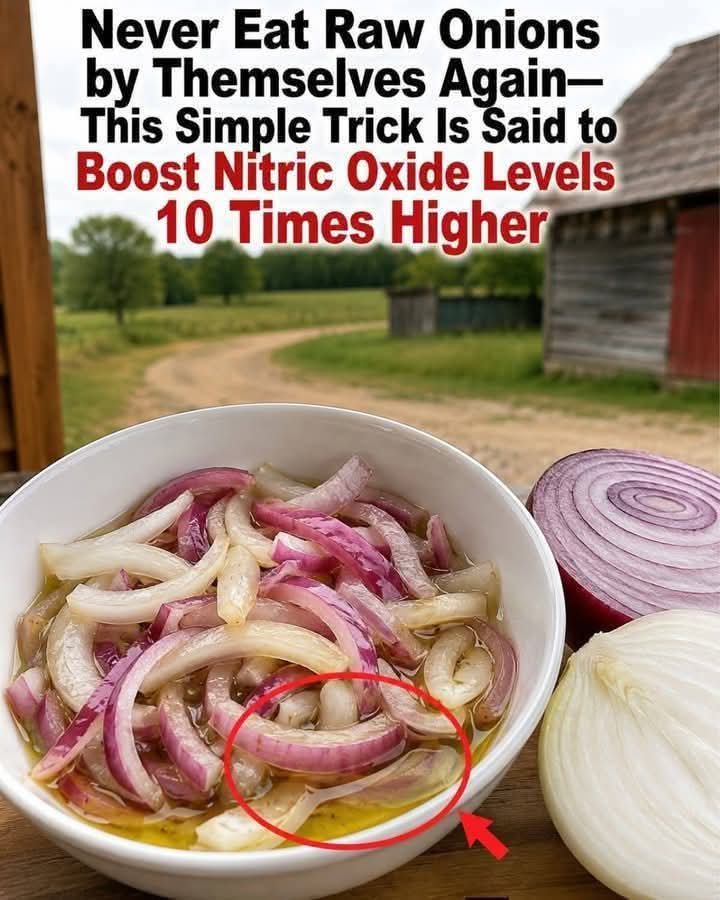
Never Eat Raw Onions by Themselves Again? The Simple Trick That May Help Your Body Make Better Use of Their Natural Compounds
Introduction
Raw onions have been part of traditional cooking for thousands of years. They add sharpness to salads, sandwiches, sauces, grilled meats, tacos, burgers, and countless home-cooked dishes. But recently, a popular claim has been circulating online suggesting that eating raw onions in a particular way can increase nitric oxide levels “10 times higher.”
That sounds impressive—but it needs an important reality check.
Onions do contain several biologically active compounds, including flavonoids such as quercetin and sulfur-containing compounds. These substances are being studied for their potential roles in antioxidant activity, vascular function, and overall cardiovascular health. However, there is not good human evidence showing that a simple onion preparation boosts nitric oxide exactly tenfold.
That does not make onions uninteresting. In fact, quite the opposite is true.
The more useful question is:
How can you enjoy raw onions in a way that makes them more pleasant to eat while taking advantage of their nutritional value?
One practical answer is to combine thinly sliced onions with an acidic ingredient such as vinegar or lemon juice, a little extra-virgin olive oil, herbs, and other vegetables. This creates a quick onion salad or light pickle that can be used with many meals.
This article explores the science behind onions, nitric oxide, quercetin, sulfur compounds, food preparation, possible cardiovascular benefits, safety considerations, and a simple recipe you can make at home.
What Makes Raw Onions Special?
Onions belong to the Allium family of vegetables, alongside garlic, leeks, shallots, and chives.
Their distinctive smell and flavor come largely from sulfur-containing compounds. When an onion is cut, its cells are damaged and enzymes interact with sulfur-containing precursors, producing compounds responsible for the familiar pungent aroma and eye-watering effect.
But onions are more than a flavoring ingredient.
They provide:
- Vitamin C
- Folate
- Potassium
- Fiber
- Flavonoids
- Quercetin
- Sulfur-containing compounds
- Various antioxidant compounds
The exact nutritional composition varies according to onion variety, size, growing conditions, storage, and preparation.
Red, yellow, white, and sweet onions all have slightly different characteristics.
Red onions are particularly popular in raw preparations because they provide a strong flavor, attractive color, and a substantial amount of plant polyphenols.
What Is Nitric Oxide?
Nitric oxide, commonly abbreviated as NO, is a signaling molecule produced naturally in the human body.
One of its most important roles involves the cardiovascular system.
The inner lining of blood vessels—the endothelium—can produce nitric oxide. This molecule helps signal the surrounding smooth muscle to relax, contributing to blood-vessel dilation.
That is one reason nitric oxide is frequently discussed in relation to circulation, blood pressure, exercise, and cardiovascular function.
However, nitric oxide biology is complicated.
It is not simply a matter of “more is always better.”
The body carefully regulates nitric oxide production and activity. Nitric oxide is generated through several pathways, including the conversion of the amino acid L-arginine and pathways involving dietary nitrate and nitrite.
Research has demonstrated that dietary nitrate can contribute to increased nitric oxide-related metabolites in humans.
But this does not mean every nitrate-containing vegetable automatically produces a dramatic increase in nitric oxide.
The amount of nitrate, the food matrix, digestion, oral bacteria, individual metabolism, and many other factors matter.
Does Eating Raw Onion Increase Nitric Oxide 10 Times?
This is where viral headlines need to be treated carefully.
The statement that a particular raw-onion trick produces “10 times higher nitric oxide” should not be presented as an established medical fact.
There is research connecting certain plant foods and their compounds with nitric oxide biology, vascular function, and antioxidant activity. There is also experimental research involving onions specifically.
For example, animal research has found that raw onion affected blood pressure-related measurements and urinary nitric oxide metabolites. However, animal findings cannot automatically be translated into the same effect in humans.
Human research has more clearly demonstrated nitric-oxide-related effects from nitrate-rich vegetables, particularly foods such as beetroot and leafy green vegetables. Studies have found that dietary nitrate can increase circulating nitrate and nitrite and may influence blood pressure and vascular function.
Onions contain many potentially beneficial plant compounds, but that is different from proving a tenfold increase in nitric oxide.
So the responsible conclusion is:
Raw onions can be part of a healthy diet, but the “10 times higher nitric oxide” claim should be considered unproven rather than a guaranteed result.
The Real Star: Quercetin
One of the most interesting compounds in onions is quercetin.
Quercetin is a flavonoid found in numerous plant foods. Onions are recognized as an important dietary source of flavonols, including quercetin.
Researchers have investigated quercetin for its antioxidant and vascular effects.
Some research suggests that quercetin may influence pathways involved in vascular function and blood pressure. However, laboratory findings, animal studies, observational studies, and human clinical trials do not all provide identical results.
This distinction is important.
Eating an onion does not mean that you are taking a pharmaceutical dose of purified quercetin.
Whole foods contain complex mixtures of nutrients and plant compounds, and the body processes them differently from isolated supplements.
Nevertheless, including onions regularly in a varied diet is a simple way to increase exposure to naturally occurring flavonoids.
Why People Prefer Red Onions
Red onions are especially popular in raw recipes.
They contain anthocyanin pigments responsible for their reddish-purple appearance, in addition to flavonoids such as quercetin.
Their color also makes meals more visually appealing.
You can use red onions in:
- Tomato salads
- Cucumber salads
- Bean salads
- Sandwiches
- Wraps
- Tacos
- Burgers
- Grain bowls
- Lentil dishes
- Fish dishes
- Chicken dishes
- Mediterranean-style salads
If raw red onion tastes too strong, there is a simple solution: slice it thinly and soak or marinate it.
The Simple Trick: Thinly Slice and Marinate the Onion
One of the easiest ways to make raw onion more enjoyable is to prepare it as a quick marinated onion salad.
The idea is simple.
Instead of eating a large piece of raw onion by itself, slice it very thinly and combine it with an acidic ingredient such as lemon juice or vinegar.
The acid changes the onion’s flavor and softens its harsh bite.
You can also add olive oil, herbs, black pepper, and other vegetables.
This isn’t a magical nitric oxide booster.
It is simply a delicious and practical way to include onions in your diet.
Easy Raw Onion and Lemon Salad
Ingredients
- 1 medium red onion
- 1–2 tablespoons fresh lemon juice
- 1 tablespoon extra-virgin olive oil
- 1 tablespoon vinegar, optional
- 1 small tomato, diced
- 1 small cucumber, diced
- A handful of fresh parsley
- A small pinch of salt
- Black pepper to taste
- Optional: a pinch of dried oregano
- Optional: a small amount of chili pepper
Instructions
Begin by peeling the onion.
Cut it in half and slice it into very thin strips.
Place the slices into a bowl.
Add the lemon juice and optional vinegar.
Gently toss everything together.
Allow the onion to sit for approximately 10–20 minutes.
This resting period helps soften the sharp flavor.
Add diced tomato, cucumber, and chopped parsley.
Drizzle with olive oil.
Season lightly with salt and black pepper.
Toss again.
The result is a bright, crunchy salad that can be served immediately.
Why Marinating Onion Makes Such a Difference
Many people dislike raw onion because of its intense bite.
Thin slicing increases the amount of onion surface exposed to the marinade.
The acidic environment helps change the sensory characteristics of the onion, making it taste less harsh.
The result is a softer, fresher flavor.
This is why quick-pickled onions are so popular.
They can transform an ordinary meal into something much more flavorful.
Should You Soak Onions in Water?
Another common kitchen technique is soaking sliced onions in cold water.
This can reduce some of the sharpness.
Simply slice the onion and place it in cold water for several minutes.
Drain thoroughly before using.
This method is useful when you want a mild onion flavor.
However, soaking can also remove some water-soluble compounds from the onion.
For that reason, there is no reason to believe that soaking onions in water is a special method for increasing nitric oxide.
If your main goal is flavor, soaking is perfectly practical.
If your goal is maximizing the nutritional value of the entire food, simply eating the onion as part of a balanced meal may be preferable.
Raw Versus Cooked Onions
Does cooking destroy everything beneficial in onions?
No.
But cooking can change the composition of plant compounds.
Different cooking methods produce different effects.
Raw onions retain many heat-sensitive compounds, while cooking can soften the vegetable and make it easier for some people to digest.
Research has shown differences between raw and boiled onions in experimental models, but these findings should not be interpreted as proof that raw onions are universally superior for human health.
The best approach is variety.
Eat onions raw when you enjoy them.
Cook them when that tastes better.
Use them in soups, stews, sauces, stir-fries, roasted vegetables, omelets, and salads.
A healthy diet does not require one preparation method.
Possible Cardiovascular Benefits
Onions fit naturally into a heart-conscious eating pattern because they are low in calories and provide plant compounds and fiber.
Their flavonoids have attracted significant scientific interest.
A review of plant polyphenols notes that onions are rich sources of flavonols such as quercetin and discusses possible cardiovascular mechanisms involving endothelial function and blood pressure.
However, eating onions should not be considered a treatment for hypertension or cardiovascular disease.
Instead, think of onions as one small part of a much larger dietary pattern.
A heart-supportive eating pattern generally emphasizes:
- Vegetables
- Fruits
- Whole grains
- Legumes
- Nuts and seeds
- Fish and other healthy protein sources
- Unsaturated fats
- Moderate sodium
- Limited highly processed foods
Adding onions to this pattern is an easy win for flavor and variety.
Onions and Blood Pressure: What Does the Evidence Really Say?
Blood pressure is influenced by many factors, including genetics, body weight, physical activity, sodium intake, potassium intake, alcohol consumption, sleep, stress, medications, kidney function, and other health conditions.
One vegetable cannot override all of these factors.
Dietary nitrate research provides stronger evidence for specific nitrate-rich foods than for onions as a special nitric oxide remedy.
For example, controlled human studies have found that nitrate-rich beetroot products can raise nitrate and nitrite levels and influence blood pressure in some circumstances.
This helps explain why viral posts sometimes connect vegetables with nitric oxide.
But it is important not to confuse nitrate-rich vegetables with every vegetable that contains plant compounds.
Onions can contribute to a healthy dietary pattern without needing exaggerated claims.
What About Garlic?
Garlic and onions belong to the same botanical family.
Both contain sulfur-containing compounds.
However, they are not identical.
Garlic has been extensively investigated for compounds such as allicin, while onions contain their own characteristic sulfur compounds and flavonoids.
Instead of asking which one is the “miracle” food, consider using both.
Try:
- Garlic and onion soup
- Roasted onions with garlic
- Tomato salad with red onion and garlic
- Lentils with caramelized onion and garlic
- Chicken with onions, garlic, herbs, and lemon
Healthy eating becomes much easier when nutritious foods also taste good.
The Role of the Oral Microbiome
One fascinating aspect of nitric oxide biology involves the mouth.
Dietary nitrate can be reduced to nitrite by bacteria in the oral cavity. Some of that nitrite can then participate in pathways that contribute to nitric oxide production.
Human studies have demonstrated that swallowing nitrate and the activity of oral bacteria are important parts of this pathway.
This is one reason researchers are interested in the relationship between diet, oral bacteria, nitrate, nitrite, and nitric oxide.
However, this does not mean that you should avoid brushing your teeth or intentionally neglect oral hygiene to increase nitric oxide.
Good oral hygiene remains important.
The body has multiple nitric oxide pathways, and dietary nitrate is only one piece of the picture.
Can You Eat Raw Onions Every Day?
For most healthy people, onions can be part of everyday meals.
There is no universal requirement to eat them every day, however.
Some people tolerate onions extremely well.
Others experience:
- Gas
- Bloating
- Abdominal discomfort
- Heartburn
- Digestive irritation
Onions contain fermentable carbohydrates that can cause digestive symptoms in people who are sensitive to them.
If raw onions consistently cause discomfort, reducing the portion size or cooking them may help.
You do not need to force yourself to eat raw onions because of an internet health claim.
Who Should Be Careful With Raw Onions?
People with digestive sensitivities may find raw onions difficult to tolerate.
Those who experience frequent reflux may also notice that raw onions trigger symptoms.
If you have a diagnosed digestive condition or follow a medically prescribed diet, follow the guidance of your healthcare professional.
People taking medication for blood pressure or other cardiovascular conditions should not replace prescribed treatment with onion, garlic, lemon water, or any other food remedy.
Food can support health.
Food is not a substitute for medically necessary treatment.
Don’t Confuse Nitric Oxide With Nitrous Oxide
These names are sometimes confused.
Nitric oxide (NO) is a naturally occurring signaling molecule involved in many physiological processes, including vascular regulation.
Nitrous oxide (N₂O) is a different chemical compound.
They are not interchangeable.
When discussing food and circulation, the relevant term is nitric oxide.
Does Lemon Make Onion Healthier?
Lemon juice is an excellent flavor partner for onion.
It provides acidity and vitamin C and can brighten the flavor of salads.
But claims that lemon juice activates a special “10x nitric oxide reaction” should be treated skeptically unless supported by specific human clinical research.
The real advantage of lemon is much simpler:
It makes healthy food taste better.
That matters.
If adding lemon helps you eat more vegetables, legumes, salads, and fresh foods instead of heavily processed foods, it can be a valuable part of your eating routine.
Adding Olive Oil
Extra-virgin olive oil pairs beautifully with onion and lemon.
It contributes monounsaturated fat and a variety of plant compounds.
A classic combination is:
Red onion + tomato + cucumber + parsley + lemon + olive oil.
This creates a colorful, crunchy salad that can accompany almost any meal.
The goal is not to create a miracle food.
The goal is to create a meal pattern that is nutritious enough to repeat regularly.
A Simple Weekly Onion Habit
You don’t need complicated recipes.
Try preparing a small container of sliced onions at the beginning of the week.
Use them in different meals.
Monday
Add red onion to a tomato and cucumber salad.
Tuesday
Use marinated onions in a chicken wrap.
Wednesday
Add chopped onion to a bean salad.
Thursday
Serve onion with grilled fish and vegetables.
Friday
Add onion to a whole-grain sandwich.
Saturday
Mix onions into a lentil or chickpea salad.
Sunday
Use onions in a homemade vegetable soup.
This approach provides variety while making healthy meals more convenient.
Quick-Pickled Red Onions
If you love the idea of marinated onions, try a quick pickle.
Ingredients
- 1 large red onion
- ½ cup vinegar
- ½ cup water
- 1 teaspoon sugar, optional
- ½ teaspoon salt
- Optional peppercorns
- Optional garlic
- Optional fresh herbs
Method
Slice the onion very thinly.
Place the slices in a clean heat-resistant container.
Combine vinegar, water, salt, and optional sugar.
Warm the mixture until the salt dissolves.
Pour the liquid over the onions.
Allow them to cool.
Refrigerate.
The onions will become increasingly flavorful as they sit.
Always use clean utensils and follow appropriate food-safety practices.
Why Whole Foods Beat “Miracle” Ingredients
One of the biggest lessons from viral health claims is that individual foods are often presented as if they work independently of the rest of the diet.
Real nutrition doesn’t work that way.
A person who eats onions while consuming an otherwise highly processed diet should not expect onions to cancel out unhealthy eating habits.
Likewise, someone eating a varied diet rich in vegetables, legumes, whole grains, nuts, fruits, and healthy fats does not need a special “hack” to make every food more powerful.
The overall pattern matters much more.
The Bigger Picture: Supporting Natural Nitric Oxide Production
If your interest in onions comes from circulation or nitric oxide, focus on the entire lifestyle.
Eat plenty of vegetables
Especially leafy greens and other vegetables that provide dietary nitrate.
Exercise regularly
Physical activity can influence endothelial function and cardiovascular fitness.
Maintain a healthy body weight
Excess body weight can contribute to cardiovascular risk.
Avoid smoking
Smoking damages blood vessels and interferes with cardiovascular health.
Sleep adequately
Poor sleep can negatively affect many aspects of health.
Eat a varied diet
Different plant foods provide different compounds.
Manage blood pressure
If your blood pressure is elevated, measure it and discuss persistent elevations with a healthcare professional.
These steps are much more meaningful than chasing a single “10x” food trick.
Common Mistakes People Make With Raw Onion
Mistake 1: Eating huge amounts
More is not necessarily better.
Large amounts may cause digestive discomfort.
Mistake 2: Believing the “10x” claim literally
There is not sufficient evidence to guarantee a tenfold nitric oxide increase from raw onions.
Mistake 3: Replacing medication
Never stop prescribed blood-pressure or cardiovascular medication because an internet post says onions can do the same thing.
Mistake 4: Ignoring food safety
Cut vegetables should be handled carefully and refrigerated when appropriate.
Mistake 5: Eating something you cannot tolerate
If raw onion repeatedly causes symptoms, try cooked onion or a smaller portion.
Best Ways to Add Raw Onion to Your Diet
There are countless possibilities.
Onion and tomato salad
Combine sliced onion, tomatoes, parsley, lemon juice, olive oil, and black pepper.
Avocado and onion toast
Top whole-grain toast with avocado, thinly sliced red onion, lemon, and herbs.
Chickpea onion salad
Combine chickpeas, cucumber, tomato, red onion, parsley, and lemon.
Tuna and onion salad
Mix tuna with onion, celery, lemon, and a light dressing.
Homemade salsa
Combine tomatoes, onion, cilantro or parsley, lemon or lime, and chili.
Yogurt onion dip
Mix finely chopped onion with plain yogurt, herbs, cucumber, and black pepper.
Grain bowl
Combine brown rice or another whole grain with vegetables, beans, onions, herbs, and olive oil.
Can Onion Improve Blood Flow?
It is more accurate to say that onions contain compounds being studied for possible cardiovascular and vascular effects than to say that onions directly “improve blood flow” in everyone.
Nitric oxide is an important regulator of vascular tone.
Dietary nitrate research provides evidence that nitrate-rich foods can increase nitric oxide-related metabolites and influence vascular function.
Onions contribute flavonoids and other compounds that may support a healthy diet.
But individual responses vary.
If you are experiencing poor circulation, cold extremities, chest discomfort, shortness of breath, or other concerning symptoms, do not attempt to treat the problem with onions.
Seek appropriate medical evaluation.
The Best Takeaway From the Viral Onion Claim
The most valuable part of the viral message is not the dramatic number.
It is the reminder that ordinary vegetables contain fascinating natural compounds.
Onions are inexpensive, versatile, flavorful, and nutritious.
You don’t need to eat them by themselves.
In fact, combining them with other vegetables, legumes, whole grains, healthy fats, herbs, and lean proteins makes much more sense nutritionally.
A simple onion salad can be a delicious addition to a balanced diet without promising impossible results.
Frequently Asked Questions
Is eating raw onion healthy?
For most people, raw onion can be a healthy addition to a varied diet. It provides fiber, vitamin C, flavonoids, and other plant compounds.
Does raw onion increase nitric oxide?
Onions contain compounds associated with cardiovascular and antioxidant pathways, but there is insufficient evidence to say that eating raw onion produces a predictable or tenfold increase in nitric oxide.
What is the best way to eat raw onion?
Thinly slicing it and combining it with lemon juice or vinegar, olive oil, herbs, and other vegetables is an easy and flavorful option.
Are red onions better than white onions?
They have different nutritional and flavor profiles. Red onions provide anthocyanin pigments as well as other flavonoids, but all onion varieties can contribute to a healthy diet.
Can onions lower blood pressure?
Some research suggests that onion compounds may influence cardiovascular pathways, but onions should not be considered a treatment for hypertension. Dietary nitrate research is stronger for specific nitrate-rich vegetables.
Can I eat onions every day?
Many people can, but there is no requirement to do so. If onions cause bloating, gas, reflux, or other symptoms, reduce the amount or try cooking them.
Does soaking onions make them healthier?
Soaking can reduce their sharp flavor, but it should not be described as a proven nitric oxide-boosting technique.
Should I stop taking blood-pressure medication if I eat onions?
Absolutely not. Foods can complement a healthy lifestyle but should not replace prescribed medical treatment.
Final Thoughts
The headline in the viral image is designed to grab attention: “Boost nitric oxide levels 10 times higher.”
But good nutrition deserves more than sensational numbers.
Raw onions really are interesting foods. They contain quercetin, sulfur-containing compounds, vitamin C, fiber, and other plant components. Research into onions and their compounds continues, while broader research into dietary nitrate and nitric oxide provides evidence that certain vegetables can influence nitric oxide-related pathways and vascular function.
Still, there is no need to turn onions into a miracle cure.
Instead, use them as one part of a balanced diet.
Try slicing a red onion thinly, adding lemon juice or vinegar, mixing it with tomatoes, cucumber, parsley, and a little olive oil, and allowing the flavors to develop for several minutes.
The result is simple, inexpensive, colorful, and delicious.
And perhaps the most important “trick” is not a special ingredient at all.
It is making healthy foods enjoyable enough that you want to eat them regularly.
Eat the onion because it is a nutritious vegetable—not because an internet headline promises a guaranteed 10-fold nitric oxide increase.
That is a much more realistic, sustainable, and evidence-conscious approach to healthy eating.