Fig Tree Milk (Latex): What It Is, Traditional Uses, Benefits, Risks, and How to Handle It Safely
Introduction
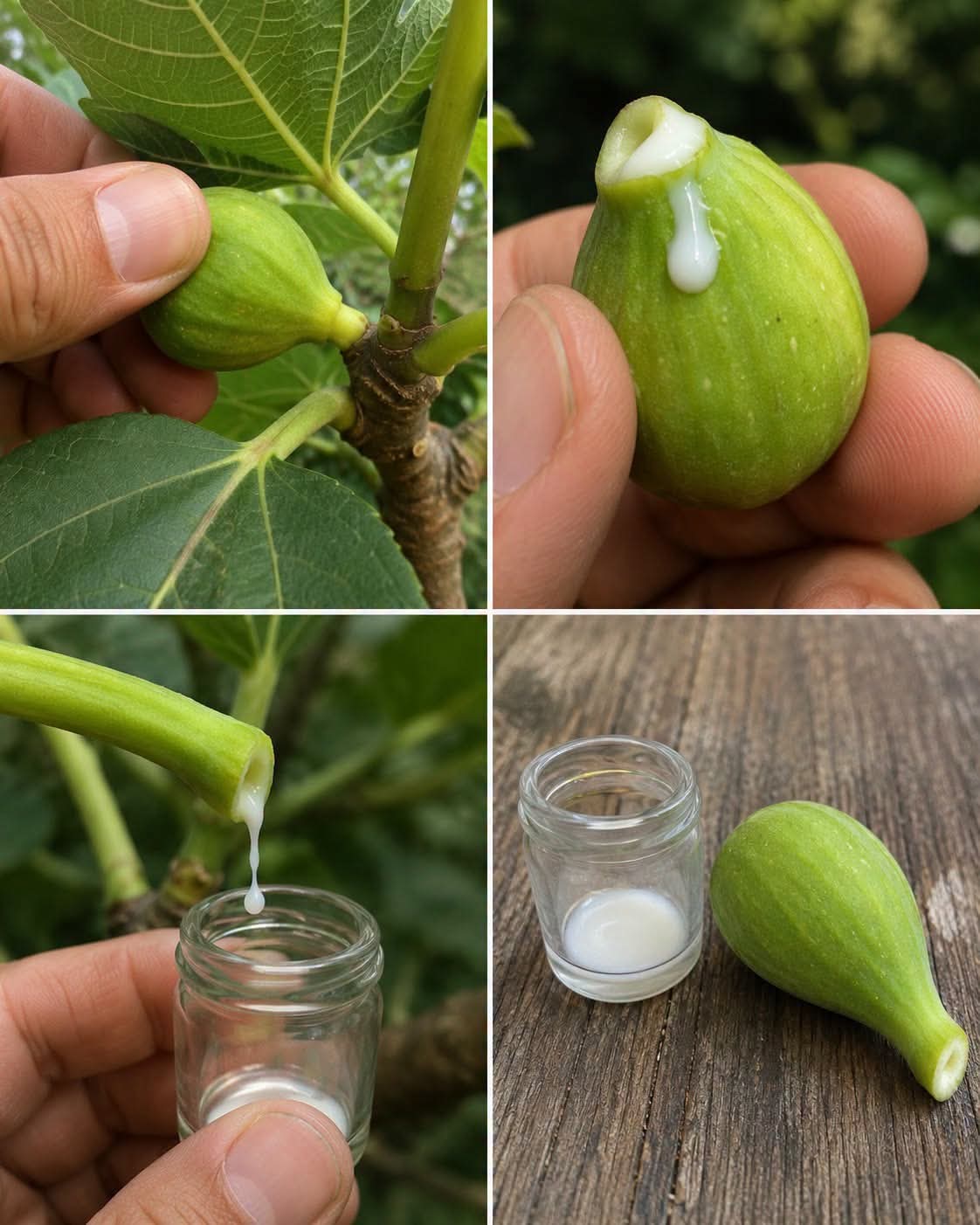
If you have ever picked a fresh fig directly from a fig tree, you may have noticed a white, milky liquid appearing from the stem or a freshly cut part of the plant. This substance is commonly called fig tree milk, fig latex, or simply fig sap. The photographs above show exactly what it looks like: a green fig attached to the tree, white latex emerging from a freshly cut part of the plant, and the collected milky sap beside a fresh fig.
For generations, fig trees have been valued not only for their delicious fruit but also for their leaves, bark, branches, and naturally occurring latex. In traditional practices in different regions, fig latex has been used for a variety of purposes, including folk remedies and household applications. This history has led to many impressive claims about what fig tree milk can do.
However, there is an important distinction between traditional use and scientifically established medical treatment. Fig latex contains biologically active compounds, including proteolytic enzymes such as ficin, as well as other plant chemicals. These substances can have effects on biological tissues, but that does not automatically mean that applying or consuming raw fig latex is safe or effective for treating a disease.
This article explores what fig tree milk really is, why fig trees produce it, how it has traditionally been used, what researchers know about its components, possible benefits, important safety concerns, and better ways to enjoy the fig tree without unnecessarily exposing yourself to concentrated plant latex.
What Is Fig Tree Milk?
Fig tree milk is the white latex released by certain parts of a fig plant when the plant tissue is damaged.
It may appear when:
- A young fig is picked from the tree
- A stem is broken
- A leaf stalk is cut
- A young branch is damaged
- A portion of the fig is cut open
The liquid is usually white or creamy when it first emerges. As it dries, it can become thicker and may leave a sticky residue.
Although people often call it “milk,” it is not milk in the nutritional sense. It is a plant latex.
Plant latex is a defensive secretion found in numerous species. In fig trees, the latex contains a mixture of water, proteins, enzymes, resins, and other compounds. Its composition can vary depending on the species, maturity of the plant, season, and part of the tree from which the latex is collected.
Why Does a Fig Tree Produce This White Sap?
A fig tree does not produce latex specifically for humans. The latex is part of the plant’s natural biology.
When plant tissue is injured, latex can flow toward the damaged area. This secretion may contribute to the plant’s defense against insects, microorganisms, and animals.
Some compounds in plant latex can be irritating, bitter, sticky, or biologically active. These characteristics may discourage herbivores from feeding heavily on damaged plant tissue.
In other words, the white sap is part of the fig tree’s natural defense system.
This is one reason why it is important not to assume that something natural is automatically gentle or safe.
Fig Latex Is Not the Same as Fig Fruit
This distinction is extremely important.
Fresh figs are a nutritious food and can be enjoyed as part of a balanced diet. They provide carbohydrates, fiber, potassium, and various plant compounds.
Fig latex, however, is a concentrated plant secretion.
The nutritional benefits associated with eating figs should not automatically be attributed to raw fig latex.
Eating a ripe fig and applying raw fig sap to your skin are two completely different exposures.
The fruit is a food.
The latex is a biologically active plant secretion.
That difference should be kept in mind whenever you encounter claims that recommend using fig sap as a remedy.
What Makes Fig Latex Interesting?
One of the most studied components associated with fig latex is ficin, a proteolytic enzyme.
Proteolytic enzymes are enzymes capable of breaking down proteins.
This helps explain why fig latex has attracted interest in traditional practices and scientific research. The enzymes and other substances present in the latex may interact with proteins and biological materials.
Ficin has been investigated for various potential applications, including food processing and laboratory uses. However, the presence of an interesting enzyme does not mean that raw fig latex should be used as a homemade medicine.
Concentration, preparation, dosage, purity, and route of exposure all matter.
A substance that can be useful under controlled conditions may cause problems when applied directly to the body.
Traditional Uses of Fig Tree Latex
Fig latex has a long history of traditional use in different cultures.
Depending on the region, traditional practices have included applying small amounts of latex to certain skin problems or using preparations made from fig trees for folk medicinal purposes.
Some traditional sources have associated fig latex with:
- Skin care
- Calluses
- Warts
- Minor skin growths
- Digestive remedies
- Parasite-related folk treatments
- Household preparations
- Traditional herbal medicine
It is important to understand that these historical uses do not establish that the remedy works for everyone.
Traditional knowledge can be valuable and deserves respect, but modern safety standards require controlled evidence before a treatment can be considered proven.
Fig Latex and Warts: A Common Traditional Claim
One of the most widely repeated claims about fig latex concerns warts.
The theory behind this traditional practice is understandable. Fig latex contains enzymes and other compounds capable of interacting with proteins. Some people have historically applied fresh latex directly to unwanted skin growths.
However, this does not mean that people should simply cut a fig branch and put the sap on a wart.
A wart can sometimes resemble other skin lesions. Attempting to remove an unknown growth with a potentially irritating substance can cause:
- Skin burns
- Inflammation
- Pain
- Scarring
- Infection
- Delayed diagnosis of a different condition
If a skin growth is persistent, changing, bleeding, painful, or unusual, professional evaluation is more appropriate than experimenting with raw plant latex.
Why Fig Latex Can Irritate the Skin
The white sap may look harmless, but fig latex can be irritating.
The combination of enzymes and other compounds may cause skin reactions, especially in sensitive individuals.
Possible reactions include:
- Redness
- Burning
- Itching
- Swelling
- Dryness
- Irritation
- Blistering in stronger reactions
The reaction can be more concerning when the latex is left on the skin for a long period or used repeatedly.
The risk may also depend on the individual person’s sensitivity and the concentration of latex.
A Special Concern: Sunlight
Another important issue is the relationship between fig plant compounds and sunlight.
Some plants contain substances that can make skin more sensitive to ultraviolet radiation. Fig plant tissues contain compounds that may contribute to photosensitivity reactions in susceptible people.
This means that getting fig sap on exposed skin and then spending time in strong sunlight can potentially result in a more severe skin reaction.
For this reason, people should avoid deliberately applying fresh fig latex to exposed skin before going outdoors.
If sap accidentally gets onto the skin, washing the area thoroughly with soap and water is a sensible precaution, particularly before sun exposure.
What Should You Do If Fig Sap Gets on Your Skin?
Accidental contact is usually much less concerning than deliberately applying large amounts.
If fresh fig latex gets onto your skin:
Step 1: Wash the area
Use plenty of water and ordinary soap to remove the sticky residue.
Step 2: Avoid rubbing aggressively
Scrubbing can further irritate the skin.
Step 3: Keep the area away from strong sunlight
This is especially important if you have a history of sensitivity to plant products.
Step 4: Monitor your skin
Watch for increasing redness, swelling, blistering, severe pain, or persistent irritation.
Step 5: Seek medical advice if the reaction is significant
A severe or worsening reaction should not be treated as a simple gardening inconvenience.
Can You Drink Fig Tree Milk?
This is one of the most important questions surrounding fig latex.
Raw fig latex should not be treated like a juice or nutritional drink.
Although traditional practices may describe internal uses, concentrated raw plant latex has not been established as a safe everyday beverage.
It contains active substances that can irritate tissues and may cause unwanted effects.
The fact that fig fruit is edible does not make the latex safe to consume.
A simple rule is:
«Enjoy the fig as food; treat the raw latex as a plant defense secretion rather than a health drink.»
This distinction can prevent unnecessary exposure.
Fig Fruit: The Safer Way to Enjoy the Benefits of the Fig Tree
If your goal is to benefit from the nutritional qualities of figs, eating the fruit is a much more appropriate approach.
Fresh figs contain:
- Dietary fiber
- Natural carbohydrates
- Potassium
- Small amounts of several vitamins and minerals
- Polyphenolic plant compounds
- Natural sugars
Dried figs are more concentrated because much of their water has been removed. They can therefore provide more calories and sugar per gram than fresh figs.
Figs can be eaten:
- Fresh
- Dried
- With yogurt
- With oatmeal
- In salads
- With nuts
- In desserts
- In savory dishes
- As part of a breakfast
- Alongside cheese
The fruit provides a practical way to include figs in a balanced diet without turning the tree’s latex into a homemade medicinal product.
Traditional Beauty Uses and Modern Caution
The internet contains many recipes recommending fig sap for skin appearance, dark spots, rough patches, or unwanted growths.
These claims should be approached carefully.
The skin is a living organ, not an inert surface. A substance capable of breaking down proteins can potentially affect healthy skin as well as the area someone wants to treat.
This is especially important for:
- The face
- Around the eyes
- Lips
- Genital areas
- Broken skin
- Areas with eczema
- Areas affected by dermatitis
Raw fig latex should not be casually applied to these sensitive areas.
Why “Natural” Does Not Always Mean “Safe”
This is perhaps the most important lesson from fig tree latex.
Natural substances can be powerful.
Poison ivy is natural. Some mushrooms are natural. Many medicinal drugs originally came from plants. Essential oils are natural. Plant latexes are natural.
Safety depends on the specific substance, concentration, route of exposure, dose, preparation, and individual response.
Fig latex is a perfect example.
A fig is a food.
The sap is a defense secretion.
They come from the same plant, but they should not automatically be treated in the same way.
Fig Latex and Scientific Research
Researchers have investigated fig latex because it contains several interesting biological compounds.
Ficin is particularly notable because it belongs to a group of enzymes capable of breaking down proteins.
Research involving fig latex and ficin has explored areas such as:
- Enzyme activity
- Food processing
- Protein breakdown
- Traditional medicinal applications
- Antimicrobial activity
- Potential industrial applications
However, laboratory findings are not the same thing as proof of a home remedy.
An experiment showing that an enzyme can break down a particular protein does not establish that applying raw sap to human skin will safely treat a medical condition.
Good health information requires distinguishing between:
Laboratory evidence → animal research → human clinical research → established medical treatment.
These are not interchangeable.
Could Fig Latex Have Antimicrobial Properties?
Some plant compounds demonstrate antimicrobial activity under laboratory conditions.
Fig latex has attracted scientific interest partly because of its complex chemical composition.
However, saying that a plant extract shows antimicrobial activity in laboratory testing is very different from saying it can safely disinfect a wound.
Fresh latex is not a sterile medical product.
It should therefore not be used as a substitute for proper wound cleaning, antiseptics recommended by healthcare professionals, or medical treatment.
Applying raw plant sap to an open wound could introduce contamination and cause additional irritation.
Can Fig Latex Help With Digestion?
Traditional medicine has sometimes used parts of the fig plant for digestive purposes.
The fruit itself contains dietary fiber, making it a useful food for people who want to increase their fiber intake.
That does not mean the raw latex is a safe digestive remedy.
Because latex contains biologically active enzymes and other substances, consuming it can produce effects that are difficult to predict.
If constipation or digestive discomfort is a persistent problem, safer approaches include:
- Adequate hydration
- Eating sufficient dietary fiber
- Regular physical activity
- Eating fruits and vegetables
- Following professional medical advice when symptoms persist
Figs can be included as one food source of fiber, but fig latex should not be treated as a routine digestive supplement.
Who Should Be Especially Careful?
Extra caution is appropriate for:
- Children
- People with sensitive skin
- People with known plant allergies
- People with eczema or dermatitis
- People with a history of severe allergic reactions
- Pregnant individuals considering herbal remedies
- Breastfeeding individuals considering herbal remedies
- People taking multiple medications
- Anyone with unexplained skin lesions
Children, in particular, should not be encouraged to experiment with plant sap.
A child may accidentally rub latex into the eyes or mouth, creating a much more serious situation.
What If Fig Latex Gets Into the Eyes?
Eye exposure should be taken seriously.
Do not intentionally put fig latex anywhere near the eyes.
If accidental exposure occurs, rinse the eyes thoroughly with clean running water and avoid rubbing them.
If pain, redness, swelling, blurred vision, light sensitivity, or persistent irritation develops, seek urgent medical evaluation.
The eyes are extremely sensitive, and a plant substance that irritates the skin can be especially problematic when it contacts ocular tissue.
Can Fig Latex Cause an Allergic Reaction?
Yes, allergic or hypersensitivity reactions to plant substances are possible.
Not every skin reaction is a true allergy. Irritant contact dermatitis and allergic contact dermatitis are different processes.
A person may experience:
- Itching
- Redness
- Swelling
- Rash
- Burning
- Blistering
If someone develops facial swelling, difficulty breathing, widespread hives, dizziness, or other signs of a severe allergic reaction after exposure to a plant product, emergency medical care is appropriate.
People who already know they are sensitive to latex or certain plants should be especially cautious.
How to Collect Fig Latex Safely
For most home gardeners, there is little reason to deliberately collect fig latex.
If you are pruning a fig tree, however, accidental exposure can happen.
Wear gloves when handling freshly cut plant material if your skin is sensitive.
Avoid touching your face while pruning.
After gardening:
- Wash your hands thoroughly.
- Clean sap from tools.
- Wash exposed skin.
- Avoid rubbing your eyes.
- Change contaminated clothing if necessary.
The goal is not to fear the fig tree. It is simply to handle plant sap responsibly.
What About Using Fig Latex for Calluses?
Another traditional claim involves thickened skin or calluses.
The protein-breaking activity of latex may make this idea seem logical, but raw sap is not a controlled skin treatment.
Calluses develop because of repeated pressure or friction. A better long-term approach is usually to address the source of the friction and use appropriate moisturization and gentle skin care.
For persistent, painful, cracked, or unusual thickened skin, professional advice is preferable.
People with certain medical conditions affecting circulation or sensation should be particularly careful about attempting home treatments on their feet.
The Difference Between Traditional Wisdom and Medical Advice
Traditional remedies can teach us interesting things about plants.
Many modern medicines have roots in traditional plant knowledge.
But tradition alone cannot answer questions such as:
- What is the correct dose?
- How concentrated should the preparation be?
- How often should it be used?
- Who should avoid it?
- What medications could interact with it?
- What are the long-term risks?
- How does it compare with established treatments?
These questions require scientific investigation.
Therefore, the best way to discuss fig latex is neither to dismiss traditional knowledge nor to exaggerate it.
Instead, we can say:
Fig latex is a biologically active plant secretion with an interesting traditional history and scientifically interesting compounds, but raw latex should not be considered a proven or universally safe medical treatment.
Common Myths About Fig Tree Milk
Myth 1: “Because it comes from an edible fig, the sap is safe to drink.”
Not necessarily.
The edible fruit and plant latex have different compositions and different safety considerations.
Myth 2: “Fig milk removes every skin problem.”
There is no basis for assuming that raw fig latex can safely remove every skin lesion.
Some skin conditions require professional diagnosis.
Myth 3: “Natural remedies cannot cause burns.”
False.
Natural plant chemicals can irritate or damage skin.
Myth 4: “More sap means faster results.”
Increasing exposure can increase irritation and does not guarantee better results.
Myth 5: “If an old remedy worked for someone, it must work for everyone.”
Individual reactions vary, and anecdotal experiences are not equivalent to controlled clinical evidence.
How to Grow a Healthy Fig Tree
If the image has inspired you to grow your own fig tree, there is good news: fig trees can be rewarding garden plants in suitable climates.
Choose a sunny location.
Fig trees generally perform best when they receive plenty of sunlight and have well-draining soil.
Basic care includes:
- Plenty of sunlight
- Well-drained soil
- Appropriate watering
- Regular pruning when necessary
- Protection from extreme conditions
- Adequate space for root and branch growth
A healthy tree can produce an abundance of fruit.
The most valuable part for the home gardener is usually the fruit itself.
Harvesting Figs
Figs are generally harvested when they have reached the appropriate stage of ripeness for their variety.
Depending on the type, ripe figs may become softer and develop characteristic changes in color and shape.
Handle ripe figs gently because they bruise easily.
When harvesting, avoid unnecessary damage to branches and leaves. Freshly broken stems may release latex.
Wearing gloves can make harvesting and pruning more comfortable for people who have sensitive skin.
How to Use Fresh Figs in the Kitchen
Instead of focusing on the sap, try making the most of the fruit.
Simple Fig and Yogurt Bowl
Combine:
- Fresh ripe figs
- Plain yogurt
- Chopped walnuts
- A small amount of honey
- Cinnamon
This makes a simple breakfast or snack.
Fig and Oatmeal
Slice fresh or dried figs into oatmeal and add nuts or seeds.
Fig Salad
Combine figs with:
- Leafy greens
- Cucumber
- Walnuts
- Cheese
- A simple olive-oil dressing
Roasted Figs
Halve fresh figs and roast them gently until soft. They can be served with yogurt or incorporated into a savory meal.
These uses allow you to enjoy the plant’s edible fruit without experimenting with raw latex.
Nutritional Value of Figs
The nutritional composition of figs varies according to variety and whether they are fresh or dried.
Fresh figs contain significant water along with natural sugars, carbohydrates, fiber, and minerals.
Dried figs contain much less water, so their calories and natural sugars are more concentrated.
Figs can contribute to an overall healthy eating pattern, particularly when eaten alongside other fruits, vegetables, whole grains, nuts, seeds, and protein-rich foods.
As with all foods, portion size matters.
Fig Leaves: Another Interesting Part of the Plant
The leaves of the fig tree have also been used traditionally and have attracted research interest.
Some culinary traditions use fig leaves to add aroma to foods. Their distinctive fragrance can be incorporated into certain preparations.
However, just because a plant leaf has traditional culinary uses does not mean every preparation is appropriate for everyone.
The same principle applies to leaves, bark, roots, latex, and other plant materials:
Know the plant, know the preparation, and understand the difference between culinary use and medicinal use.
Why the Image Is So Interesting
The photograph illustrates several stages of fig latex exposure.
In one section, the green fig is still attached to the tree. In another, the fruit has been opened or damaged and white latex is visible. The lower-left image shows sap dripping from freshly cut plant material into a small container.
This visual sequence helps demonstrate an important botanical fact: the white liquid is released when the plant tissue is damaged.
It also illustrates why people who prune or harvest fig trees may come into contact with the latex without intentionally seeking it.
The final photograph shows a fresh green fig next to collected white sap, making the distinction between fruit and latex especially clear.
Should You Collect Fig Latex at Home?
For ordinary household purposes, there is generally little reason to collect it.
If you are interested in fig latex because of its enzyme content, remember that laboratory and industrial applications use controlled preparations.
Home-collected sap can vary considerably in composition and concentration. It may also become contaminated during collection and storage.
A small glass container filled with raw sap may look harmless, but it should not be assumed to be a standardized herbal product.
If you are interested in plant-derived enzymes, properly prepared commercial or laboratory-grade materials are more appropriate than homemade raw latex.
A Safer Approach to Natural Remedies
If you enjoy traditional herbal practices, consider adopting a few simple rules.
- Research the plant
Make sure you have correctly identified it.
- Distinguish food from medicine
An edible fruit does not mean every part of the plant is edible.
- Avoid raw sap on broken skin
Plant latex can be irritating.
- Protect your eyes
Never experiment with plant latex near the eyes.
- Consider sunlight exposure
Some plant compounds can make skin reactions worse after ultraviolet exposure.
- Do not replace medical treatment
Natural remedies should not delay diagnosis or treatment of potentially serious conditions.
- Stop if irritation occurs
Do not assume that burning means a remedy is “working.”
Burning can simply mean that the skin is being injured.
Final Thoughts
Fig tree milk is one of the most fascinating substances produced by the fig tree. The white latex that appears when a stem, leaf stalk, or young fig is damaged is a natural plant secretion containing enzymes and other biologically active compounds.
Its traditional history is extensive, and scientific research has made fig latex interesting because of compounds such as ficin. Nevertheless, traditional reputation should not be confused with proven medical effectiveness.
The most sensible way to appreciate fig latex is to understand it rather than exaggerate it.
The fig fruit can be a nutritious addition to a balanced diet.
The fig tree can be a beautiful and productive garden plant.
The latex, meanwhile, should be treated as an active plant secretion that may irritate the skin and should not be casually consumed or applied as a cure for medical conditions.
If you accidentally get fig sap on your skin, wash it away and avoid unnecessary sun exposure. If it enters your eyes or causes a significant reaction, seek appropriate medical attention.
Nature gives us many useful plants, but understanding how to use them safely is just as important as discovering their traditional uses.
So the next time you see that familiar white drop appearing from a freshly picked fig, remember what you are looking at: not ordinary “milk,” but a complex natural latex produced by the tree as part of its own defense system.
Enjoy the fruit, respect the plant, and treat the sap with caution.
Frequently Asked Questions
Is the white liquid from a fig tree normal?
Yes. White latex commonly appears when certain parts of a fig tree are cut, broken, or damaged.
Is fig tree sap edible?
The raw latex should not be treated as an edible food or beverage. The fact that ripe figs are edible does not mean the latex is safe to consume.
Can fig sap irritate the skin?
Yes. Fresh fig latex can cause irritation in some people, including redness, itching, burning, and other skin reactions.
Can fig sap make skin sensitive to sunlight?
Fig plant compounds may contribute to photosensitivity in susceptible people. Washing sap from the skin and avoiding strong sunlight after exposure is a sensible precaution.
Can fig latex remove warts?
This is a traditional use, but raw fig latex should not be considered a proven or universally safe wart treatment. Unusual or persistent skin growths should be evaluated by a healthcare professional.
What is ficin?
Ficin is a proteolytic enzyme associated with fig latex. It can break down proteins and has attracted scientific and industrial interest.
Can I use fig latex on a wound?
It is not recommended to use raw fig latex as a wound treatment. It is not a sterile medical preparation and may irritate damaged tissue.
What is the safest way to enjoy the fig tree?
For most people, the simplest approach is to enjoy properly ripe figs as food and handle the tree with ordinary gardening precautions.
Important Safety Note
This article is intended for general educational purposes. Traditional uses of fig latex should not be interpreted as medical advice or proof that it can diagnose, treat, cure, or prevent disease. Raw plant latex can cause irritation or other reactions. If you have a persistent skin problem, unexplained growth, severe reaction, eye exposure, or other concerning symptoms, consult an appropriately qualified healthcare professional.
Conclusion
The humble fig tree has much more going on than meets the eye. Beneath its broad leaves and delicious fruit is a natural defense system that produces a distinctive white latex whenever the plant is damaged.
That latex has fascinated people for centuries and continues to attract scientific interest because of its enzymes and other plant compounds. Yet its traditional reputation should be balanced with modern safety awareness.
Fig fruit is food. Fig latex is plant latex.
Understanding that difference is the key to appreciating this fascinating natural substance without taking unnecessary risks.
If you grow figs, harvest the fruit, enjoy their flavor, and admire the remarkable biology of the tree—but handle the white sap carefully and avoid treating it as a miracle cure.