Rice and Onion Water for Orchids: A Natural Homemade Fertilizer Guide for Healthier Leaves, Stronger Roots, and More Beautiful Blooms
If you love orchids, you already know that these elegant plants can be both rewarding and surprisingly demanding. Their beautiful flowers can brighten a room for weeks, while their thick green leaves and exposed roots give them a unique appearance unlike many traditional houseplants. But when an orchid stops flowering, develops weak roots, or simply looks less vigorous than before, many plant lovers begin searching for simple, affordable ways to support its growth.
One homemade method that has become popular among gardeners is rice and onion water for orchids. The idea is simple: rice is soaked or rinsed in water, onion is added, and the resulting liquid is used around the orchid’s growing medium. The mixture is often promoted as a natural source of nutrients and plant-supporting compounds.
However, there is an important distinction between a traditional homemade plant tonic and a scientifically established fertilizer. Rice and onion water should not be considered a magical treatment that guarantees flowers. Orchids have specific requirements for light, watering, humidity, airflow, temperature, and nutrition. A homemade mixture can be used cautiously as a supplement, but good orchid care remains the foundation of healthy growth.
This complete guide explains how to prepare a mild rice and onion water, how to use it safely, what it may contribute, common mistakes to avoid, and how to combine the method with proper orchid care.
What Is Rice and Onion Water for Orchids?
Rice and onion water is a homemade plant tonic prepared by soaking rice and pieces of onion in water. After the mixture has been strained, the liquid can be diluted and applied to an orchid’s growing medium.
Rice contains small amounts of nutrients and carbohydrates, while onion contains various naturally occurring plant compounds. When these ingredients are soaked in water, some water-soluble substances move into the liquid.
The resulting solution is usually much weaker than a commercial orchid fertilizer. That can actually be useful when experimenting with homemade plant treatments because orchids are sensitive to excessive fertilizer salts.
The most important rule is:
Rice and onion water should complement proper orchid care, not replace it.
An orchid growing in poor light, constantly wet soil, or a damaged root system will not become healthy simply because it receives a homemade mixture.
Why Do Orchid Lovers Use Rice Water?
Rice water has been used traditionally in gardening because rice contains nutrients that can enter the water during rinsing or soaking.
Depending on the preparation method, rice water may contain small quantities of:
- Starch
- Small amounts of minerals
- Trace nutrients
- Organic compounds
- Residues from the rice surface
Some gardeners believe these components can provide mild nutritional support to plants.
However, rice water is not a complete fertilizer. Orchids require a balanced supply of nutrients, including nitrogen, phosphorus, potassium, calcium, magnesium, and micronutrients. The exact nutrient content of homemade rice water is also highly variable.
Therefore, it is better to think of rice water as an occasional homemade supplement rather than a replacement for a balanced orchid fertilizer.
What Does Onion Add to the Mixture?
Onions contain naturally occurring sulfur-containing compounds, antioxidants, and other plant compounds. Onion skins and outer layers also contain various compounds that have attracted interest in gardening.
Because of this, some gardeners use onion-infused water as a homemade plant treatment.
However, it is important not to exaggerate what onion water can do.
There is no reliable guarantee that onion water will make an orchid bloom, and it should not be presented as a cure for fungal infections, root rot, pests, or serious plant disease.
The safest approach is to make a very mild preparation and observe how the orchid responds.
Benefits That Gardeners Hope to Get From Rice and Onion Water
When used carefully, a mild homemade solution may provide a small amount of additional organic material or nutrients. Gardeners commonly use it with the goal of supporting overall plant vigor.
1. It Is Inexpensive
Rice and onions are common kitchen ingredients. If you already have them at home, preparing a small amount of water costs almost nothing.
2. It Makes Use of Kitchen Ingredients
Instead of immediately discarding rice-rinsing water or small onion pieces, some gardeners prefer to experiment with using them in the garden.
3. It Provides a Mild Supplement
A diluted homemade solution can provide some soluble compounds, although the nutrient concentration is unpredictable.
4. It Encourages a Gardening Routine
One of the biggest advantages may actually be indirect. Preparing a plant tonic encourages you to spend more time observing your orchid.
Regular observation helps you notice:
- Yellowing leaves
- Root damage
- Pest infestations
- Changes in leaf firmness
- New roots
- New leaves
- Flower spikes
- Signs of dehydration
Early detection is often much more valuable than any homemade fertilizer.
How to Make Rice and Onion Water for Orchids
The goal should be a mild, fresh, diluted preparation.
Ingredients
You will need:
- 2 tablespoons uncooked white rice
- 500 ml clean water
- A small piece of fresh onion
- A clean glass or jar
- A fine strainer
- A clean watering container
Avoid adding salt, oil, spices, sugar, vinegar, or other cooking ingredients.
Method 1: Simple Rice and Onion Infusion
Step 1: Prepare the Rice
Place approximately two tablespoons of uncooked rice in a clean container.
Add about 500 ml of water.
Gently swirl the rice in the water for several seconds.
Step 2: Add the Onion
Cut a very small piece of onion.
You do not need a large amount. A small piece is sufficient for a mild homemade infusion.
Add it to the water.
Step 3: Soak
Allow the mixture to sit for approximately 30 minutes.
There is no need to leave it sitting for several days.
Long fermentation can encourage microbial growth and unpleasant odors, especially when the mixture is kept at room temperature.
Step 4: Strain
Remove the rice and onion pieces.
Strain the liquid carefully so that solid particles do not enter the orchid pot.
Step 5: Dilute
For a cautious first application, dilute the prepared liquid further with clean water.
A weak solution is preferable to a concentrated one.
Step 6: Use Immediately
Fresh homemade plant mixtures are generally preferable to storing them for long periods.
If the liquid develops an unpleasant smell, becomes cloudy in an unusual way, develops mold, or otherwise changes significantly, discard it.
An Even Simpler Approach: Rice Water Alone
If you are concerned about using onion with orchids, rice water by itself is a simpler option.
Place rice in clean water, gently agitate it, and strain the water.
Use the resulting liquid in moderation and avoid allowing excess moisture to remain trapped around the roots.
This approach is easier to control and less likely to create a strong smell.
How to Apply Rice and Onion Water to an Orchid
One of the most important things to understand is that orchids should not be treated like ordinary garden plants.
Many popular orchids, particularly Phalaenopsis orchids, are epiphytes in nature. They naturally grow attached to trees rather than buried in dense garden soil.
Their roots need access to both moisture and air.
That means application should be gentle.
Step 1: Check the Orchid
Before watering, inspect:
- Leaves
- Roots
- Growing medium
- Pot drainage
- Signs of pests
- Signs of rot
Do not automatically water simply because it is your scheduled day.
Step 2: Check Moisture
If the growing medium is still wet, wait.
An orchid that remains constantly wet can develop serious root problems.
Step 3: Apply a Small Amount
Pour the diluted mixture around the growing medium rather than directly into the crown of the orchid.
Step 4: Allow Excess Water to Drain
This is extremely important.
The pot should have drainage holes, and excess water should be allowed to escape.
Never leave an orchid sitting in a container full of stagnant water.
Step 5: Keep the Crown Dry
The crown is the central point from which new leaves emerge.
Water trapped inside the crown can increase the risk of crown rot.
If water accidentally collects there, gently remove it with a clean paper towel.
How Often Should You Use It?
More is not necessarily better.
A homemade rice and onion solution should be used occasionally rather than every day.
For a healthy orchid, a cautious approach might be to use a very diluted preparation no more than occasionally while monitoring the plant.
If the orchid is already growing strongly and producing healthy leaves and roots, there is no reason to repeatedly increase the concentration.
Remember:
Orchids can suffer from both underwatering and overwatering, as well as excessive fertilizer.
A regular, balanced orchid fertilizer used according to its label is generally more predictable than homemade mixtures.
Can Rice and Onion Water Make an Orchid Bloom?
This is one of the most common questions.
The honest answer is:
There is no guarantee.
Flowering depends on several factors, including:
- Plant maturity
- Light intensity
- Day and night temperatures
- Watering
- Root health
- Nutritional status
- Seasonal changes
- Genetics
- Previous flowering cycle
A healthy orchid receiving excellent care may flower without ever receiving rice or onion water.
Likewise, an orchid receiving homemade fertilizer may fail to flower if it does not receive enough appropriate light.
Therefore, if your main goal is flowering, focus first on the plant’s growing conditions.
Light Is More Important Than Homemade Fertilizer
For many indoor orchids, especially Phalaenopsis, bright but indirect light is important.
A dark corner may keep an orchid alive, but it may not provide enough energy for vigorous growth and flowering.
A suitable location often provides:
- Bright filtered light
- Protection from intense midday sun
- Good airflow
- Stable temperatures
- No extreme drafts
If leaves are exposed to harsh direct sunlight for long periods, they may develop sunburn.
On the other hand, if the plant receives too little light, flowering may become difficult.
Finding the right balance is more important than any kitchen-made fertilizer.
Understanding Orchid Roots
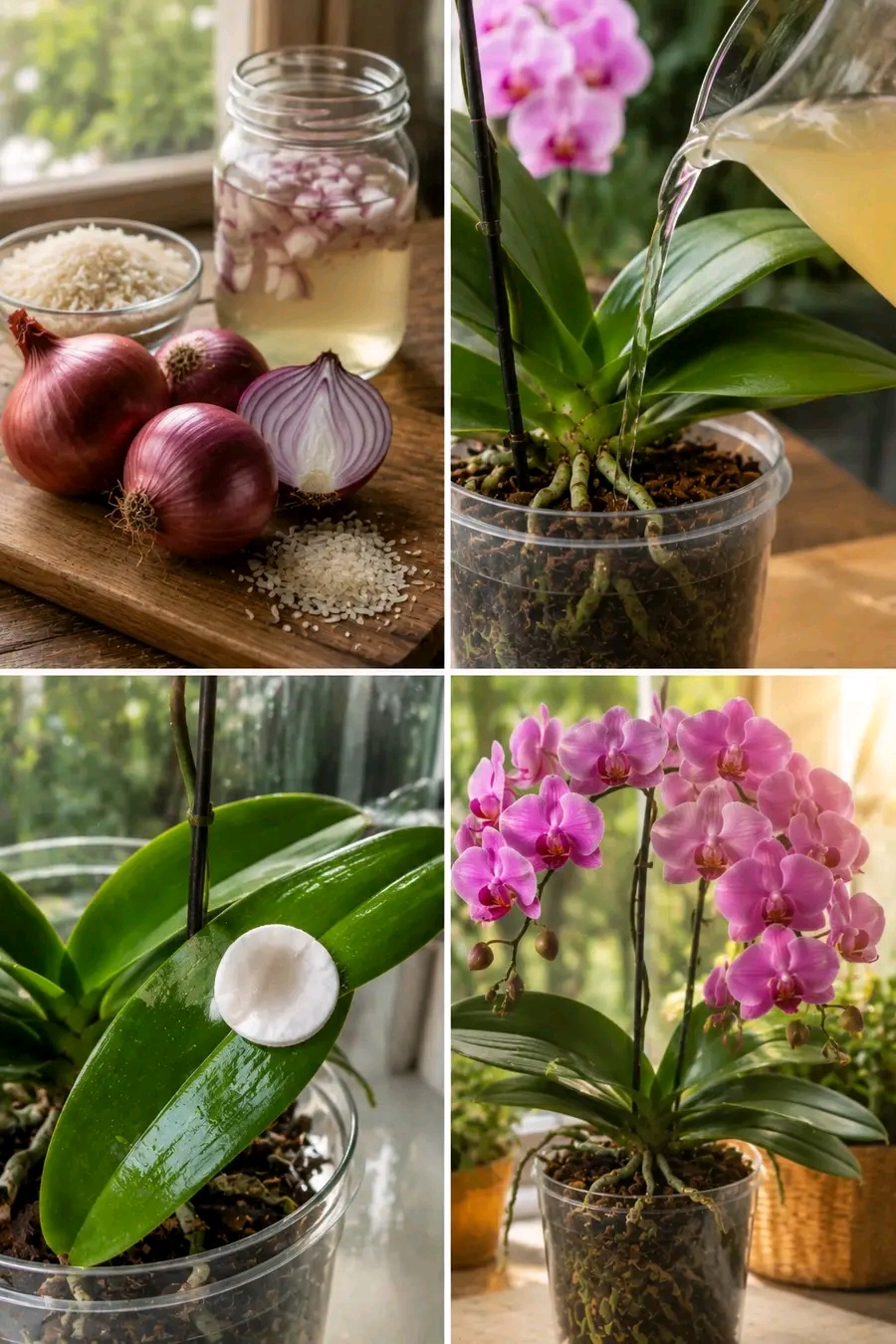
The image accompanying this article shows an orchid growing in a transparent container, allowing the roots to be observed.
This is especially useful because orchid roots can provide valuable information about plant condition.
Healthy roots are typically:
- Firm
- Plump
- Not mushy
- Not collapsing
- Free from a foul smell
Orchid roots can appear different depending on whether they are wet or dry. Some healthy roots may appear green after becoming wet and silvery or pale when dry.
This makes transparent pots particularly useful for beginners.
Why Drainage Matters
One of the biggest mistakes new orchid owners make is treating orchids like ordinary potted flowers.
Traditional houseplants may tolerate dense potting soil, but orchids usually need a specialized growing medium.
Common orchid-growing materials include:
- Bark
- Sphagnum moss
- Perlite
- Coconut-based materials
- Specialized orchid mixes
- Other chunky, well-aerated media
The purpose is to provide moisture while maintaining air around the roots.
A compact, constantly wet medium can suffocate roots and encourage decay.
Rice Water and Root Health
It is tempting to describe rice water as a root-growth miracle, but that would be misleading.
Healthy roots depend primarily on the environment.
Roots need:
- Oxygen
- Appropriate moisture
- Suitable temperature
- Appropriate nutrition
- A healthy growing medium
If an orchid has rotten roots, adding rice and onion water will not solve the underlying problem.
Instead, the plant should be examined and unhealthy roots addressed appropriately.
What to Do If Your Orchid Has Root Rot
Root rot often occurs when roots remain excessively wet for too long.
Possible warning signs include:
- Brown or black roots
- Soft or mushy roots
- Bad odor
- Leaves becoming limp
- Yellowing leaves
- Plant instability in its pot
If root rot is suspected, stop adding homemade fertilizer and investigate the cause.
Remove the plant from its pot carefully and inspect the roots.
Healthy roots should be preserved whenever possible.
Damaged, dead, or mushy material may need to be removed using clean, sterilized tools.
Afterward, the orchid should be placed in an appropriate growing medium and provided with suitable care.
Can Onion Water Fight Orchid Diseases?
You may see claims online that onion water can eliminate fungal infections or protect orchids from every disease.
These claims should be treated cautiously.
A homemade onion infusion is not a reliable substitute for an appropriate plant disease treatment.
If your orchid develops a serious infection, first identify the problem.
Different issues can look similar, including:
- Fungal disease
- Bacterial disease
- Sun damage
- Cold damage
- Nutrient deficiency
- Root rot
- Pest damage
Treating the wrong problem can make the situation worse.
Rice and Onion Water for Orchid Leaves
The mixture should generally be applied to the growing medium rather than used as a routine leaf spray.
Orchid leaves have a waxy surface, and water can remain trapped in places where it should not.
If you accidentally splash the leaves, wipe away excess liquid, particularly around the crown.
Never allow homemade solutions to remain pooled in the center of the plant.
What About Using Onion Peels?
Some gardeners make onion-peel water rather than using fresh onion.
The idea is to soak onion skins in water and use the resulting liquid as a garden infusion.
If you want to experiment with this method, keep the preparation weak and fresh.
Do not assume that a darker or stronger-colored solution is automatically better.
A stronger homemade solution can potentially create more problems than benefits.
Avoid Sugar in Orchid Water
A common mistake is adding sugar to homemade plant fertilizers.
Although sugar provides energy for humans, that does not mean adding sugar directly to an orchid’s growing medium is beneficial.
Excess sugar can encourage microbial activity and may attract insects or create other problems.
There is generally no reason to add table sugar to rice and onion water.
Avoid Salt and Seasonings
If you are preparing rice water for orchids, use plain rice and plain water.
Never use leftover cooking water containing:
- Salt
- Butter
- Oil
- Spices
- Sauces
- Broth
These ingredients are not appropriate for orchid roots.
Freshness Is Important
Homemade plant preparations are different from commercial fertilizers.
Commercial fertilizers are manufactured and labeled for predictable storage and concentration.
Rice and onion water is prepared from organic kitchen materials and can spoil.
For this reason:
Make small quantities and use them fresh.
Do not keep a jar of homemade rice and onion water sitting in a warm room for weeks.
If you notice:
- Mold
- Strong fermentation smell
- Rotten odor
- Unusual slime
- Significant discoloration
throw it away.
The Importance of Clean Water
The quality of your water can influence orchid health.
Depending on your location, tap water may contain significant minerals or salts.
If your orchid develops mineral buildup or consistently struggles despite good care, water quality may be worth considering.
Some growers use filtered, rain, or other suitable water sources depending on their local conditions.
However, changing water alone will not fix every orchid problem.
How to Combine Homemade Water With Proper Fertilizing
If you want the best chance of maintaining a healthy orchid, think of rice and onion water as optional rather than essential.
A practical orchid-care routine can include:
Bright, Appropriate Light
Place the orchid where it receives enough light without excessive direct sun.
Proper Watering
Water thoroughly when appropriate, then allow excess water to drain.
Good Airflow
Gentle airflow helps prevent stagnant, overly humid conditions.
Appropriate Humidity
Orchids often appreciate moderate humidity, but humidity should not come at the expense of ventilation.
Proper Potting Medium
Use a medium designed for orchids.
Balanced Fertilization
Use an orchid fertilizer according to its instructions when the plant is actively growing.
Regular Inspection
Look at the roots, leaves, and growing medium regularly.
These factors are far more important than any single homemade recipe.
Signs Your Orchid Is Growing Well
A healthy orchid often gives you several clues.
Look for:
- Firm green leaves
- New leaf growth
- Strong roots
- New root tips
- Stable plant growth
- Healthy flower spikes
- Bud development
- Long-lasting flowers
Not every healthy orchid will look exactly the same.
Some plants naturally have lighter green leaves, different root colors, or different growth patterns.
The most useful comparison is often the plant’s condition over time.
Common Mistakes When Using Rice and Onion Water
Mistake 1: Making the Solution Too Strong
More ingredients do not automatically mean more benefits.
Start weak.
Mistake 2: Applying It Too Frequently
Orchids do not need constant feeding.
Repeated applications can contribute to unwanted buildup.
Mistake 3: Watering an Already-Wet Orchid
If the growing medium is saturated, adding more liquid is usually counterproductive.
Mistake 4: Pouring Water Into the Crown
This can create conditions favorable to crown rot.
Mistake 5: Storing the Mixture for Too Long
Homemade organic mixtures can spoil.
Mistake 6: Expecting Instant Flowers
Flowering is influenced by many environmental factors.
Mistake 7: Using It to Treat Severe Disease
A kitchen infusion should not replace proper diagnosis and treatment.
Rice and Onion Water vs. Commercial Orchid Fertilizer
There is an important difference.
| Feature | Rice & Onion Water | Commercial Orchid Fertilizer |
|---|---|---|
| Cost | Very low | Moderate |
| Nutrient concentration | Variable | More predictable |
| Nutrient balance | Unknown | Formulated |
| Storage | Limited | Usually longer |
| Ease of measuring | Difficult | Easy |
| Best use | Optional supplement | Main fertilizer |
| Guaranteed flowering | No | No |
Commercial fertilizer has an important advantage: you know approximately what nutrients you are providing.
For serious orchid care, that predictability can be valuable.
A Gentle Monthly Orchid Care Routine
Instead of focusing entirely on homemade fertilizer, create a complete routine.
Week One: Inspect
Check the leaves and roots.
Look for pests, damaged roots, or unusual spots.
Week Two: Check the Growing Medium
Make sure it is not staying excessively wet.
Inspect the pot and drainage holes.
Week Three: Evaluate Light
Observe whether the orchid is receiving appropriate brightness.
If the plant receives very little light, consider moving it gradually to a brighter location.
Week Four: Evaluate Growth
Look for new roots, leaves, spikes, or buds.
This long-term approach is much more useful than expecting one homemade mixture to transform the plant overnight.
Can You Use Rice and Onion Water on Other Plants?
The concept of rice water is commonly used by home gardeners on many plants.
However, different plants have different nutritional and watering requirements.
A mixture suitable for one plant may not be suitable for another.
Always consider:
- Plant species
- Soil type
- Drainage
- Nutritional needs
- Water requirements
- Sensitivity to salts
- Environmental conditions
Orchids deserve special attention because their root systems and growing media differ substantially from ordinary garden plants.
Why the Orchid in the Image Is Growing in a Transparent Pot
Transparent orchid pots are popular for several reasons.
First, they allow you to observe the roots.
Second, they make it easier to determine whether the growing medium is wet.
Third, they allow light to reach roots in ways that can resemble the conditions experienced by epiphytic orchids.
A transparent pot is not mandatory for every orchid, but it can be extremely helpful for beginners.
How to Encourage More Orchid Flowers Naturally
If your orchid is healthy but has not bloomed recently, begin with the basics.
Improve Light
Make sure the plant receives enough bright, indirect light.
Avoid Overwatering
Allow the growing medium to approach an appropriate drying point before watering again.
Maintain Healthy Roots
Healthy roots are essential for vigorous growth.
Feed Appropriately
Use a balanced orchid fertilizer according to the product directions.
Maintain Stable Conditions
Avoid repeatedly moving the orchid between dramatically different environments.
Be Patient
Orchids can take time to produce new flower spikes.
Sometimes the best treatment is simply consistent care.
The Role of Patience in Orchid Growing
One reason orchid care can be frustrating is that plants do not always respond immediately.
You may make a change today and see no visible difference for weeks.
That does not necessarily mean the change failed.
Roots develop gradually.
Leaves take time to grow.
Flower spikes can take weeks or months to mature.
Instead of judging your orchid every day, take photographs every few weeks.
Comparing photographs can help you see changes that are difficult to notice from day to day.
Frequently Asked Questions
Is rice and onion water good for orchids?
It can be used as an occasional, diluted homemade supplement, but there is not strong evidence that it provides special benefits compared with proper orchid fertilizer and good growing conditions.
Can it make an orchid bloom?
There is no guarantee. Flowering depends primarily on the orchid’s overall health, light, temperature, nutrition, maturity, and genetics.
How often should I use it?
Use it sparingly rather than frequently. A weak solution is preferable to a concentrated one.
Can I use cooked rice water?
Only if it is plain and free from salt, oil, butter, spices, or other ingredients. Even then, it should be used cautiously.
Can I leave onion pieces in the orchid pot?
No. Solid onion pieces can decompose, create odors, attract pests, and encourage unwanted microbial activity.
Can I spray rice and onion water directly on leaves?
It is generally better to avoid routine spraying. Apply a diluted solution to the growing medium and keep liquid away from the crown.
Can rice water replace orchid fertilizer?
No. It should not be considered a complete fertilizer.
What if my orchid has yellow leaves?
Yellow leaves can have many causes, including natural aging, excessive watering, insufficient light, root problems, or other stress. Look at the entire plant before deciding on a treatment.
Final Thoughts: Use the Natural Method Wisely
Rice and onion water is an interesting homemade gardening technique that many orchid lovers enjoy experimenting with. The ingredients are inexpensive, easy to find, and simple to prepare. A mild, fresh, diluted solution can be incorporated into an orchid-care routine if the plant is healthy and the grower understands its limitations.
But the most beautiful orchids are not created by one secret ingredient.
They are created through consistent care.
Give your orchid appropriate light. Use a suitable growing medium. Keep the roots healthy. Water correctly. Provide good airflow. Fertilize responsibly. Watch for pests and disease. And most importantly, give the plant time.
If you decide to try rice and onion water, start with a weak preparation rather than a concentrated one. Apply it occasionally, avoid the crown, allow excess water to drain, and stop if the plant shows signs of stress.
The image of a thriving orchid with glossy green leaves and abundant pink flowers is a beautiful reminder of what patient plant care can achieve. Homemade remedies can be part of the gardening experience, but they should never distract from the fundamentals.
Healthy roots + appropriate light + correct watering + good airflow + balanced nutrition + patience = the foundation of a beautiful orchid.
And when those conditions come together, your orchid has the best possible opportunity to produce strong new growth and, eventually, those spectacular flowers that make orchid growing so rewarding.
🌸 Quick Rice & Onion Water Recipe for Orchids
Ingredients:
- 2 tablespoons uncooked rice
- 500 ml clean water
- A very small piece of fresh onion
Directions:
- Place the rice in a clean container.
- Add the water.
- Add a small piece of onion.
- Allow the mixture to sit for about 30 minutes.
- Strain out all solid pieces.
- Dilute the liquid with additional clean water.
- Apply a small amount around the orchid’s growing medium.
- Allow excess water to drain completely.
- Keep the crown dry.
- Use the mixture fresh and discard leftovers that develop an unpleasant smell or signs of spoilage.
🌿 Important Reminder
This homemade mixture is optional. It is not a cure for orchid disease and is not a substitute for proper orchid fertilizer. If your orchid is suffering from root rot, pests, severe leaf damage, or another serious problem, identify and address the underlying cause rather than relying on homemade water alone.
For the healthiest orchids, focus first on light, watering, drainage, roots, airflow, and balanced nutrition.