The Ultimate Festive Rainbow Jelly Tropical Nectar: A Culinary Masterclass
Introduction: A Visual and Sensory Masterpiece
There are certain culinary creations that transcend the boundaries of mere food or drink and enter the realm of pure, unadulterated joy. The beverage you see before you—a glowing, amber-hued tropical nectar suspended with brilliant, jewel-like translucent cubes of red, green, and yellow—is the epitome of edible art. This is the Rainbow Jelly Tropical Nectar, a luxurious, thick fruit punch concentrate that doubles as a dessert base, a cocktail mixer, and the ultimate festive gift.
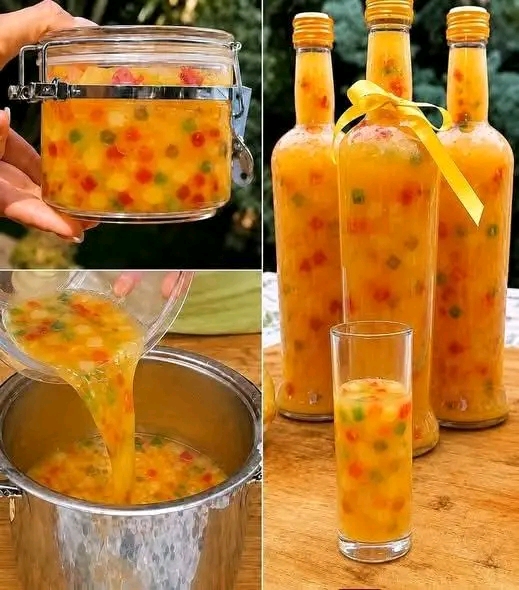
When you gaze upon this creation, stored beautifully in glass swing-top jars or elegantly bottled in tall, slender glass vessels adorned with bright yellow ribbons, it evokes a sense of celebration, nostalgia, and wonder. The thick, luscious golden syrup, bursting with the flavors of mango, peach, and citrus, acts as a perfect suspension matrix for the colorful, chewy agar-agar jelly pearls (reminiscent of traditional “tutti frutti” or modern boba).
This comprehensive, masterclass-level guide will take you on a profound journey through the creation of this magical elixir. We will explore its rich history, the precise culinary science of its formation, the nutritional benefits it offers, and the exact methods required to replicate this masterpiece in your own kitchen. Whether you are pouring it into a stainless steel pot to warm and mix, sealing it in a jar for preservation, or serving it chilled in a tall, elegant glass, this recipe will transform your approach to homemade beverages.
History: The Global Journey of Fruit Punch and Jelly Jewels
To truly appreciate this vibrant nectar, we must trace the historical lineage of its two main components: the spiced fruit punch base and the colorful, chewy inclusions.
The concept of a fruit “punch” has ancient origins, tracing back to the Indian subcontinent. The word “punch” is widely believed to derive from the Hindi and Sanskrit word pancha, which translates to “five.” This referred to the five traditional ingredients used in early iterations of the drink: alcohol, sugar, lemon (citrus/acid), water, and tea or spices. As trade routes expanded in the 17th century, sailors of the British East India Company brought this concept back to Europe, where it evolved into the fruit-heavy, often non-alcoholic party punches we recognize today. The golden, tropical base of our nectar pays homage to this rich history of blending exotic fruits into a harmonious, unified liquid.
Simultaneously, the concept of suspending colorful, chewy elements in desserts and drinks has a rich global heritage. In Italy, Tutti Frutti (literally “all fruits”) referred to chopped, candied fruits used to flavor gelatos and cakes. In Southeast Asia, particularly in Taiwan and the Philippines, the use of tapioca pearls and agar-agar jellies in sweet, milky, or fruity beverages became a cultural phenomenon. Agar-agar, a plant-based gelatin derived from red algae, was discovered in Japan in the 1650s. It revolutionized Asian desserts because it sets at room temperature and maintains its firm, chewy texture even when submerged in warm liquids.
Our Rainbow Jelly Tropical Nectar is the glorious marriage of these diverse culinary traditions. It combines the Western love for thick, fruit-heavy nectars with the Eastern mastery of textural, chewy jellies, resulting in a modern, viral sensation that captures the hearts of anyone who tastes it.
Benefits: Nourishing the Body and the Mind
While this sweet, festive nectar is undeniably an indulgence, it offers a fascinating array of physical and psychological benefits.
Psychological Joy and “Eating the Rainbow” The most immediate benefit of this drink is psychological. Human beings are visually driven creatures, and we are evolutionary wired to be attracted to bright, vibrant colors in our food, as they typically indicate ripeness and high nutrient density. The sheer visual impact of the red, green, and yellow cubes floating in a sea of golden orange triggers the release of dopamine. It brings out the inner child, elevates the mood, and acts as an instant conversation starter at any social gathering.
Hydration and Vitamin Density The base of this nectar is crafted from pure, high-quality tropical fruit purees—specifically mango, orange, and peach. Mangoes are a nutritional powerhouse, loaded with Vitamin C, which is essential for immune system function, collagen production, and skin health. They are also incredibly rich in beta-carotene (Vitamin A), which supports eye health and cellular growth. The addition of citrus provides an extra boost of antioxidants, helping the body combat free radicals.
Digestive Benefits of Agar-Agar Unlike animal-based gelatin, the colorful jelly cubes in this recipe are traditionally made using agar-agar. Agar is approximately 80% dietary fiber. This type of soluble fiber acts as a prebiotic, feeding the beneficial bacteria in your gut microbiome. It also absorbs water in the digestive tract, which can aid in satiety (making you feel full) and promote healthy, regular digestion. It is a completely vegan, plant-based ingredient that adds incredible texture without empty, heavy calories.
Formation: The Culinary Science of Suspension
One of the most visually striking aspects of the image provided is that the colorful jelly cubes are perfectly suspended throughout the tall bottles and the glass jar. They do not all float to the very top, nor do they sink heavily to the bottom. How is this architectural culinary feat achieved? The secret lies in the formation of the liquid, specifically manipulating its specific gravity and viscosity.
The Matrix of Viscosity If you were to drop these heavy agar jellies into plain water or thin apple juice, gravity would immediately pull them to the bottom of the glass. To achieve suspension, the liquid base must be thickened to create a viscous matrix. This is done by utilizing the natural pectins found in the fruit.
Mangoes and peaches are naturally high in pectin and soluble fibers. When these fruits are pureed and gently simmered with sugar, the water content reduces, and the pectins cross-link, creating a thick, syrup-like consistency. The sugar is not just for sweetness; it acts as a structural binder, increasing the density (specific gravity) of the liquid.
The Temperature Factor During the formation process (as seen in the image where the mixture is poured into a stainless steel pot), the nectar is often heated to perfectly integrate the sugars and fruit purees. When the liquid is warm, it is thinner. As it cools in the glass bottles, the pectin sets slightly, thickening the nectar to its final, luxurious state. This precise balance ensures that when the jelly cubes are folded in, they are gently held in place by the thick, golden fruit matrix, creating the stunning, gravity-defying visual effect.
The Lovers: The Community of Aesthetes and Foodies (Part 1)
The community of “lovers” for this specific type of culinary creation is vast, passionate, and incredibly diverse.
The Aesthetic Crafters First and foremost, this recipe belongs to the culinary aesthetes—those who believe that we eat and drink with our eyes first. Lovers of this nectar are the individuals who take pride in the presentation of their food. They are the ones who carefully select vintage swing-top jars, purchase tall, elegant glass bottles, and tie meticulous yellow satin ribbons around the necks to finish the presentation. For this group, the creation of the Rainbow Jelly Nectar is an artistic endeavor as much as it is a cooking process.
The Festive Hosts and Hostesses This drink has a massive following among party hosts, holiday gatherers, and event planners. Because the recipe yields a concentrated, spectacular base, it is the ultimate “host hack.” Lovers of this drink keep a bottle in their refrigerator to instantly elevate a summer barbecue, a baby shower, or a holiday dinner. It is universally loved because it bridges the gap between generations; adults appreciate its sophisticated tropical flavor profile, while children are utterly mesmerized by the chewy, colorful “jewels” swimming inside their glasses.
Ingredients: The Master Shopping List
To replicate the glowing perfection seen in the images, you must source the highest quality ingredients. This recipe is broken down into two components: The Tropical Nectar Base, and The Rainbow Agar Jellies.
Yields: Approximately 3 Tall Bottles (as pictured) or 2 Large Swing-Top Jars.
For the Rainbow Agar Jellies (The Colored Jewels):
Agar-Agar Powder: 2 tablespoons (Ensure it is 100% pure agar powder, not flakes, for a firm set).
Water: 3 cups (Filtered, for clarity).
Granulated Sugar: ½ cup (To sweeten the jellies).
Flavoring Extracts (Optional): 1 teaspoon of clear vanilla, lychee, or coconut extract.
Food Coloring: High-quality gel food coloring in vibrant Red, Emerald Green, and Lemon Yellow. (Alternatively, you can use natural fruit juices like beet juice, pandan/matcha, and turmeric, though the colors may be slightly less neon).
(Note: If you do not wish to make the jellies from scratch, you can purchase 2 cups of high-quality, pre-made, multicolored “Tutti Frutti” candied fruit cubes or commercial rainbow konjac/agar boba pearls from an Asian supermarket).
For the Thick Tropical Nectar Base (The Golden Matrix):
Mango Puree: 3 cups. (Use fresh Alphonso or Ataulfo mangoes for the best color and flavor, or high-quality canned unsweetened mango puree).
Peach Nectar or Puree: 2 cups. (Adds a delicate floral sweetness and contributes to the thick texture).
Fresh Orange Juice: 1 cup. (Freshly squeezed and strained of pulp to provide brightness and acidity).
Granulated White Sugar: 1 ½ cups. (Adjust based on the natural sweetness of your fruit. This preserves the nectar and aids in the suspension viscosity).
Fresh Lemon Juice: 3 tablespoons. (The citric acid balances the immense sweetness and helps preserve the vibrant orange color by preventing oxidation).
Water: 1 cup (To adjust the final thickness).
Methods: Crafting the Elements (Part 1)
The methodology behind this recipe requires patience, precision, and a love for the culinary process. We will begin by crafting the colorful jewels, followed by the golden matrix.
Method 1: Crafting the Rainbow Jellies (From Scratch) The process of making agar jellies is akin to simple chemistry. Unlike gelatin, agar requires a rolling boil to activate its setting properties. In a medium saucepan, whisk together the 3 cups of water, ½ cup of sugar, and the 2 tablespoons of agar-agar powder before turning on the heat to prevent clumping. Place the saucepan over medium-high heat and bring the mixture to a rolling boil. You must let it boil vigorously for exactly 2 to 3 minutes, stirring constantly, to fully dissolve and activate the agar. Remove from heat and stir in your clear flavoring extract.
Immediately divide this hot liquid evenly into three separate, shallow, heat-proof, flat-bottomed containers (like small glass Pyrex dishes). Working quickly before the agar sets, add a few drops of red food coloring to the first dish, green to the second, and yellow to the third. Whisk each dish thoroughly to distribute the color.
Let the dishes sit undisturbed at room temperature. Agar sets remarkably fast—within 30 to 40 minutes, you will have three firm, colorful blocks of jelly. Once completely set and firm to the touch, turn the blocks out onto a clean cutting board. Using a very sharp knife, meticulously cut the jelly blocks into tiny, uniform cubes (about ¼ inch in size). Toss all the red, green, and yellow cubes together in a bowl. You have now created the “jewels.”
Method 2: Crafting the Thick Tropical Nectar To create the viscous, golden base that will suspend your jewels, you must cook down your fruit purees. In a large, heavy-bottomed stainless steel pot (just like the one pictured in the bottom left of your image), combine the mango puree, peach nectar, freshly squeezed orange juice, granulated sugar, and lemon juice.
Place the pot over medium heat and stir constantly with a wooden spoon or silicone spatula. The goal here is not to boil the fruit into a jam, but to dissolve the sugar completely and allow the natural pectins in the mango and peach to activate. Simmer the mixture gently for about 10 to 15 minutes. You will notice the liquid becoming glossy, slightly translucent, and noticeably thicker. If the mixture is too thick (like a puree), slowly whisk in the 1 cup of water until it reaches the consistency of a heavy syrup or a light nectar.
Turn off the heat and allow the golden nectar to cool to room temperature. It is crucial that the nectar is completely cool before adding the jellies; if it is too hot, it could melt or soften the agar cubes.
Instructions: The Final Assembly and Bottling
With both elements prepared, it is time to bring the Rainbow Jelly Tropical Nectar to life and prepare it for its spectacular visual presentation.
Step 1: The Great Integration Once your thick mango-peach nectar has cooled to room temperature, take your bowl of multicolored jelly cubes and gently pour them into the stainless steel pot containing the nectar. Using a large ladle, gently fold the jellies into the liquid. Watch in awe as the red, green, and yellow cubes swirl through the golden syrup. Because you cooked the nectar down to a viscous state, the jellies should disperse evenly and remain suspended, rather than sinking instantly to the bottom.
Step 2: Preparing the Vessels To achieve the stunning aesthetic seen in the images, you must prepare your glass vessels. Wash your swing-top glass jars and tall, clear glass bottles with hot, soapy water. For longevity and food safety, it is highly recommended to sterilize them by boiling the glass vessels in water for 10 minutes, or running them through a high-heat dishwasher cycle. Allow them to dry completely.
Step 3: The Pour Using a wide-mouth funnel, carefully ladle the mixture from your pot into the swing-top jars (as seen in the top-left image, held proudly in a hand) and into the tall bottles (as seen on the right). Ensure that every bottle gets an even distribution of the colorful jellies and the liquid.
Step 4: The Finishing Aesthetic Touches Seal the swing-top jar securely with its metal clasp. For the tall bottles, twist on their golden or yellow caps tightly. To replicate the gorgeous, festive presentation, take a length of bright yellow satin ribbon and tie an elegant bow around the neck of the bottles. This simple touch transforms a homemade drink into a boutique-quality gift.
Step 5: Chilling Place the jars and bottles into the refrigerator. The nectar must be served completely chilled. As it cools, the liquid will thicken just a fraction more, locking the beautiful rainbow cubes in their suspended state.
Methods: Serving, Utilization, and Preservation (Part 2)
The Magic of the Rainbow Jelly Tropical Nectar is its immense versatility. It is not just a drink; it is an ingredient, a base, and a garnish. Here are the preferred methods for utilizing and preserving your creation.
Method 1: The Refreshing Thirst Quencher The most direct way to enjoy this is exactly as pictured in the bottom right image—poured directly into a tall, clear highball glass. Because the nectar is quite thick and concentrated, many lovers of this drink prefer to dilute it slightly upon serving. Fill a glass halfway with the nectar and jelly mix, add a handful of ice cubes, and top it off with sparkling water, club soda, or a splash of cold coconut water. Stir gently. The carbonation lifts the tropical aromas, and the chewy jellies provide a delightful textual surprise at the bottom of the glass.
Method 2: The Ultimate Dessert Topper This thick nectar is a revelation when used as a dessert topping. Spoon it generously over a bowl of high-quality vanilla bean ice cream or coconut gelato. The thick syrup pools around the ice cream, while the colorful jellies freeze slightly against the cold, creating an incredible textural contrast. It is also phenomenal spooned over classic cheesecake, panna cotta, or a traditional Asian shaved ice dessert (Bingsu).
Method 3: Adult Festive Cocktails For evening gatherings, this nectar transforms into a world-class cocktail mixer. In a cocktail shaker, combine 2 ounces of the Rainbow Jelly Nectar, 1.5 ounces of white rum, coconut rum, or vodka, and a squeeze of fresh lime. Shake vigorously with ice, and pour the entire mixture (including the jellies) into a glass. It is a visually stunning, tropical masterpiece that rivals any high-end beach resort beverage.
Preservation Method Because this recipe contains fresh fruit and limited preservatives, it must be stored in the refrigerator. In an airtight, sterilized glass jar or bottle, the nectar will keep beautifully for 10 to 14 days. If you wish to preserve it for longer, you can omit the agar jellies during the cooking process, safely hot-water-bath can the fruit nectar in mason jars for shelf stability, and simply add fresh jellies upon opening the jars months later.
Nutrition: Balancing Indulgence with Vitality
Understanding the nutritional profile of the Rainbow Jelly Tropical Nectar helps you incorporate it mindfully into your diet.
Macronutrient Profile: The primary macronutrient in this beverage is carbohydrates, derived entirely from the natural fruit sugars (fructose) and the added granulated sugar. A standard 8-ounce serving of the undiluted nectar contains approximately 150-180 calories, making it an energy-dense treat. It contains negligible amounts of fat and protein.
Micronutrients and Fiber: Where this nectar truly shines is in its micronutrient density. The heavy reliance on mango and orange means a single serving provides well over 100% of your daily recommended intake of Vitamin C. It is also an excellent source of Potassium, which helps regulate blood pressure and fluid balance in the body.
The agar-agar jellies elevate the nutritional value by introducing soluble dietary fiber. While they do not add significant calories, the fiber in the agar aids in slowing down the absorption of the fruit sugars into the bloodstream, preventing severe blood sugar spikes compared to drinking a standard, filtered soda or commercial fruit juice.
To make a lighter, more diet-friendly version of this recipe, lovers of the drink often substitute the granulated sugar in the nectar with natural, zero-calorie sweeteners like Monk Fruit or Stevia, and ensure their homemade agar jellies are sweetened minimally.
Conclusion: The Culmination of Culinary Artistry (Part 1)
To embark on the journey of creating the Rainbow Jelly Tropical Nectar is to engage in a profound act of culinary artistry. It requires a symphony of techniques: the precision of boiling agar to the perfect temperature, the patience of simmering fruit purees until the pectins yield a thick, glossy matrix, and the artistic eye required to chop colorful jewels and bottle them with a delicate yellow ribbon.
When you stand back and look at your kitchen counter, lined with tall glass bottles glowing with amber nectar and studded with red, green, and yellow confetti, you realize that you have not just followed a recipe. You have captured the very essence of summer, festivity, and joy, and sealed it inside a glass jar.
The Lovers: Gifting and the Joy of Sharing (Part 2)
The final, and perhaps most important, aspect of this recipe belongs to the lovers of gifting. Food is the universal language of care, and this specific creation is the ultimate edible gift.
The visual of the tall, elegant bottles tied with pristine yellow ribbons (as prominently featured in the images) is not an accident—it is a deliberate act of presentation designed to make the recipient feel special. Lovers of this recipe do not just make it for themselves; they make massive batches during the holidays, during the peak of summer, or for special occasions, and distribute them to neighbors, friends, and family.
Presenting someone with a jar of this Rainbow Jelly Nectar is presenting them with a bottled celebration. It tells the recipient that you took the time to craft something meticulous, beautiful, and vibrant just for them. It is a favorite among artisanal craft fair vendors and homemade holiday gift exchanges because it looks impossibly professional, yet carries the undeniable warmth of a home kitchen. The community of lovers for this drink knows that the true magic of the recipe is not just in the drinking, but in the widening of the recipient’s eyes when they are handed a bottle of liquid, edible rainbows.
Conclusion: A Final Toast to the Rainbow Elixir (Part 2)
In a culinary landscape often dominated by muted tones and heavy, complex meals, the Rainbow Jelly Tropical Nectar stands as a shining beacon of light, color, and absolute fun. It reminds us that food should be playful. It reminds us that the textures of chewy, colorful jellies and the bright, acidic punch of pure tropical fruit can instantly transport us to a sun-drenched beach, regardless of the weather outside.
From the ancient origins of spiced punches and Asian jelly desserts, to the modern, viral aesthetic of swing-top jars and ribbon-tied bottles, this recipe represents the best of global culinary fusion. As you pour that thick, golden liquid from your stainless steel pot, watching the red, green, and yellow cubes tumble into the glass, take a moment to appreciate the sheer beauty of what you have created. Chill your bottles, tie your ribbons tightly, and raise a tall, vibrant glass to the joy of cooking, the thrill of color, and the unmatched taste of the ultimate festive nectar.