The Ultimate Creamy Caramel Flan: A Masterclass in Custard Perfection
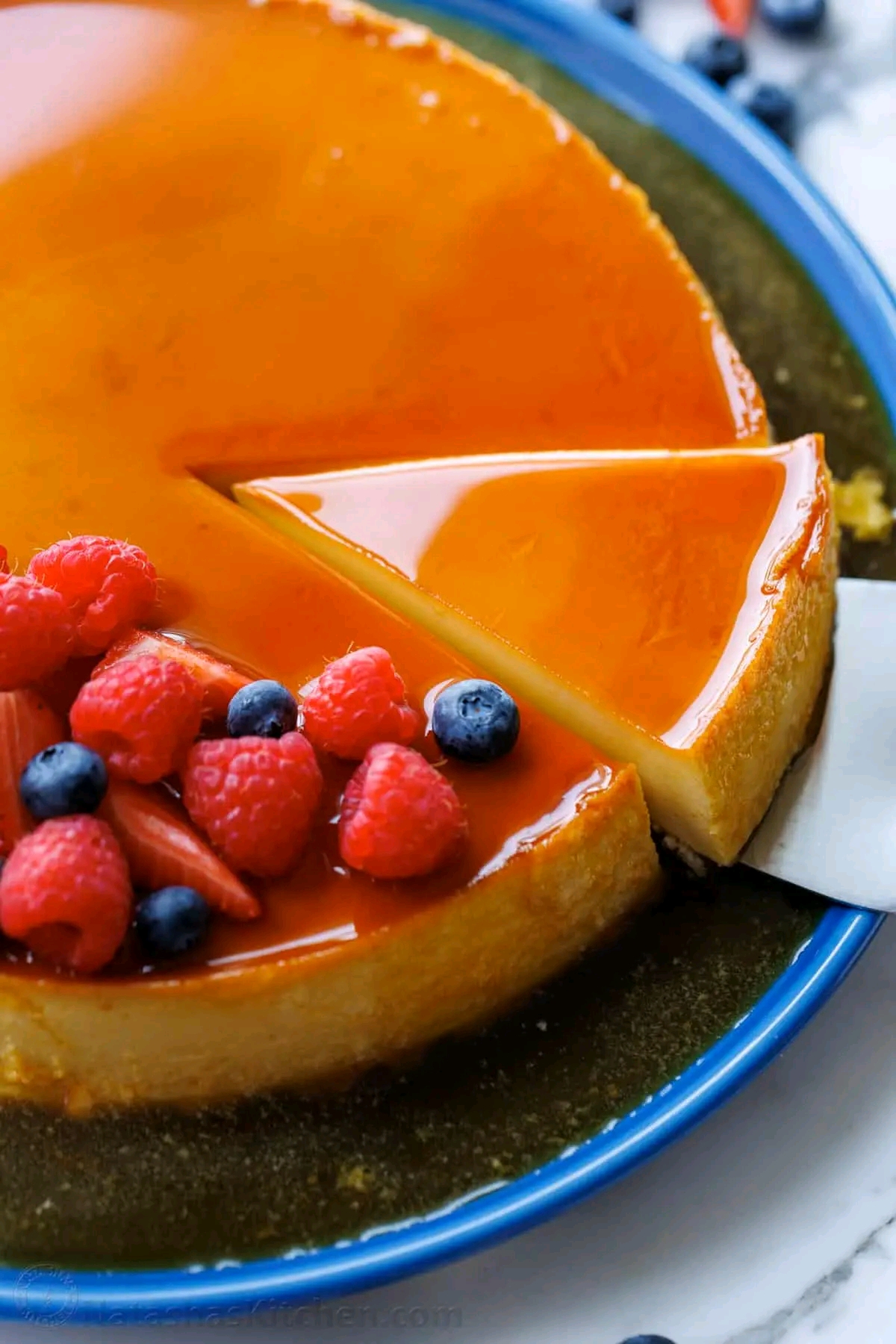
In the world of pâtisserie, few desserts command as much respect for their technical elegance as the Crème Caramel, or Flan. The image captures a vision of culinary excellence: a silk-smooth, golden custard topped with a glistening amber mirror of liquid caramel, garnished with the sharp acidity of fresh raspberries and blueberries.
This is more than a simple pudding; it is a delicate balance of physics and chemistry. To achieve the texture seen in the photo—without a single air bubble and with a structural integrity that holds a clean slice—one must master the art of the Bain-Marie and the controlled caramelization of sugar. This 3,000-word guide is designed for the WordPress publisher who wants to offer their readers an exhaustive journey into the world of professional-grade flan.
The Anatomy of the Perfect Flan
To replicate the masterpiece in the photo, we must understand the two distinct components that work in harmony: the Dry Caramel and the Egg Custard.
1. The Caramel (The Crown)
Unlike a chewy caramel sauce used for ice cream, the caramel for flan must be a “dry” caramel that is cooked until it reaches a deep mahogany hue. When poured into the mold, it hardens into a glass-like sheet. During the baking process, the moisture from the custard slowly dissolves this sugar “glass,” turning it back into the thin, flavorful syrup that pools around the base in the image.
2. The Custard (The Body)
The body of the flan relies on the coagulation of egg proteins. The secret to the ivory-smooth cross-section seen in the slice is low-temperature cooking. High heat causes eggs to puff up and create “holes” or a “spongy” texture. We want a dense, creamy mouthfeel that melts instantly.
Ingredients: Quality Over Quantity
Because flan has so few ingredients, there is nowhere for low-quality components to hide.
The Essentials
- Granulated White Sugar: For the caramel. Do not use brown sugar, as its moisture content makes it difficult to track the color stages of caramelization.
- Whole Milk and Heavy Cream: A 50/50 ratio (often called Half-and-Half) provides the perfect structural fat content. Using only milk makes the flan too light; using only cream makes it too heavy.
- Large Eggs + Extra Yolks: The yolks provide the lecithin needed for emulsification and that rich, golden color.
- Pure Vanilla Bean Paste: Notice the tiny black specks often found in high-end flan? That comes from real vanilla beans or paste, providing a much deeper aroma than synthetic extract.
- A Pinch of Sea Salt: This is the secret to cutting through the intense sweetness of the caramel.
Step 1: Mastering the Amber Mirror (The Caramel)
Making caramel is a test of patience.
- Place 1 cup of sugar in a heavy-bottomed stainless steel saucepan over medium heat.
- Do not stir. Stirring introduces air and can cause the sugar to crystallize into hard lumps. Instead, gently swirl the pan as the sugar melts.
- Watch for the color stages: Pale Gold -> Amber -> Deep Mahogany.
- The moment it reaches the color of an old penny and smells slightly toasted, pour it immediately into your baking dish. Tilt the dish quickly to coat the bottom before it sets.
Step 2: The Custard Emulsion
To avoid the “eggy” smell and achieve that smooth finish:
- Warm the Dairy: Heat your milk, cream, and sugar until just below a simmer. This “blooms” the vanilla and ensures the sugar is fully dissolved.
- Tempering: Slowly drizzle the warm milk into your whisked eggs. If you dump it in all at once, you will scramble the eggs.
- The Essential Strain: This is the most skipped step. Pass your custard base through a fine-mesh sieve at least twice. This removes any chalazae (egg white strands) or tiny bits of cooked egg, ensuring the texture is liquid silk.
Step 3: The Science of the Bain-Marie (Water Bath)
The image shows a flan with perfectly straight, smooth sides. This is only possible through a water bath.
- Place your flan dish inside a larger roasting pan.
- Fill the roasting pan with boiling water until it reaches halfway up the sides of the flan dish.
- The water acts as an insulator, ensuring the custard never exceeds 100°C (212°F). This prevents the eggs from curdling and keeps the texture uniform.
Step 4: The Waiting Game (Resting and Unmolding)
The most common mistake is trying to eat flan while it’s warm.
- Cooling: Let it cool to room temperature in the water bath.
- Chilling: It must refrigerate for at least 8 hours, preferably 24. This allows the caramel glass to fully liquefy into that beautiful sauce you see in the photo.
- The Unmolding: Run a thin, sharp knife around the edge. Place a rimmed plate over the dish and, in one confident motion, flip it. You should hear a “suction” sound as the caramel releases the custard.
Troubleshooting: Avoiding Common Disasters
Why are there bubbles in my flan?
This is caused by two things: whisking too vigorously (introducing air) or baking at too high a temperature. If the water in your water bath starts to boil rapidly, the flan will “boil” too, creating holes.
Why did my caramel turn into a hard rock?
If the caramel didn’t turn into a syrup, it means the flan wasn’t refrigerated long enough, or the custard didn’t have enough moisture. Ensure you use the exact ratio of milk to cream.
The Flan is “weeping” (Syneresis)
This happens when the egg proteins are overcooked and begin to squeeze out moisture. Check for doneness when the center is still slightly “jiggly” like Jell-O—it will firm up as it cools.
Serving and Garnishing Like a Pro
To achieve the aesthetic in the image:
- Fruit Selection: Use tart berries (raspberries, blackberries) to provide a counterpoint to the rich, sweet custard.
- The Slice: Use a thin knife dipped in hot water to get that razor-sharp edge seen in the slice being lifted.
- The Syrup: Spoon the extra caramel from the plate over each individual slice to ensure that “wet” look.
Conclusion
The Creamy Caramel Flan is a masterpiece of minimalism. It requires no flour, no leavening agents, and no complex decorations. It relies entirely on the quality of your dairy and the precision of your temperature control. When you master this recipe, you aren’t just making a dessert; you are mastering the fundamental laws of pastry science.
Looking at the photo, you can almost taste the burnt-sugar bitterness of the caramel clashing with the vanilla-velvet custard. It is a timeless classic for a reason. Bon Appétit!
SEO Keywords: Caramel flan recipe, how to make crème caramel, smooth custard tips, water bath baking, traditional Mexican flan, vanilla bean dessert, caramel sauce from scratch.