Clove Water for Oral Health: What a 5-Minute Rinse Can—and Cannot—Do for Your Teeth and Gums
Introduction
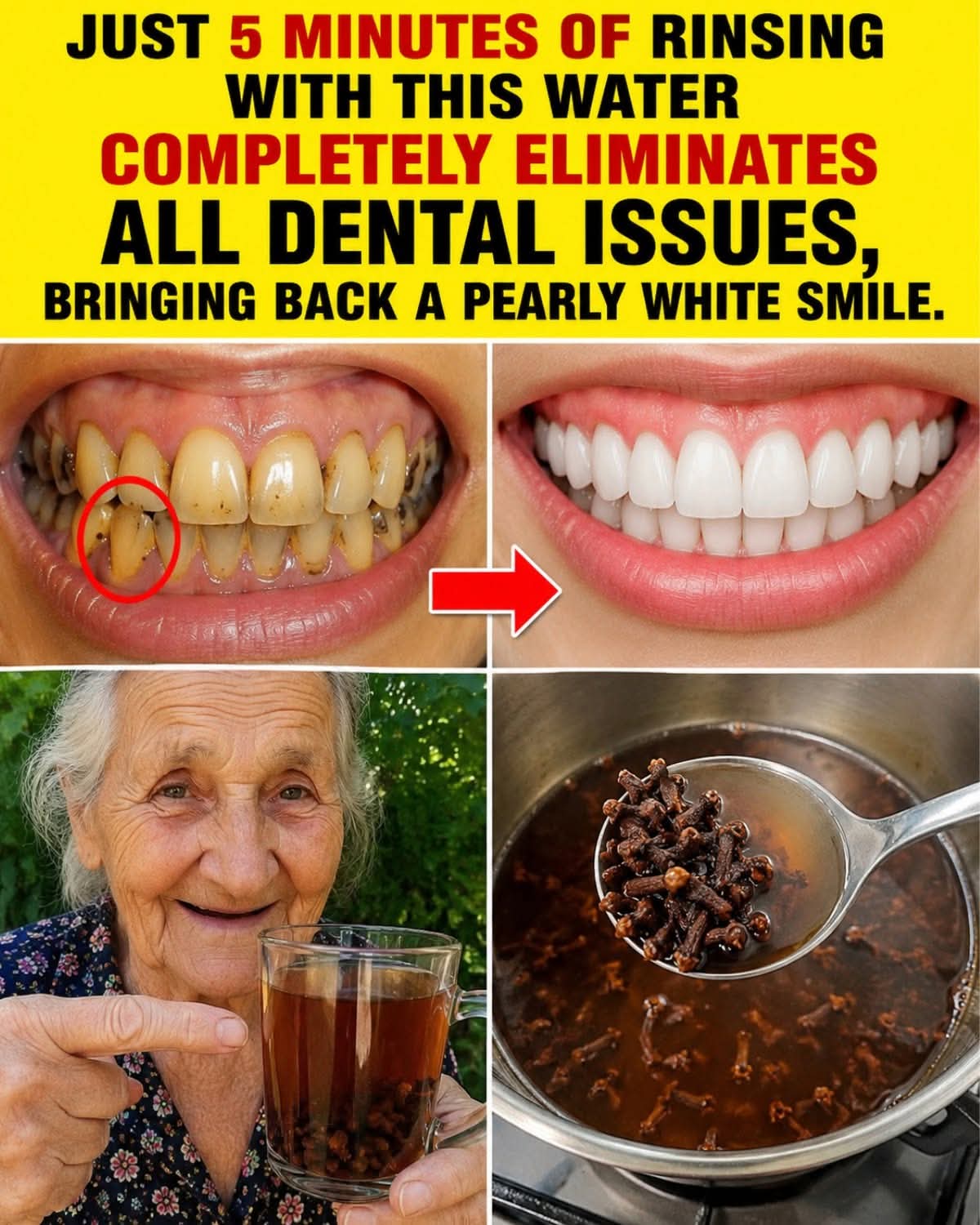
A bright, healthy smile is something almost everyone wants, and that is why natural oral-care remedies continue to attract so much attention. One popular idea circulating online involves preparing water with cloves and using it as a mouth rinse. The claim is often dramatic: rinse with clove water for five minutes and dental problems will supposedly disappear, leaving the teeth perfectly white and the mouth completely healthy.
There is an interesting traditional remedy behind this viral claim, but the reality is more nuanced.
Cloves contain eugenol, a naturally occurring compound that has been studied for its antimicrobial and pain-relieving properties. Clove-derived preparations have also been used in dentistry, particularly in certain professional treatments involving dental pain. Recent reviews have found evidence that eugenol and clove-based preparations can have analgesic effects in some dental situations. However, this does not mean that a homemade clove-water rinse can eliminate cavities, tartar, gum disease, infections, or every other dental problem.
That distinction is extremely important.
A homemade clove rinse may be an interesting complementary oral-care practice for some adults, but it should never replace brushing with fluoride toothpaste, cleaning between the teeth, professional dental examinations, or treatment when a dental problem is present.
In this article, we will explore what clove water is, how it is traditionally prepared, what science actually says about cloves and oral health, what benefits may be realistic, what claims should be avoided, and how to build a complete daily routine for healthier teeth and gums.
What Is Clove Water?
Clove water is simply water infused with whole dried cloves.
Cloves are the aromatic flower buds of the clove tree, commonly used as a spice in cooking and traditional remedies. Their distinctive smell and flavor come partly from volatile compounds, especially eugenol.
When whole cloves are steeped or gently simmered in water, some of their water-soluble and volatile compounds move into the liquid. The resulting drink has a strong, spicy aroma and flavor.
Traditional uses of cloves have included:
- Freshening the mouth
- Supporting oral comfort
- Temporarily reducing unpleasant odors
- Providing a warming sensation
- Supporting general hygiene
- Traditional management of tooth discomfort
Modern research has investigated clove and eugenol in dentistry, especially in relation to pain and inflammation. However, research on a particular homemade recipe—such as boiling a few cloves and rinsing for exactly five minutes—is not enough to prove that the recipe treats dental disease.
This is an important difference between traditional use, laboratory research, and clinical treatment.
Why Are Cloves Associated With Dental Health?
The main compound that attracts scientific attention is eugenol.
Eugenol is found naturally in cloves and has been used in several dental materials and preparations. Research has investigated its antimicrobial, anti-inflammatory, and analgesic properties.
A recent systematic review of phytotherapeutic agents used in dental pain management identified clove oil and eugenol among the plant-derived substances with evidence of pain-relieving effects in certain dental applications.
Another systematic review examining herbal extracts in orofacial pain reported clinical research involving eugenol-based preparations for conditions such as pain following tooth extraction.
But there is a crucial point:
Evidence involving purified eugenol, clove oil, gels, pastes, or professional dental preparations cannot automatically be applied to homemade clove water.
The concentration of active compounds can be very different.
Therefore, it is reasonable to say that cloves contain compounds with properties of interest to dental researchers. It is not reasonable to promise that a five-minute clove-water rinse will eliminate all dental problems.
Can Clove Water Whiten Teeth?
This is one of the biggest questions surrounding viral clove-water recipes.
The answer is: do not expect clove water to bleach teeth.
Natural tooth color varies from person to person. Teeth can also become darker because of age, certain foods and drinks, tobacco use, surface stains, or changes inside the tooth.
A dark-looking tooth may have a completely different cause from ordinary surface staining.
Clove water does not contain a clinically established tooth-bleaching agent comparable to professional whitening treatments or proven whitening products.
So if a social-media image shows severely stained teeth on one side and extremely white teeth on the other, that image should not be treated as evidence that clove water created the transformation.
Healthy teeth are not necessarily brilliant white.
In fact, natural teeth commonly have some yellow or cream coloration.
The primary goal of oral hygiene should be healthy teeth and gums, not achieving an artificially bright shade.
Can Clove Water Remove Tartar?
No.
This is another important myth to understand.
Dental plaque is a sticky bacterial film that develops on teeth. If plaque remains and becomes mineralized, it can harden into tartar, also called calculus.
Once tartar has formed, brushing and rinsing cannot simply dissolve it away.
The National Institute of Dental and Craniofacial Research explains that hardened calculus must be removed through professional dental cleaning.
That means clove water should never be promoted as a replacement for professional scaling.
You might notice your teeth feeling cleaner after rinsing, but that sensation does not mean hardened tartar has disappeared.
If you have visible deposits around your gumline, particularly yellow, brown, or hard material, arrange a dental examination rather than trying increasingly strong homemade remedies.
Can Clove Water Cure Cavities?
Clove water cannot be considered a cure for tooth decay.
A cavity occurs when the tooth’s hard tissues are damaged by an ongoing process involving acids produced by bacteria in dental plaque.
Early tooth decay may sometimes be managed or reversed through appropriate preventive measures, especially fluoride exposure and improved oral hygiene. But an established cavity may require professional treatment.
A rinse cannot rebuild a large hole in a tooth.
If you have:
- Tooth sensitivity
- Persistent toothache
- A visible hole
- Food repeatedly becoming trapped
- Pain when biting
- A broken tooth
- Swelling around a tooth
you should not depend on clove water.
The correct approach is professional dental evaluation.
Can Clove Water Help With Bad Breath?
This is a more reasonable area in which a clove rinse might provide a temporary benefit.
Cloves have a strong aromatic flavor, and rinsing with a pleasantly scented preparation may temporarily improve the smell of the mouth.
However, persistent bad breath should not simply be covered up.
Bad breath can be associated with plaque, gum disease, dry mouth, tongue coating, dental infections, food debris, smoking, and other conditions.
The American Dental Association notes that therapeutic mouthrinses can help with issues such as bad breath, plaque, gingivitis, and tooth decay depending on their active ingredients. However, mouthrinse is an addition to oral hygiene rather than a replacement for brushing and cleaning between the teeth.
If bad breath continues despite good oral hygiene, a dental examination is worthwhile.
Clove Water and Gum Health
Healthy gums are usually firm and should not regularly bleed during brushing.
Gum disease begins when plaque accumulates around the teeth and irritates the gum tissue. Early gum disease, known as gingivitis, can cause redness, swelling, tenderness, and bleeding.
The good news is that early plaque-related gingivitis can often be improved with consistent oral hygiene.
The National Institute of Dental and Craniofacial Research recommends brushing twice daily with fluoride toothpaste and cleaning between the teeth regularly.
A rinse may reach areas that are difficult to access with a toothbrush, but it cannot physically remove all plaque deposits from every tooth surface.
That is why rinsing should be viewed as an addition, not the foundation, of oral care.
A Simple Homemade Clove-Water Recipe
If you are an adult interested in trying clove water as a complementary rinse, keep the preparation simple and mild.
Ingredients
- 1 cup of water
- 4–6 whole cloves
Instructions
- Place the water in a small saucepan.
- Add the whole cloves.
- Bring the water to a gentle simmer.
- Simmer for approximately 5 minutes.
- Turn off the heat.
- Allow the liquid to cool completely.
- Strain out the cloves.
- Transfer the cooled liquid to a clean container.
- Use a small amount as a brief mouth rinse.
- Spit it out rather than swallowing large amounts.
The goal should be a mild rinse, not an extremely concentrated preparation.
There is no scientifically established requirement that someone must rinse continuously for five minutes to obtain dental benefits. In fact, holding a strongly flavored homemade preparation in the mouth for a prolonged period may cause irritation in some people.
How to Use It More Safely
If you choose to experiment with clove water, moderation is important.
Do not assume that stronger means better.
Using more cloves, concentrating the liquid heavily, or repeatedly rinsing for long periods does not automatically improve oral health.
Consider the following precautions:
- Do not swallow large quantities
Clove preparations are not ordinary drinking water. Their concentration can vary significantly depending on how they are prepared.
- Stop if irritation occurs
If your mouth becomes painful, irritated, unusually dry, or develops sores after using the rinse, discontinue it.
- Avoid putting concentrated clove oil directly on your gums
Clove essential oil is far more concentrated than clove-infused water. Undiluted essential oils can irritate or damage tissues.
- Do not use it to delay dental treatment
If you have tooth pain, swelling, bleeding gums, loose teeth, or a suspected infection, arrange professional care.
- Be particularly cautious with children
Children may accidentally swallow mouth rinses. The American Dental Association advises that children younger than six should not use mouthrinse unless directed by a dentist.
What About Clove Oil?
Clove oil deserves separate discussion because it is substantially more concentrated than clove water.
Eugenol has a long history in dentistry, and research supports interest in its pain-relieving properties in particular dental applications.
But that does not mean people should freely apply undiluted clove oil to their gums.
Essential oils are concentrated substances. Incorrect use can irritate oral tissues.
Commercial dental products containing eugenol are formulated for specific purposes and used according to professional instructions.
Homemade applications should therefore be approached cautiously.
The Most Important Step: Brush With Fluoride Toothpaste
If you want healthier teeth, do not allow an exciting natural remedy to distract you from the basics.
The National Institute of Dental and Craniofacial Research recommends brushing twice a day with fluoride toothpaste. Fluoride helps strengthen enamel and protect against tooth decay.
A good brushing routine includes:
- Using a soft-bristled toothbrush
- Applying fluoride toothpaste
- Brushing twice daily
- Cleaning the front, back, and chewing surfaces
- Brushing gently along the gumline
- Cleaning the tongue
- Avoiding excessively hard scrubbing
Hard brushing does not necessarily produce cleaner teeth.
In fact, aggressive brushing can irritate the gums and contribute to tooth wear.
Don’t Forget the Spaces Between Your Teeth
A toothbrush cannot effectively reach every area between the teeth.
That is why interdental cleaning is so important.
Floss, interdental brushes, or other suitable devices can help remove plaque and food particles from areas that brushing alone may miss.
The American Dental Association recommends cleaning between the teeth once a day, using floss or another interdental cleaner appropriate for the individual.
The NIDCR similarly explains that the purpose of interdental cleaning is to disrupt plaque before it hardens into calculus.
This is one of the most important lessons for anyone interested in natural mouth rinses:
A rinse cannot replace mechanical plaque removal.
Why Tartar Is Different From Plaque
Many viral dental posts confuse plaque and tartar.
Plaque is relatively soft and can be removed through regular brushing and interdental cleaning.
Tartar is hardened mineralized plaque.
Once tartar has developed, it can create rough surfaces where additional plaque accumulates.
Professional cleaning is required to remove established calculus.
Therefore, if someone has heavy deposits on their teeth, repeatedly rinsing with herbs, vinegar, baking soda, lemon juice, or other household ingredients is not a safe substitute for professional care.
What About Bleeding Gums?
Bleeding gums should not automatically be considered normal.
They can be a sign of gingivitis or other gum problems.
The NHS lists bleeding during brushing or eating, swollen gums, redness, soreness, bad breath, gum recession, and loose teeth among symptoms associated with gum disease.
If your gums bleed repeatedly, do not simply increase the strength of your homemade mouth rinse.
Instead:
- Improve your brushing technique.
- Clean between the teeth regularly.
- Arrange a dental check-up.
- Follow professional treatment recommendations.
If gum disease has progressed, rinsing alone cannot repair the tissues supporting the teeth.
Can Clove Water Prevent All Dental Problems?
No single ingredient can prevent every dental condition.
Oral health depends on multiple factors, including:
- Daily plaque control
- Fluoride exposure
- Diet
- Sugar consumption
- Smoking
- Dry mouth
- Medications
- Genetics
- Existing dental work
- Overall health
- Regular professional examinations
The NIDCR notes that gum disease has several risk factors, including smoking, certain illnesses, medications, hormonal changes, and genetics.
This explains why two people can have very different oral-health experiences even when they follow similar routines.
The Problem With Viral Before-and-After Dental Photos
The dramatic before-and-after image accompanying many natural-remedy posts can be persuasive.
But a photograph alone cannot establish what caused the change.
Lighting can differ.
The angle can differ.
The teeth can be professionally cleaned between photographs.
Whitening treatment may have been performed.
Dental restorations may have been added.
The images may even come from unrelated situations.
Therefore, never use a social-media before-and-after picture as clinical evidence.
A responsible health article should distinguish between what looks convincing online and what has actually been demonstrated scientifically.
What Science Really Says About Cloves
The scientific evidence surrounding clove and dental health is promising in some areas but should not be exaggerated.
Research has investigated eugenol for pain management and other dental applications. Systematic reviews have reported beneficial effects in certain circumstances, especially involving dental pain.
However, research quality varies according to the preparation, dose, condition being treated, and study design.
There is a major difference between:
“Eugenol has demonstrated useful properties in certain dental applications.”
and:
“Clove water eliminates all dental problems.”
The first statement can be supported by scientific literature.
The second is an unsupported generalization.
That distinction should be preserved whenever natural remedies are discussed.
A Better Daily Oral-Care Routine
Instead of depending on one special rinse, consider a complete routine.
Morning
Start the day by brushing with fluoride toothpaste.
Spend enough time cleaning all tooth surfaces without aggressively scrubbing.
Clean the tongue gently if desired.
After breakfast, rinse your mouth with water if food remains.
During the Day
Drink water regularly.
Limit frequent sugary snacks and drinks.
If you consume acidic beverages, avoid repeatedly exposing your teeth to them throughout the day.
Pay attention to persistent dry mouth or unusual oral symptoms.
Evening
Clean between your teeth.
Then brush with fluoride toothpaste.
Make sure you clean along the gumline.
If your dentist has recommended a specific mouthwash, use it according to the instructions.
A homemade clove rinse can be considered optional—not essential.
Food and Oral Health
Your daily diet also influences your teeth.
Frequent consumption of sugary foods and drinks can increase the risk of tooth decay.
Instead of constantly sipping sweetened beverages, water is generally a better choice.
A balanced diet that provides adequate nutrients supports general health, while good oral hygiene helps protect the teeth directly.
Remember that even nutritious foods can affect the teeth when they are consumed frequently, especially if they contain fermentable carbohydrates or acids.
The goal is not to fear food.
It is to maintain healthy habits and avoid constant exposure to substances that can promote decay or erosion.
When You Should See a Dentist
A natural rinse may be acceptable as a complementary habit for some people, but certain symptoms require professional attention.
See a dentist if you experience:
- Persistent toothache
- Facial or jaw swelling
- Repeated gum bleeding
- A loose adult tooth
- Pain when chewing
- Severe sensitivity
- A visible cavity
- A broken tooth
- Persistent bad breath
- Pus around the gums
- A dental abscess
- Significant gum recession
- A mouth ulcer that does not heal normally
The NHS recommends dental assessment for symptoms such as bleeding, painful or swollen gums, and persistent bad breath. More serious symptoms such as very swollen gums, loose teeth, ulcers, red patches, or lumps warrant prompt attention.
Do not allow a home remedy to delay treatment.
Who Should Be Especially Careful?
People with existing dental conditions should be cautious about replacing professional care with homemade treatments.
This includes people who have:
- Advanced gum disease
- Dental implants
- Recent dental surgery
- Significant tooth decay
- Dental abscesses
- Extensive crowns or restorations
- Severe mouth sensitivity
- Persistent oral sores
Anyone who has questions about whether a particular rinse is appropriate should ask a dentist.
Can Clove Water Replace Mouthwash?
Not necessarily.
Commercial therapeutic mouthrinses can contain specific active ingredients that have been studied for particular purposes.
The American Dental Association explains that therapeutic mouthrinses may contain ingredients such as fluoride, essential oils, chlorhexidine, cetylpyridinium chloride, or peroxide, depending on the product and its intended purpose.
Some therapeutic rinses have evidence for reducing plaque or gingivitis when used alongside brushing and flossing.
A homemade clove infusion has not been standardized in the same way.
That means you cannot assume that every homemade batch has the same concentration or effect.
Natural Does Not Automatically Mean Harmless
One of the most important principles of natural health is that “natural” and “safe for everyone” are not synonyms.
Plants contain biologically active chemicals.
Cloves are no exception.
The concentration matters.
The method of preparation matters.
The amount used matters.
The person’s age and health matter.
Existing dental conditions matter.
For this reason, responsible use means keeping preparations mild and stopping if irritation occurs.
It also means avoiding exaggerated claims.
Frequently Asked Questions
Is clove water good for your teeth?
Cloves contain eugenol, a compound studied in dental applications, particularly for pain. However, homemade clove water should be considered a complementary rinse rather than a proven treatment for cavities, tartar, gum disease, or tooth whitening.
Can I rinse with clove water every day?
There is no universally established evidence-based schedule for homemade clove-water rinses. If you choose to use one, keep it mild and discontinue it if irritation occurs. Your primary daily routine should remain brushing with fluoride toothpaste and cleaning between the teeth.
Can clove water remove yellow teeth?
It should not be expected to bleach teeth. Yellow coloration may be natural or caused by staining, aging, or other factors.
Can clove water remove tartar?
No. Hardened tartar generally requires professional dental cleaning.
Can it cure a cavity?
No. A cavity cannot reliably be repaired by a homemade rinse.
Can it stop toothache?
Clove-derived eugenol has demonstrated pain-relieving properties in certain dental applications, but a toothache can have many causes. Pain relief does not necessarily mean the underlying problem has been treated.
Is clove oil stronger than clove water?
Yes, clove oil is a concentrated preparation. It should not be treated as interchangeable with a mild clove infusion.
Should I stop brushing if I use clove water?
Absolutely not.
Brushing twice daily with fluoride toothpaste remains a cornerstone of oral hygiene.
The Bottom Line
Clove water is an interesting traditional oral-care remedy, and cloves contain eugenol, a compound with documented scientific interest in dentistry.
There is legitimate research surrounding clove-derived compounds, particularly their potential role in dental pain management.
But the viral claim that rinsing with clove water for five minutes will “completely eliminate all dental issues” goes far beyond the available evidence.
Clove water cannot be relied upon to:
- Remove tartar
- Fill cavities
- Reverse advanced gum disease
- Replace dental treatment
- Guarantee white teeth
- Eliminate every cause of bad breath
- Prevent every dental condition
A healthier and more realistic approach is to think of clove water, if used at all, as an optional complementary practice.
The foundation of oral health remains simple:
Brush twice daily with fluoride toothpaste. Clean between your teeth regularly. Limit frequent sugar exposure. Avoid tobacco. Pay attention to changes in your mouth. Visit your dentist routinely.
Those habits have far stronger support than any single viral remedy.
A natural ingredient can be interesting without being a miracle cure.
And when it comes to your teeth and gums, evidence-based care is worth far more than a sensational before-and-after photograph.
Final Takeaway
The image that inspired this article makes a powerful promise: five minutes of rinsing with a special water can supposedly transform unhealthy teeth into a perfect white smile.
The truth is more useful than the headline.
Cloves are an aromatic spice containing eugenol, and eugenol has legitimate dental research behind it. But homemade clove water is not a universal cure for dental disease.
If you enjoy clove water as an occasional complementary rinse and it causes no irritation, it may be part of a broader personal hygiene routine. Just do not let it replace the practices that matter most.
Healthy teeth are built through consistent care—not one miracle rinse.
And if your gums bleed, your tooth hurts, your teeth are loose, or you notice swelling, seek professional dental advice rather than trying to rinse the problem away.
Your smile deserves both the wisdom of traditional practices and the protection of modern dental science.