Onion Juice and Hair Growth: Can This Viral Home Remedy Really Regrow Hair in 16 Days?
Introduction
Hair loss can be frustrating, emotional, and difficult to understand. For many people, seeing a thinning crown, a widening part, or a bald patch can lead to a constant search for simple and affordable solutions. That is one reason home remedies for hair growth continue to attract so much attention online.
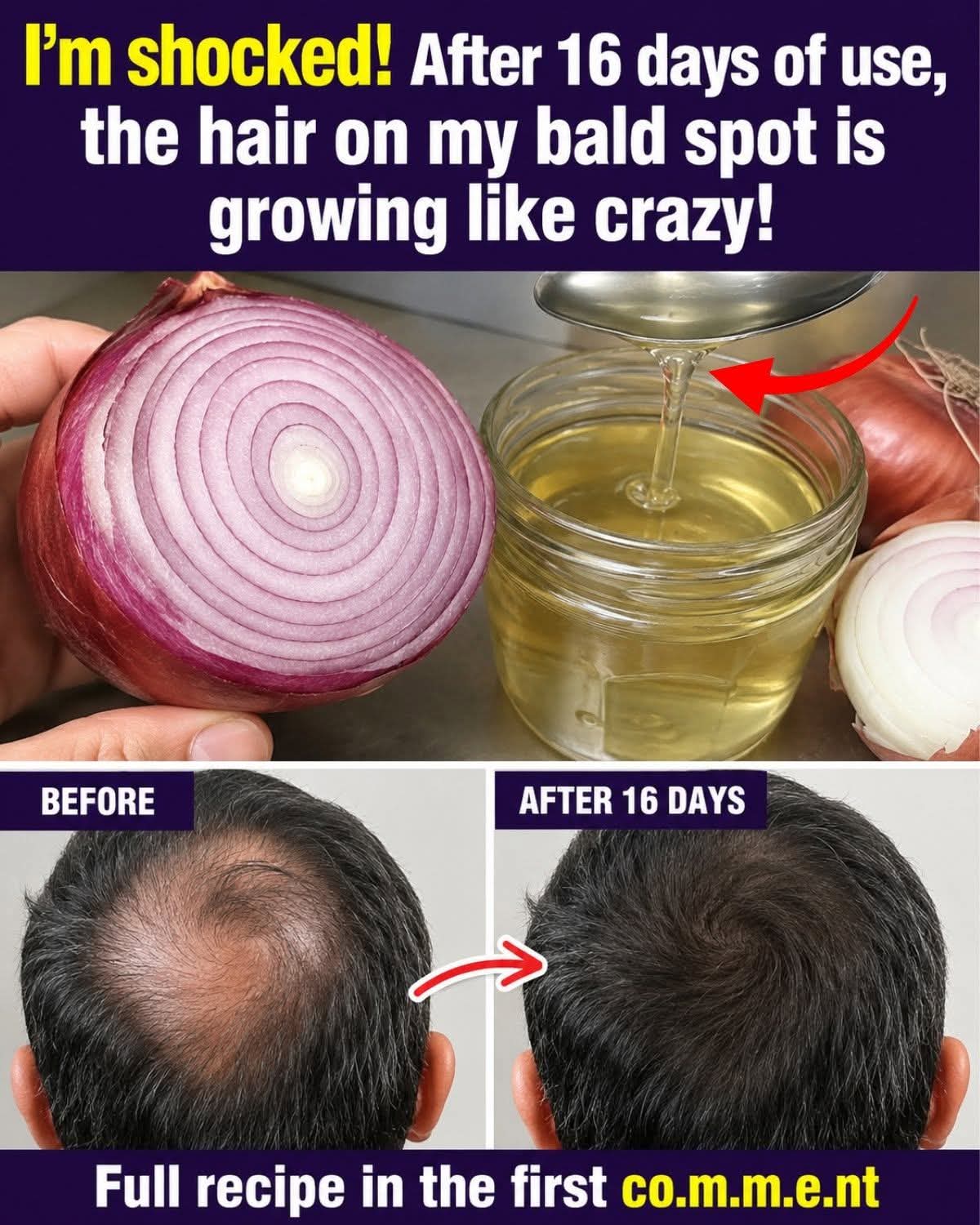
One viral claim shows a red onion, a jar of pale-colored liquid, and dramatic “before and after” photographs of a bald spot. The headline promises astonishing results after only 16 days of use, suggesting that hair can suddenly begin “growing like crazy.”
The image is certainly attention-grabbing—but it is important to separate an appealing internet claim from what is actually known about hair biology.
Onion juice has been discussed for years as a traditional hair-care remedy. There is some limited scientific interest in onion preparations, particularly in relation to certain forms of patchy hair loss. However, there is not enough high-quality evidence to conclude that rubbing onion juice or an onion-and-oil mixture on the scalp will regrow a completely bald area in 16 days.
That distinction matters.
Hair growth is a biological process that normally takes much longer than a couple of weeks. Hair follicles move through growth, resting, and shedding phases, and different causes of hair loss require very different approaches. The NHS notes that hair loss can have many causes, including inherited pattern baldness, illness, stress, weight loss, and nutritional deficiencies.
So, could onion juice have a role in a healthy scalp-care routine? Possibly. Can it be described as a guaranteed cure for baldness? No.
This article explores the viral onion remedy, what it contains, how people traditionally prepare it, what science does and does not tell us, potential risks, and when persistent hair loss deserves professional evaluation.
What Is the Viral Onion Hair-Growth Remedy?
The image accompanying this article appears to promote an onion-based topical preparation. The most prominent ingredient is a red onion, while a liquid is shown being poured into a small glass jar.
Recipes circulating online vary considerably. Some involve:
- Fresh red onion
- Onion juice
- Olive oil
- Coconut oil
- Castor oil
- Other carrier oils
- Occasionally honey or other household ingredients
There is no single standardized “onion hair-growth recipe.”
This is important because a homemade mixture cannot automatically be assumed to have the same composition, concentration, purity, or safety profile as a preparation evaluated in a clinical study.
The simplest version is usually onion juice applied directly to the scalp. Another version involves combining onion juice with a carrier oil.
The purpose is generally to expose the scalp to compounds naturally present in onions while reducing the harshness of the raw juice with an oil.
However, adding more ingredients does not necessarily make a remedy more effective.
Why Do People Believe Onion Can Help Hair Growth?
Onions contain numerous naturally occurring compounds, including sulfur-containing substances and antioxidant compounds such as quercetin.
Onions are certainly nutritious foods, and research has investigated various potential health effects associated with their compounds.
The reasoning behind onion juice for hair is often based on several ideas:
- Sulfur is associated with keratin, the protein that makes up much of the hair shaft.
- Certain onion compounds have antioxidant activity.
- Onion preparations may have antimicrobial properties.
- Massage of the scalp may temporarily increase circulation.
- Some people believe onion juice can stimulate dormant follicles.
These ideas sound plausible, but plausibility is not the same as proof.
A substance can contain an interesting biological compound without necessarily producing a clinically meaningful result when applied to the scalp.
Can Onion Juice Really Regrow Hair in 16 Days?
This is the most important question raised by the viral image.
The short answer is: there is no reliable evidence that onion juice can consistently transform a bald spot into dense hair in only 16 days.
Hair follicles operate according to biological cycles. A visible change in hair density generally requires time.
The NHS explains that individual hairs spend years in a growing phase before entering a resting phase and eventually shedding.
Therefore, a dramatic transformation within 16 days should be viewed skeptically.
There are several possible explanations for apparent “before and after” changes:
- Different lighting
Hair can appear dramatically thicker under different lighting conditions.
Bright overhead lighting can make the scalp more visible, while softer lighting can make the same hair appear much denser.
- Different camera angles
A photograph taken from directly above can reveal thinning more clearly than a photograph taken from a lower angle.
- Hair styling
Hair direction, brushing, wetness, oils, and styling products can substantially change the appearance of the scalp.
- Hair length
Even a small difference in hair length can make a thinning area appear more or less noticeable.
- Image editing
Social media before-and-after photographs are not always independently verified.
- Natural hair-cycle changes
Some forms of hair loss can improve spontaneously. Alopecia areata, for example, can sometimes show spontaneous regrowth. The American Academy of Dermatology describes alopecia areata as a condition that often begins with a round or oval smooth bald patch, and some people experience regrowth without treatment.
This means that if somebody uses onion juice while their hair is naturally beginning to regrow, they may incorrectly attribute the improvement entirely to the remedy.
Understanding the Different Types of Hair Loss
Before trying any home remedy, it is useful to understand that “hair loss” is not one single condition.
Male Pattern Hair Loss
Male pattern hair loss, also called androgenetic alopecia, is strongly influenced by genetics and hormones.
It commonly begins around the temples, hairline, or crown and may gradually progress.
A homemade onion treatment should not be presented as a replacement for established treatments for this condition.
Minoxidil, for example, is one of the recognized treatments used for pattern hair loss. NHS information states that topical minoxidil can be effective for male and female pattern hair loss, although it does not work for everyone and requires ongoing use.
Female Pattern Hair Loss
Women can also develop genetically influenced pattern hair loss.
It often appears as gradual thinning over the top of the scalp rather than a completely bald patch.
Hormonal changes, genetics, age, medical conditions, and nutritional problems may all play roles.
Alopecia Areata
Alopecia areata is different.
It is an autoimmune condition that can cause sudden, smooth, round or oval patches of hair loss.
Because alopecia areata involves the immune system, treating it as though it were simply “poor circulation” or a dry scalp can delay appropriate treatment.
Modern medical treatments are available for some forms of alopecia areata, including treatments that target immune pathways.
Telogen Effluvium
Telogen effluvium is another form of hair shedding.
It can occur after significant stress, illness, surgery, major weight loss, dietary changes, hormonal changes, or nutritional deficiencies.
In many cases, the underlying trigger needs to be addressed rather than simply applying a product to the scalp.
Scarring Hair Loss
Some forms of hair loss involve permanent damage to the follicle.
This is particularly important because once a follicle is destroyed and replaced by scar tissue, a simple home remedy cannot be expected to recreate it.
This is one reason unexplained or rapidly progressing hair loss deserves professional attention.
A Simple Onion Scalp Preparation
If someone wants to experiment with onion as a cosmetic scalp treatment, the safest approach is to keep the recipe simple rather than combining numerous irritating substances.
Basic Onion Juice
Ingredients
- 1 small fresh onion
- Clean water, if needed
- A clean blender or grater
- Clean strainer or cheesecloth
- Small clean container
Method
- Wash and peel the onion.
- Cut it into small pieces.
- Blend or grate the onion.
- Strain the pulp through clean cheesecloth or a fine strainer.
- Collect a small amount of the juice.
- Apply a small quantity to a limited area of scalp.
- Leave it on for a short period if tolerated.
- Wash the scalp thoroughly with a gentle shampoo.
Do not assume that leaving onion juice on the scalp overnight will produce better results.
More exposure does not necessarily mean more benefit, and prolonged exposure may increase irritation.
Onion and Carrier Oil
Some people prefer mixing onion juice with a carrier oil.
A basic cosmetic mixture could contain:
- 1 tablespoon fresh onion juice
- 1 tablespoon coconut or olive oil
Mix thoroughly and apply a small amount to the scalp.
However, there is no established clinical evidence showing that combining onion juice with oil makes hair regrowth faster.
The carrier oil may simply make the preparation easier to spread and can reduce the direct concentration of onion juice on the skin.
How to Perform a Patch Test
Never assume that a natural ingredient is automatically safe for everyone.
Before applying onion juice to a large area of the scalp, perform a small patch test.
Apply a tiny amount to a small area of skin and observe it.
Stop if you experience:
- Burning
- Significant redness
- Swelling
- Severe itching
- Rash
- Blistering
- Pain
If a serious skin reaction occurs, seek medical advice.
People with sensitive skin, eczema, psoriasis, scalp inflammation, open wounds, or known allergies should be especially cautious.
Why Onion Juice May Irritate the Scalp
Fresh onions contain compounds that can irritate tissues.
Anyone who has chopped onions knows that they can cause the eyes to water and burn.
The scalp may also react to concentrated onion juice.
Possible problems include:
- Burning sensation
- Redness
- Itching
- Dryness
- Irritation
- Contact dermatitis
A damaged or irritated scalp is not necessarily a healthier scalp.
Therefore, “stronger” onion juice is not automatically better.
What About the Smell?
This is one of the biggest practical disadvantages.
Fresh onion juice has a strong odor that can remain in the hair even after washing.
Some people attempt to mask the smell with essential oils, lemon juice, perfumes, or other ingredients.
That can create another problem: adding multiple substances increases the chance of irritation.
If you use onion juice, thorough washing is generally preferable to creating a complicated homemade chemical mixture.
Could Scalp Massage Help?
Interestingly, the massage itself may be an overlooked part of many home hair remedies.
When someone applies onion juice, they often massage the scalp for several minutes.
The massage may:
- Help distribute the product
- Remove loose flakes
- Make the scalp feel refreshed
- Provide a relaxing routine
However, massage should not be confused with proven treatment for genetic baldness.
There is insufficient evidence to say that simply massaging the scalp can regenerate severely damaged follicles.
Nutrition and Hair Growth
Healthy hair also depends on overall nutrition.
Hair is made largely from keratin, a protein structure.
A balanced diet should provide adequate:
- Protein
- Iron
- Zinc
- Essential fatty acids
- Vitamins
- Minerals
- Overall calories
Severe nutritional deficiencies can contribute to hair shedding.
The NHS identifies iron deficiency and weight loss among possible contributors to temporary hair loss.
This does not mean that everyone with hair loss should immediately start taking supplements.
Taking excessive doses of vitamins or minerals can be harmful.
If hair loss is persistent, a healthcare professional can help determine whether a nutritional deficiency or another medical problem should be investigated.
Protein Matters More Than Most People Realize
Hair production requires amino acids.
Good dietary sources of protein include:
- Eggs
- Fish
- Chicken
- Lean meat
- Yogurt
- Milk
- Beans
- Lentils
- Chickpeas
- Nuts
- Seeds
- Soy products
A restrictive diet that does not provide enough protein may make it more difficult to maintain healthy hair.
However, eating extra protein beyond your body’s needs does not guarantee faster hair growth.
Balance is the key.
Sleep and Stress
Stress is another factor frequently overlooked.
Major physical or emotional stress can contribute to temporary hair shedding.
The important point is that stress-related hair loss may not appear immediately after the stressful event.
Some people notice increased shedding weeks or months later.
Instead of searching only for a topical treatment, it can be useful to consider the broader picture:
- Have you recently been ill?
- Have you lost a significant amount of weight?
- Have you experienced major stress?
- Have you changed your diet?
- Are you sleeping poorly?
- Have you started a new medication?
- Have you recently undergone surgery?
These questions may help identify the underlying cause.
Hair Care Habits That Can Reduce Damage
Even when a person has genetic hair loss, good hair-care practices can help protect existing hair.
Try to avoid unnecessary:
- Excessive heat
- Tight hairstyles
- Aggressive brushing
- Repeated chemical processing
- Harsh scalp products
- Pulling or twisting the hair
Be gentle when washing and drying.
Remember that preventing breakage is not the same as reversing follicle-related hair loss.
A broken hair shaft can look like thinning, but it is biologically different from a follicle that has stopped producing hair.
What Treatments Have Better Evidence?
For certain types of hair loss, medically recognized treatments have considerably more evidence than homemade onion preparations.
Minoxidil
Topical minoxidil is used for certain forms of pattern hair loss.
NHS guidance explains that minoxidil can promote longer hair growth phases and may increase the size and diameter of hair follicles.
However, it is not an instant solution.
Treatment generally requires consistent use, and results vary.
Some people can experience scalp irritation or unwanted hair growth outside the intended treatment area.
People should follow the instructions for the specific product and discuss treatment with a healthcare professional when appropriate.
Finasteride
Finasteride is another treatment used for male pattern hair loss.
It is not appropriate for everyone and has important safety considerations.
Women who are pregnant or may become pregnant should not handle crushed or broken finasteride tablets because of potential risk to a developing male fetus.
Because treatment decisions depend on the individual, professional advice is appropriate.
Treatments for Alopecia Areata
Alopecia areata is treated differently from ordinary pattern baldness.
Depending on severity and individual circumstances, dermatologists may consider corticosteroids, topical treatments, injections, or newer immune-targeting medications.
The American Academy of Dermatology notes that JAK inhibitors have expanded treatment options for moderate-to-severe alopecia areata.
Why the “16-Day Miracle” Claim Is Misleading
The wording used in viral posts is often designed to create urgency and excitement.
Phrases such as:
“I’m shocked!”
“After 16 days!”
“Growing like crazy!”
are emotionally powerful, but they are not scientific measurements.
A proper hair-growth study would normally need:
- A defined group of participants
- A clearly diagnosed type of hair loss
- A standardized preparation
- A comparison or control group
- Objective measurements
- Consistent photography
- A meaningful follow-up period
- Assessment of side effects
- Statistical analysis
A social media before-and-after image does not provide those things.
That does not automatically prove that onion juice is useless. It simply means that the image alone cannot establish that onion juice caused the dramatic change.
Can Onion Juice Be Part of a Hair-Care Routine?
For someone who is not allergic or sensitive to onions, a carefully prepared onion treatment may be considered a cosmetic experiment.
But expectations should remain realistic.
Think of it as a home scalp-care practice rather than a medically proven cure for baldness.
The goal should not be:
“Use this for 16 days and your bald spot will disappear.”
A more responsible expectation is:
“Some people use onion preparations as a traditional scalp treatment, but evidence is limited, and results are not guaranteed.”
That difference protects readers from false promises.
When Should You See a Doctor?
You should consider medical evaluation when hair loss is:
- Sudden
- Rapid
- Severe
- Associated with pain
- Associated with inflammation
- Associated with scaling
- Associated with scarring
- Appearing in clearly defined bald patches
- Affecting eyebrows or eyelashes
- Accompanied by other unexplained symptoms
- Causing significant emotional distress
The NHS advises people who are concerned about hair loss to seek medical advice to identify the cause before pursuing commercial hair clinics.
A dermatologist can examine the scalp and determine whether the pattern suggests androgenetic alopecia, alopecia areata, infection, nutritional problems, inflammation, or another condition.
The Bottom Line on Onion Juice
Onion is an inexpensive household ingredient, and it contains biologically interesting compounds.
But the viral claim that an onion-based mixture will reliably regrow a bald spot in 16 days is not supported by strong evidence.
Some forms of patchy hair loss may naturally regrow. Some conditions respond well to medical treatment. And changes in lighting, hairstyle, camera angle, and hair length can make before-and-after photographs appear much more dramatic than the underlying biological change.
If you enjoy natural hair-care remedies and your scalp tolerates onion juice, you may choose to experiment cautiously.
Just do not allow a viral photograph to replace an accurate diagnosis.
A Practical 30-Day Hair-Health Routine
Instead of focusing entirely on one miracle ingredient, consider a broader routine.
Week 1: Observe
Take clear photographs of your scalp under the same lighting.
Do not manipulate the hair to hide or exaggerate thinning.
Record:
- Hairline
- Crown
- Temples
- Part line
- Any bald patches
Week 2: Improve Hair Care
Use gentle shampooing.
Reduce unnecessary heat.
Avoid extremely tight hairstyles.
Do not scratch or aggressively massage an irritated scalp.
Week 3: Review Nutrition
Make sure meals contain adequate protein and a variety of nutrient-rich foods.
Avoid extreme dieting.
If you suspect a deficiency, discuss appropriate testing with a healthcare professional rather than taking large doses of supplements without guidance.
Week 4: Evaluate
Compare photographs taken under similar conditions.
Do not expect dramatic biological transformation in a few weeks.
If hair loss continues or worsens, consider professional evaluation.
Frequently Asked Questions
Does onion juice permanently cure baldness?
No. There is no strong evidence that onion juice permanently cures genetic baldness.
Can onion juice grow hair in 16 days?
A dramatic, reliable regrowth of a bald area in 16 days has not been established by strong clinical evidence.
Can I use onion juice every day?
Daily use may increase scalp irritation. There is no established evidence that daily application produces superior results.
Is red onion better than white onion?
There is no strong clinical evidence showing that red onions are superior to white onions for hair regrowth.
Can I leave onion juice overnight?
Leaving it on overnight is not necessary to establish effectiveness and may increase irritation. If you experience burning or redness, wash it off.
Can onion juice stop male pattern baldness?
It should not be considered a proven treatment for male pattern baldness. Established medical options such as minoxidil may be appropriate for some people.
Why did someone’s hair grow back after using onion?
Hair may regrow naturally, particularly in some forms of patchy hair loss. Alopecia areata, for example, can involve spontaneous regrowth.
Is natural always safer?
No. Natural substances can irritate the skin or cause allergic reactions.
Final Thoughts
The viral onion-and-oil hair-growth image is a perfect example of why before-and-after photographs should be viewed carefully.
Onion juice is inexpensive, easy to prepare, and has a long history in home remedies. Its natural compounds make it an interesting subject for research, but interesting chemistry does not automatically translate into dramatic clinical results.
Most importantly, hair loss is a symptom rather than a single disease.
A receding hairline, thinning crown, sudden round bald patch, widespread shedding, and scalp scarring can all have different causes. Treating every type of hair loss with the same homemade recipe can waste time and potentially delay effective treatment.
If you want to try onion juice, approach it as a cautious cosmetic experiment rather than a guaranteed cure. Perform a patch test, avoid irritated or damaged skin, stop if significant irritation develops, and do not expect a miracle in 16 days.
For persistent, sudden, or unexplained hair loss, the smartest first step is to identify the cause.
Healthy hair is built over time—not through overnight miracles.
And that is the most important lesson behind the viral claim: a dramatic photograph can inspire curiosity, but good hair-care decisions should be based on realistic expectations, evidence, safety, and an understanding of what is actually causing the hair loss.