The Ultimate Guide to Perfect Golden French Toast with Fresh Strawberries
There is something undeniably magical about a slow weekend morning. The sun is streaming through the kitchen windows, the coffee is brewing, and the unmistakable, intoxicating aroma of butter, cinnamon, and vanilla begins to waft through the house. When it comes to the pantheon of breakfast and brunch royalty, few dishes command as much respect, nostalgia, and pure unadulterated joy as classic French toast.
Today, we are diving deep into the ultimate recipe for perfectly golden, crisp-on-the-outside, custard-like-on-the-inside French toast, crowned with the vibrant, sweet-tart perfection of fresh strawberries. This isn’t just a quick recipe; this is a comprehensive masterclass. We will explore the fascinating history of the dish, the exact culinary science behind the perfect custard dip, how to select the absolute best ingredients, and foolproof techniques to ensure you never serve a soggy or burnt slice again. Whether you are hosting a grand holiday brunch, treating your family on a Sunday, or simply indulging in a well-deserved solo breakfast, this guide will elevate your French toast game to professional restaurant heights.
The Fascinating History of “Lost Bread”
Before we heat our skillets and whisk our eggs, it is worth understanding the rich, centuries-old history of this beloved dish. Despite its modern name, French toast did not necessarily originate in France.
Ancient Roman Origins
The earliest known reference to a dish resembling what we now call French toast dates back to the Roman Empire. In a collection of recipes compiled around the 4th or 5th century AD, attributed to Apicius, there is a recipe for Aliter Dulcia (another sweet dish). The instructions were remarkably similar to our modern methods: slice fine white bread, remove the crust, break it into large pieces, soak it in milk and beaten eggs, fry it in oil, and cover it in honey before serving.
The Medieval Solution to Food Waste
Throughout the Middle Ages in Europe, this culinary technique gained widespread popularity out of sheer necessity. In an era where food was precious and baking bread was a labor-intensive, time-consuming process, throwing away stale, hardened bread was simply not an option. Cooks across the continent realized that by reviving rock-hard, day-old (or week-old) bread in a mixture of eggs and milk, then frying it, they could create a delicious, calorie-dense meal.
This practice of rescuing stale bread gave birth to the traditional French name for the dish: pain perdu, which literally translates to “lost bread.” The bread was “lost” to staleness, but rescued by the rich custard and the heat of the pan.
A Global Phenomenon
As time passed, the dish evolved and took on new names and variations across the globe. In the United Kingdom, it is often called “eggy bread” and is sometimes served savory with ketchup or baked beans. In Spain, torrijas are traditionally prepared during Lent and Holy Week, often soaked in wine or honey-infused milk before being coated in egg and fried in olive oil. In Hong Kong, French toast is a beloved cha chaan teng (teahouse) staple, usually made with multiple slices of bread spread with peanut butter or fruit jam, deep-fried to a golden crisp, and served with a generous pat of butter and golden syrup.
Understanding this history reminds us of the core philosophy of French toast: transformation. It is the culinary alchemy of taking simple, humble, even past-their-prime ingredients and turning them into something extraordinary.
The Science of the Perfect French Toast
To achieve French toast nirvana—where the exterior boasts a deeply caramelized, slightly crunchy crust, and the interior is soft, rich, and pudding-like without being wet or soggy—we must understand the science of the custard.
The Custard Ratio
The liquid mixture used to soak the bread is, technically speaking, a custard base. The standard, golden ratio for French toast custard is one large egg for every 1/4 cup of dairy.
If you use too many eggs, the proteins will coagulate on the surface of the bread too quickly in the pan, resulting in a tough, rubbery exterior that tastes strongly of scrambled eggs—a common flaw in diner French toast. If you use too much milk, the mixture lacks the necessary protein structure to bind and cook firmly, leaving you with bread that collapses into a soggy, wet mush that refuses to crisp up.
The Role of Fat
Fat is flavor, but in French toast, fat is also texture. The fat content in your dairy directly impacts the richness of the final product. Using skim milk or water will result in a thin, lackluster interior. Whole milk provides a great baseline of flavor and texture. However, replacing a portion of the whole milk with heavy cream or half-and-half introduces additional butterfat. This fat coats the starches in the bread and tenderizes the protein in the eggs, leading to a much more luxurious, melt-in-your-mouth interior.
The Maillard Reaction
That beautiful, golden-brown crust you strive for is the result of the Maillard reaction. This is a complex chemical reaction between amino acids (from the proteins in the eggs and milk) and reducing sugars (from the bread, the milk lactose, and any added sugar) that occurs when exposed to high heat. This reaction not only changes the color of the food but produces hundreds of different flavor compounds, creating that distinct, savory-sweet, toasted flavor profile. To achieve a proper Maillard reaction, the surface of the bread needs to reach temperatures above 285°F (140°C), which requires a properly preheated pan and a cooking fat that can handle the heat.
The Ultimate Ingredient Deep Dive
A recipe with so few components relies entirely on the quality and specific characteristics of those ingredients. Let us break down every single element you need to create the perfect plate of French toast with fresh strawberries.
1. The Bread: The Foundation of Flavor and Texture
You cannot build a sturdy house on a weak foundation, and you cannot make excellent French toast with flimsy, ultra-processed sandwich bread. The ideal bread must be sturdy enough to absorb the custard without disintegrating, yet porous enough to allow the liquid to penetrate deeply.
Brioche: This is the undisputed champion of French toast. Brioche is a French pastry bread enriched heavily with butter and eggs. It has a tight but incredibly soft crumb. Because it already contains the very ingredients in the custard, the flavors meld seamlessly. It yields the most decadent, dessert-like French toast imaginable.
Challah: A traditional Jewish braided egg bread, Challah is similar to brioche but is typically made with oil instead of butter, giving it a slightly different texture and flavor profile. It is incredibly sturdy, absorbs custard beautifully, and holds its shape flawlessly in the pan.
French Baguette: For a chewier, more rustic texture with a higher crust-to-crumb ratio, slicing a baguette on a sharp bias (to maximize surface area) is a wonderful option, particularly if you prefer a less sweet, more substantial bite.
Texas Toast: If you are at a standard grocery store and cannot find artisanal loaves, look for Texas Toast. These are simply extra-thick slices of standard white bread. The thickness is key here, as it prevents the bread from instantly turning to mush when dipped.
The Golden Rule of Bread: It must be stale. Fresh bread contains too much moisture. When you dip fresh bread into liquid, it turns into a sponge that lacks structural integrity. Stale bread has lost a significant amount of its internal moisture, allowing it to act like a dry sponge, eagerly soaking up the flavorful custard without falling apart.
Pro Tip: If you only have fresh bread, slice it the night before and leave it out on a wire rack overnight to dry out. In a rush? Place the slices in a 275°F (135°C) oven for 10-15 minutes until they feel dry to the touch, but not browned.
2. The Dairy
As discussed in the science section, whole milk should be your minimum standard. For this ultimate recipe, we will use a combination of whole milk and heavy cream. The cream adds an unmatched velvetiness to the interior of the toast. If you are looking for a slightly tangy contrast to the sweetness, you can experiment with replacing a small amount of the milk with buttermilk.
3. The Eggs
Use large, fresh, free-range eggs if possible. The yolks of high-quality eggs are richer and have a deeper orange color, which will translate to a more beautiful golden hue on your finished dish. Ensure your eggs are at room temperature before whisking to help them blend more smoothly with the dairy.
4. The Flavor Enhancers
The custard is a blank canvas waiting to be painted with aromatics and spices.
Vanilla Extract: Always use pure vanilla extract, never imitation. The complex, floral notes of real vanilla are essential for that classic French toast aroma. You can even use vanilla bean paste for those beautiful little black specks of flavor.
Ground Cinnamon: The classic warming spice. It adds depth and a comforting, autumnal flavor.
Ground Nutmeg: Just a tiny pinch of freshly grated nutmeg goes a long way. It enhances the richness of the dairy and adds a subtle, mysterious background note.
Sugar: A small amount of granulated or brown sugar in the custard helps with caramelization in the pan, ensuring a crisp crust.
Salt: Never skip the salt! A pinch of fine sea salt enhances all the other flavors and balances the sweetness.
5. The Cooking Fat
How you fry your French toast is just as important as how you soak it.
Butter: The classic choice for flavor. However, whole butter contains milk solids that have a low smoke point and will burn quickly over medium heat, leaving bitter black specks on your beautiful toast.
Neutral Oil (Canola or Vegetable): Has a high smoke point and won’t burn, but adds absolutely zero flavor.
The Best Compromise: Use a combination of both. Swirling a tablespoon of butter and a tablespoon of oil into the pan gives you the rich flavor of the butter, while the oil raises the overall smoke point of the fat mixture, preventing burning.
The Ultimate Choice: Clarified butter or Ghee. This is butter that has had the milk solids and water removed. It has the pure, intense flavor of butter but a smoke point as high as vegetable oil. It is perfect for frying French toast.
6. The Star Garnish: Fresh Strawberries
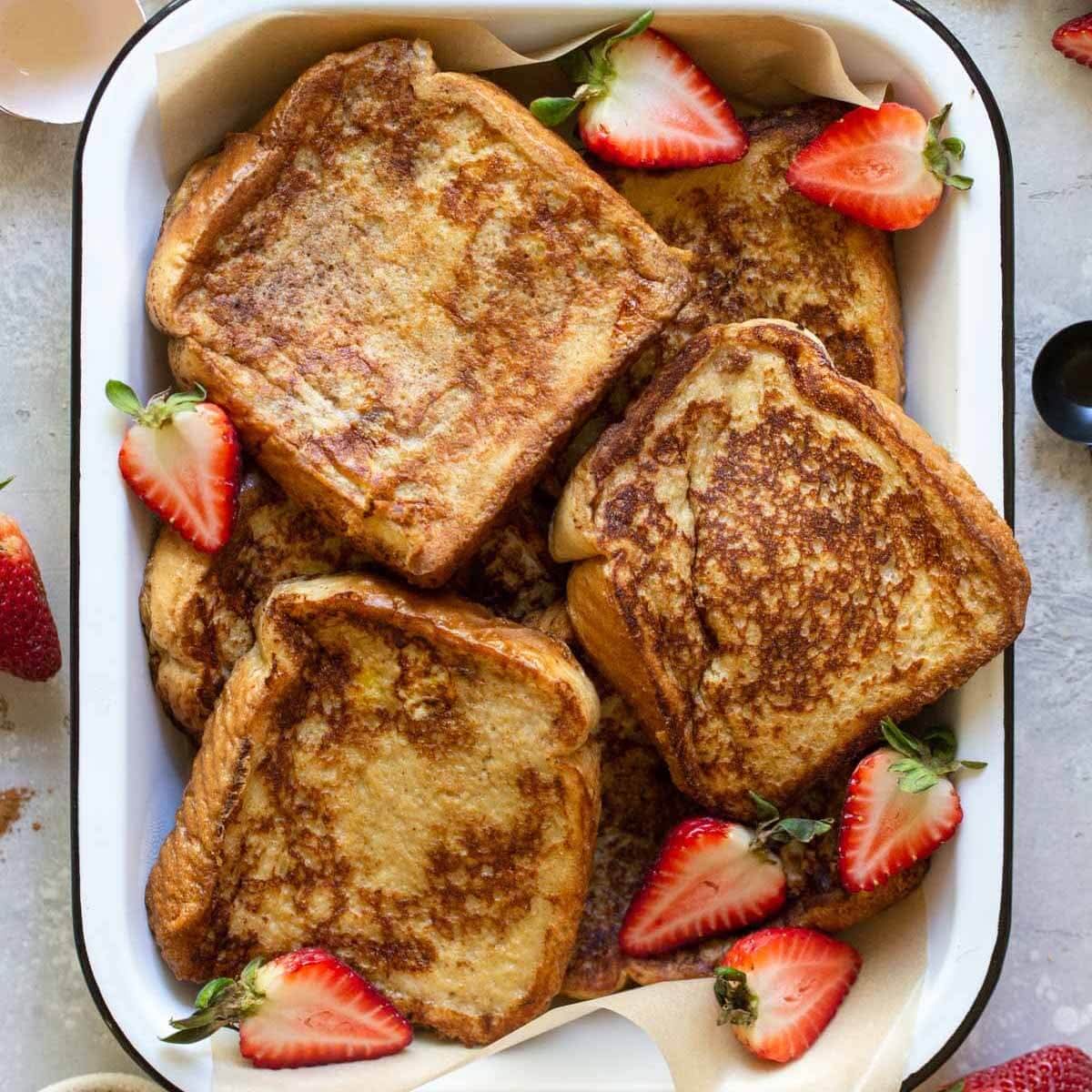
The image inspiring this recipe features glorious, vibrant fresh strawberries scattered among the thick slices of golden toast. Strawberries provide the perfect acidic, juicy counterpoint to the rich, heavy, sweet and buttery toast.
Selection: Look for berries that are bright red all the way to the stem, plump, and highly aromatic. If you can smell them strongly in the grocery store, they will taste amazing.
Preparation: Wash them gently only right before you plan to use them. Hull them (remove the green leafy top and the pale inner core) and slice them in half or into thick slices.
Maceration (Optional but recommended): If your strawberries are not perfectly ripe or sweet, you can macerate them. Simply toss the sliced berries in a bowl with a tablespoon of granulated sugar and a squeeze of fresh lemon juice. Let them sit for 15-30 minutes. The sugar will draw out the natural juices of the berries, creating a beautiful, natural strawberry syrup that is incredible spooned over the finished dish.
Essential Equipment Guide
You don’t need a professional kitchen to make perfect French toast, but having the right tools makes the process seamless and enjoyable.
A Large Skillet or Griddle: A well-seasoned cast-iron skillet, a heavy-bottomed stainless steel pan, or a high-quality non-stick griddle are ideal. You want a heavy pan that retains and distributes heat evenly to prevent hot spots that can burn the bread. A large griddle is fantastic if you are cooking for a crowd, as you can flip multiple slices at once.
A Shallow, Wide Dish: You need a vessel wide enough to accommodate a slice or two of bread lying completely flat. A pie dish, a shallow casserole dish, or even a rimmed baking sheet works perfectly. Do not use a deep mixing bowl, as you will have to cram the bread in, risking tearing it.
A Good Whisk: Crucial for thoroughly combining the eggs, milk, and spices until completely smooth.
A Wide Spatula: A fish spatula or a wide silicone turner allows you to confidently slide under the heavy, soaked bread and flip it in one clean motion without tearing.
A Wire Cooling Rack: This is the secret weapon for making large batches. Place a wire rack over a baking sheet and keep it in a warm oven (200°F/90°C). As slices finish cooking, transfer them to the rack. The air circulation prevents the bottoms from getting soggy while you finish the rest of the batch.
Step-by-Step Preparation Walkthrough
Now that we have the knowledge and the ingredients, let us walk through the method. French toast is a dish of rhythm and timing. Once the cooking starts, it moves quickly.
Step 1: Prepare the Custard
In a medium mixing bowl, vigorously whisk together the eggs until the yolks and whites are completely combined and there are no streaks of albumen (the clear part of the egg) remaining. This is crucial—unmixed egg whites will cook onto the outside of the bread like an unappealing fried egg.
Once the eggs are smooth, whisk in the milk, heavy cream, granulated sugar, vanilla extract, cinnamon, nutmeg, and a pinch of salt. Whisk until the sugar has dissolved and the spices are evenly distributed.
Note on spices: Cinnamon is hydrophobic, meaning it repels water. It will naturally want to float to the top of your custard. You will need to give the mixture a quick whisking right before dipping every single piece of bread to ensure an even coating of spices.
Step 2: Set Up the Breading Station
Pour your beautifully mixed custard into your wide, shallow dish. Place your sliced, slightly stale bread right next to the dish. Have your skillet or griddle on the stove, and your butter/oil ready. Have your serving platter or wire rack in the oven ready to receive the cooked pieces. Organization (mise en place) is the secret to stress-free cooking.
Step 3: Preheat the Pan
Place your skillet over medium-low to medium heat. You want the pan hot enough to immediately begin cooking the egg and creating a crust, but low enough that the heat can penetrate all the way to the center of the thick bread before the outside burns. This usually takes 3-5 minutes of preheating.
Add a tablespoon of butter and a tablespoon of oil (or two tablespoons of clarified butter) to the pan. Let it melt and begin to foam slightly. Swirl it around so the bottom of the pan is evenly coated.
Step 4: The Dip
Working with one or two slices at a time (depending on the size of your pan), place the bread into the custard.
How long to dip? This is the million-dollar question and depends entirely on your bread.
Standard white bread or Texas toast: 3 to 5 seconds per side.
Dense brioche or Challah: 10 to 15 seconds per side.
Very dry, crusty baguette: Up to 30 seconds per side.
You want the bread to feel heavy and saturated, but you do not want it falling apart in your hands. Lift the bread out of the custard with your fingers or a slotted spatula, and let the excess liquid drip off back into the dish for a few seconds.
Step 5: The Cook
Gently lay the soaked bread into the hot, buttered skillet. You should hear a satisfying sizzle immediately. If it does not sizzle, your pan is too cold. If it aggressively pops and smokes, your pan is too hot.
Cook undisturbed for 3 to 4 minutes on the first side. Resist the urge to press down on the bread with your spatula; doing so will squeeze out the beautiful custard and compress the fluffy texture.
Carefully lift one corner to check the color. It should be a deep, rich, golden brown. Once perfectly colored, slide your wide spatula firmly underneath and flip it in one quick motion. Cook for an additional 2 to 3 minutes on the second side until equally golden and the center feels springy to the touch.
Step 6: Keep Warm and Repeat
Transfer the finished slices to the wire rack in your preheated warm oven. Wipe out the skillet with a paper towel if the butter has browned too much or if there are burnt spices left behind. Add fresh butter and oil, re-whisk your custard, dip the next slices, and repeat the process until all the bread is cooked.
Step 7: Garnish and Serve
Remove the mountain of glorious French toast from the oven. Arrange them beautifully on a large serving platter or individual plates, slightly overlapping. Scatter your fresh (or macerated) strawberry halves generously over the top and around the sides. Dust the entire plate lightly with powdered sugar (confectioners’ sugar) using a fine-mesh sieve for that professional, snow-dusted finish. Serve immediately with warmed pure maple syrup on the side.
Troubleshooting Common French Toast Mistakes
Even experienced cooks can occasionally run into trouble. Here are the most common pitfalls and how to avoid them.
The Problem: The outside is burnt, but the inside is raw and soggy.
The Cause: Your pan is too hot, or your bread is sliced too thick.
The Solution: Lower the heat to medium-low. French toast requires gentle, consistent heat to cook the dense custard all the way through before the sugars on the outside scorch. If using very thick slices (over 1.5 inches), you may need to brown them quickly on the stove and finish them in a 350°F (175°C) oven for 10 minutes to cook the center.
The Problem: The bread completely falls apart in the custard.
The Cause: Your bread is too fresh and soft, or you soaked it for too long.
The Solution: Ensure you are using slightly stale, sturdy bread. Reduce your dipping time to just a quick dunk on each side.
The Problem: It tastes like scrambled eggs on toast.
The Cause: Your custard ratio has too much egg, or you didn’t whisk the eggs thoroughly enough.
The Solution: Stick strictly to the ratio of 1 egg per 1/4 cup of dairy. Spend an extra minute whisking the eggs before adding the milk to ensure the yolks and whites are perfectly homogenous.
The Problem: The toast is flat and lacks richness.
The Cause: Using thin, cheap bread, skipping the heavy cream, or not using enough butter in the pan.
The Solution: Upgrade to thick-sliced Brioche or Challah. Ensure you have adequate fat in both your custard and your frying pan. Fat provides the lift and the luxurious mouthfeel.
Exciting Variations and Customizations
Once you have mastered this foundational recipe, the variations are truly limitless. French toast is incredibly adaptable.
Stuffed French Toast: Before dipping, take two thinner slices of bread and spread a thick layer of softened cream cheese mixed with powdered sugar and finely diced strawberries between them. Pinch the edges slightly, dip the entire sandwich in the custard, and fry.
Coconut Crusted: After dipping the bread in the custard, press it gently into a plate of sweetened, shredded coconut flakes before frying. This adds a tremendous crunch and a tropical flavor profile.
Savory Herb and Cheese: Omit the sugar, vanilla, and sweet spices from the custard. Instead, whisk in finely chopped fresh herbs (chives, parsley, thyme), cracked black pepper, and a handful of finely grated Parmesan cheese. Serve topped with a fried egg and sliced avocado.
Overnight Baked French Toast Casserole: If cooking individual slices on the stove is too tedious for a large brunch party, assemble everything the night before. Layer the stale bread in a buttered 9×13 inch baking dish. Pour the custard over the top, cover tightly, and refrigerate overnight. The next morning, bake at 350°F (175°C) for 45-55 minutes until puffed and golden.
Dietary Adaptations
You do not have to miss out on the joy of French toast if you have dietary restrictions. With a few smart substitutions, you can easily adapt this master recipe.
Dairy-Free: Replace the whole milk and heavy cream with an equal amount of full-fat canned coconut milk, oat milk, or unsweetened almond milk. Substitute the butter in the pan with coconut oil or a high-quality vegan butter block.
Gluten-Free: The bread is the only source of gluten here. Simply swap the standard bread for a high-quality, sturdy gluten-free loaf. Look for one that has a dense crumb, and be sure to let it go slightly stale, as gluten-free bread can be quite delicate.
Vegan: Replacing the eggs is the biggest challenge in vegan French toast. A popular and effective method is using flax eggs (ground flaxseed mixed with water) or chickpea flour mixed with a plant-based milk to mimic the binding and protein properties of regular eggs. Add a pinch of nutritional yeast for a slightly savory depth, and black salt (kala namak) if you want an eggy flavor.
What to Serve with Classic French Toast
While this dish, topped with fresh strawberries, is a masterpiece on its own, building a complete breakfast spread around it elevates the entire experience.
The Syrups: Pure maple syrup is the gold standard. Do not use artificially flavored pancake syrups; they are too cloyingly sweet and lack depth. Warm the pure maple syrup slightly in the microwave or on the stove before serving—pouring cold syrup over hot food is a culinary sin.
Compound Butters: Take a stick of softened butter and mash it with a little powdered sugar, a splash of vanilla, and a dash of cinnamon. Place a scoop of this cinnamon-honey butter on the hot toast right before serving.
Whipped Cream: For a truly decadent, dessert-for-breakfast vibe, serve alongside a bowl of softly whipped heavy cream flavored with a touch of vanilla bean paste.
Savory Sides: Because French toast is inherently sweet and rich, serving it with something salty and savory provides perfect palate balance. Thick-cut, smoky applewood bacon, savory breakfast sausage patties, or a simple side of softly scrambled eggs are classic pairings.
Storing, Freezing, and Reheating
If you find yourself with leftover French toast, do not throw it away! It stores and reheats beautifully, making it an excellent candidate for breakfast meal prep.
To Store in the Fridge: Let the cooked slices cool completely to room temperature. Transfer them to an airtight container or a large zip-top bag, placing a small square of parchment paper between the slices to prevent sticking. They will keep in the refrigerator for up to 3 days.
To Freeze: Freezing is the best way to preserve French toast for a quick weekday breakfast. Let the slices cool completely. Place them in a single layer on a baking sheet lined with parchment paper and freeze for 1-2 hours until solid (this is called flash freezing). Once completely frozen, transfer the slices to a heavy-duty freezer bag, squeezing out as much air as possible. They will keep for up to 2 months.
To Reheat:
The Toaster Method (Best for single servings): Pop the refrigerated or frozen slices directly into a standard slot toaster. Toast on a medium setting until warmed through and the exterior is re-crisped. This is the fastest and most effective method.
The Oven Method (Best for large batches): Preheat the oven to 375°F (190°C). Place the slices in a single layer on a wire rack set over a baking sheet. Bake for 5-8 minutes (if from the fridge) or 10-15 minutes (if from frozen) until hot and crispy.
Avoid the Microwave: While it will heat the food quickly, the microwave will steam the bread, turning your carefully crafted crispy exterior into a soft, rubbery mess. Avoid microwaving French toast at all costs.
Frequently Asked Questions (FAQ)
To ensure absolutely nothing stands between you and breakfast perfection, here are the most frequently asked questions regarding the art of making French toast.
Q: Can I use fresh bread if I don’t have time to dry it out? A: You can, but you must be incredibly careful. Fresh bread will absorb liquid instantly and turn to mush. If you must use fresh bread, cut it into thicker slices (at least 1 inch thick) and literally just tap the bread against the surface of the custard rather than submerging it. It won’t be as rich inside, but it will save the dish from disintegrating.
Q: Why does my French toast always burn on the outside? A: There are usually three culprits for burnt toast:
The heat is too high. Remember, medium-low to medium is best.
You are using only butter, which has a low smoke point. Try mixing butter with a neutral oil.
There is too much sugar in your custard. Sugar burns extremely fast in a hot pan. Stick to the recipe measurements.
Q: Can I make the custard mixture the night before? A: Absolutely! Making the custard mixture ahead of time and storing it in a sealed container in the refrigerator actually allows the flavors of the vanilla and spices to meld beautifully. Just be sure to give it a very vigorous whisk before dipping your bread the next morning, as the spices will have settled to the bottom.
Q: Do I really need to use heavy cream? A: No, you do not have to use heavy cream, but it is highly recommended. The extra fat content transforms the interior of the toast into a rich, velvety custard. If you only have milk, the recipe will still work perfectly well, but it won’t have that “luxury hotel brunch” mouthfeel.
Q: Can I use frozen strawberries? A: For garnishing as pictured in this classic presentation, no. Thawed frozen strawberries release massive amounts of liquid and become very mushy, which will ruin the texture of the crisp toast and look unappealing. However, you can easily simmer frozen strawberries in a small saucepan with a little sugar and a splash of water to create a delicious, warm strawberry compote to pour over the top!
Q: Is it safe to feed French toast to young toddlers? A: Yes, generally, as long as it is cooked thoroughly. Ensure the center of the toast reaches an internal temperature of 160°F (71°C) to ensure the eggs are fully cooked and safe for young children. You may also want to omit the added salt and sugar in the custard if preparing specifically for infants or toddlers.
The Ultimate Classic French Toast with Fresh Strawberries Recipe
Here is the finalized, distilled, step-by-step master recipe.
Prep time: 15 minutes
Cook time: 15 minutes
Total time: 30 minutes
Yields: 4 generous servings (about 8 thick slices)
Cuisine: French/American Breakfast
Category: Breakfast & Brunch
The Ingredients List
For the French Toast:
8 thick slices of Brioche or Challah bread (ideally a day or two old, sliced about 1 inch thick)
4 large eggs, at room temperature
3/4 cup whole milk
1/4 cup heavy cream
1 Tablespoon granulated sugar (or light brown sugar)
2 teaspoons pure vanilla extract
1 teaspoon ground cinnamon
1/4 teaspoon freshly grated nutmeg
1/8 teaspoon fine sea salt
2 Tablespoons unsalted butter (for the pan)
2 Tablespoons neutral vegetable or canola oil (for the pan)
For the Garnish and Serving:
1 pound fresh, ripe strawberries (washed, hulled, and sliced in half)
Powdered sugar, for dusting
Pure, high-quality maple syrup, warmed
Step-by-Step Instructions
Prep the Oven: Preheat your oven to 200°F (90°C). Place a wire cooling rack over a large baking sheet and place it in the oven. This will be your holding station to keep cooked slices perfectly warm and crisp while you finish the batch.
Whisk the Eggs: In a medium mixing bowl, vigorously whisk the 4 large eggs until the yolks and whites are completely combined and homogenous. There should be no visible streaks of egg white remaining.
Create the Custard: Pour the whole milk, heavy cream, granulated sugar, pure vanilla extract, ground cinnamon, grated nutmeg, and salt into the beaten eggs. Whisk continuously until the sugar is fully dissolved and the spices are well distributed.
Set Up the Station: Pour the prepared custard mixture into a wide, shallow dish (like a 9×13 inch baking dish or a pie plate). Have your sliced bread ready next to the dish.
Heat the Pan: Place a large, heavy-bottomed skillet or a non-stick griddle over medium heat. Allow it to heat up for about 3 to 4 minutes. Add half of the butter (1 tablespoon) and half of the oil (1 tablespoon) to the pan, swirling to coat the entire cooking surface as the butter melts and foams.
Dip the Bread: Whisk the custard in the shallow dish quickly to redistribute the cinnamon. Take one slice of bread and gently lay it into the custard. Let it soak for about 10 seconds. Carefully flip the bread and let it soak for another 10 seconds on the other side. Using a wide slotted spatula, lift the bread out of the liquid, letting any excess drip off back into the dish for a second.
Fry the Toast: Gently place the soaked bread into the hot skillet. You should hear a gentle sizzle. Cook undisturbed for 3 to 4 minutes until the bottom is a deep, rich golden brown. Carefully flip the bread and cook for an additional 2 to 3 minutes on the second side until browned and the center feels somewhat firm and springy when lightly touched.
Keep Warm: Transfer the cooked slices to the wire rack in the preheated oven.
Repeat: Wipe the skillet clean with a paper towel if necessary (to remove any burnt butter or spices). Add the remaining butter and oil, re-whisk the custard, dip the remaining slices of bread, and fry. Repeat until all bread is cooked.
Garnish and Serve: Remove the warm French toast from the oven. Arrange two slices on each serving plate. Generously top and surround the toast with the freshly sliced strawberries. Using a fine-mesh sieve, lightly dust the plates with powdered sugar. Serve immediately with a side of warmed pure maple syrup.
Nutritional Information (Estimation per serving – 2 slices with strawberries, without syrup)
Calories: 520 kcal
Carbohydrates: 54 g
Protein: 16 g
Fat: 26 g
Saturated Fat: 12 g
Cholesterol: 235 mg
Sodium: 410 mg
Fiber: 4 g
Sugar: 18 g
Conclusion
Mastering classic French toast is a culinary milestone that pays dividends for years to come. By respecting the humble ingredients, understanding the basic science of the custard emulsion, and employing patient, gentle cooking techniques, you can transform simple bread and eggs into a luxurious, spectacular breakfast event.
The vibrant addition of fresh, sweet-tart strawberries as pictured isn’t just a beautiful garnish; it is a vital component that cuts through the buttery richness of the toast, perfectly balancing every single bite. So this weekend, skip the crowded brunch lines at local restaurants, buy a beautiful loaf of brioche, heat up your favorite skillet, and treat yourself and your loved ones to the ultimate homemade French toast experience. Happy cooking!