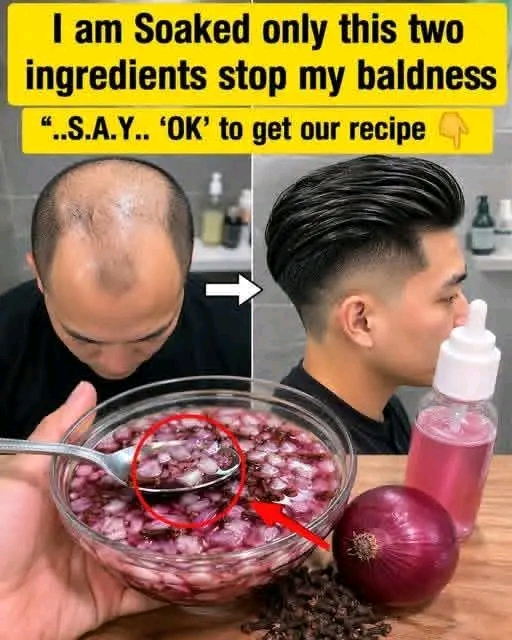
I Soaked These Two Ingredients for Hair Growth: What Really Helps With Hair Loss?
Hair loss is one of the most common beauty concerns, and it is easy to understand why simple home remedies become popular online. A viral image may promise that soaking two everyday ingredients can “stop baldness,” but hair loss is more complicated than a single recipe or treatment.
The image accompanying this article appears to show red onion and a soaking liquid, presented as a homemade hair treatment. Onion-based remedies have attracted attention because onions contain sulfur compounds and antioxidants, and a small study has investigated topical onion juice for a particular type of hair loss. However, that does not mean that onion water can cure baldness or regrow every type of thinning hair.
This article explains the popular homemade treatment, how people prepare it, what is actually known about onion and hair, how to use a simple preparation safely, and which proven approaches are worth considering.
The Viral Two-Ingredient Hair Remedy
The basic idea behind many homemade hair remedies is wonderfully simple: take inexpensive ingredients from the kitchen, soak or blend them, and apply the resulting liquid to the scalp.
In the version shown in the viral image, red onion is the prominent ingredient. Onion is traditionally used in various home-care practices, including scalp and hair treatments.
A typical homemade onion preparation may involve:
- Red onion
- Clean water
Some versions use additional ingredients such as garlic, ginger, oils, herbs, or essential oils. However, adding more ingredients does not necessarily make the treatment more effective.
For a simple approach, keeping the preparation limited to onion and water makes it easier to identify whether your scalp tolerates it.
Important reality check
There is no reliable evidence that soaking two ingredients can permanently stop male- or female-pattern baldness.
Hair loss can result from genetics, hormones, aging, nutritional deficiencies, medications, illness, stress, autoimmune conditions, scalp disorders, or physical damage. A kitchen remedy cannot address all of these causes.
Why Is Onion Associated With Hair Growth?
Onions contain a variety of naturally occurring compounds, including sulfur-containing substances and antioxidants.
Sulfur is important biologically because it is present in amino acids such as cysteine, which contributes to the structure of keratin—the protein that makes up much of the hair shaft.
This has led to the popular theory that onion preparations might support healthier-looking hair.
But there is an important distinction:
An ingredient containing a nutrient associated with hair structure does not automatically mean applying that ingredient to the scalp will regrow hair.
Hair growth occurs inside follicles beneath the skin. The biological processes controlling the growth cycle are complex.
What Does the Research Say?
The evidence surrounding onion juice and hair loss is limited.
One frequently discussed clinical study investigated crude onion juice as a topical treatment for alopecia areata, an autoimmune form of hair loss that commonly produces round or patchy areas of missing hair.
The results generated interest because some participants experienced hair regrowth.
However, this study should not be interpreted as proof that onion juice cures all forms of baldness.
Alopecia areata is very different from androgenetic alopecia, commonly called male-pattern or female-pattern hair loss.
Pattern hair loss is different
In androgenetic alopecia, genetically susceptible hair follicles gradually become smaller under the influence of androgen signaling. Over time, individual hairs can become finer and shorter.
A topical kitchen preparation has not been established as a replacement for medically supported treatments for this condition.
Therefore, headlines such as “two ingredients stop baldness” are far stronger than the available evidence.
Understanding the Hair Growth Cycle
To understand why hair-loss treatments take time, it helps to understand the normal hair cycle.
Hair follicles generally move through several phases.
1. Anagen — the growth phase
During anagen, the follicle actively produces hair.
This phase can last for years, depending on the individual and the location of the follicle.
2. Catagen — the transition phase
The follicle temporarily changes activity and prepares to enter a resting period.
3. Telogen — the resting phase
The follicle rests before the old hair eventually sheds.
Because follicles are not all synchronized, losing some hair every day can be completely normal.
This also explains why a treatment that genuinely helps hair growth would not normally produce dramatic overnight results.
Why Do People Notice Hair Shedding?
Hair shedding can happen for many reasons.
Some common possibilities include:
- Genetics
- Aging
- Hormonal changes
- Stress
- Rapid weight loss
- Poor nutrition
- Certain medications
- Thyroid problems
- Iron deficiency
- Pregnancy and postpartum changes
- Autoimmune conditions
- Scalp inflammation
- Tight hairstyles
- Excessive chemical treatments
- Repeated heat damage
Sometimes several factors occur simultaneously.
For this reason, identifying the cause is usually more useful than trying random hair-growth recipes.
A Simple Onion-Soak Preparation
If you want to experiment with an onion-based scalp preparation, keep the recipe simple and hygienic.
Ingredients
- 1 small red onion
- 1 cup clean water
Equipment
- Clean glass jar or bowl
- Knife and cutting board
- Fine strainer or clean cloth
- Clean bottle with a lid
Method
Step 1: Wash the onion
Remove the outer skin and rinse the onion thoroughly.
Step 2: Chop it
Cut the onion into small pieces.
Smaller pieces expose more surface area to the water.
Step 3: Add water
Place the chopped onion into a clean container and add approximately one cup of water.
Step 4: Soak
Cover the container and refrigerate it for several hours.
Some homemade recipes recommend overnight soaking.
Step 5: Strain
Strain out the onion pieces using a clean strainer.
Step 6: Store carefully
Place the liquid in a clean, closed container and keep it refrigerated.
Because homemade preparations do not contain preservatives, it is better to make small quantities and discard them if they develop an unusual smell, appearance, or signs of contamination.
How to Apply an Onion Preparation to the Scalp
Before using any onion preparation over a large area, perform a small patch test.
Apply a small amount to an inconspicuous area of skin and wait to see whether irritation develops.
If your skin reacts with significant burning, swelling, redness, itching, or discomfort, wash it off and do not continue.
If your skin tolerates it, a cautious approach is to apply a small amount to the scalp rather than saturating the entire head.
Gently massage it into the scalp.
Avoid getting the preparation into your eyes.
Leave it on only for a limited period and wash the scalp thoroughly afterward.
There is no established evidence-based schedule showing that leaving onion preparations on the scalp for many hours—or overnight—produces better hair growth.
What About the Strong Onion Smell?
This is one of the biggest practical disadvantages.
Onions contain volatile compounds responsible for their characteristic smell. After soaking or crushing onion, some of these compounds can remain in the liquid.
If you dislike the smell, wash your hair thoroughly with a mild shampoo.
Do not try to cover the smell by adding large amounts of essential oil. Essential oils can themselves cause skin irritation or allergic reactions.
Can Onion Water Stop Baldness?
This is the most important question.
There is not enough evidence to say that onion water stops baldness.
A viral before-and-after photograph is not the same as a clinical trial.
Hair can appear dramatically different because of:
- Hair styling
- Lighting
- Camera angle
- Hair length
- Hair fibers or concealers
- Temporary shedding
- Different hairstyles
- Image editing
- Natural changes over time
A photograph cannot establish that a particular homemade treatment caused hair regrowth.
Why Before-and-After Hair Photos Can Be Misleading
Social-media hair-growth posts often show a dramatic transformation.
But several things can change between two photographs.
For example, the “before” image may show wet or flattened hair, while the “after” image may show professionally styled hair.
Hair direction can also make the scalp look more or less visible.
Lighting has an enormous effect on the appearance of thinning hair.
A trustworthy evaluation of a hair treatment requires controlled observation rather than a single pair of photographs.
Potential Benefits of Onion for the Scalp
Although the evidence for hair regrowth is limited, onions contain compounds that make them scientifically interesting.
Antioxidant compounds
Onions contain antioxidants that participate in protecting cells from oxidative processes.
Sulfur-containing compounds
Sulfur-containing molecules are one reason onions are frequently discussed in relation to hair and skin.
Traditional use
Onion has been used in traditional household beauty practices for generations.
However, traditional use should not be confused with proof of medical effectiveness.
Possible Side Effects
Natural does not automatically mean harmless.
Onion can irritate sensitive skin.
Possible reactions include:
- Burning
- Redness
- Itching
- Dryness
- Irritation
- Contact dermatitis
- Eye irritation
People with sensitive skin or an existing scalp condition should be especially cautious.
If your scalp is already inflamed, scratched, infected, or affected by a dermatological condition, applying a strong homemade preparation could make the problem worse.
Who Should Avoid Homemade Onion Treatments?
Consider avoiding onion preparations if you:
- Have a known onion allergy
- Have broken or damaged skin
- Have severe scalp inflammation
- Recently underwent scalp surgery
- Experience significant burning with topical products
- Have unexplained scalp sores
- Are currently being treated for a scalp disorder and your clinician has advised against additional products
If you develop swelling, severe irritation, blistering, or difficulty breathing after exposure, seek appropriate medical care immediately.
The Difference Between Hair Breakage and Hair Loss
This distinction is often overlooked.
Hair breakage
Breakage happens when the hair shaft becomes damaged and snaps.
Common causes include:
- Bleaching
- Frequent straightening
- Excessive heat
- Chemical treatments
- Rough brushing
- Tight hairstyles
Hair loss
Hair loss involves the follicle producing less hair, shedding hair prematurely, or stopping hair production.
A scalp treatment may make hair feel softer or improve its cosmetic appearance, but that does not necessarily mean it is treating follicle-level hair loss.
Nutrition and Healthy Hair
A balanced diet is an important part of maintaining normal hair growth.
Hair follicles require adequate energy and nutrients.
Important nutritional factors include:
- Protein
- Iron
- Zinc
- Vitamin D
- Vitamin B12
- Folate
- Essential fatty acids
However, taking supplements blindly is not necessarily beneficial.
Excessive intake of certain nutrients can actually cause problems.
For example, high doses of some supplements may contribute to hair loss or other adverse effects.
If significant hair loss is occurring, a healthcare professional can help determine whether a nutritional deficiency or another medical problem should be investigated.
Protein Matters
Hair is largely made from keratin, a structural protein.
Adequate protein intake is therefore important for people trying to maintain healthy hair.
Good dietary protein sources include:
- Eggs
- Fish
- Chicken
- Beans
- Lentils
- Yogurt
- Milk
- Nuts
- Seeds
- Lean meats
A balanced diet is more useful than relying on one special food or drink.
Iron and Hair Loss
Iron deficiency can be associated with hair shedding, particularly in certain populations.
People who experience unexplained or substantial hair loss may need medical evaluation to determine whether iron status is relevant.
However, taking iron supplements without determining whether you actually need them is not a good idea.
Iron can be harmful in excessive amounts.
Gentle Hair Care Can Make a Difference
Even when a person has genetic hair loss, reducing hair damage can improve the appearance and strength of the remaining hair.
Try to:
- Avoid excessively tight hairstyles.
- Limit high-temperature styling.
- Use conditioner regularly.
- Brush gently.
- Avoid repeatedly bleaching fragile hair.
- Give wet hair gentle treatment.
- Avoid aggressive scalp scratching.
These habits may reduce breakage, even though they do not necessarily reverse genetic baldness.
What Treatments Have Better Evidence?
For common pattern hair loss, certain treatments have substantially more scientific evidence than kitchen remedies.
One widely recognized topical option is minoxidil.
Minoxidil has been studied for several forms of pattern hair loss and is available in different formulations and strengths depending on the country and product.
However, it is not appropriate for everyone, and results generally require continued use.
Other medical treatments may be considered depending on the type and cause of hair loss.
A dermatologist can determine whether your pattern is consistent with androgenetic alopecia, alopecia areata, telogen effluvium, or another condition.
When Should You See a Dermatologist?
Don’t rely exclusively on home remedies if you experience:
- Sudden heavy shedding
- Bald patches
- Rapidly expanding areas of hair loss
- Scalp pain
- Severe itching
- Scaling
- Redness
- Pus or sores
- Eyebrow or eyelash loss
- Hair loss accompanied by other unexplained symptoms
Sudden or unusual hair loss deserves attention because some causes can be treated effectively when identified early.
The Role of Stress
Stress can influence the hair cycle.
A major physical or emotional stressor can sometimes be followed by increased shedding several weeks or months later.
This type of shedding is often called telogen effluvium.
Potential triggers include:
- Severe illness
- Major surgery
- Significant weight loss
- Extreme stress
- Childbirth
- Certain medications
The important point is that stress-related shedding can have a different mechanism from hereditary pattern baldness.
Therefore, the correct solution depends on the underlying cause.
Can Scalp Massage Help?
Scalp massage is popular because it is relaxing and inexpensive.
Gentle massage may improve the experience of caring for your scalp and hair, but strong evidence that ordinary scalp massage produces substantial regrowth in people with established baldness remains limited.
If you massage your scalp, use your fingertips rather than your fingernails and avoid aggressive rubbing.
Don’t Confuse Hair Appearance With New Growth
A homemade treatment can sometimes make hair appear different without creating new follicles.
For example, conditioning products can make strands look fuller.
Oils can reduce friction and make hair appear smoother.
Styling can increase apparent volume.
These effects can be useful cosmetically, but they are different from genuine follicular regrowth.
A Better Way to Track Hair Progress
If you are trying any hair-care routine, don’t depend on memory.
Take photographs under consistent conditions:
- Use the same room.
- Use similar lighting.
- Keep the camera at approximately the same distance.
- Photograph the same areas.
- Keep hair dry or wet consistently.
- Take photographs at regular intervals.
Hair grows slowly, so meaningful changes may require months rather than days.
The Biggest Mistake: Expecting Instant Results
One of the most misleading aspects of viral hair-growth content is the promise of rapid transformation.
Hair follicles operate according to biological cycles.
Even medically supported treatments generally require patience.
If someone claims that a homemade mixture can completely reverse baldness within a few days, that claim should be treated skeptically.
A Safer Homemade Hair-Care Philosophy
If you enjoy natural hair-care routines, there is nothing wrong with keeping them simple and cautious.
A sensible routine can include:
- Gentle cleansing
- Regular conditioning
- Avoiding unnecessary chemical damage
- Protecting hair from excessive heat
- Eating a balanced diet
- Managing stress
- Getting enough sleep
- Treating scalp problems appropriately
- Seeking medical advice for significant hair loss
An onion-based preparation can be considered an optional cosmetic experiment—not a guaranteed medical treatment.
Frequently Asked Questions
Can onion water regrow bald spots?
There is insufficient evidence to conclude that onion water reliably regrows bald spots. Some research has investigated onion juice in alopecia areata, but that does not establish effectiveness for every form of hair loss.
How often should I use onion water?
There is no scientifically established frequency that guarantees hair growth. If you choose to try it, prioritize scalp tolerance and stop if irritation develops.
Can I leave onion water overnight?
There is no good evidence that overnight application produces superior results. Longer exposure may increase irritation for some people.
Can I use red onion instead of white onion?
Red onions contain many of the same broad categories of compounds found in other onions. There is no strong evidence showing that red onion is a proven superior treatment for baldness.
Can onion cure male-pattern baldness?
No. Onion preparations have not been established as a cure for androgenetic alopecia.
Is onion water safe?
It may be tolerated by some people, but topical onion can irritate the skin. A small patch test is prudent before broader application.
Can I drink onion water for hair growth?
There is no established evidence that drinking onion-soaked water will reverse baldness. A balanced diet is a much more reliable foundation for nutritional support.
The Bottom Line
The viral claim that “soaking these two ingredients stops baldness” is much stronger than the available scientific evidence.
Onion is an interesting traditional ingredient, and limited research has investigated topical onion preparations for particular forms of hair loss. Nevertheless, there is no solid evidence that a simple onion soak can stop genetic baldness or guarantee new hair growth.
If you enjoy natural remedies, an onion-based scalp preparation can be approached cautiously as a homemade experiment, provided you understand its limitations and watch carefully for irritation.
But if your hair is rapidly thinning, you are developing bald patches, or the shedding is significant, the most useful step is identifying why the hair is being lost.
A healthy diet, gentle hair care, appropriate treatment of scalp conditions, and evidence-based medical therapies when indicated are far more dependable than relying on a viral recipe.
Remember: healthy hair care is not about finding one magical ingredient. It is about understanding the cause of hair loss and choosing the right approach for your scalp and follicles.
Suggested WordPress SEO Title
I Soaked Red Onion for Hair Growth: Can This Viral Remedy Really Stop Baldness?
Suggested Meta Description
Can soaked onion really stop baldness? Discover what science says about onion water, hair growth, possible benefits, side effects, and evidence-based hair-loss treatments.
Suggested URL Slug
onion-water-hair-growth-baldness
Suggested Featured-Image Caption
A homemade red-onion hair treatment has gone viral online, but does the science support claims that it can stop baldness?
Important: This article is for general educational purposes and does not diagnose or treat hair loss. Persistent, sudden, patchy, or severe hair loss should be evaluated by a qualified healthcare professional.