Prostate Drink for Men Over 40: What the Viral Claim Gets Right—and Wrong
Introduction
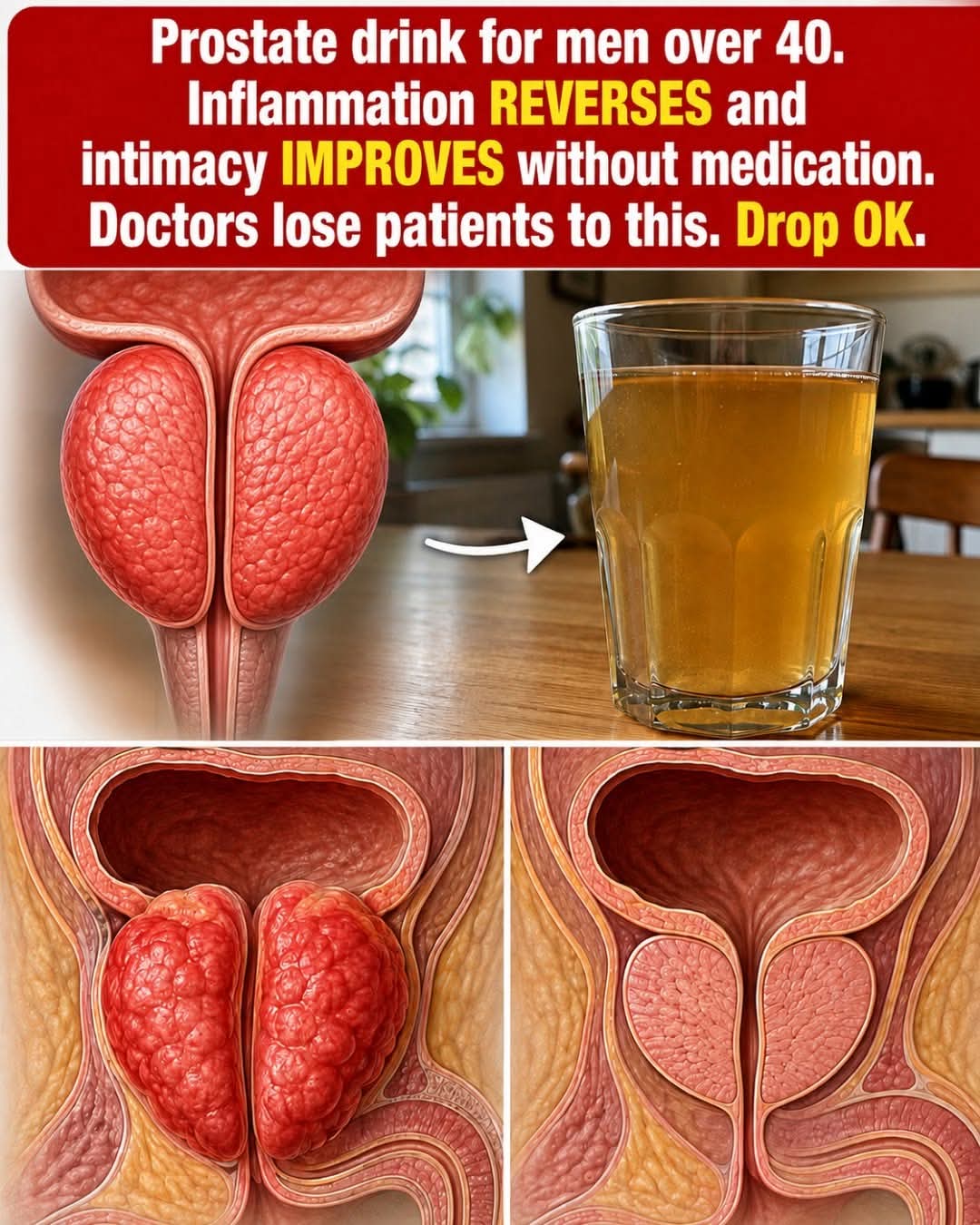
A bold health claim is circulating online: “Prostate drink for men over 40. Inflammation reverses and intimacy improves without medication.” The accompanying image shows an enlarged-looking prostate beside a glass of golden liquid, suggesting that a simple drink can shrink the prostate, reverse inflammation, improve urination, and restore sexual performance.
It is an appealing message—especially for men who have started noticing more nighttime trips to the bathroom, a weaker urine stream, urgency, pelvic discomfort, or changes in sexual function. But there is an important distinction between a healthy drink that supports an overall healthy lifestyle and a drink that can actually treat a prostate disease.
There is currently no single beverage proven to “reverse” prostate inflammation, eliminate an enlarged prostate, or reliably restore sexual function without medical evaluation or treatment. Prostate symptoms can have several different causes, including benign prostatic hyperplasia (BPH), prostatitis, urinary problems, medication effects, hormonal problems, diabetes, cardiovascular disease, and, in some cases, prostate cancer.
That does not mean nutrition is irrelevant. Quite the opposite. What you eat and drink can be part of a healthy lifestyle, and a nutritious dietary pattern may support cardiovascular and metabolic health—factors that are also important for sexual function. Research summarized by the U.S. National Institute of Diabetes and Digestive and Kidney Diseases (NIDDK) indicates that a healthy diet can reduce the risk of erectile dysfunction (ED) or improve symptoms in some men.
So, what should men over 40 know about the viral “prostate drink” idea? And what can realistically be done to support urinary, prostate, and sexual health?
Let’s separate the promising lifestyle habits from the exaggerated claims.
Why Prostate Health Becomes More Important With Age
The prostate is a small gland located below the bladder and surrounding part of the urethra. It plays a role in the male reproductive system.
As men age, prostate-related symptoms become increasingly common. One of the most common conditions is benign prostatic hyperplasia, usually called BPH.
BPH is a noncancerous enlargement of the prostate. As the prostate becomes larger, it can press against the urethra and interfere with urine flow.
Symptoms can include:
- A weak urine stream
- Difficulty starting urination
- Frequent urination
- A sudden or urgent need to urinate
- Getting up repeatedly during the night
- Dribbling after urination
- Feeling that the bladder has not completely emptied
- Difficulty maintaining a normal urinary routine
BPH is particularly common as men get older, although not every man with an enlarged prostate develops bothersome symptoms.
This is why the age of 40 is often mentioned in online discussions about men’s health. Forty is not a magical point at which the prostate suddenly becomes unhealthy, but it is a reasonable age for men to become more attentive to long-term lifestyle habits and to discuss persistent symptoms with a healthcare professional.
The Image’s Biggest Claim: Can a Drink Reverse Prostate Inflammation?
This is where caution is needed.
Inflammation of the prostate is called prostatitis, but prostatitis is not one single disease. NIDDK describes several forms, including acute bacterial prostatitis, chronic bacterial prostatitis, chronic prostatitis/chronic pelvic pain syndrome, and asymptomatic inflammatory prostatitis.
The cause and treatment can therefore be completely different from one person to another.
For example, bacterial prostatitis can require antibiotics. Chronic prostatitis/chronic pelvic pain syndrome may involve pain, urinary symptoms, pelvic-floor problems, nerve-related factors, inflammation, or other mechanisms, and treatment may require a combination of approaches.
A homemade drink cannot be assumed to treat an infection.
That is an important point because delaying treatment for a bacterial infection can potentially allow the condition to become more serious.
Therefore, claims such as “this drink reverses prostate inflammation” should not be interpreted as established medical facts.
A better statement is:
«A nutritious beverage can be part of a healthy lifestyle, but it should not be considered a proven treatment for prostatitis, BPH, or another prostate disorder.»
What About an Enlarged Prostate?
Another common misconception is that an enlarged prostate is simply an “inflamed prostate.”
They are not necessarily the same thing.
BPH is an enlargement of prostate tissue that can occur with aging. Prostatitis involves inflammation and may cause pain and urinary symptoms. Prostate cancer is a separate condition altogether.
A man may experience similar urinary symptoms from several different conditions, which is why diagnosing the cause matters.
NIDDK notes that symptoms such as frequent urination, urgency, weak urine flow, difficulty starting urination, and incomplete emptying can occur with prostate problems. A healthcare professional may use medical history, physical examination, urine tests, blood tests, imaging, and other evaluations to determine the cause.
This is one reason a viral drink should never replace a medical evaluation when symptoms are persistent or worsening.
Can Better Hydration Help?
Yes—but hydration needs to be understood correctly.
Water is essential for normal body function. Staying adequately hydrated supports normal urine production and helps prevent dehydration.
However, more water is not always better for urinary symptoms.
A man who drinks a very large amount of fluid shortly before bedtime may naturally wake up more often to urinate. NIDDK lists reducing fluids before sleep as one lifestyle strategy that may help men with BPH-related urinary symptoms. Limiting caffeine and alcohol can also help some men.
The goal is not to “flush the prostate.”
The prostate is not a filter that can simply be washed clean with a special beverage.
Instead, aim for sensible hydration throughout the day while adjusting timing according to your symptoms, activity, climate, and medical needs.
A Simple Healthy Drink: What Should It Contain?
Because the viral image does not provide a verified ingredient list, it would be misleading to claim that the pictured drink contains a particular ingredient or that its exact recipe has been scientifically proven.
Instead, men looking for a nutritious beverage can focus on simple principles.
A reasonable homemade option is a low-sugar fruit-and-seed smoothie made from foods that fit into an overall healthy eating pattern.
Example Ingredients
- 1 cup unsweetened low-fat or plain yogurt
- ½ cup fresh or frozen berries
- 1 tablespoon ground flaxseed
- 1 tablespoon pumpkin seeds
- ½ cup water, depending on desired consistency
- A small amount of cinnamon for flavor, if desired
- No added sugar
Blend until smooth.
This should be viewed as a nutritious snack or breakfast—not a prostate cure.
Berries provide fruit and fiber, while nuts and seeds provide unsaturated fats and other nutrients. Yogurt can contribute protein and, depending on the product, calcium.
The purpose is to make healthy eating easier, not to create a “magic prostate formula.”
Why a Healthy Diet Matters More Than One Drink
One of the biggest problems with viral health trends is that they focus on a single ingredient.
Human health does not usually work that way.
Eating one food every day while maintaining an otherwise unhealthy diet is unlikely to cancel out the broader effects of poor nutrition, inactivity, smoking, excessive alcohol consumption, inadequate sleep, or uncontrolled medical conditions.
For sexual health in particular, dietary quality matters because erectile function is closely connected with blood vessels, nerves, hormones, metabolic health, and psychological factors.
NIDDK states that healthy dietary patterns can reduce the risk of ED or improve symptoms. Foods emphasized include vegetables, fruits, legumes, nuts, seeds, whole grains, and healthy sources of unsaturated fats.
This means the better question is not:
“Which drink will fix my prostate?”
A better question is:
“What lifestyle pattern can help me protect my urinary, cardiovascular, metabolic, and sexual health as I age?”
That shift in thinking is much more useful.
Prostate Health and Sexual Function
The image also claims that the drink can improve “intimacy.”
This needs its own discussion.
Sexual function and prostate health can overlap, but they are not identical.
Erectile dysfunction, or ED, means having difficulty getting or keeping an erection firm enough for sex.
According to NIDDK, ED can have many causes, including diabetes, cardiovascular disease, high blood pressure, obesity, hormone problems, nerve disorders, certain medications, stress, anxiety, smoking, excessive alcohol use, and some reproductive-system conditions.
Therefore, if a man develops persistent erectile difficulties, simply drinking a particular beverage may miss the underlying cause.
Sometimes ED can be an early sign that a man should pay more attention to cardiovascular or metabolic health.
That makes persistent sexual difficulties worth discussing with a healthcare professional rather than simply hiding them or relying on online remedies.
The Connection Between Blood Flow and Sexual Health
An erection depends heavily on healthy blood flow.
When blood vessels are affected by conditions such as high blood pressure, diabetes, atherosclerosis, obesity, or smoking, erectile function can be affected.
This is one reason lifestyle improvements can be valuable.
Regular physical activity, a nutritious diet, maintaining a healthy weight, avoiding smoking, moderating alcohol, and managing conditions such as diabetes and high blood pressure can contribute to better overall health.
NIDDK also emphasizes that ED is not simply an unavoidable part of normal aging. It is more common with age, but it can often be evaluated and treated.
That is an empowering message.
Men should not assume they have to accept persistent sexual problems simply because they are getting older.
What About Pumpkin Seeds?
Pumpkin seeds frequently appear in online prostate-health recipes.
They are nutritious and provide protein, minerals, fiber, and unsaturated fats. Including them as part of a balanced diet can be a sensible choice.
However, it is important not to jump from:
“Pumpkin seeds are nutritious”
to:
“Pumpkin seeds shrink an enlarged prostate.”
Those are very different claims.
A healthy food can contribute to a healthy dietary pattern without functioning as a medication.
Adding a tablespoon of pumpkin seeds to yogurt, oatmeal, salads, or a smoothie can be a practical way to increase nutrient intake, but men with diagnosed BPH should not stop prescribed treatment because they begin eating pumpkin seeds.
What About Lycopene and Tomatoes?
Tomatoes contain lycopene, a carotenoid that has attracted significant scientific interest.
Tomatoes can certainly be part of a healthy diet. Tomato-based foods may provide nutrients and antioxidants, and they can be incorporated into many balanced meals.
However, the evidence is not strong enough to claim that lycopene is a proven treatment for BPH.
The National Center for Complementary and Integrative Health notes that there is insufficient evidence to support lycopene for the prevention or treatment of BPH.
So, enjoy tomatoes—but do not treat tomato juice as a replacement for medical care.
What About Saw Palmetto?
Saw palmetto is one of the most frequently mentioned herbal ingredients in prostate supplements.
It has been promoted for urinary symptoms associated with BPH.
However, the scientific evidence is mixed, and high-quality evidence does not justify the dramatic claims often seen online.
NCCIH reports that a 2023 review of 27 studies found that saw palmetto used alone provides little or no benefit for BPH symptoms. Earlier large trials also found that saw palmetto was not more effective than placebo.
That does not mean every herbal product is automatically dangerous. It means consumers should be careful about confusing traditional use, marketing claims, preliminary research, and established clinical evidence.
If you are taking medications or have a medical condition, discuss supplements with your healthcare professional before using them regularly.
Lifestyle Habits That May Help Urinary Health
If you want to support prostate and urinary health, focus on the habits that can realistically make a difference.
- Watch Evening Fluid Intake
If nighttime urination is a problem, avoid consuming large amounts of fluid immediately before bed.
This does not mean becoming dehydrated. Instead, spread fluids sensibly throughout the day.
- Be Careful With Caffeine
Coffee, tea, energy drinks, and other caffeinated beverages can increase urinary frequency or urgency in some people.
If you notice that caffeine makes your symptoms worse, reducing your intake may help.
- Limit Alcohol
Alcohol can affect sleep and urinary habits and may worsen some urinary symptoms.
Moderation is particularly important if you are experiencing frequent nighttime urination.
- Stay Physically Active
Regular movement supports cardiovascular health, weight management, metabolic health, and general well-being.
Because erectile function is closely connected with vascular health, physical activity can also be relevant to sexual health.
- Maintain a Healthy Weight
Excess body weight is associated with several health conditions that can contribute to ED and other problems.
A sustainable approach involving nutritious foods and regular activity is more useful than extreme diets.
- Do Not Smoke
Smoking damages blood vessels and is a major threat to cardiovascular health.
Because erections depend on healthy blood flow, quitting smoking can be an important part of protecting sexual function.
- Manage Existing Health Conditions
High blood pressure, diabetes, high cholesterol, and cardiovascular disease can affect sexual health.
Keeping these conditions under appropriate medical care is often much more meaningful than searching for a single “miracle drink.”
When Prostate Symptoms Should Not Be Ignored
Some men put off medical care because urinary symptoms develop gradually.
That is understandable, but persistent symptoms deserve attention.
Speak with a healthcare professional if you experience:
- A consistently weak urine stream
- Difficulty starting urination
- Frequent nighttime urination
- Persistent urgency
- Pain during urination
- Pain during or after ejaculation
- Pelvic or lower abdominal pain
- Blood in the urine
- Repeated urinary infections
- A feeling that the bladder does not empty completely
- New or persistent erectile difficulties
These symptoms do not automatically mean cancer or another serious disease.
They simply mean that the cause should be identified.
NIDDK notes that prostate symptoms can overlap with other urinary conditions, and some symptoms can also occur with more serious diseases.
Emergency Warning Signs
Some prostate and urinary symptoms require urgent medical attention.
For example, NIDDK advises immediate medical care for men who are completely unable to urinate, or who have painful frequent or urgent urination accompanied by fever and chills. Blood in the urine or severe lower abdominal or urinary-tract pain also warrants prompt medical attention.
Do not try to solve these symptoms with a homemade drink.
An inability to urinate can represent urinary retention and may require immediate treatment.
What Medical Treatment for BPH Can Look Like
Another misleading idea in viral posts is that choosing medical treatment means failing to use natural approaches.
In reality, treatment depends on the severity of symptoms and the individual’s condition.
For mild symptoms, a healthcare professional may recommend monitoring and lifestyle changes.
For more bothersome symptoms, medications may be used.
NIDDK describes several treatment approaches for BPH, including watchful waiting, lifestyle changes, medications, and surgical or minimally invasive procedures when appropriate.
Some medications can relax the muscles around the prostate and bladder to improve urine flow. Other medicines can slow prostate growth or shrink prostate tissue over time.
The important point is that treatment is individualized.
A man should not stop prescribed medication simply because an online post claims that a beverage can do the same thing.
Why “Without Medication” Is a Misleading Promise
The phrase “without medication” sounds attractive because many people prefer natural solutions.
But “natural” does not automatically mean “effective,” and “medication-free” does not automatically mean “safer.”
If a man has bacterial prostatitis, appropriate treatment may include antibiotics. If he has significant BPH, medication or a procedure may provide meaningful relief. If ED is related to diabetes, cardiovascular disease, hormonal problems, or medication side effects, the underlying issue needs to be addressed.
Lifestyle changes can complement medical care.
They should not automatically replace it.
A Better “Prostate Drink” Philosophy
Instead of looking for one secret recipe, think about beverages in terms of what they can realistically contribute.
A good everyday beverage should ideally be:
- Low in added sugar
- Nutrient-rich when possible
- Appropriate for your medical conditions
- Compatible with your medications
- Not excessively caffeinated
- Not consumed in huge quantities at bedtime
- Part of a balanced diet rather than a replacement for meals
For example, water remains an excellent foundation for hydration.
A smoothie containing berries, plain yogurt, and seeds can provide nutrients and protein.
Unsweetened vegetable-based drinks can also fit into a balanced diet, depending on sodium content and individual dietary needs.
The key is not the “magic” combination.
The key is the overall dietary pattern.
A Practical Daily Routine for Men Over 40
A simple prostate-conscious routine might look like this:
Morning
Start the day with water and a balanced breakfast containing protein, fiber, and minimally processed foods.
If you enjoy coffee, monitor whether caffeine makes urinary urgency worse.
Midday
Eat a meal centered around vegetables, whole grains or legumes, and a healthy protein source.
Drink fluids throughout the day instead of consuming most of your fluids late at night.
Afternoon
Get some physical activity.
A brisk walk, cycling, swimming, strength training, or another activity you enjoy can make healthy living easier to maintain.
Evening
Choose a balanced dinner and avoid excessive alcohol.
If nighttime urination is a problem, reduce large amounts of fluid close to bedtime.
Before Bed
Give yourself time to use the bathroom before going to sleep.
If you repeatedly wake several times every night to urinate, do not simply assume it is normal aging. Discuss persistent symptoms with a healthcare professional.
The Truth About “Prostate Cleansing”
There is no established need to “cleanse” or “detox” the prostate with a special drink.
The body already has sophisticated systems for processing nutrients and eliminating waste.
A prostate cleanse marketed online may sound impressive, but a product being labeled “detox,” “cleanse,” or “flush” does not establish that it treats prostate disease.
In fact, the more dramatic the promise, the more important it is to ask:
Where is the clinical evidence?
A trustworthy health claim should ideally be supported by appropriately designed human research rather than testimonials, before-and-after images, anonymous doctors, or claims that “doctors don’t want you to know.”
Why Viral Before-and-After Images Can Be Misleading
The image accompanying the claim uses illustrations showing a large, irregular prostate next to a smaller-looking prostate.
Visually, this creates the impression that the drink produced the change.
But an illustration is not clinical evidence.
It does not prove that the drink caused the improvement.
It does not show that the two prostate images represent real patients.
And it does not tell us how the prostate was measured.
Real medical research uses defined diagnostic methods, appropriate participants, control groups when applicable, measurable outcomes, and statistical analysis.
A social media graphic cannot replace that evidence.
A Message for Men Who Are Embarrassed About Prostate Symptoms
One of the most important reasons to discuss prostate health is that embarrassment can prevent men from seeking help.
Urinary symptoms and sexual difficulties can be uncomfortable to talk about, but healthcare professionals deal with them regularly.
ED, for example, can be associated with physical conditions, medications, psychological factors, and lifestyle behaviors. Proper evaluation can help identify the cause and determine suitable treatment.
Talking about the problem is not a sign of weakness.
It is part of taking responsibility for your health.
Frequently Asked Questions
Can one drink shrink an enlarged prostate?
There is no established evidence that a particular homemade beverage can reliably shrink an enlarged prostate. BPH has multiple treatment options, and treatment should depend on symptom severity and individual medical circumstances.
Can a drink cure prostatitis?
No beverage should be promoted as a cure for prostatitis. Different forms of prostatitis have different causes and treatments. Bacterial prostatitis may require antibiotics and medical evaluation.
Can healthy foods support prostate health?
Healthy foods can contribute to overall health, but individual foods should not be portrayed as medications. A balanced diet rich in vegetables, fruits, legumes, whole grains, nuts, seeds, and healthy fats is a sensible foundation.
Can diet help erectile dysfunction?
A healthy diet may reduce the risk of ED or improve symptoms, particularly when it supports cardiovascular and metabolic health.
Is saw palmetto a proven prostate treatment?
Evidence is mixed, and NCCIH reports that saw palmetto alone provides little or no benefit for BPH symptoms in a recent review.
Should men over 40 drink more water for their prostate?
Adequate hydration is important, but drinking excessive amounts of fluid is not a proven prostate treatment. Men with nighttime urination may actually benefit from reducing large amounts of fluid before bed.
Is frequent nighttime urination normal?
It can become more common with age, but repeated nighttime urination can also be associated with prostate, bladder, metabolic, medication, or other health issues. Persistent or bothersome symptoms deserve evaluation.
Final Thoughts
The viral image is right about one thing: prostate health deserves attention as men get older.
Where it goes too far is suggesting that a mysterious drink can reverse inflammation and improve intimacy without medication.
There is no need to be afraid of healthy foods or homemade drinks. A nutritious beverage can be a pleasant part of a balanced lifestyle. Foods such as fruits, vegetables, yogurt, nuts, seeds, and whole grains can contribute valuable nutrients, while sensible hydration supports normal body function.
But a drink is not a substitute for diagnosis.
If you have a weak urine stream, difficulty starting urination, persistent urgency, repeated nighttime urination, pelvic pain, painful ejaculation, blood in the urine, or erectile difficulties, the most valuable step may be identifying why those symptoms are occurring.
Prostate problems are not all the same.
BPH, prostatitis, urinary disorders, medication effects, hormonal issues, cardiovascular disease, diabetes, and other conditions can produce overlapping symptoms. Proper evaluation makes it possible to choose the right approach.
The healthiest goal is therefore not to find a secret drink that “beats” medicine.
The better goal is to build a lifestyle that supports long-term health while getting appropriate medical care when symptoms appear.
Drink wisely. Eat well. Stay active. Avoid smoking. Moderate alcohol. Pay attention to urinary and sexual changes. And when symptoms persist, talk with a healthcare professional rather than relying on a viral claim.
A simple drink can be part of a healthy routine—but your prostate deserves more than a promise in a picture.
Medical Disclaimer
This article is for educational purposes only and is not a diagnosis or treatment recommendation. The claims shown in the viral image should not be interpreted as established medical facts. Men with persistent urinary symptoms, pelvic pain, blood in the urine, fever or chills, inability to urinate, or ongoing erectile difficulties should seek appropriate medical evaluation. Do not stop prescribed medication or delay treatment because of a social-media remedy.