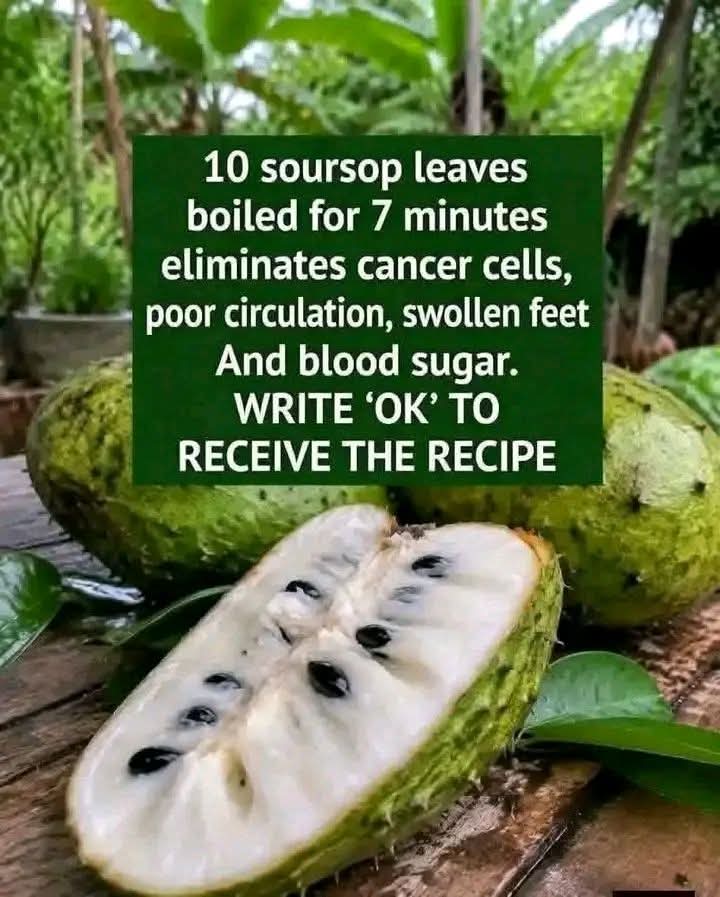
Important disclaimer first: The image’s claim that boiling 10 soursop leaves for 7 minutes “eliminates cancer cells, poor circulation, swollen feet and blood sugar” is not supported by reliable human clinical evidence. Laboratory and animal studies have shown that compounds in soursop (Annona muricata, also called graviola or guanábana) can have effects against some cancer cells in dishes or mice, and traditional medicine has used the leaves for various purposes, but there are no strong, high-quality human trials proving it cures cancer or the other conditions listed. Major cancer organizations (Cancer Research UK, Memorial Sloan Kettering, etc.) state there is insufficient evidence it works as a cancer treatment, and some chemicals in the plant (especially annonacin) have been linked in observational data to possible nerve problems with heavy long-term use.
Do not use this or any herbal tea as a substitute for medical diagnosis or treatment. If you have cancer, diabetes, circulation issues, swelling, or any health concern, see a qualified doctor. Pregnant or breastfeeding people, children, and anyone with Parkinson’s-like symptoms or on medication (especially for blood pressure or blood sugar) should avoid or consult a doctor first. The recipe below is for a traditional-style herbal tea only.
Introduction
Soursop leaf tea is a simple herbal infusion made from the leaves of the tropical Annona muricata tree. The fruit is the large, spiky green one with creamy white flesh and black seeds; the leaves have long been used in folk practices across the Caribbean, Latin America, West Africa, and Southeast Asia. People traditionally prepare a mild tea from fresh or dried leaves. Below is a fuller, practical version of the common home preparation (not a medical cure).
History & Traditional Background
Native to tropical America (Mexico through northern South America and the Caribbean), the tree was spread by early travelers and is now grown widely in the tropics. Indigenous and traditional communities used the leaves as a decoction or infusion for comfort with fever, digestive upset, restlessness, and other everyday complaints. The fruit itself has long been eaten fresh or turned into juice, punch, ice cream, and sweets. Modern interest in the leaves grew from laboratory findings about certain compounds (acetogenins, flavonoids, etc.), but traditional use predates those studies by centuries.
Ingredients (makes about 2–3 cups / roughly 500–750 ml)
- 8–12 fresh soursop leaves (or 5–8 dried leaves) — the image’s “10 leaves” is in this range
- 3–4 cups (700–950 ml) clean filtered water
- Optional: ½–1 tsp honey, a slice of fresh ginger, a cinnamon stick, or a few mint leaves for flavor
(Use leaves from a clean, pesticide-free source. Rinse thoroughly.)
Instructions / Method
- Rinse the leaves well under cool running water to remove dust or residue. Gently tear or bruise fresh leaves to help release compounds.
- Place the leaves and water in a clean stainless-steel or glass pot.
- Bring just to a gentle simmer over medium heat, then reduce to low.
- Simmer gently for 5–10 minutes (the image suggests 7 minutes; longer simmering makes a stronger, sometimes more bitter tea). Do not boil hard for a long time.
- Remove from heat, cover, and let steep another 5–10 minutes if desired.
- Strain through a fine mesh strainer or cloth into a cup or teapot.
- Sweeten lightly if you like, or add optional flavorings. Drink warm.
Variations
- Iced: Cool the strained tea and pour over ice.
- Milder: Use fewer leaves or shorter simmer time.
- Stronger: Slightly more leaves or longer gentle simmer.
Typical traditional servings are 1 cup once or twice a day; do not treat this as a high-dose “medicine.”
Formation / How the Tea Is Made (Simple Chemistry Note)
Hot water extracts water-soluble compounds from the leaves (polyphenols, some acetogenins, flavonoids, etc.). Gentle simmering rather than prolonged hard boiling is commonly recommended to avoid excessive bitterness while still extracting the infusion.
Potential Traditional Uses & Research Notes (Not Claims of Cure)
Traditional folk uses have included support for general well-being, restfulness, and various everyday discomforts. Laboratory and animal research has explored antioxidant, anti-inflammatory, and other activities of leaf extracts, and some early work has looked at effects on certain cancer cell lines. Human clinical evidence remains limited and of low quality; no rigorous proof exists that the tea eliminates cancer cells or reliably treats the conditions named in the image. Any benefits people report are anecdotal or preliminary.
Nutrition (Approximate for plain leaf tea)
A plain cup is very low in calories (essentially 0–5 kcal), contains negligible protein/fat/carbohydrate, and contributes small amounts of plant compounds and minerals depending on the leaves and water. It is caffeine-free. Adding honey increases calories and sugar.
Safety & Practical Notes
- Possible side effects with heavy or prolonged use: digestive upset; theoretical interaction with blood-pressure or blood-sugar medications; concerns about neurotoxicity from certain compounds with very high long-term intake in some populations.
- Stop if you feel unwell and seek medical advice.
- Source leaves carefully; avoid contaminated or chemically treated plants.
Conclusion
Soursop leaf tea is a traditional tropical herbal infusion that many people enjoy for its mild flavor and cultural association with everyday wellness practices. The viral claim that a short boil of 10 leaves “eliminates” cancer cells and other conditions overstates what current science supports. Enjoy it, if you like, as a simple tea—never as a replacement for proven medical care.
If you have a diagnosed condition, work with your healthcare provider. Curiosity about traditional plants is fine; treating serious disease requires evidence-based medicine.
(The repeated “lovers” and extra “methods/conclusion” requests in your message appear to be phrasing variations; the above covers a complete practical recipe with context, history, preparation, notes on research, and clear limits.)