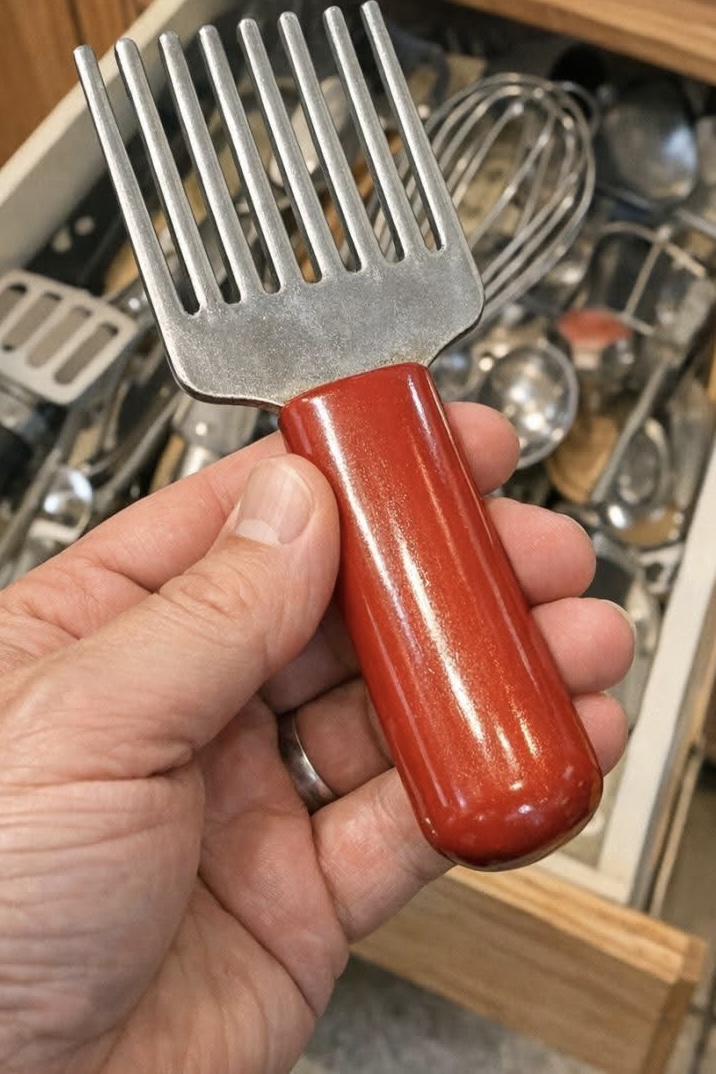
Sorting through a box of old kitchen utensils can sometimes feel like diving into a time capsule, uncovering objects that once played an important role in everyday life but have since faded into obscurity. Among the wooden spoons, tarnished ladles, and well-worn rolling pins, you might stumble upon a peculiar item that sparks curiosity and intrigue.
One such item is a tool that resembles a giant hair pick, with thick metal prongs and a handle crafted from the vintage material known as Bakelite. At first glance, it might seem like an oddity, but this utensil holds a fascinating story about mid-century baking practices and the evolution of kitchen technology.
- The Mystery Utensil: More Than a Giant Hair Pick
The unusual utensil in question, with its robust metal prongs spaced widely apart, is not designed for hair grooming but for slicing through delicate baked goods. Measuring approximately 6 to 8 inches in length, with prongs that are about 2 to 3 inches long, this tool was specifically crafted for a unique purpose. Its primary function is to slice through the light and airy texture of angel food cake without compressing or tearing it, ensuring that each slice retains the cake’s characteristic fluffiness and integrity.
Unlike a traditional knife, the wide spacing and thickness of the prongs minimize contact with the cake, reducing the risk of flattening or crumbling. This design highlights the meticulous thought put into mid-century baking tools, where functionality was finely tuned to specific culinary tasks. - A Clue in the Handle: Why Bakelite Matters
The handle of this mystery utensil is made from Bakelite, an early form of plastic that was widely used in the first half of the 20th century. Developed in 1907 by Belgian chemist Leo Baekeland, Bakelite was celebrated for its heat-resistant properties and durability, making it a popular choice for a variety of household items. By the 1930s and 1940s, it had become a staple material in kitchenware, prized not only for its functionality but also for its ability to be molded into a range of colors and styles.
The presence of a Bakelite handle helps date the utensil to a time period when this material was at the height of its popularity, providing a tangible link to a specific era of kitchen design and innovation. Bakelite’s distinctive look and feel also add an element of nostalgia, evoking memories of family kitchens from decades past. - Thick Metal Prongs and Wide Spacing: What the Design Tells Us
The thick metal prongs of this utensil are a key feature that sets it apart from other kitchen tools. Typically made from chrome or stainless steel, these prongs are designed to be sturdy enough to slice through the cake, yet gentle enough to preserve its delicate texture. The wide spacing between the prongs, usually about half an inch apart, allows for minimal contact with the cake, which is crucial for maintaining its airy structure.
This design insight reveals an era when kitchen tools were crafted with a deep understanding of the ingredients and methods they were meant to work with. It reflects a time when specialized tools were devised to address specific culinary challenges, offering a glimpse into the meticulous nature of mid-century baking culture. - From Baking Boom to Obscurity: The Rise of the Angel Food Cake Breaker
The angel food cake breaker rose to prominence during a time when home baking was experiencing a significant boom. In the mid-20th century, baking was not only a domestic necessity but also a popular pastime, with home cooks eager to recreate the airy, light cakes that were emblematic of American desserts. Angel food cake, with its ethereal texture and sweet simplicity, became a household favorite.
However, as baking trends evolved and new technologies emerged, the need for specialized tools like the cake breaker diminished. The rise of electric knives and more versatile kitchen gadgets gradually led to the decline of the cake breaker, relegating it to the realm of forgotten utensils. Today, it stands as a symbol of a bygone era, when baking was as much about precision and technique as it was about creativity and enjoyment. - How an Angel Food Cake Breaker Was Used in the Mid-Century Kitchen
Using an angel food cake breaker required a deft hand and an understanding of its unique design. Bakers would carefully insert the prongs into the cake, applying gentle pressure to ensure a clean cut without compressing the cake’s delicate structure. The breaker was typically used for slicing the cake into even portions, allowing for beautiful presentation at family gatherings and social events.
The technique of using a cake breaker was passed down through generations, with many home cooks learning the skill from their parents or grandparents. This tool was often part of a larger set of baking utensils, each designed for a specific purpose, reflecting the thoughtful approach to cooking and baking that characterized mid-century kitchens. - Why Bakers Preferred a Breaker Over a Knife for Delicate Cakes
Bakers preferred using a cake breaker over a knife for slicing angel food cake due to its ability to preserve the cake’s delicate texture. A knife, with its sharp edge, tended to compress and tear the cake, ruining its light and airy quality. In contrast, the cake breaker’s prongs gently separated the cake fibers, maintaining its fluffiness and visual appeal.
This preference highlights the importance of tool selection in baking, where the right utensil can make a significant difference in the final product. The cake breaker was specifically designed to address the challenges of cutting a delicate cake, showcasing the ingenuity and craftsmanship of mid-century kitchenware. - Distinguishing an Angel Food Cake Breaker From Similar Vintage Tools
To distinguish an angel food cake breaker from similar vintage tools, one must look at the specifics of its design. The characteristic features include thick metal prongs spaced widely apart and a Bakelite handle. Unlike hair picks or meat forks, which may appear similar at first glance, the cake breaker’s prongs are usually blunter and more widely spaced, serving its specific purpose of slicing through soft, airy cake.
Additionally, the overall length and proportion of the tool can provide clues. Cake breakers typically have a more substantial build compared to everyday forks and are designed for a particular culinary task, making them a distinct addition to any vintage utensil collection. - Bakelite, Chrome, and Color: Dating Your Vintage Cake Breaker
Dating a vintage angel food cake breaker can be done by examining the materials and design elements. Bakelite handles often come in a variety of colors, ranging from classic black to vibrant hues like red or green, popular in the 1930s and 1940s. The metal prongs, made of chrome or stainless steel, can also provide clues to the tool’s age, as these materials were commonly used in mid-century kitchenware.
By cross-referencing these characteristics with historical data on kitchen tool manufacturing, collectors and enthusiasts can estimate the time period during which a specific cake breaker was made. This process not only adds historical context to the utensil but also enhances its value as a collectible item. - Caring For and Displaying a Vintage Angel Food Cake Breaker Today
Caring for a vintage angel food cake breaker involves a few simple steps to preserve its condition. Cleaning should be done with mild soap and water, avoiding harsh chemicals that could damage the Bakelite handle. After washing, it should be thoroughly dried to prevent rusting of the metal prongs.
Displaying a cake breaker can be a delightful way to showcase its historical significance and unique design. It can be placed in a shadow box or mounted on a kitchen wall, serving as a conversation starter and a reminder of the rich history of home baking. Arranging it alongside other vintage kitchen tools can create a charming display that celebrates culinary heritage. - What This Forgotten Tool Reveals About Changing Home Baking Habits
The decline of the angel food cake breaker reflects broader changes in home baking habits over the decades. As convenience and speed became priorities, many home cooks shifted towards using multi-purpose tools and pre-packaged mixes, moving away from specialized utensils that required specific techniques.
This shift underscores a transformation in the culinary landscape, where the art of baking became more about efficiency than tradition. However, the resurgence of interest in vintage kitchen tools and traditional baking methods signals a renewed appreciation for the skill and craftsmanship that defined mid-century home cooking. - Turning a Box-Found Oddity Into a Conversation-Starting Collectible
Discovering an angel food cake breaker in a box of old utensils can be the start of a fascinating journey into the world of vintage kitchenware. As a conversation-starting collectible, it offers a glimpse into the past, inviting stories and memories of family gatherings and culinary traditions.
Collectors and enthusiasts can find joy in researching the history and significance of such items, connecting with others who share an appreciation for the artistry and function of vintage utensils. By displaying and sharing these treasures, one can celebrate the rich tapestry of culinary history and the enduring legacy of home baking.
.