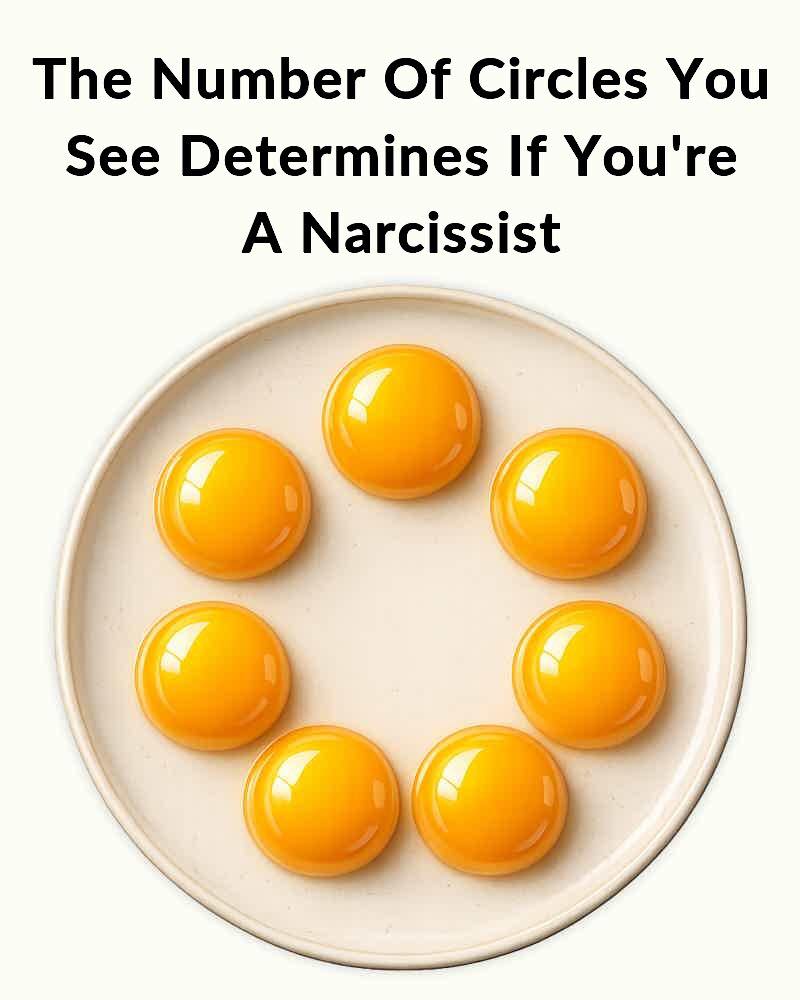
At first glance, the image feels almost playful. A clean plate sits centered on a plain background. On it rest seven smooth, golden egg yolks, arranged carefully in a near-perfect ring. Nothing about it appears dramatic or complicated. And yet, once you pause for a moment, your eyes begin to work a little harder.
You start counting.
What seems like a straightforward visual suddenly becomes something else entirely. Some people see only the obvious shapes. Others notice the container holding them. Still others become aware of empty space, outlines, reflections, or subtle curves that were easy to miss at first glance.
That difference in perception is what makes this kind of visual exercise so fascinating, especially for older adults who have spent a lifetime learning how differently people can experience the same moment.
Despite bold headlines you may have seen online, this image is not about labeling anyone or diagnosing personality traits. Instead, it offers a gentle and entertaining way to reflect on how we notice the world, how we assign meaning, and how our minds naturally organize information.
Think of it as a mirror for your attention, not a judgment.
Why Visual Puzzles Capture Our Interest
Visual challenges like this one spread quickly because they tap into something universal. Humans are meaning-makers. We enjoy patterns, structure, and the quiet satisfaction of figuring something out.
As we age, these moments of curiosity become even more valuable. They remind us that learning does not stop with retirement or routine. Our minds remain active, flexible, and capable of insight well into later life.
What you see first often reflects habits built over decades. How quickly you scan a scene. Whether you focus on details or the whole picture. Whether you pause to reflect or move on instinctively.
None of these approaches are right or wrong. They are simply different ways of engaging with the world.
If You Noticed Seven Circles
Some people look at the image and immediately count the seven egg yolks. Nothing more, nothing less.
This suggests a direct and practical way of seeing things. You focus on what is clear, tangible, and right in front of you. You do not feel the need to search for hidden meanings or layers unless there is a good reason to do so.
People with this outlook often value simplicity. They prefer straightforward communication and tend to approach challenges one step at a time. In daily life, this can translate into reliability, common sense, and an ability to stay grounded when situations become complicated.
You are not dismissing complexity. You simply choose not to add it where it is not necessary.
If You Counted Eight Circles
Others notice the seven yolks and then include the plate itself.
This indicates an awareness of context. You naturally see how individual elements fit into a larger structure. Rather than isolating details, you take in the full scene.
This balanced perspective is often found in people who are thoughtful decision-makers. You understand that no situation exists in isolation. Family dynamics, financial choices, and long-term planning all benefit from this kind of big-picture thinking.
You recognize your own role within a broader environment, which can make you adaptable and considerate in relationships.
If You Counted Nine Circles
Some viewers go a step further. In addition to the yolks and the plate, they notice the empty space in the center, forming its own circular shape.
This shows sensitivity to what is implied rather than stated. You are comfortable noticing absence as much as presence. You read between the lines and often sense underlying meaning before others do.
People who see this way tend to be reflective. They may enjoy quiet moments, thoughtful conversation, and exploring ideas beyond surface-level explanations. Life, for you, is not only about what is visible, but also about what is felt.
This kind of awareness often deepens with age, shaped by experience, loss, joy, and reflection.
If You Counted Ten or More Circles
A smaller group of people notice everything. The yolks. The plate. The central space. Reflections of light. Outlines. Subtle curves created by shadows or highlights
This indicates a highly detailed way of processing information. You take your time, examining things closely and forming your own interpretations. You trust your observations and are comfortable standing by them.
This approach can be a strength, especially in problem-solving and creative thinking. It also reflects independence of thought. You are not satisfied with quick answers and prefer to understand things thoroughly before forming conclusions.
At times, this depth of focus can make you seem intense to others. But it also allows you to notice possibilities that might otherwise be overlooked.
If You Counted Fewer Than Seven
Some people glance at the image briefly and move on without much engagement.
This does not say anything negative about you. It may simply reflect your current state of mind. You could be tired, distracted, or more interested in other things at the moment.
Our attention shifts throughout the day and throughout life. There is no obligation to be intrigued by every puzzle that crosses your path.
What This Image Is Really About
Despite what attention-grabbing headlines might suggest, this visual exercise does not define personality types or determine character traits. Human behavior and emotional health are far too complex for that.
What it does offer is insight into how attention works.
Ezoic
It highlights whether you tend to focus on:
Clear objects or subtle patterns
Individual details or overall structure
What is present or what is implied
These tendencies are shaped by life experience, not by labels.
For many older adults, exercises like this can be a reminder of something important. Our minds continue to interpret, adapt, and explore long after our routines become familiar. Curiosity does not fade unless we stop inviting it.
Why Curiosity Matters More Than the Answer
The most meaningful part of this image is not the number you counted.
It is the fact that you paused. You looked closely. You considered what it might mean.
That moment of reflection matters. It keeps the mind engaged. It encourages awareness. It reminds us that perception is personal and that different viewpoints can coexist without conflict.
In a world that often rushes forward, taking a few seconds to notice how you see things can be quietly powerful.
You are not defined by a circle count. You are defined by a lifetime of experiences, choices, relationships, and reflections that shape how you move through the world today.
And that is far more interesting than any puzzle could ever be.