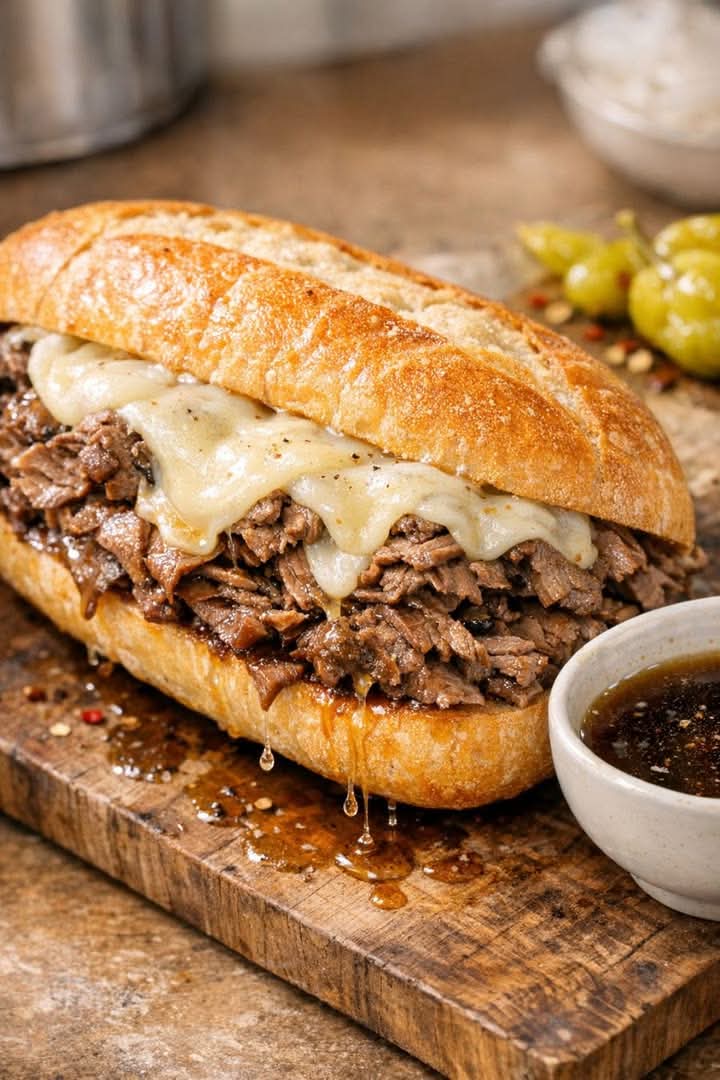
The Ultimate French Dip Sandwich: Tender Beef, Rich Au Jus, and Melty Cheese Perfection
The French Dip sandwich is a timeless comfort food classic: thinly sliced, melt-in-your-mouth roast beef piled high on a crusty roll, often topped with gooey provolone or Swiss cheese, and served with a steaming side of savory au jus for dipping. Every bite delivers juicy beef, buttery bread soaked just enough in flavorful broth, and that irresistible cheese pull. Despite the name, it’s not French—it’s an American invention from Los Angeles, where two historic spots still debate who created it first.
This homemade version elevates the sandwich to restaurant (or better) quality using low-and-slow braising or slow cooking for ultra-tender beef and a deeply flavorful au jus made from scratch. It’s perfect for game days, family dinners, or meal prep—the beef improves overnight as flavors meld.
Prep Time: 20–30 minutes
Cook Time: 4–8 hours (oven or slow cooker) + resting
Total Time: About 5–9 hours (mostly hands-off)
Servings: 6–8 large sandwiches
Calories per sandwich: Approximately 650–800 (depending on cheese and roll size)
A Brief History of the French Dip Sandwich
The French Dip originated in Los Angeles in the early 20th century. Two restaurants—Cole’s Pacific Electric Buffet (opened 1908) and Philippe the Original (also 1908)—both claim invention.
Cole’s story: Around 1908, chef Jack Garlinghouse dipped bread in pan juices to soften it for a customer with sore gums. The customer loved it, and the “French dip” (referring to the French-style roll) was born.
Philippe’s version: In 1918, owner Philippe Mathieu accidentally dropped a roll into beef drippings for a hurried customer (possibly a police officer or worker). The customer took it anyway, returned the next day asking for it “dipped,” and the sandwich became legendary.
The “French” likely refers to the baguette-style roll, not France. Both spots still serve versions today, with Philippe’s famous for sawdust floors and mustard options. The sandwich spread nationwide as a diner staple—simple, hearty, and endlessly craveable.
Ingredients
For the Beef and Braising:
- 3–4 lbs (1.3–1.8 kg) beef chuck roast, rump roast, or eye of round (boneless; chuck for richest flavor)
- 2–3 tablespoons neutral oil (vegetable, canola, or avocado)
- Kosher salt and freshly ground black pepper (generous amounts)
- 1 large yellow onion, halved and sliced
- 4–6 garlic cloves, smashed
- 2–3 carrots, roughly chopped (optional, for sweetness)
- 2 celery stalks, chopped (optional)
- 4 cups (1 liter) low-sodium beef broth (or bone broth for extra depth)
- 1–2 cups (240–480 ml) water or additional broth (as needed)
- ¼ cup (60 ml) dry red wine or sherry (optional, for complexity)
- 2–3 tablespoons Worcestershire sauce
- 1–2 tablespoons soy sauce or tamari (for umami)
- 1–2 bay leaves
- 1 teaspoon dried thyme (or 2–3 fresh sprigs)
- 1 teaspoon dried rosemary (or 1 sprig fresh)
- Optional: 1–2 teaspoons beef bouillon paste (Better Than Bouillon) for intensified flavor
For the Au Jus (finishing sauce):
- Reserved braising liquid (strained and skimmed)
- 1–2 tablespoons butter or flour roux (for slight thickening, optional)
- Salt, pepper, and extra Worcestershire to taste
For the Sandwiches:
- 6–8 crusty French rolls, hoagie buns, or baguette sections (6–8 inches each; Amoroso or similar if available)
- 12–16 slices provolone, Swiss, or gruyère cheese (2 per sandwich)
- Optional toppings: Caramelized onions (from 2–3 extra onions sautéed slowly), horseradish mayo (mix mayo with fresh horseradish), giardiniera peppers, or hot mustard
Step-by-Step Instructions
- Prep the Beef
Pat the roast dry with paper towels. Season generously on all sides with kosher salt and black pepper (about 2–3 teaspoons salt total). Let sit at room temperature 30–60 minutes if time allows—this helps even cooking. - Sear the Roast
Heat 2 tablespoons oil in a large Dutch oven (or heavy pot) over medium-high heat until shimmering.
Sear the roast 4–5 minutes per side until deeply browned (this Maillard reaction builds flavor—don’t skip!). Remove to a plate. - Build the Braising Base
Reduce heat to medium. Add onion, garlic, carrots, and celery (if using). Sauté 5–7 minutes until softened and lightly browned.
Deglaze with wine/sherry (if using), scraping up browned bits. Stir in Worcestershire, soy sauce, thyme, rosemary, bay leaves, and bouillon paste. - Braise the Beef
Oven Method (preferred for depth): Return roast to pot. Pour in beef broth and enough water to mostly cover (about ¾ up the meat). Bring to simmer. Cover tightly and transfer to 300°F (150°C) oven. Braise 4–6 hours until fork-tender (internal temp ~195–205°F for shreddable).
Slow Cooker Method: Transfer seared roast and aromatics to slow cooker. Add liquids. Cook on low 8–10 hours or high 5–6 hours until tender. - Rest and Slice
Remove roast to a cutting board or bowl. Tent with foil and rest 20–30 minutes (or refrigerate overnight for easier slicing).
Strain braising liquid into a saucepan (discard solids or save onions for topping). Skim fat. Simmer to reduce slightly if thin. Taste and adjust seasoning—this is your au jus. Keep warm. - Slice the Beef
For best results, chill roast 1–2 hours (or overnight) for firm slicing. Slice thinly against the grain (¼-inch or less) with a sharp knife or meat slicer. If shredding, pull apart with forks. - Assemble the Sandwiches
Preheat broiler or oven to 400°F (200°C).
Slice rolls lengthwise. Lightly butter insides and toast cut-side up 2–3 minutes until golden.
Pile sliced beef generously on bottom halves (dip slices briefly in hot au jus first for extra juiciness). Top with 2 cheese slices. Broil 1–3 minutes until cheese melts and bubbles.
Add optional caramelized onions or condiments. Close sandwich. - Serve
Ladle hot au jus into small bowls for dipping. Serve sandwiches immediately—dip edges or whole sandwich for maximum flavor soak. Enjoy with pickles, chips, or fries.
Expert Tips for Success
- Beef tenderness: Low-and-slow is key—over 195°F internal breaks down connective tissue. Don’t rush.
- Au jus richness: Homemade from drippings beats packets. Add bouillon if bland; reduce for intensity.
- Bread choice: Crusty exterior with soft interior (baguette or hoagie) holds up to dipping without disintegrating.
- Cheese melt: Broil briefly—provolone melts smoothly; Swiss adds nuttiness.
- Make-ahead: Braise beef 1–2 days ahead. Refrigerate in jus; reheat gently in liquid to stay juicy.
- Horseradish mayo: Mix ½ cup mayo + 1–2 tsp fresh horseradish + pinch salt for creamy kick.
- Caramelized onions: Slow-cook extra sliced onions in butter 30–45 minutes for sweet contrast.
Delicious Variations
- Cheesesteak-style: Add sautéed bell peppers and onions.
- Spicy French Dip: Include jalapeños or giardiniera; add red pepper flakes to jus.
- Instant Pot shortcut: Sear on sauté mode, pressure cook high 60–75 minutes + natural release.
- Open-face version: Skip top bun; serve over toasted bread with extra jus poured over.
- Lightened up: Use eye of round (leaner), turkey, or portobello mushrooms for vegetarian.
- Slider style: Use small rolls for parties—perfect finger food.
Common Mistakes and Fixes
- Tough beef: Under-cooked—extend time until shreddable. Slice against grain.
- Soggy bread: Toast well; dip only edges or serve jus on side.
- Bland jus: Under-seasoned—taste and add Worcestershire, soy, or bouillon.
- Dry sandwich: Don’t over-reduce jus; dip beef before assembling.
- Cheese not melting: Broil closer to heat or use thinner slices.
Why This French Dip Recipe Stands Out
This version combines tradition with home-cook practicality: deeply flavorful au jus from real braising, tender beef without deli slices, and customizable toppings. It’s forgiving—scale up for crowds, freeze extras (beef + jus), and tastes better day two.
Once you make homemade au jus and slow-braised beef, bottled versions pale in comparison. It’s hearty, satisfying, and pure comfort.