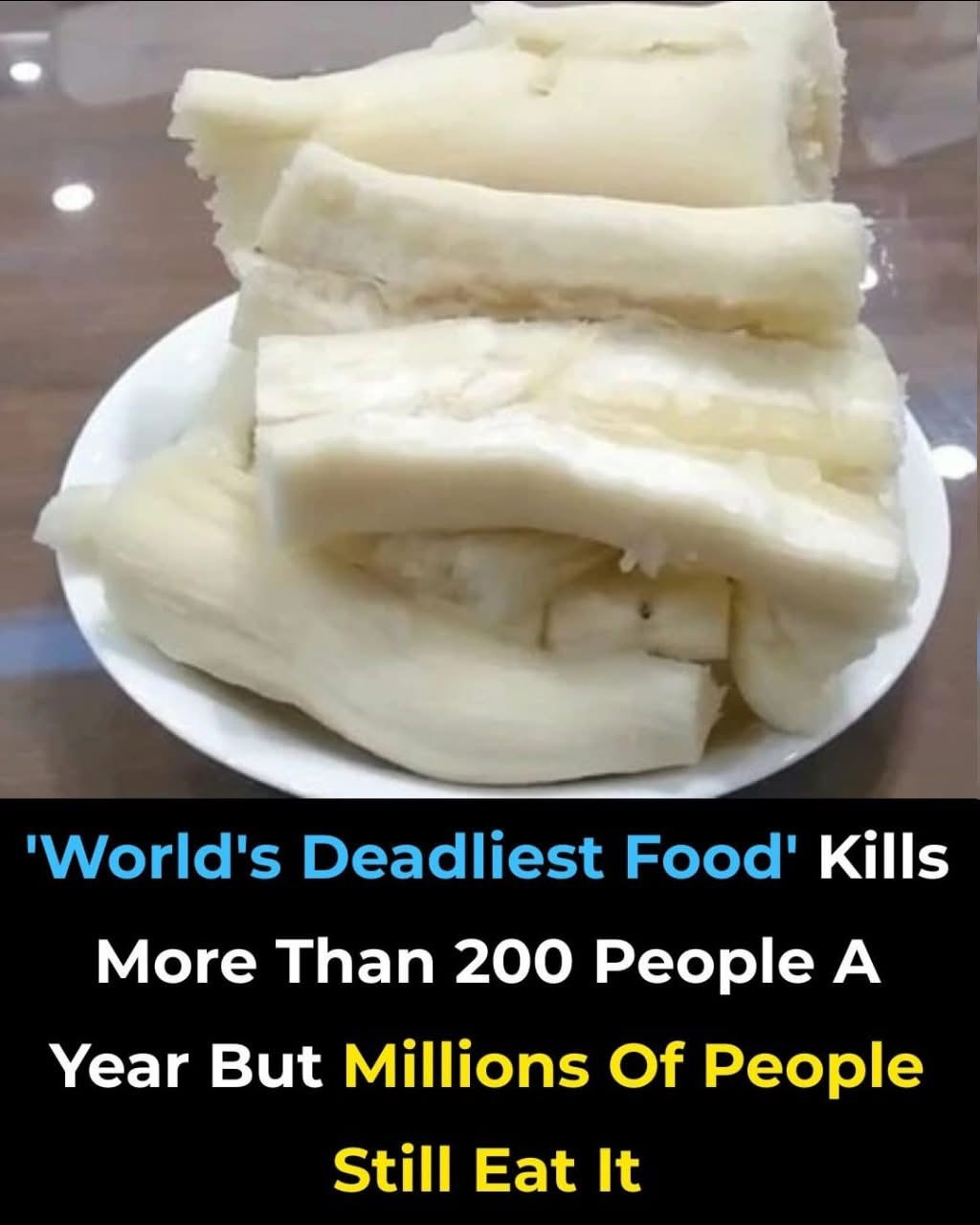
Every year, over 200 people die from consuming what is known as the “world’s deadliest food,” yet nearly 500 million people still eat it.
There are many foods that could fill you up quickly, but you wouldn’t find them on your dinner plate every night. So, what is the food that’s both deadly and widely consumed around the globe?
Cassava.
A plant and a staple food for many, cassava plays an important role in the diets of millions of people worldwide. Each year, it is consumed by over 500 million people, and hundreds of millions of tons are grown across Africa, Latin America, and Asia.
Originating in South America, cassava is both a lifeline and a latent threat. The plant’s stems, peel, and leaves contain compounds that can produce hydrogen cyanide—making it potentially fatal if consumed improperly.
What Makes Cassava Dangerous?
Cassava contains naturally occurring compounds called cyanogenic glycosides. When the plant is damaged—through chewing, grating, crushing, or slicing—these compounds come into contact with an enzyme that triggers a chemical reaction, releasing hydrogen cyanide.
Yes, the same poison famous in spy novels.
The danger depends on:
The variety of cassava (sweet vs. bitter)
How it’s prepared
How much is eaten
Bitter cassava contains significantly higher levels of cyanogenic compounds than sweet cassava. It’s hardier and more drought-resistant, making it a critical food source in poor soil regions—but it also requires much more careful processing.
Why Do People Still Eat It?
Because cassava is a lifesaving crop. It:
Grows in poor soil where other crops fail
Withstands drought better than most staples
Provides calories for hundreds of millions of people
Is affordable and widely available
For communities across Africa, Asia, and Latin America, cassava isn’t a choice—it’s a necessity.
How Is Cassava Made Safe?
Traditional processing methods have been developed over centuries to remove the toxins:
Method How It Works
Peeling The highest concentrations are in the peel and the layer just beneath it
Soaking Submerging in water for 2-3 days leaches out cyanogenic compounds
Fermentation Breaking down the compounds through microbial action (used for fufu, gari)
Boiling Cooking in an open pot allows hydrogen cyanide gas to escape (never cover the pot tightly)
Drying Sun-drying or roasting breaks down the compounds
Grating and pressing Squeezing out the toxic liquid (used for cassava flour)
One crucial rule: Never eat cassava raw. Never eat bitter cassava without thorough processing.
What Happens When Preparation Fails?
When cassava is improperly processed, cyanide poisoning can occur.
Acute poisoning symptoms (within hours):
Dizziness and headache
Nausea and vomiting
Rapid breathing
Convulsions
Cardiac arrest
Chronic poisoning (from long-term low-level exposure):
Konzo – A paralytic disease affecting the legs (irreversible)
Tropical ataxic neuropathy – Nerve damage causing weakness, vision problems, and difficulty walking
These conditions occur when communities, often during famines or displacement, consume insufficiently processed bitter cassava over extended periods.
Who Is Most at Risk?
Communities in famine zones – Desperation leads to rushed processing
Refugee populations – Displaced people may lack proper equipment or knowledge
Children and malnourished individuals – Already vulnerable; cyanide’s effects are worse with protein deficiency
Cassava vs. Other Deadly Foods
Food Toxin Deaths (approx.)
Cassava Cyanide 200+ per year
Fugu (pufferfish) Tetrodotoxin Fewer than 10 per year (with strict regulation)
Ackee fruit Hypoglycin Rare (if unripe)
Elderberries Cyanide (in leaves/stems) Rare
Raw kidney beans Phytohaemagglutinin Rare
Cassava is unique because of the scale of its consumption. Millions rely on it daily. The death rate is low relative to the number of people who eat it—a testament to traditional processing knowledge.
The Bottom Line
Cassava isn’t “evil.” It’s a remarkable plant that has sustained millions through drought, poverty, and hardship. Its toxicity isn’t a flaw—it’s a natural defense mechanism that humans learned to overcome through ingenuity.
The real tragedy isn’t that cassava is dangerous. It’s that when famine, war, or displacement disrupt traditional processing methods, people get hurt.
What we can learn:
Traditional food knowledge saves lives
Preparation methods exist for a reason—never skip them
Hunger drives people to take risks they wouldn’t otherwise take
The next time you enjoy cassava—whether as yuca fries, tapioca pudding, or fufu—you’re tasting centuries of human adaptation.
That’s not just food. That’s resilience.