The One Kitchen Appliance You Must Unplug Before Bed to Avoid a Fire: A Comprehensive Safety Guide
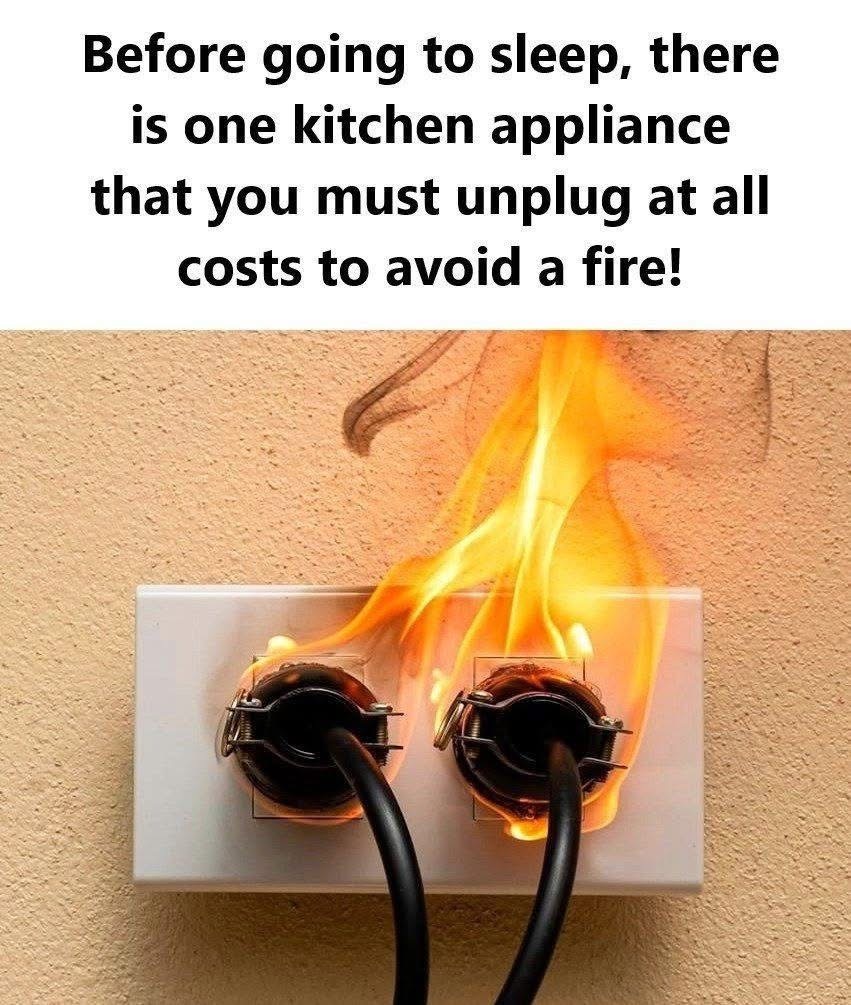
In kitchens around the world, small appliances have become essential parts of daily life. They help us prepare meals quickly, brew perfect coffee, and handle countless other tasks with ease. Yet hidden within this convenience lies a serious safety concern that many people overlook entirely. A widely shared warning circulates online with a dramatic image of flames shooting from an electrical outlet, accompanied by a stark message: before going to sleep, there is one kitchen appliance you must unplug at all costs to prevent a fire.
That appliance is most commonly the toaster.
While other devices can also present risks, the standard pop-up toaster stands out as the item most frequently singled out in safety discussions for a very practical reason: the combination of heat-producing elements, accumulated food debris, and the lack of reliable automatic shut-off in many basic models creates a perfect storm for potential fire hazards when the device remains connected to power overnight.
This in-depth guide explores why the toaster earns this top spot on the “must-unplug” list, examines the broader landscape of kitchen fire risks, explains the science behind how these incidents start, reviews which other appliances deserve attention, and provides actionable steps to build safer habits. The goal is straightforward: equip you with clear, evidence-based information so you can protect your home, reduce unnecessary energy waste, and sleep with greater peace of mind.
Understanding the Scale of Kitchen Fire Danger
Cooking remains the leading cause of home fires in most developed countries. Official statistics consistently show that kitchen-related incidents account for roughly 40–50 percent of all reported residential structure fires. These events produce hundreds of civilian deaths, thousands of injuries, and enormous property losses every year.
What makes the numbers especially concerning is timing. A significant portion of kitchen fires begin when no one is awake or actively present in the room. Electrical faults, overheating components, forgotten “keep warm” settings, and spontaneous malfunctions can all ignite long after the household has gone to bed.
Small countertop appliances contribute disproportionately to these late-night risks. Unlike large built-in ovens or stovetops—which usually have more robust safety features and are harder to leave running unnoticed—toasters, coffee makers, electric kettles, and similar plug-in devices sit quietly on the counter, often forgotten in the rush of evening cleanup.
The combination of high internal temperatures, flammable crumbs or grease residue, and continuous connection to household current turns even a minor defect into a serious threat. When a short circuit, thermostat failure, or external power surge occurs, the result can be rapid ignition.
Beyond the immediate danger of flames, there is a secondary but still meaningful cost: standby power consumption. Devices that remain plugged in draw small amounts of electricity even when switched off or idle. Over months and years, these “vampire loads” add up to noticeable sums on electricity bills and contribute to unnecessary environmental impact.
Why the Toaster Deserves Special Attention
Among all kitchen appliances, the classic two-slice or four-slice pop-up toaster is the one most safety experts single out for mandatory unplugging.
Several factors explain this emphasis:
First, toasters generate intense heat very quickly. The glowing nichrome wires inside reach temperatures well above 1,000 degrees Fahrenheit in seconds. That heat is precisely what makes toasting efficient, but it also means any nearby combustible material ignites almost instantly.
Second, bread crumbs, bits of bagel, English muffin fragments, and stray seeds inevitably fall through the slots and collect at the bottom or stick to the heating elements. These organic particles are highly flammable once they dry out. In a device that cycles through repeated heating sessions, the debris gradually builds up into layers that can smolder or burst into flame under the right conditions.
Third, many consumer toasters—especially budget models—lack sophisticated safety features. While higher-end versions may include auto-shutoff timers, thermal fuses, or better insulation, countless units sold every year rely on a simple mechanical lever and basic thermostat. If that thermostat sticks, if the spring mechanism jams, or if internal wiring degrades, the toaster can remain energized far longer than intended.
Fourth, external triggers amplify the risk. Household power surges (common during thunderstorms or when large appliances cycle on and off), damaged cords, loose internal connections, rodent activity (chewed wires), and manufacturing defects have all been documented as starting points for toaster fires.
Real-world data supports the concern. Fire departments and consumer safety agencies regularly report toaster-related incidents. In some analyses covering multiple years, toasters and toaster ovens rank among the top three small appliances involved in kitchen electrical fires. The pattern repeats across different countries: uncleaned toasters left plugged in overnight appear again and again in fire investigation summaries.
The solution is elegantly simple. Unplugging the toaster after each use removes the power source entirely. No current means no possibility of accidental activation, no risk from surges, and no chance for smoldering crumbs to receive sustained energy. It takes only seconds and eliminates the primary pathway to disaster.
Proper Toaster Maintenance – A Necessary Companion Habit
Unplugging is the ultimate safeguard, but regular cleaning dramatically reduces the baseline risk.
Follow this sequence every time you use the toaster:
- Allow the unit to cool completely after the last cycle (at least 30–45 minutes).
- Unplug the cord from the wall outlet.
- Remove and empty the crumb tray over a trash bin or sink.
- Turn the toaster upside down and gently shake it to dislodge loose particles.
- Use a soft, dry brush (an old toothbrush works well) to sweep out stubborn crumbs stuck between elements.
- Wipe the exterior with a slightly damp cloth; never submerge the unit or pour water inside.
- Inspect the power cord for fraying, cracking, or exposed wires. If damage is visible, replace the appliance immediately.
Perform a deeper cleaning every few weeks or whenever you notice significant buildup:
- Shake out all loose debris.
- Use compressed air (from a can designed for electronics) to blow out hard-to-reach areas.
- For stubborn grease or burnt-on residue, a cotton swab lightly dampened with white vinegar can help dissolve deposits without risking electrical components.
Never use metal utensils, abrasive scrubbers, or excessive water—these practices damage heating wires and increase the chance of shorts.
Even with meticulous maintenance, the smartest long-term strategy remains the same: keep the toaster unplugged whenever it is not actively in use.
Beyond the Toaster: Other Appliances That Merit the Same Treatment
While the toaster receives the most attention in viral warnings, several other countertop appliances share similar risk profiles. Safety organizations and electrical professionals recommend unplugging the following devices before bedtime:
- Coffee makers (especially models with “keep warm” plates or digital clocks)
The hot plate can remain energized for hours, drying out any spilled liquid or residue until it smokes or ignites. - Electric kettles
Many kettles switch to a low-power “keep warm” mode rather than shutting off completely. Mineral scale buildup inside can also cause overheating. - Slow cookers / crock pots
Designed for long unattended cooking, these units become hazardous if liquid evaporates completely or if a faulty thermostat fails to cycle off. - Air fryers
Grease accumulation inside creates a ready fuel source. Some models continue drawing power in standby mode. - Toaster ovens / countertop convection ovens
Larger heating elements and more complex electronics increase both fire potential and standby consumption. - Electric griddles and hot plates
Leftover cooking oil and food particles provide ample ignition material. - Immersion blenders, hand mixers, and food processors (when stored plugged in)
Less common ignition sources, but damaged cords or accidental activation remain concerns.
The guiding principle is consistent: if the appliance produces significant heat, contains electronic displays or timers, or accumulates food residue, treat it as a candidate for nightly unplugging.
The Hidden Bonus: Energy and Cost Savings
Unplugging delivers benefits beyond fire prevention.
Most modern appliances draw a small but measurable amount of power even when switched off. This standby or “vampire” load typically ranges from 0.5 watts to 5 watts per device, depending on features such as digital clocks, Wi-Fi connectivity, or LED indicators.
In a kitchen containing a toaster, coffee maker, kettle, air fryer, and slow cooker—all left plugged in twenty-four hours a day—the cumulative standby draw can easily reach 10–20 watts continuously. Over the course of a year, that translates to roughly 90–175 kilowatt-hours of electricity consumed for no useful purpose.
At average residential rates, the annual cost falls between twenty and fifty dollars for those five devices alone. Multiply that figure across an entire household and the savings become meaningful.
Environmentally, each kilowatt-hour avoided reduces carbon emissions and eases demand on power plants. When millions of households adopt the habit, the collective impact grows substantial.
Creating a Reliable Nightly Routine
Changing behavior takes repetition. The following practical system helps make unplugging automatic:
- Designate a specific time—right after dinner cleanup or right before turning off kitchen lights.
- Walk a consistent path around the countertops and check each appliance in the same order every night.
- Physically touch the plug and pull it out; mental checklists are easy to skip, but the tactile action reinforces the habit.
- Use a single power strip for multiple small appliances so you can flip one switch to cut power to everything at once.
- Place a visible reminder note on the refrigerator or cabinet door during the first few weeks until the routine feels natural.
- Involve other household members so everyone shares responsibility.
After a month, the action becomes second nature, requiring almost no conscious effort.
Additional Layers of Protection
While unplugging addresses the root cause, complementary measures strengthen overall safety:
- Install smoke alarms inside the kitchen and on every level of the home. Test them monthly and replace batteries annually.
- Consider interconnected smoke detectors so one alarm triggers all others.
- Use ground-fault circuit interrupter (GFCI) outlets in the kitchen; these devices cut power instantly if they detect an imbalance that could indicate a short.
- Keep a multi-purpose fire extinguisher (Class K for kitchen use or ABC-rated) mounted within easy reach and verify it is charged.
- Never disable or remove the crumb tray from a toaster; it exists to catch flammable debris.
- Replace any appliance that shows signs of overheating, unusual smells, sparking, or damaged cords.
Final Thoughts: Small Action, Major Impact
The viral warning about unplugging one specific kitchen appliance before bed captures attention because it distills a complex safety issue into a single, memorable rule. While no single habit eliminates every risk, consistently unplugging the toaster—and extending the practice to other heat-producing countertop devices—removes one of the most common pathways to overnight kitchen fires.
The act requires almost no time, costs nothing, saves electricity, and provides genuine protection for you, your family, and your home. Tonight, after the dishes are done and the lights are dimmed, take those few extra seconds to walk the counter, pull the plugs, and remove the possibility of disaster before it ever begins.
Sleep better knowing the kitchen is as safe as you can reasonably make it.